Paper: 2603.12237 Authors: Fengwei Tian, Payel Bhattacharjee, Heidi Hanson, Geoffrey D. Rubin, Joseph Y. Lo, Ravi Tandon Categories: cs.LG, cs.CR, cs.IT
The Gap
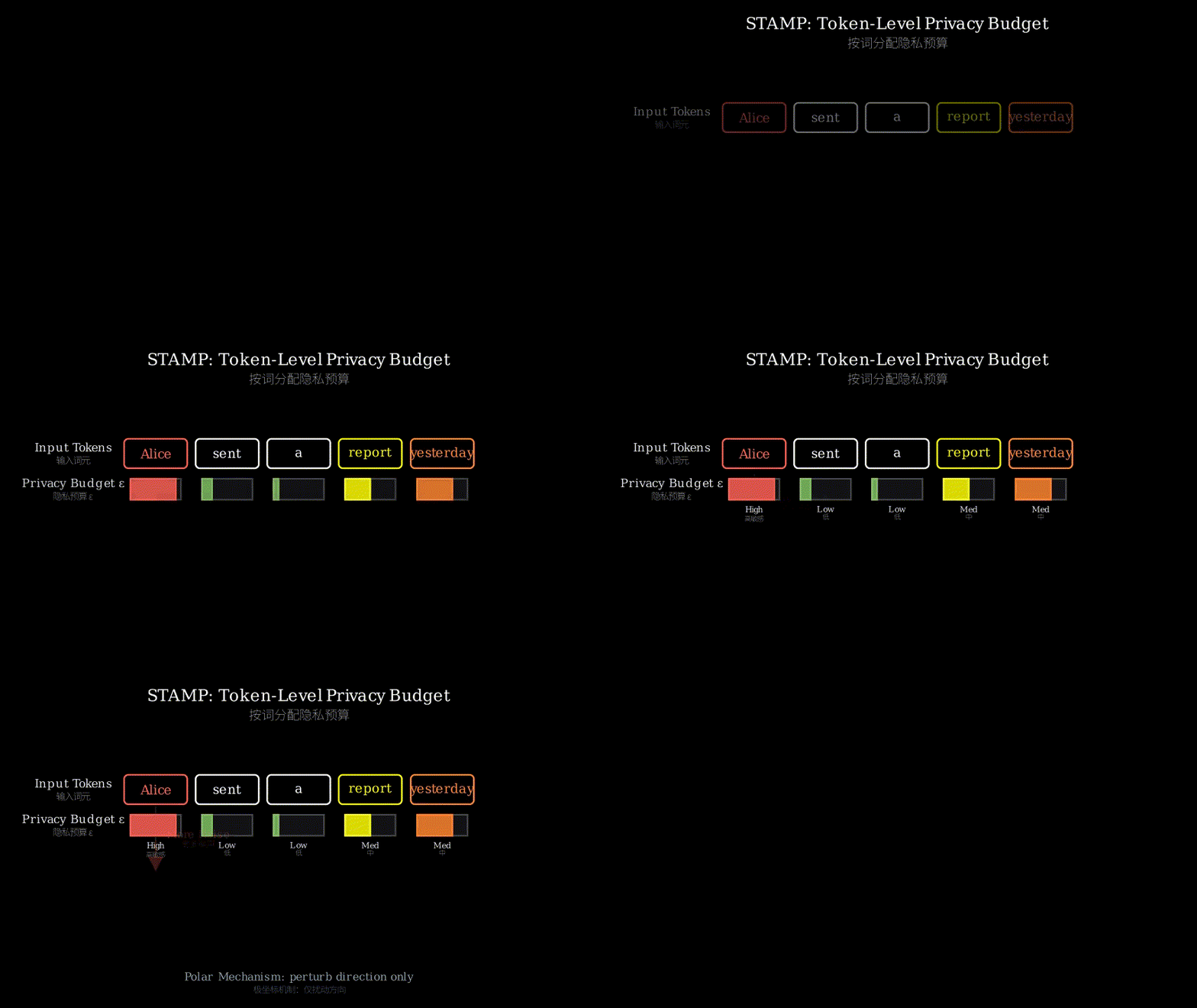
Text privatization under local differential privacy (LDP) has been an active area since Feyisara et al.’s CusText and the Mahalanobis mechanism (Xu et al.), and more recently the metric-LDP approaches like SanText and CMP. These methods perturb token embeddings by adding calibrated noise, then decode back to the nearest word. The problem: they treat every token the same. “The” gets the same privacy budget as “John Smith.” A date of birth gets the same noise as a filler word. This uniform allocation is wasteful — you’re burning privacy budget on tokens that don’t matter and under-protecting the ones that do.
There’s also a geometric mismatch. Most mechanisms add isotropic Gaussian or Laplace noise in embedding space, but decoding is done via cosine similarity (nearest neighbor on the unit sphere). You’re perturbing in one geometry and decoding in another. That’s like measuring a room in feet and cutting lumber in meters — the numbers don’t line up.
Problem: Uniform budget + geometry mismatch
         |
         v
Assumption: Token importance and sensitivity vary;
            perturbation geometry should match decoding geometry
         |
         v
Method: STAMP = selective budget allocation (task + sensitivity)
               + polar mechanism (direction-only perturbation)
         |
         v
Evidence: SQuAD, Yelp, AG News -- better privacy-utility curves
         |
         v
Conclusion: Fine-grained token treatment beats uniform noise
            when you align geometry with decoding
The Increment
One sentence: Before STAMP, text privatization treated every word as equally important and perturbed embeddings in a geometry misaligned with decoding; after STAMP, budgets are allocated by what matters and noise lives on the same sphere where decoding happens.
Core Mechanism
STAMP has two separable ideas that work together. The first is the budget allocation policy. For each token in the input, STAMP computes two scores: a task-relevance score (how much does this token affect the downstream prediction — think attention weights or gradient-based importance) and a privacy-sensitivity score (is this a named entity, a date, an identifier?). These two scores jointly determine how much of the total privacy budget epsilon gets assigned to this token. High-sensitivity tokens get more noise; low-importance tokens also get more noise (since corrupting them costs little utility). The sweet spot — high task importance, low sensitivity — gets the most budget preserved.
The second idea is the polar mechanism. Instead of adding a noise vector anywhere in embedding space, STAMP projects the token embedding onto the unit sphere and perturbs only its direction. The magnitude stays fixed. The perturbation is drawn from a distribution on the sphere calibrated to the assigned epsilon. Decoding then uses cosine nearest-neighbor search, which is exactly the right operation on a unit sphere. The geometry of perturbation and the geometry of decoding are now the same thing.
At inference time: tokenize input → embed tokens → score each token for task relevance and sensitivity → assign per-token epsilon → apply polar perturbation → decode each perturbed embedding via cosine NN → reconstruct privatized text → send to downstream model.
Input text
    |
    v
[Tokenizer] --> token_1, token_2, ..., token_n
                    |
                    v
             [Embedding layer]
                    |
                    v
         +----------+----------+
         |                     |
  [Task relevance]    [Sensitivity tagger]
  (attention/grad)    (NER, rule-based)
         |                     |
         +----------+----------+
                    |
                    v
         [Budget allocator]
         epsilon_i = f(relevance_i, sensitivity_i)
                    |
                    v
         [Polar mechanism]
         project to unit sphere
         perturb direction by epsilon_i
                    |
                    v
         [Cosine NN decoder]
         find nearest word on sphere
                    |
                    v
         Privatized token sequence
                    |
                    v
         Downstream task (QA, classification, etc.)
Think of it like a postal sorting office with a security clearance system. Each letter (token) arrives and gets two stamps: one for how important it is to the recipient (task relevance) and one for how sensitive its contents are (privacy sensitivity). The sorting office then decides how much to scramble each letter before forwarding it — important but non-sensitive letters go through mostly intact, sensitive letters get heavily redacted, and junk mail gets scrambled freely because nobody cares. The scrambling itself (polar mechanism) is done by rotating the letter’s orientation on a globe rather than stretching or shrinking it — so when the recipient uses their globe-based decoder to read it, the geometry matches perfectly. Without this metaphor: you’re back to staring at epsilon allocation tables.
Key Concepts
-
Metric Local Differential Privacy (metric-LDP): Regular LDP says “your output shouldn’t reveal which of two possible inputs you had.” Metric-LDP relaxes this: inputs that are *close to each other (by some distance metric) are allowed to produce more similar outputs. In text, two semantically similar words (“happy” and “joyful”) can produce more similar privatized outputs than two unrelated words (“happy” and “carburetor”). This lets you add less noise while still providing meaningful privacy guarantees — the privacy budget epsilon now scales with semantic distance rather than being a flat bound.
-
Polar mechanism: Standard noise mechanisms add a vector sampled from a ball or Gaussian in R^d. The polar mechanism instead samples a perturbation *on the unit sphere — only the direction changes, not the magnitude. This matters because cosine similarity (used for NN decoding) is purely a function of direction. If you add radial noise, you’re perturbing something the decoder ignores. The polar mechanism wastes no noise budget on the radial component.
-
Privacy-utility trade-off curve: For a given epsilon, you get some level of privacy (measured by how hard it is to recover the original token) and some level of utility (measured by downstream task accuracy). The “trade-off” is the curve you trace as epsilon varies. A better mechanism shifts this curve — same privacy, higher utility, or same utility, stronger privacy. STAMP claims to shift the curve favorably compared to SanText and CMP baselines.
Framework Shift
Before (mainstream approach):        After (this paper):

Input tokens                         Input tokens
  |                                    |
  v                                    v
[Embed all tokens]               [Embed + Score each token]
  |                                    |  (task relevance + sensitivity)
  v                                    v
[Apply uniform epsilon]          [Assign per-token epsilon_i]
  |                                    |
  v                                    v
[Isotropic noise in R^d]         [Polar perturbation on S^(d-1)]
  |                                    |
  v                                    v
[Cosine NN decode]               [Cosine NN decode]
  |                                    |
  v                                    v
Privatized text                  Privatized text

  * same noise everywhere            * noise proportional to what matters
  * geometry mismatch                * geometry aligned end-to-end
From uniform-and-misaligned to selective-and-coherent, the core shift is treating token heterogeneity as a first-class design variable rather than an afterthought.
Expert Assessment
Problem choice: This is a real gap. The uniform budget allocation problem has been noted informally in the community for a while, and the geometry mismatch between isotropic perturbation and cosine decoding is a genuine inconsistency that’s easy to overlook. The paper sits at a natural next step in the metric-LDP-for-text trajectory. It’s not a manufactured gap, though it’s also not a surprising one — someone was going to close this.
Method maturity: The polar mechanism is a clean, principled insight. The budget allocation is more heuristic — the specific function mapping (relevance, sensitivity) to epsilon is not deeply theorized, and the choice of task-relevance proxy (attention weights vs. gradients) is left somewhat open. The combination is clever but not tight. A simpler baseline worth comparing: just allocate more budget to named entities and nothing else. The paper doesn’t show this ablation clearly enough.
Experimental integrity: The datasets (SQuAD, Yelp, AG News) are standard and the baselines (SanText, CMP) are appropriate. The privacy-utility curves look convincing. One concern: the task-relevance scoring requires access to a model, which means the privacy guarantee is conditioned on that model being available at privatization time. This is a non-trivial assumption for deployment scenarios (e.g., client-side privatization before sending to a server). The paper acknowledges this but doesn’t stress-test it. Also, the sensitivity tagger is rule-based NER — it would be worth knowing how performance degrades when the tagger makes errors.
Writing quality: The theoretical section on the polar mechanism is solid. The budget allocation section is where the paper gets hand-wavy — the joint scoring function is introduced without enough justification for why this particular combination is principled rather than just empirically tuned. Rewriting Section 3 (or wherever the allocation policy lives) with a cleaner theoretical motivation — even a simple information-theoretic argument — would elevate the whole paper from “nice engineering” to “principled framework.”
Verdict: weak accept — the polar mechanism is a genuine contribution and the selective allocation idea is well-motivated, but the allocation policy lacks theoretical grounding and the deployment assumptions deserve more scrutiny.
Takeaways
A few things worth stealing:
The geometry alignment principle is broadly applicable. Whenever you’re adding noise in one space and decoding in another, check whether your perturbation geometry matches your decoding geometry. This applies beyond text — any embedding-based retrieval system with privacy constraints has this issue.
The two-axis token scoring (task relevance × sensitivity) is a useful framing for any selective processing pipeline. You can apply this logic to attention masking, data augmentation, or even active learning sample selection — not just privacy.
The polar mechanism specifically is worth keeping in your toolkit if you work with cosine-similarity-based retrieval. Perturbing only direction while preserving magnitude is a clean way to add controlled noise without breaking the retrieval geometry.
论文: 2603.12237 作者: Fengwei Tian, Payel Bhattacharjee, Heidi Hanson, Geoffrey D. Rubin, Joseph Y. Lo, Ravi Tandon 分类: cs.LG, cs.CR, cs.IT
缺口
文本局部差分隐私(LDP)领域已有不少工作,比如 CusText、Mahalanobis 机制,以及更近的 SanText 和 CMP。 这些方法的共同逻辑是:把词嵌入加噪,再解码回最近邻词。 问题在于,它们对每个词一视同仁——“的”和”张三”分到同样的隐私预算,生日和语气词受到同等程度的扰动。 这种均匀分配既浪费又不合理:把预算烧在无关紧要的词上,真正敏感的词反而保护不足。
还有一个几何错位问题。 主流机制在嵌入空间里加各向同性的高斯或拉普拉斯噪声,但解码时用的是余弦相似度(单位球上的最近邻)。 扰动在一种几何里发生,解码在另一种几何里进行——就像用英尺量房间、用米锯木头,数字对不上。
问题:均匀预算 + 几何错位
         |
         v
假设:词的重要性和敏感度各不相同;
      扰动几何应与解码几何一致
         |
         v
方法:STAMP = 选择性预算分配(任务相关性 + 敏感度)
             + 极坐标机制(仅扰动方向)
         |
         v
证据:SQuAD、Yelp、AG News 上更优的隐私-效用曲线
         |
         v
结论:细粒度词级处理优于均匀噪声,
      前提是几何与解码对齐
增量
一句话:STAMP 之前,文本隐私化对每个词一视同仁,且扰动几何与解码几何错位;STAMP 之后,预算按重要性分配,噪声生活在解码所在的同一个球面上。
核心机制
STAMP 有两个可以分开理解的核心想法,组合在一起才发挥作用。
第一个是预算分配策略。 对输入中的每个词,STAMP 计算两个分数:任务相关性分数(这个词对下游预测有多重要,可以用注意力权重或梯度来衡量)和隐私敏感度分数(这是不是命名实体、日期、标识符?)。 这两个分数共同决定总隐私预算 epsilon 中有多少分给这个词。 高敏感度的词获得更多噪声;低重要性的词也获得更多噪声(因为破坏它们几乎不损失效用)。 最优点——高任务重要性、低敏感度——获得最多保留的预算。
第二个是极坐标机制。 不同于在嵌入空间任意位置加噪声向量,STAMP 把词嵌入投影到单位球面上,只扰动其方向,幅度保持不变。 扰动从按分配 epsilon 校准的球面分布中采样。 解码时用余弦最近邻搜索——这正是单位球面上的正确操作。 扰动几何和解码几何现在是同一件事。
输入文本
    |
    v
[分词器] --> token_1, token_2, ..., token_n
                    |
                    v
             [嵌入层]
                    |
                    v
         +----------+----------+
         |                     |
  [任务相关性评分]        [敏感度标注]
  (注意力/梯度)          (NER、规则)
         |                     |
         +----------+----------+
                    |
                    v
         [预算分配器]
         epsilon_i = f(relevance_i, sensitivity_i)
                    |
                    v
         [极坐标机制]
         投影到单位球面
         按 epsilon_i 扰动方向
                    |
                    v
         [余弦最近邻解码]
         在球面上找最近词
                    |
                    v
         隐私化词序列
                    |
                    v
         下游任务(问答、分类等)
用一个核喻来理解:把整个流程想象成一个带安全审查的邮件分拣中心。 每封信(词)到达后被盖两个章:一个标注它对收件人有多重要(任务相关性),一个标注内容有多敏感(隐私敏感度)。 分拣中心据此决定每封信在转发前要被打乱多少——重要但不敏感的信基本原样通过,敏感的信被大量涂黑,垃圾邮件随便打乱反正没人在乎。 打乱的方式(极坐标机制)是在地球仪上旋转信的朝向,而不是拉伸或压缩它——这样收件人用同一个地球仪解码时,几何完全对得上。 没有这个比喻,你就只能盯着 epsilon 分配表发呆。
关键概念
-
度量局部差分隐私(metric-LDP):普通 LDP 说”你的输出不应该暴露你的输入是哪两个可能值中的哪一个”。 度量-LDP 放宽了这一点:在某个距离度量下彼此接近的输入,允许产生更相似的输出。 在文本中,“高兴”和”开心”可以产生比”高兴”和”化油器”更相似的隐私化输出。 这让你在提供有意义的隐私保证的同时加更少的噪声——隐私预算 epsilon 现在随语义距离缩放,而不是一个固定上界。
-
极坐标机制:标准噪声机制在 R^d 中从球体或高斯分布采样一个向量加上去。 极坐标机制则在单位球面上采样扰动——只有方向变,幅度不变。 这很重要,因为余弦相似度(用于最近邻解码)纯粹是方向的函数。 如果你加径向噪声,你在扰动一个解码器根本不看的东西。 极坐标机制不把预算浪费在径向分量上。
-
隐私-效用权衡曲线:给定 epsilon,你得到某种隐私水平(用恢复原始词的难度衡量)和某种效用水平(用下游任务准确率衡量)。 “权衡”是你随 epsilon 变化描出的曲线。 更好的机制让这条曲线移动——相同隐私、更高效用,或相同效用、更强隐私。 STAMP 声称相比 SanText 和 CMP 基线有利地移动了这条曲线。
框架转变
之前(主流方法):                    之后(本文方法):

输入词序列                            输入词序列
  |                                      |
  v                                      v
[统一嵌入所有词]                   [嵌入 + 对每个词评分]
  |                                      |  (任务相关性 + 敏感度)
  v                                      v
[施加统一 epsilon]                 [分配每词 epsilon_i]
  |                                      |
  v                                      v
[R^d 中各向同性噪声]               [S^(d-1) 上极坐标扰动]
  |                                      |
  v                                      v
[余弦最近邻解码]                   [余弦最近邻解码]
  |                                      |
  v                                      v
隐私化文本                          隐私化文本

  * 所有词同等对待                     * 噪声与重要性成比例
  * 几何错位                           * 几何端到端对齐
从”均匀且错位”到”选择性且一致”,核心转变是把词的异质性作为一等设计变量,而不是事后补丁。
专家评审
选题眼光:这是真缺口。 均匀预算分配的问题在社区里已被非正式地提及过,各向同性扰动与余弦解码之间的几何错位也是一个容易被忽视的真实矛盾。 这篇论文处于度量-LDP 文本隐私轨迹上自然的下一步。 不是人造缺口,但也不令人意外——早晚有人会填上这个坑。
方法成熟度:极坐标机制是一个干净、有原则的洞见。 预算分配更像启发式——将(相关性、敏感度)映射到 epsilon 的具体函数没有深入的理论支撑,任务相关性代理的选择(注意力权重还是梯度)也留得比较开放。 组合是聪明的,但不够紧凑。 一个值得对比的更简单基线:只给命名实体分配更多预算,其他不变。 论文没有清晰地展示这个消融实验。
实验诚意:数据集(SQuAD、Yelp、AG News)是标准的,基线(SanText、CMP)选得合适,隐私-效用曲线看起来令人信服。 一个值得关注的问题:任务相关性评分需要访问一个模型,这意味着隐私保证以该模型在隐私化时可用为前提。 对于部署场景(比如客户端隐私化后再发送到服务器),这是一个非平凡的假设。 论文承认了这一点,但没有做压力测试。 此外,敏感度标注器是基于规则的 NER——当标注器出错时性能如何退化,值得深入探讨。
写作功力:极坐标机制的理论部分写得扎实。 预算分配部分是论文变得含糊的地方——联合评分函数的引入缺乏足够的理由说明为什么这种特定组合是有原则的而不只是经验调出来的。 把预算分配策略那一节重写,加入更清晰的理论动机——哪怕只是一个简单的信息论论证——就能把整篇论文从”不错的工程”提升到”有原则的框架”。
判决:弱接收——极坐标机制是真实贡献,选择性分配的想法动机充分,但分配策略缺乏理论基础,部署假设值得更多审视。
要点总结
几个值得”偷走”的东西:
几何对齐原则有广泛的适用性。 只要你在一个空间加噪声、在另一个空间解码,就应该检查扰动几何是否与解码几何匹配。 这不只适用于文本——任何基于嵌入的检索系统加上隐私约束都有这个问题。
双轴词评分(任务相关性 × 敏感度)是一个有用的框架,可以迁移到任何选择性处理流水线。 注意力掩码、数据增强、主动学习样本选择——都可以用这个逻辑,不只是隐私保护。
极坐标机制本身值得放进工具箱,特别是如果你在做基于余弦相似度的检索。 只扰动方向、保持幅度不变,是在不破坏检索几何的前提下加受控噪声的干净方式。