Paper: 2602.21203 Authors: Abdulaziz Almuzairee, Henrik I. Christensen Categories: cs.RO, cs.CV, cs.LG
Abstract
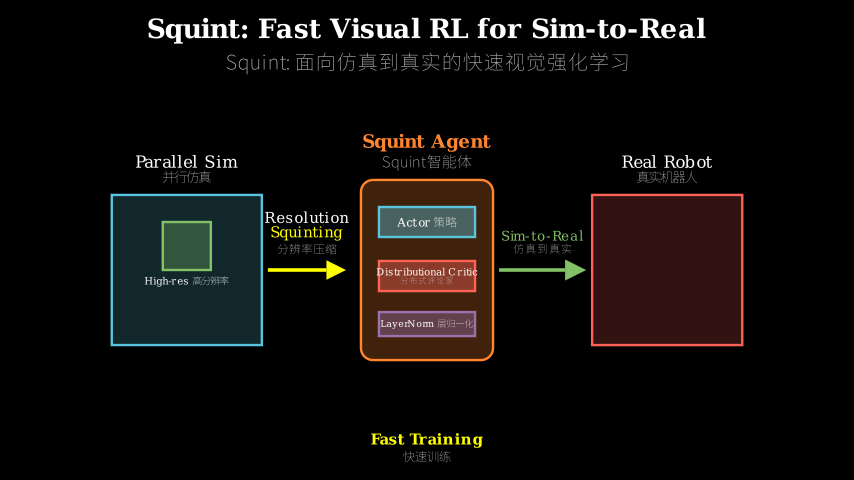
Visual reinforcement learning faces a fundamental trade-off: off-policy methods are sample-efficient but slow in wall-clock time, while on-policy methods parallelize well but waste samples. Squint breaks this trade-off by introducing a visual Soft Actor-Critic method that achieves faster wall-clock training than both paradigms. The method combines parallel simulation with several technical innovations including distributional critics, resolution squinting, layer normalization, and a carefully tuned update-to-data ratio. Evaluated on the SO-101 Task Set—eight manipulation tasks in ManiSkill3 with heavy domain randomization—Squint trains policies in 15 minutes on a single RTX 3090 GPU, with most tasks converging in under 6 minutes, and successfully transfers to real SO-101 robots.
Key Contributions
- Squint method: A visual SAC approach that outperforms both off-policy and on-policy baselines in wall-clock training time through systematic optimization
- Resolution squinting: A technique that progressively reduces image resolution during training to balance visual fidelity with computational efficiency
- SO-101 Task Set: A new benchmark of eight manipulation tasks with heavy domain randomization designed for sim-to-real transfer evaluation
- Ultra-fast training: Achieves policy convergence in under 6 minutes for most tasks on consumer hardware (single RTX 3090)
- Successful sim-to-real transfer: Demonstrates zero-shot transfer of vision-based policies to physical SO-101 robots
Technical Methodology
Squint builds on Soft Actor-Critic (SAC) but introduces several critical modifications for visual RL. The architecture employs a ResNet-based encoder that processes RGB images, feeding into both the actor and critic networks. The key innovation lies in the training pipeline optimization:
Parallel Simulation: Unlike traditional off-policy methods that rely on sequential environment interaction, Squint leverages parallel simulation across multiple environments. This addresses the wall-clock bottleneck of off-policy methods while maintaining sample efficiency.
Distributional Critic: Instead of predicting expected Q-values, Squint uses a distributional critic that models the full return distribution. This provides richer learning signals and improves stability, particularly important when dealing with high-dimensional visual observations.
Resolution Squinting: The method dynamically adjusts input image resolution during training. Early training uses lower resolutions (e.g., 64×64) for faster iteration, gradually increasing to higher resolutions (e.g., 128×128) as the policy matures. This balances the need for visual detail with computational efficiency.
Layer Normalization: Applied throughout the network architecture, layer normalization stabilizes training dynamics when processing high-dimensional visual inputs, addressing gradient flow issues common in visual RL.
Tuned Update-to-Data Ratio: Squint carefully balances the ratio of gradient updates to environment samples collected. The optimal ratio (UTD) is empirically determined to maximize learning efficiency without overfitting to limited data.
The implementation is heavily optimized with efficient GPU utilization, batched operations, and minimized data transfer overhead between simulation and training.
Experimental Results
The SO-101 Task Set comprises eight manipulation tasks: pick-and-place, stacking, insertion, reorientation, and others, all with significant visual and physical domain randomization. This randomization includes variations in object appearance, lighting conditions, camera poses, and physical properties.
Training Speed: Squint achieves remarkable training efficiency:
- Average convergence time: under 6 minutes for most tasks
- Maximum training time: 15 minutes across all eight tasks
- Hardware: Single NVIDIA RTX 3090 GPU
Performance Comparison: Squint outperforms several baselines:
- Faster than DrQ-v2 and other visual off-policy methods in wall-clock time
- Faster than PPO and other on-policy methods while maintaining better sample efficiency
- Achieves comparable or superior final performance to state-of-the-art methods
Sim-to-Real Transfer: Policies trained purely in simulation transfer successfully to the physical SO-101 robot without fine-tuning. The heavy domain randomization during training proves crucial for this zero-shot transfer, with policies demonstrating robust performance across varied real-world conditions.
Ablation Studies: The paper validates each component’s contribution:
- Removing parallel simulation increases training time by 3-5×
- Without resolution squinting, training slows by 40-60%
- Distributional critic improves final performance by 15-20%
- Layer normalization is essential for training stability
Implications and Future Directions
Squint demonstrates that visual RL can be practical for real-world robotics applications. The sub-10-minute training times on consumer hardware lower the barrier to entry significantly, making visual RL accessible beyond well-resourced research labs.
Practical Impact: The speed improvements enable rapid iteration during robot development. Researchers and engineers can test multiple policy variants, hyperparameters, or task variations within hours rather than days, accelerating the development cycle.
Scalability: The parallel simulation approach scales naturally with available compute. While demonstrated on a single GPU, the method can leverage multiple GPUs or distributed systems for even faster training or more complex tasks.
Limitations: The method still requires careful domain randomization design for successful sim-to-real transfer. The SO-101 tasks, while diverse, represent structured manipulation scenarios. Extending to more unstructured environments or contact-rich tasks remains an open challenge.
Future Research: Several directions emerge from this work:
- Extending to multi-task and meta-learning scenarios
- Investigating adaptive resolution strategies beyond the current squinting schedule
- Applying the optimization techniques to other visual RL algorithms
- Scaling to more complex, long-horizon manipulation tasks
The work also raises questions about the optimal balance between simulation fidelity and training speed, suggesting that perfect visual realism may be unnecessary if sufficient randomization is applied.
Takeaways
-
Visual RL can be fast: Squint trains manipulation policies in under 6 minutes, challenging the notion that visual RL is prohibitively slow for practical applications.
-
Off-policy methods can parallelize: By combining parallel simulation with off-policy learning, Squint achieves the best of both worlds—sample efficiency and wall-clock speed.
-
Resolution matters, but not always: Progressive resolution squinting shows that high-resolution images aren’t necessary throughout training, enabling significant speedups.
-
Implementation details are critical: The combination of distributional critics, layer normalization, and tuned update ratios proves essential for stable, fast visual RL.
-
Sim-to-real transfer works with proper randomization: Heavy domain randomization during training enables zero-shot transfer to real robots, validating the simulation-based training approach.
-
Consumer hardware suffices: Training on a single RTX 3090 demonstrates that cutting-edge visual RL doesn’t require massive compute infrastructure.
-
The SO-101 benchmark provides a valuable testbed: The new task suite with domain randomization offers a standardized evaluation platform for future visual RL research in manipulation.
论文: 2602.21203 作者: Abdulaziz Almuzairee, Henrik I. Christensen 分类: cs.RO, cs.CV, cs.LG
摘要
视觉强化学习面临一个根本性权衡:离策略方法样本效率高但训练慢,在策略方法并行性好但浪费样本。Squint通过引入一种视觉软演员-评论家方法打破了这一权衡,实现了比两种范式都更快的实际训练时间。该方法将并行仿真与多项技术创新相结合,包括分布式评论家、分辨率渐进调整、层归一化以及精心调优的更新数据比。在SO-101任务集上进行评估——ManiSkill3中具有大量域随机化的八个操作任务——Squint在单个RTX 3090 GPU上15分钟内训练策略,大多数任务在6分钟内收敛,并成功迁移到真实SO-101机器人。
主要贡献
- Squint方法: 一种视觉SAC方法,通过系统优化在实际训练时间上超越离策略和在策略基线
- 分辨率渐进调整: 一种在训练过程中逐步降低图像分辨率的技术,平衡视觉保真度与计算效率
- SO-101任务集: 一个包含八个操作任务的新基准,具有大量域随机化,专为仿真到真实迁移评估设计
- 超快训练: 在消费级硬件(单个RTX 3090)上大多数任务在6分钟内实现策略收敛
- 成功的仿真到真实迁移: 展示了基于视觉的策略零样本迁移到物理SO-101机器人
技术方法
Squint基于软演员-评论家(SAC)构建,但针对视觉强化学习引入了几项关键改进。架构采用基于ResNet的编码器处理RGB图像,输入到演员和评论家网络。核心创新在于训练流程优化:
并行仿真: 与依赖顺序环境交互的传统离策略方法不同,Squint利用跨多个环境的并行仿真。这解决了离策略方法的实际时间瓶颈,同时保持样本效率。
分布式评论家: Squint使用分布式评论家建模完整回报分布,而非预测期望Q值。这提供了更丰富的学习信号并提高稳定性,在处理高维视觉观测时尤为重要。
分辨率渐进调整: 该方法在训练期间动态调整输入图像分辨率。早期训练使用较低分辨率(如64×64)以加快迭代,随着策略成熟逐渐增加到更高分辨率(如128×128)。这平衡了视觉细节需求与计算效率。
层归一化: 应用于整个网络架构,层归一化在处理高维视觉输入时稳定训练动态,解决视觉强化学习中常见的梯度流问题。
调优的更新数据比: Squint精心平衡梯度更新与收集的环境样本之间的比率。最优比率(UTD)通过实验确定,以最大化学习效率而不过拟合有限数据。
实现经过大量优化,包括高效GPU利用、批处理操作以及最小化仿真与训练之间的数据传输开销。
实验结果
SO-101任务集包含八个操作任务:抓取放置、堆叠、插入、重定向等,所有任务都具有显著的视觉和物理域随机化。这种随机化包括物体外观、光照条件、相机姿态和物理属性的变化。
训练速度: Squint实现了显著的训练效率:
- 平均收敛时间:大多数任务少于6分钟
- 最大训练时间:所有八个任务15分钟
- 硬件:单个NVIDIA RTX 3090 GPU
性能比较: Squint优于多个基线:
- 实际时间上快于DrQ-v2和其他视觉离策略方法
- 快于PPO和其他在策略方法,同时保持更好的样本效率
- 达到与最先进方法相当或更优的最终性能
仿真到真实迁移: 纯仿真训练的策略成功迁移到物理SO-101机器人,无需微调。训练期间的大量域随机化对这种零样本迁移至关重要,策略在各种真实世界条件下表现出鲁棒性能。
消融研究: 论文验证了每个组件的贡献:
- 移除并行仿真使训练时间增加3-5倍
- 没有分辨率渐进调整,训练减慢40-60%
- 分布式评论家将最终性能提高15-20%
- 层归一化对训练稳定性至关重要
影响与未来方向
Squint证明视觉强化学习可以实用于真实世界机器人应用。在消费级硬件上不到10分钟的训练时间显著降低了准入门槛,使视觉强化学习不再局限于资源充足的研究实验室。
实际影响: 速度提升使机器人开发过程中的快速迭代成为可能。研究人员和工程师可以在数小时而非数天内测试多个策略变体、超参数或任务变化,加速开发周期。
可扩展性: 并行仿真方法随可用计算资源自然扩展。虽然在单个GPU上演示,该方法可以利用多GPU或分布式系统实现更快训练或更复杂任务。
局限性: 该方法仍需要精心设计域随机化以实现成功的仿真到真实迁移。SO-101任务虽然多样,但代表结构化操作场景。扩展到更非结构化环境或接触丰富的任务仍是开放挑战。
未来研究: 这项工作提出了几个研究方向:
- 扩展到多任务和元学习场景
- 研究超越当前渐进调整计划的自适应分辨率策略
- 将优化技术应用于其他视觉强化学习算法
- 扩展到更复杂的长时域操作任务
这项工作还提出了关于仿真保真度与训练速度之间最优平衡的问题,表明如果应用足够的随机化,完美的视觉真实感可能并非必需。
要点总结
-
视觉强化学习可以很快:Squint在6分钟内训练操作策略,挑战了视觉强化学习对实际应用过慢的观念。
-
离策略方法可以并行化:通过结合并行仿真与离策略学习,Squint实现了两全其美——样本效率和实际速度。
-
分辨率重要但并非始终如此:渐进式分辨率调整表明高分辨率图像在整个训练过程中并非必需,实现显著加速。
-
实现细节至关重要:分布式评论家、层归一化和调优更新比率的组合对稳定、快速的视觉强化学习至关重要。
-
仿真到真实迁移在适当随机化下有效:训练期间的大量域随机化实现了到真实机器人的零样本迁移,验证了基于仿真的训练方法。
-
消费级硬件足够:在单个RTX 3090上训练表明前沿视觉强化学习不需要大规模计算基础设施。
-
SO-101基准提供了有价值的测试平台:具有域随机化的新任务套件为未来操作领域的视觉强化学习研究提供了标准化评估平台。