
Paper: 2603.08687 Authors: Yiannis Papageorgiou, Yannis Thomas, Ramin Khalili, Iordanis Koutsopoulos Categories: cs.LG, cs.AI
The Gap
Existing Split Federated Learning (SFL) treats model partitioning as a communication problem: cut the model somewhere, clients run the bottom part, server runs the top part, minimize data transfer. Hierarchical SFL (HSFL) adds a middle tier of local aggregators but still assumes the split point doesn’t affect training accuracy—only delay and bandwidth.
The gap: nobody asked whether where you cut the model changes what the model learns. Prior work optimized for communication efficiency while treating accuracy as invariant to architecture choices. This paper shows that’s wrong: split points and client-to-aggregator assignments jointly determine both accuracy and efficiency.
Problem: HSFL ignores split point impact on accuracy
   |
   v
Assumption: Split points affect accuracy via gradient flow
   |
   v
Method: Joint optimization of 2 split points + client assignments
   |
   v
Evidence: 3% accuracy gain + 20% delay reduction on CIFAR/MNIST
   |
   v
Conclusion: Architecture choices in SFL are accuracy-critical
The Increment
One sentence: Before this paper, split federated learning optimized communication assuming accuracy was architecture-invariant; after, we know split points and device assignments are first-order accuracy factors requiring joint optimization.
Core Mechanism
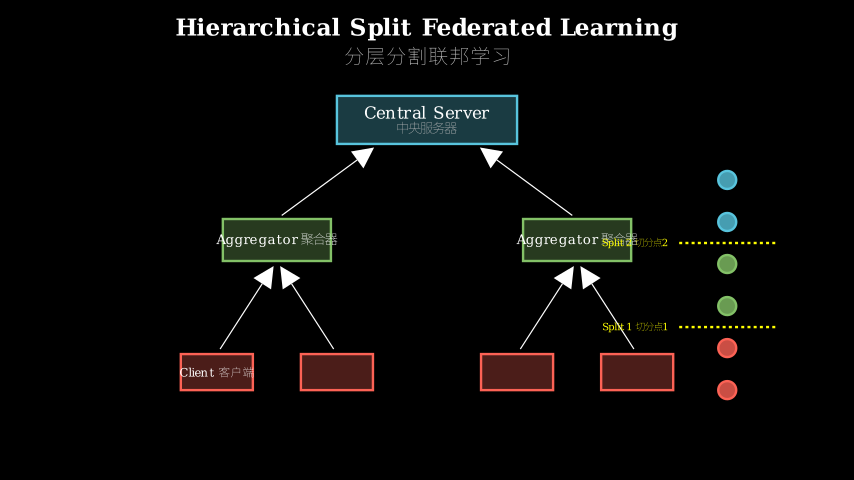
The method operates on a three-tier hierarchy: clients (edge devices), aggregators (edge servers), and a central server. A neural network is split at two points—creating three sub-models. Clients run the bottom sub-model on their local data, aggregators run the middle sub-model on aggregated client outputs, and the server runs the top sub-model.
The key insight: gradient flow quality depends on where you cut. Cut too early (near input), and aggregators see raw, high-dimensional activations that are hard to aggregate meaningfully. Cut too late (near output), and clients do too much work with limited data. The algorithm searches for two optimal split layers while simultaneously assigning clients to aggregators to balance load and minimize communication rounds.
The optimization is NP-hard (proven via reduction from bin packing), so the paper proposes a heuristic: start with accuracy-optimal split points from a centralized baseline, then iteratively adjust assignments and splits to reduce delay while monitoring accuracy degradation. The heuristic uses a penalty function that trades off accuracy loss against delay reduction.
Input Data (clients)
   |
   v
[Client Sub-Model] <-- Split Point 1
   |
   v
Activations --> [Aggregator] --> Aggregated Activations
                     |
                     v
              [Aggregator Sub-Model] <-- Split Point 2
                     |
                     v
              Features --> [Server] --> [Server Sub-Model]
                                            |
                                            v
                                        Final Output
                                            |
                                            v
                     Gradients flow backward through all splits
Think of it like a relay race with two handoff zones. In a traditional relay, handoff zones are fixed by track rules. But imagine you could move the zones: hand off too early and the first runner is exhausted; too late and you waste the second runner’s speed. Now add a twist—you also choose which runners form teams (client-to-aggregator assignment). The optimal strategy depends on each runner’s stamina (client compute), the track surface (network conditions), and how well runners synchronize at handoffs (gradient aggregation quality). This paper finds that handoff zones (split points) affect not just race time (delay) but also whether runners drop the baton (accuracy degradation from poor gradient flow). The algorithm searches for handoff positions and team compositions that keep the baton secure while minimizing race time.
Key Concepts
-
Split Point Impact on Accuracy: In standard federated learning, all clients train the full model—accuracy depends only on data distribution and aggregation strategy. In split learning, the model is partitioned, and intermediate activations (not gradients) are communicated. Where you split determines what information flows between tiers. Early splits send high-dimensional, noisy activations; late splits send compressed, semantically rich features. Aggregating noisy activations across heterogeneous clients can corrupt the learning signal—like trying to average blurry photos before sharpening them. The paper shows empirically that split points near the middle of the network (layers 3-5 in a 7-layer CNN) preserve enough structure for meaningful aggregation while keeping client computation manageable.
-
Client-to-Aggregator Assignment as Accuracy Lever: Traditional HSFL assigns clients to aggregators based on proximity or load balancing. But clients have different data distributions (non-IID data). If you group clients with similar data under one aggregator, that aggregator sees a biased view and produces biased gradients. If you mix dissimilar clients, aggregation is noisy but more representative. The paper models this as a constraint: each aggregator must see a minimum diversity of data to avoid local optima. The assignment problem becomes: cluster clients to balance load, minimize communication delay, and maintain statistical diversity at each aggregator.
-
Joint Optimization Necessity: You can’t optimize split points and assignments separately. A split point that works well for one assignment may fail for another. Example: if all clients with class-imbalanced data are assigned to one aggregator, a late split (where features are class-specific) will amplify the imbalance. An early split might dilute it. The paper proves the joint problem is NP-hard but shows that greedy heuristics guided by accuracy feedback can find near-optimal solutions. The heuristic alternates: fix splits, optimize assignments; fix assignments, adjust splits; repeat until convergence.
Framework Shift
Before (standard HSFL):              After (this paper):

Clients --> Aggregators --> Server   Clients --> Aggregators --> Server
   |            |              |        |            |              |
[Fixed]     [Fixed]        [Fixed]   [Tuned]     [Tuned]        [Tuned]
 Split       Split          Model      Split       Split          Model
   |            |              |        |            |              |
   +------------+--------------+        +------------+--------------+
            |                                    |
    Optimize for delay only          Optimize for accuracy + delay
From treating architecture as a communication problem to treating it as a learning problem, the core shift is recognizing that split points are hyperparameters affecting gradient quality, not just bandwidth.
Expert Assessment
Problem choice: Real gap. The assumption that split points don’t affect accuracy is pervasive in SFL literature, but it’s clearly false once you think about gradient flow through aggregation operations. The paper identifies a genuine oversight in a growing subfield (federated learning on resource-constrained devices). It sits at the intersection of distributed systems and ML theory—fertile ground.
Method maturity: The NP-hardness proof is straightforward (reduction from bin packing), and the heuristic is reasonable but not particularly clever. The paper doesn’t explore why certain split points work better—just that they do. A deeper analysis of gradient variance at different layers, or a theoretical characterization of “good” split points, would strengthen the contribution. The heuristic feels like a starting point, not a mature solution.
Experimental integrity: Baselines are fair (standard SFL, random HSFL, load-balanced HSFL). The datasets (CIFAR-10, MNIST, Fashion-MNIST) are standard but small-scale. The 3% accuracy improvement is modest and dataset-dependent—on MNIST it’s negligible, on CIFAR-10 it’s more pronounced. The delay and overhead reductions (20%, 50%) are more impressive but depend heavily on network simulation parameters. I’d want to see results on larger models (ResNet-50, Transformers) and real-world network traces before calling this robust.
Writing quality: The paper front-loads formalism (problem formulation, NP-hardness proof) before building intuition. Section 3 (system model) is dense with notation that could be simplified. The experimental section (Section 5) is where the paper shines—clear plots, ablation studies, sensitivity analysis. If the authors rewrote Section 3 to lead with intuition (why split points matter) and deferred formalism to an appendix, the paper would be much more accessible.
Verdict: weak accept — Identifies a real gap and provides the first accuracy-aware solution, but the method is incremental and experiments are limited in scale; needs stronger theoretical grounding or more ambitious empirical validation.
Takeaways
If you’re building any distributed ML system where models are partitioned across devices, don’t assume partition points are accuracy-neutral. Test multiple split configurations during hyperparameter search. The paper’s key transferable idea: aggregation operations (averaging, concatenation) on intermediate representations are lossy, and the loss depends on what you’re aggregating. This applies beyond federated learning—think model parallelism, pipeline parallelism, even ensemble methods. When you combine outputs from different model fragments, the combination point is a design choice with first-order effects on final performance.
Concretely: if you’re doing split learning, run a small grid search over split points (e.g., after every 2-3 layers) and measure validation accuracy, not just communication cost. The 20% delay reduction comes mostly from better client-aggregator assignment (balancing load), which is a standard scheduling problem—but the accuracy constraint (maintain diversity at each aggregator) is novel and worth stealing for any federated system with non-IID data.
论文: 2603.08687 作者: Yiannis Papageorgiou, Yannis Thomas, Ramin Khalili, Iordanis Koutsopoulos 分类: cs.LG, cs.AI
缺口
现有的分割联邦学习(SFL)把模型分割当作通信问题:在某处切开模型,客户端跑底部,服务器跑顶部,最小化数据传输。
层级分割联邦学习(HSFL)增加了中间层的本地聚合器,但仍然假设切分点不影响训练精度——只影响延迟和带宽。
缺口在于:没人问过模型的切分位置是否会改变模型学到的东西。
先前工作优化通信效率时,把精度当作与架构选择无关的量。
本文证明这是错的:切分点和客户端到聚合器的分配共同决定精度和效率。
问题:HSFL 忽略切分点对精度的影响
   |
   v
假设:切分点通过梯度流影响精度
   |
   v
方法:联合优化 2 个切分点 + 客户端分配
   |
   v
证据:CIFAR/MNIST 上精度提升 3% + 延迟降低 20%
   |
   v
结论:SFL 中的架构选择对精度至关重要
增量
一句话: 本文之前,分割联邦学习优化通信时假设精度与架构无关;本文之后,我们知道切分点和设备分配是影响精度的一阶因素,需要联合优化。
核心机制
该方法在三层架构上运行:客户端(边缘设备)、聚合器(边缘服务器)和中央服务器。
神经网络在两个点被切分——产生三个子模型。
客户端在本地数据上运行底部子模型,聚合器在聚合后的客户端输出上运行中间子模型,服务器运行顶部子模型。
关键洞察:梯度流的质量取决于切分位置。
切得太早(靠近输入),聚合器看到的是原始的高维激活值,难以有意义地聚合。
切得太晚(靠近输出),客户端用有限数据做太多工作。
算法搜索两个最优切分层,同时分配客户端到聚合器以平衡负载并最小化通信轮次。
优化问题是 NP 难的(通过从装箱问题归约证明),因此论文提出启发式算法:从中心化基线的精度最优切分点开始,然后迭代调整分配和切分以降低延迟,同时监控精度下降。
启发式使用惩罚函数在精度损失和延迟降低之间权衡。
输入数据(客户端)
   |
   v
[客户端子模型] <-- 切分点 1
   |
   v
激活值 --> [聚合器] --> 聚合后的激活值
              |
              v
         [聚合器子模型] <-- 切分点 2
              |
              v
         特征 --> [服务器] --> [服务器子模型]
                                   |
                                   v
                               最终输出
                                   |
                                   v
              梯度通过所有切分点反向流动
把它想象成有两个交接区的接力赛。
在传统接力赛中,交接区由赛道规则固定。
但想象你可以移动交接区:交接太早,第一个跑者精疲力竭;太晚,浪费第二个跑者的速度。
现在加个变化——你还要选择哪些跑者组队(客户端到聚合器的分配)。
最优策略取决于每个跑者的耐力(客户端计算能力)、赛道表面(网络条件)以及跑者在交接时的同步程度(梯度聚合质量)。
本文发现交接区(切分点)不仅影响比赛时间(延迟),还影响跑者是否掉棒(梯度流不良导致的精度下降)。
算法搜索交接位置和团队组成,在保持接棒稳定的同时最小化比赛时间。
关键概念
- 切分点对精度的影响: 在标准联邦学习中,所有客户端训练完整模型——精度只取决于数据分布和聚合策略。
在分割学习中,模型被分割,中间激活值(而非梯度)被通信。
切分位置决定了层间流动的信息。
早期切分发送高维、有噪声的激活值;晚期切分发送压缩的、语义丰富的特征。
在异构客户端间聚合有噪声的激活值会破坏学习信号——就像在锐化之前试图平均模糊照片。
论文通过实验表明,网络中间附近的切分点(7 层 CNN 中的第 3-5 层)既保留了足够的结构以进行有意义的聚合,又保持了客户端计算的可管理性。
- 客户端到聚合器分配作为精度杠杆: 传统 HSFL 基于邻近性或负载均衡分配客户端到聚合器。
但客户端有不同的数据分布(非独立同分布数据)。
如果你把数据相似的客户端分到一个聚合器下,该聚合器看到的是有偏视图,产生有偏梯度。
如果你混合不相似的客户端,聚合有噪声但更具代表性。
论文将此建模为约束:每个聚合器必须看到最小的数据多样性以避免局部最优。
分配问题变成:聚类客户端以平衡负载、最小化通信延迟并在每个聚合器处保持统计多样性。
- 联合优化的必要性: 你不能分别优化切分点和分配。
对一种分配有效的切分点可能对另一种失效。
例如:如果所有类别不平衡数据的客户端都分配给一个聚合器,晚期切分(特征是类别特定的)会放大不平衡。
早期切分可能会稀释它。
论文证明联合问题是 NP 难的,但表明由精度反馈引导的贪婪启发式可以找到近似最优解。
启发式交替进行:固定切分,优化分配;固定分配,调整切分;重复直到收敛。
框架转变
之前(标准 HSFL):              之后(本文):

客户端 --> 聚合器 --> 服务器     客户端 --> 聚合器 --> 服务器
   |          |          |          |          |          |
[固定]    [固定]    [固定]      [调优]    [调优]    [调优]
 切分      切分      模型        切分      切分      模型
   |          |          |          |          |          |
   +----------+----------+          +----------+----------+
            |                                |
    仅优化延迟                      优化精度 + 延迟
从把架构当作通信问题到把它当作学习问题,核心转变是认识到切分点是影响梯度质量的超参数,而不仅仅是带宽。
专家评审
选题眼光: 真实缺口。
切分点不影响精度的假设在 SFL 文献中很普遍,但一旦你思考梯度流经聚合操作,这显然是错误的。
论文识别了一个不断增长的子领域(资源受限设备上的联邦学习)中的真正疏忽。
它位于分布式系统和机器学习理论的交叉点——肥沃的土壤。
方法成熟度: NP 难度证明很直接(从装箱问题归约),启发式合理但不特别巧妙。
论文没有探索为什么某些切分点效果更好——只是说它们确实更好。
对不同层梯度方差的更深入分析,或对”好”切分点的理论刻画,会加强贡献。
启发式感觉像起点,而非成熟解决方案。
实验诚意: 基线公平(标准 SFL、随机 HSFL、负载均衡 HSFL)。
数据集(CIFAR-10、MNIST、Fashion-MNIST)是标准的但规模较小。
3% 的精度提升是适度的且依赖数据集——在 MNIST 上可忽略不计,在 CIFAR-10 上更明显。
延迟和开销降低(20%、50%)更令人印象深刻,但严重依赖网络模拟参数。
在称其稳健之前,我想看到更大模型(ResNet-50、Transformer)和真实世界网络轨迹上的结果。
写作功力: 论文在建立直觉之前就前置了形式化(问题表述、NP 难度证明)。
第 3 节(系统模型)充满了可以简化的符号。
实验部分(第 5 节)是论文的亮点——清晰的图表、消融研究、敏感性分析。
如果作者重写第 3 节,先给出直觉(为什么切分点重要),将形式化推迟到附录,论文会更易理解。
判决: 弱接收 — 识别了真实缺口并提供了首个精度感知解决方案,但方法是增量式的,实验规模有限;需要更强的理论基础或更雄心勃勃的实证验证。
要点总结
如果你在构建任何跨设备分割模型的分布式机器学习系统,不要假设分割点对精度中性。
在超参数搜索期间测试多个切分配置。
论文的关键可迁移思想:对中间表示的聚合操作(平均、拼接)是有损的,损失取决于你在聚合什么。
这适用于联邦学习之外——想想模型并行、流水线并行,甚至集成方法。
当你组合来自不同模型片段的输出时,组合点是一个设计选择,对最终性能有一阶影响。
具体来说:如果你在做分割学习,对切分点运行小型网格搜索(例如,每 2-3 层之后),测量验证精度,而不仅仅是通信成本。
20% 的延迟降低主要来自更好的客户端-聚合器分配(平衡负载),这是标准调度问题——但精度约束(在每个聚合器处保持多样性)是新颖的,值得为任何具有非独立同分布数据的联邦系统借鉴。