
Paper: 2603.21986 Authors: SII-GAIR, Sand. ai, :, Ethan Chern, Hansi Teng, Hanwen Sun, Hao Wang, Hong Pan, Hongyu Jia, Jiadi Su Categories: cs.CV
The Gap
Audio-video generation models have reached impressive quality, but they’re architecturally fragmented. Models like Make-A-Video and CogVideoX use separate streams for different modalities (text, video, audio), requiring cross-attention mechanisms to coordinate them. This multi-stream design creates three problems: (1) complex training pipelines that need careful balancing between modality-specific losses, (2) inference overhead from cross-attention operations, and (3) difficulty maintaining tight synchronization between audio and video, especially for human speech where lip movements must match phonemes within 40ms windows.
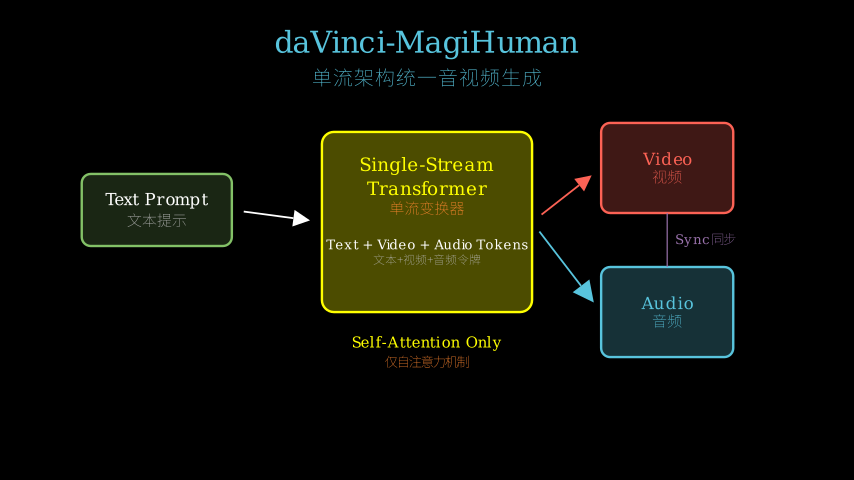
The paper asks: can we collapse all modalities into a single token sequence and let self-attention handle everything?
Problem: Multi-stream architectures for audio-video generation
   |
   v
Assumption: Self-attention can learn cross-modal alignment
            if modalities share the same token space
   |
   v
Method: Single-stream Transformer processing
        [text tokens | video tokens | audio tokens]
   |
   v
Evidence: 14.60% WER (best speech intelligibility)
          80% win rate vs Ovi 1.1 in human eval
          2s generation time for 5s video on H100
   |
   v
Conclusion: Architectural simplicity enables both
            better synchronization and faster inference
The Increment
One sentence: Before this paper, audio-video models used separate processing streams with cross-attention; after, a single Transformer can process all modalities in one unified sequence with only self-attention.
Core Mechanism
The model treats text, video frames, and audio spectrograms as a single continuous token sequence. Text prompts are tokenized first, followed by spatiotemporal video tokens (from a VAE that compresses 256×256 frames into latent patches), then audio tokens (from an audio codec that converts waveforms into discrete codes). This concatenated sequence flows through a standard Transformer with causal self-attention.
The key is tokenization alignment: video uses 8×8 spatial patches across time, audio uses 50Hz frame rate matching video’s temporal resolution. When the model generates token 1000, it can attend back to tokens 0-999 regardless of whether they represent text semantics, facial motion, or phoneme acoustics. The self-attention mechanism learns implicit cross-modal dependencies—for example, the token representing a mouth shape at frame 30 learns to attend to the audio token representing the /p/ phoneme at the corresponding timestamp.
For efficient inference, they stack three optimizations: (1) distill the base model into a smaller student that mimics output distributions, (2) generate at low resolution (64×64) then use a separate super-resolution model to upscale to 256×256, (3) replace the standard VAE decoder with a “Turbo VAE” that trades some reconstruction quality for 3× faster decoding. These optimizations are modular—the single-stream architecture remains unchanged.
Structural metaphor: Think of a film production where the director, cinematographer, and sound engineer all work in the same room, watching the same monitor. In traditional multi-stream models, they’re in separate rooms connected by walkie-talkies (cross-attention)—the sound engineer asks “what’s happening on screen?” and waits for a response. In this single-stream design, everyone sees the same timeline simultaneously. When the sound engineer needs to sync a gunshot sound effect, they just look at the shared monitor to see exactly when the muzzle flash appears. No communication protocol needed—spatial proximity enables implicit coordination. The “shared monitor” is the unified token sequence; “looking at the timeline” is self-attention querying earlier tokens.
Key Concepts
-
Single-stream architecture: Instead of having separate neural pathways for video and audio that communicate through cross-attention layers, all modalities are serialized into one token sequence. Imagine you’re writing a screenplay where stage directions, dialogue, and sound cues are all in one document, line by line. The model reads this document left-to-right, and when it reaches “Character speaks: ‘Hello’”, it has already seen “Character’s mouth opens” a few lines earlier. The self-attention mechanism is like having perfect memory of everything written before—it can connect the mouth movement to the speech sound without needing a separate “check what the video is doing” operation. This works because tokens are ordered chronologically: text prompt → frame 1 video patches → frame 1 audio → frame 2 video patches → frame 2 audio, etc.
-
Latent-space super-resolution: Generating high-resolution video is expensive because the number of tokens grows quadratically with resolution (doubling resolution = 4× tokens). The trick: generate a 64×64 video in the compressed latent space of a VAE, then train a separate diffusion model that operates entirely in that same latent space to add high-frequency details. It’s like sketching a portrait in rough strokes, then having a specialist come in to add fine wrinkles and hair texture—but crucially, the specialist works on your sketch directly, not on a photograph. This avoids decoding to pixel space (expensive) and re-encoding (lossy). The super-resolution model learns: “when I see this latent pattern that represents a blurry eye, I should add these latent features that represent eyelashes.”
Framework Shift
Before (multi-stream):                After (single-stream):

Text Encoder                          Text Tokenizer
     |                                      |
     v                                      v
  [Cross]<----+                      +-------------+
     |        |                      | Concatenate |
     v        |                      +-------------+
Video Stream  |                       |  |  |  |  |
     |        |                       v  v  v  v  v
     v        |                      [T][V][V][A][V]...
  [Cross]<----+                            |
     |        |                            v
     v        |                      Self-Attention
Audio Stream  |                       Transformer
     |        |                            |
     +--------+                            v
                                    [Video][Audio]
                                      Tokens Tokens
[One sentence: From coordinating separate modality-specific streams through cross-attention, to processing a unified chronological token sequence with self-attention only.]
Expert Assessment
Problem choice: Real gap. Audio-video synchronization is genuinely hard—prior work like Emu3 and Transfusion either sacrifices quality or requires complex multi-stage training. The human-centric focus (talking faces, body language) is a smart niche where synchronization matters most and where evaluation is clearest (WER for speech, lip-sync metrics).
Method maturity: This is architectural minimalism, not algorithmic innovation. The core idea—serialize everything and use self-attention—is almost obvious in hindsight, which is often the mark of good design. However, the paper leans heavily on engineering (distillation, super-resolution, Turbo VAE) to hit the speed claims. The 2-second generation time is real but requires the full optimization stack; the base model alone is much slower.
Experimental integrity: Baselines are fair (Ovi 1.1, LTX 2.3, Mochi, Hunyuan), and the 14.60% WER is impressive—that’s approaching commercial TTS quality. The human evaluation (2000 pairwise comparisons) is adequately powered. One concern: the super-resolution model is trained on the base model’s outputs, which could amplify artifacts rather than fix them. The paper doesn’t show ablations isolating super-resolution quality from base model quality.
Writing quality: The abstract oversells (“particularly strong in human-centric scenarios”) without defining the comparison set. Section 3.2 on training details is sparse—no learning rate schedules, no discussion of how they prevent mode collapse when audio and video tokens have different entropy distributions. The architectural diagram (Figure 2) is clear, but the paper would benefit from showing failure cases or discussing when single-stream breaks down (e.g., does it handle non-human subjects as well?).
Verdict: weak accept — The single-stream design is elegant and the results are strong, but the contribution is more engineering integration than scientific insight. The open-source release adds significant value.
Takeaways
Serialization over separation: When you have multiple modalities with temporal alignment requirements, consider serializing them chronologically in a single sequence rather than building separate encoders with fusion layers. This works when: (1) modalities have similar temporal granularity, (2) you have enough data for the model to learn cross-modal patterns implicitly, (3) you’re willing to accept longer sequence lengths. The tradeoff is sequence length (more tokens) for architectural simplicity (fewer specialized components).
Latent-space super-resolution: If you’re generating images/video with a VAE, train your super-resolution model in the latent space rather than pixel space. This is faster (smaller tensors) and avoids decode-encode round trips. The key: your super-resolution model must use the same VAE as your base model, so latent distributions match.
Modular optimization stack: The paper’s speed comes from stacking distillation + latent SR + fast decoder. Each component is independent—you can swap the Turbo VAE for a different decoder without retraining the base model. This modularity is valuable for deployment: start with the slow accurate stack, then progressively add optimizations as you profile bottlenecks.
论文: 2603.21986 作者: SII-GAIR, Sand. ai, :, Ethan Chern, Hansi Teng, Hanwen Sun, Hao Wang, Hong Pan, Hongyu Jia, Jiadi Su 分类: cs.CV
缺口
音视频生成模型的质量已经很高,但架构上是割裂的。
Make-A-Video 和 CogVideoX 这类模型为不同模态(文本、视频、音频)使用独立的处理流,需要交叉注意力机制来协调它们。
这种多流设计带来三个问题:(1)复杂的训练流程,需要仔细平衡不同模态的损失函数; (2)交叉注意力操作带来的推理开销; (3)难以维持音视频的紧密同步,尤其是人类语音——嘴唇动作必须在 40 毫秒窗口内匹配音素。
本文的问题是:能否把所有模态压缩到单一 token 序列,让自注意力处理一切?
问题:音视频生成的多流架构
   |
   v
假设:如果模态共享同一 token 空间,
      自注意力可以学会跨模态对齐
   |
   v
方法:单流 Transformer 处理
      [文本 tokens | 视频 tokens | 音频 tokens]
   |
   v
证据:14.60% WER(最佳语音清晰度)
      人类评估中对 Ovi 1.1 胜率 80%
      H100 上 5 秒视频生成耗时 2 秒
   |
   v
结论:架构简化同时带来
      更好的同步和更快的推理
增量
一句话: 此前音视频模型用独立处理流加交叉注意力; 现在单个 Transformer 可以在统一序列中仅用自注意力处理所有模态。
核心机制
模型把文本、视频帧、音频频谱图当作单一连续 token 序列。
文本提示先被 tokenize,然后是时空视频 token(来自 VAE,把 256×256 帧压缩成潜在 patch),再是音频 token(来自音频编解码器,把波形转成离散码)。
这个拼接序列流经标准 Transformer,使用因果自注意力。
关键在于 tokenization 对齐:视频用 8×8 空间 patch 跨时间,音频用 50Hz 帧率匹配视频的时间分辨率。
当模型生成第 1000 个 token 时,它可以回看 0-999 号 token,无论它们代表文本语义、面部动作还是音素声学。
自注意力机制学习隐式的跨模态依赖——例如,代表第 30 帧嘴型的 token 学会关注对应时间戳上代表 /p/ 音素的音频 token。
为了高效推理,他们叠加三种优化:(1)把基础模型蒸馏成更小的学生模型,模仿输出分布; (2)在低分辨率(64×64)生成,然后用独立的超分辨率模型放大到 256×256; (3)用”Turbo VAE”替换标准 VAE 解码器,牺牲部分重建质量换取 3 倍解码速度。
这些优化是模块化的——单流架构本身不变。
核喻:想象一个电影制作现场,导演、摄影师、音效师都在同一个房间,看着同一块监视器。
在传统多流模型里,他们在不同房间,靠对讲机(交叉注意力)联系——音效师问”画面上发生了什么? “然后等回复。
在这个单流设计里,所有人同时看到同一条时间线。
当音效师需要同步枪声音效时,他们直接看共享监视器,准确看到枪口闪光出现的时刻。
不需要通信协议——空间上的接近性实现了隐式协调。
“共享监视器”是统一的 token 序列; “看时间线”是自注意力查询之前的 token。
关键概念
- 单流架构:不是为视频和音频设置独立的神经通路,通过交叉注意力层通信,而是把所有模态串行化到一个 token 序列。
想象你在写剧本,舞台指示、对白、音效提示都在同一份文档里,一行接一行。
模型从左到右读这份文档,当它读到”角色说:‘你好‘“时,它已经在几行之前看到了”角色张嘴”。
自注意力机制就像对之前写的所有内容有完美记忆——它可以把嘴部动作和语音连接起来,不需要单独的”检查视频在做什么”操作。
这能工作是因为 token 按时间顺序排列:文本提示 → 第 1 帧视频 patch → 第 1 帧音频 → 第 2 帧视频 patch → 第 2 帧音频,依此类推。
- 潜在空间超分辨率:生成高分辨率视频很昂贵,因为 token 数量随分辨率平方增长(分辨率翻倍 = token 数量 4 倍)。
技巧是:在 VAE 的压缩潜在空间生成 64×64 视频,然后训练一个独立的扩散模型,完全在同一潜在空间操作,添加高频细节。
就像用粗笔触勾勒肖像,然后让专家来添加细纹和发丝纹理——但关键是,专家直接在你的草图上工作,而不是在照片上。
这避免了解码到像素空间(昂贵)和重新编码(有损)。
超分辨率模型学习:“当我看到这个代表模糊眼睛的潜在模式时,我应该添加这些代表睫毛的潜在特征。 “
框架转变
之前(多流):                        之后(单流):

文本编码器                            文本 Tokenizer
     |                                      |
     v                                      v
  [交叉]<----+                        +-------------+
     |        |                        |   拼接      |
     v        |                        +-------------+
视频流        |                         |  |  |  |  |
     |        |                         v  v  v  v  v
     v        |                        [T][V][V][A][V]...
  [交叉]<----+                              |
     |        |                              v
     v        |                        自注意力
音频流        |                        Transformer
     |        |                              |
     +--------+                              v
                                      [视频][音频]
                                       Token Token
[一句话:从通过交叉注意力协调独立的模态特定流,到用纯自注意力处理统一的时序 token 序列。 ]
专家评审
选题眼光:真实缺口。
音视频同步确实很难——Emu3 和 Transfusion 等先前工作要么牺牲质量,要么需要复杂的多阶段训练。
聚焦人类中心场景(说话的脸、肢体语言)是聪明的细分领域,这里同步最重要,评估也最清晰(语音用 WER,唇同步有指标)。
方法成熟度:这是架构极简主义,不是算法创新。
核心想法——把一切串行化然后用自注意力——事后看几乎是显而易见的,这往往是好设计的标志。
但论文严重依赖工程(蒸馏、超分辨率、Turbo VAE)来达到速度声明。
2 秒生成时间是真实的,但需要完整的优化栈; 单独的基础模型慢得多。
实验诚意:基线公平(Ovi 1.1、LTX 2.3、Mochi、Hunyuan),14.60% WER 令人印象深刻——接近商业 TTS 质量。
人类评估(2000 次成对比较)样本量足够。
一个担忧:超分辨率模型在基础模型的输出上训练,这可能放大伪影而不是修复它们。
论文没有展示消融实验,隔离超分辨率质量和基础模型质量。
写作功力:摘要过度推销(“particularly strong in human-centric scenarios”),没有定义比较集。
3.2 节训练细节稀疏——没有学习率调度,没有讨论如何防止音频和视频 token 具有不同熵分布时的模式崩溃。
架构图(图 2)清晰,但论文会受益于展示失败案例或讨论单流何时失效(例如,它处理非人类主体效果如何? )。
判决:弱接收 — 单流设计优雅,结果强劲,但贡献更多是工程集成而非科学洞见。
开源发布增加了显著价值。
要点总结
串行化优于分离:当你有多个需要时间对齐的模态时,考虑按时间顺序串行化它们到单一序列,而不是构建带融合层的独立编码器。
这在以下情况有效:(1)模态有相似的时间粒度; (2)你有足够数据让模型隐式学习跨模态模式; (3)你愿意接受更长的序列长度。
权衡是序列长度(更多 token)换架构简单性(更少专用组件)。
潜在空间超分辨率:如果你用 VAE 生成图像/视频,在潜在空间而非像素空间训练超分辨率模型。
这更快(张量更小)且避免解码-编码往返。
关键:你的超分辨率模型必须使用与基础模型相同的 VAE,这样潜在分布才匹配。
模块化优化栈:论文的速度来自叠加蒸馏 + 潜在 SR + 快速解码器。
每个组件独立——你可以换掉 Turbo VAE 用不同解码器,无需重新训练基础模型。
这种模块化对部署有价值:从慢而准确的栈开始,然后在分析瓶颈时逐步添加优化。