
Paper: 2603.23483 Authors: Haoyu Huang, Jinfa Huang, Zhongwei Wan, Xiawu Zheng, Rongrong Ji, Jiebo Luo Categories: cs.CV, cs.CL
The Gap
Agentic multimodal LLMs (like OpenAI o3, Gemini Agentic Vision) achieve strong reasoning by iteratively calling visual tools—perceive, reason, invoke tool, repeat. This cascaded loop creates “agentic depth”: each step waits for the previous one to finish. The problem isn’t just latency for a single query—it’s that this sequential dependency kills system-level concurrency. When serving multiple users, you can’t parallelize effectively because each agent is stuck in its own serial chain.
Prior work optimized individual components (faster vision encoders, better tool APIs) but left the fundamental sequential bottleneck untouched. The gap: no one questioned whether you need to execute the full tool chain every time.
Problem: Sequential tool chains block concurrency
   |
   v
Assumption: Lightweight model can predict trajectory
   |
   v
Method: Speculative planning + cognitive gating + parallel funnel
   |
   v
Evidence: 1.1-3.35x speedup, +6.7% accuracy on benchmarks
   |
   v
Conclusion: Speculation breaks sequential bottleneck
The Increment
One sentence: Before, agentic MLLMs executed every tool call sequentially; after, a small model speculates the trajectory and the system verifies only when needed, masking latency through parallelism.
Core Mechanism
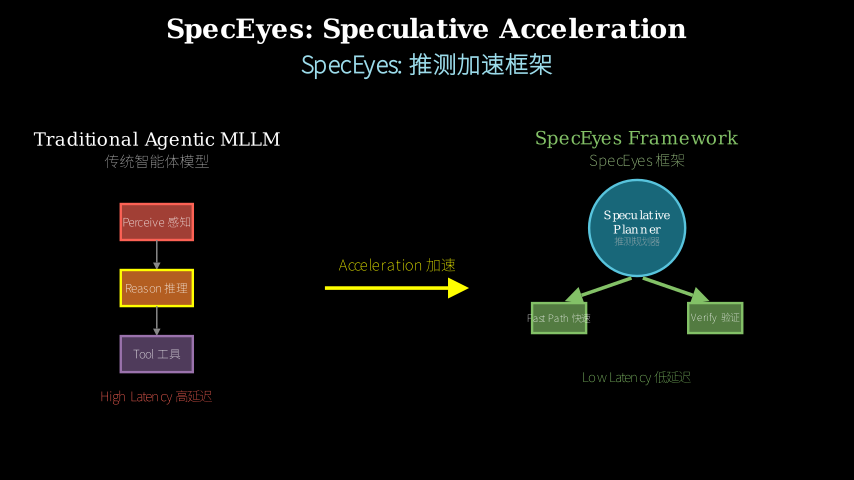
SpecEyes has three components. First, a lightweight MLLM (the “drafter”) predicts the full execution trajectory—what tools to call, in what order, with what results—without actually invoking expensive tools. Second, a cognitive gating mechanism decides whether to trust this draft. It uses “answer separability” (how distinct the model’s top answers are) as a confidence proxy: if the model is sure, accept the draft; if uncertain, fall back to full execution. Third, a heterogeneous parallel funnel exploits the fact that the small model is stateless (can run many drafts concurrently) while the large model is stateful (must verify serially). The system batches multiple queries, drafts them in parallel, then verifies only the uncertain ones.
Data flows like this: user query → small model drafts trajectory → gating checks confidence → if confident, return draft; if not, large model verifies → return verified result. The key is that drafting happens in parallel across queries, so the small model’s work overlaps with the large model’s verification of previous queries.
Query batch
    |
    v
[Small Model]---drafts--->[ Draft Pool ]
(stateless,                     |
 parallel)                      v
                          [Cognitive Gate]
                           /           \
                    confident?      uncertain?
                       /                 \
                      v                   v
                 Return draft      [Large Model]
                                   (stateful, serial)
                                        |
                                        v
                                   Verify & return
Think of it like a restaurant with a trainee and a head chef. The trainee (small model) quickly sketches out dishes for multiple tables simultaneously—“Table 3 wants pasta, Table 5 wants steak.” The head chef (large model) only steps in when the trainee is unsure or when quality control is needed. Because the trainee works on many orders at once, the head chef’s time is masked—while verifying Table 3’s pasta, the trainee is already drafting for Tables 6, 7, and 8. The cognitive gate is the trainee’s self-awareness: “I’m 90% sure about this pasta, but only 50% sure about that soufflé—better call the chef for the soufflé.”
Key Concepts
-
Agentic Depth: The number of sequential tool invocations in an agentic loop. Each step must wait for the previous one—perceive image, reason about it, call tool, perceive tool output, reason again. Depth of 5 means 5 serial round-trips. High depth kills concurrency because you can’t start the next query until the current one finishes all its steps. It’s like a single-lane bridge: no matter how many cars are waiting, only one crosses at a time.
-
Answer Separability: A confidence metric based on how spread out the model’s probability distribution is over candidate answers. If the model assigns 0.9 to answer A and 0.05 to answer B, separability is high—the model is confident. If it assigns 0.4 to A and 0.35 to B, separability is low—the model is guessing. Mathematically, it’s the entropy or margin between top predictions. The insight: you don’t need ground truth labels to know if the model is confident; just look at how decisively it picks an answer.
-
Heterogeneous Parallel Funnel: A scheduling pattern that exploits asymmetry between two processors. The small model is stateless (each query is independent, so you can run 10 in parallel). The large model is stateful (must maintain context across tool calls, so it’s serial). The funnel batches queries, lets the small model draft all of them concurrently, then funnels uncertain ones to the large model one-by-one. The parallelism of drafting masks the serialization of verification, like a wide intake narrowing to a single-file checkout.
Framework Shift
Before (mainstream approach):        After (this paper):

Query --> [Large Model] --> Tool     Query batch
             |                           |
             v                           v
          Tool result              [Small Model]
             |                      (parallel drafts)
             v                           |
        [Large Model] --> Tool            v
             |                       [Gate: confident?]
            ...                         /        \
         (serial chain)            yes /          \ no
                                      /            \
                                     v              v
                                 Return         [Large Model]
                                                (serial verify)
From executing every step serially to speculating the trajectory in parallel and verifying only when uncertain, the core shift is trading sequential depth for concurrent breadth.
Expert Assessment
Problem choice: Real and timely. Agentic MLLMs are the current frontier (o3, Gemini Agentic), and their latency/concurrency issues are blocking deployment. The problem isn’t manufactured—it’s the natural consequence of cascading tool calls. Sits at the intersection of systems optimization and model design, which is where the field is heading.
Method maturity: The speculative execution idea is borrowed from CPU design (branch prediction) and LLM decoding (speculative sampling), but the application to agentic loops is novel. The cognitive gating mechanism is clever—using answer separability as a confidence proxy avoids the need for labeled validation sets. However, the heterogeneous funnel feels like standard batching dressed up with new terminology. The real contribution is recognizing that agentic depth is a parallelism problem, not just a latency problem.
Experimental integrity: Baselines are fair (vanilla agentic MLLM, no speculation). The speedup numbers (1.1-3.35x) are believable given the parallelism gains. The accuracy improvement (+6.7% in some cases) is surprising and suggests the small model’s drafts sometimes correct the large model’s errors—worth investigating further. One red flag: no analysis of failure modes. What happens when the gate mispredicts confidence? How often does speculation make things worse?
Writing quality: The abstract and intro are strong. The method section buries the key insight (stateless vs stateful parallelism) under implementation details. Figure 2 (the system diagram) is cluttered—should be split into conceptual flow and implementation architecture. The related work section is perfunctory, missing connections to speculative execution in databases and compilers. Rewriting Section 3.2 (Cognitive Gating) to lead with the intuition (confidence without labels) would elevate the whole paper.
Verdict: weak accept — Solid systems contribution with clear practical impact, but the novelty is more in problem framing than algorithmic innovation.
Takeaways
Practitioners can steal the cognitive gating pattern: use output distribution entropy as a confidence signal to decide when to invoke expensive verification. This transfers beyond MLLMs—any two-stage system (cheap draft, expensive verify) can use separability to gate the second stage. The heterogeneous funnel is a reminder that stateless operations should always be batched and parallelized to mask stateful bottlenecks. Finally, the framing of “agentic depth” as a concurrency killer is useful for diagnosing performance issues in any multi-step reasoning system.
论文: 2603.23483 作者: Haoyu Huang, Jinfa Huang, Zhongwei Wan, Xiawu Zheng, Rongrong Ji, Jiebo Luo 分类: cs.CV, cs.CL
缺口
智能体多模态大模型(如 OpenAI o3、Gemini Agentic Vision)通过迭代调用视觉工具实现强推理能力——感知、推理、调用工具、重复。
这种级联循环产生了”智能体深度”:每一步都要等前一步完成。
问题不仅是单个查询的延迟,更在于这种串行依赖扼杀了系统级并发。
服务多用户时无法有效并行化,因为每个智能体都困在自己的串行链条里。
此前的工作优化了单个组件(更快的视觉编码器、更好的工具 API),但没有触及根本的串行瓶颈。
缺口在于:没人质疑是否每次都需要执行完整的工具链。
问题:串行工具链阻塞并发
   |
   v
假设:轻量模型可预测执行轨迹
   |
   v
方法:推测规划 + 认知门控 + 并行漏斗
   |
   v
证据:1.1-3.35倍加速,准确率提升6.7%
   |
   v
结论:推测打破串行瓶颈
增量
一句话: 之前智能体多模态大模型串行执行每个工具调用;之后小模型推测轨迹,系统仅在需要时验证,通过并行掩盖延迟。
核心机制
SpecEyes 有三个组件。
首先,轻量级多模态大模型(“起草者”)预测完整执行轨迹——调用什么工具、什么顺序、什么结果——无需真正调用昂贵的工具。
其次,认知门控机制决定是否信任这个草稿。
它用”答案可分性”(模型的首选答案有多明确)作为置信度代理:如果模型确定,接受草稿;如果不确定,回退到完整执行。
第三,异构并行漏斗利用了小模型无状态(可并发运行多个草稿)而大模型有状态(必须串行验证)的特性。
系统批量处理查询,并行起草,然后只验证不确定的那些。
数据流如下:用户查询 → 小模型起草轨迹 → 门控检查置信度 → 如果确定,返回草稿;如果不确定,大模型验证 → 返回验证结果。
关键在于起草跨查询并行发生,所以小模型的工作与大模型对先前查询的验证重叠。
查询批次
    |
    v
[小模型]---起草--->[ 草稿池 ]
(无状态,                |
 并行)                   v
                   [认知门控]
                    /        \
               确定?        不确定?
                /              \
               v                v
          返回草稿          [大模型]
                           (有状态,串行)
                                |
                                v
                           验证并返回
把它想象成一家餐厅,有实习生和主厨。
实习生(小模型)快速为多张桌子同时勾画菜品——“3号桌要意面,5号桌要牛排”。
主厨(大模型)只在实习生不确定或需要质量控制时介入。
因为实习生同时处理多个订单,主厨的时间被掩盖了——验证3号桌意面时,实习生已经在为6、7、8号桌起草了。
认知门控是实习生的自我意识:“我90%确定这个意面,但只50%确定那个舒芙蕾——舒芙蕾最好叫主厨”。
关键概念
- 智能体深度: 智能体循环中串行工具调用的次数。
每一步必须等待前一步——感知图像、推理、调用工具、感知工具输出、再次推理。
深度为5意味着5次串行往返。
高深度扼杀并发,因为在当前查询完成所有步骤前无法开始下一个查询。
就像单车道桥:无论有多少车在等,一次只能过一辆。
- 答案可分性: 基于模型在候选答案上的概率分布有多分散的置信度指标。
如果模型给答案A分配0.9,给答案B分配0.05,可分性高——模型有信心。
如果给A分配0.4,给B分配0.35,可分性低——模型在猜。
数学上,它是熵或首选预测之间的边际。
洞见:不需要真实标签就能知道模型是否有信心;只需看它选择答案有多果断。
- 异构并行漏斗: 利用两个处理器之间不对称性的调度模式。
小模型无状态(每个查询独立,可并行运行10个)。
大模型有状态(必须跨工具调用维护上下文,所以是串行的)。
漏斗批量处理查询,让小模型并发起草所有查询,然后将不确定的查询逐个输送给大模型。
起草的并行性掩盖了验证的串行化,就像宽进口收窄到单列结账。
框架转变
之前(主流方法):              之后(本文方法):

查询 --> [大模型] --> 工具      查询批次
            |                      |
            v                      v
         工具结果               [小模型]
            |                  (并行起草)
            v                      |
       [大模型] --> 工具            v
            |                  [门控:确定?]
           ...                   /        \
        (串行链)             是 /          \ 否
                               /            \
                              v              v
                          返回            [大模型]
                                         (串行验证)
从串行执行每一步到并行推测轨迹并仅在不确定时验证,核心转变是用并发广度换取串行深度。
专家评审
选题眼光: 真实且及时。
智能体多模态大模型是当前前沿(o3、Gemini Agentic),它们的延迟/并发问题正在阻碍部署。
问题不是人造的——它是级联工具调用的自然后果。
处于系统优化和模型设计的交叉点,这正是该领域的发展方向。
方法成熟度: 推测执行的想法借鉴自 CPU 设计(分支预测)和大模型解码(推测采样),但应用于智能体循环是新颖的。
认知门控机制很巧妙——用答案可分性作为置信度代理,避免了对标注验证集的需求。
然而,异构漏斗感觉像是用新术语包装的标准批处理。
真正的贡献是认识到智能体深度是并行问题,而不仅仅是延迟问题。
实验诚意: 基线公平(原始智能体多模态大模型,无推测)。
加速数字(1.1-3.35倍)考虑到并行增益是可信的。
准确率提升(某些情况下+6.7%)令人惊讶,表明小模型的草稿有时会纠正大模型的错误——值得进一步研究。
一个警示:没有失败模式分析。
当门控误判置信度时会发生什么?推测使情况变糟的频率有多高?
写作功力: 摘要和引言很强。
方法部分将关键洞见(无状态 vs 有状态并行)埋在实现细节下。
图2(系统图)杂乱——应该拆分为概念流和实现架构。
相关工作部分敷衍,缺少与数据库和编译器中推测执行的联系。
重写3.2节(认知门控)以直觉(无标签的置信度)开头会提升整篇论文。
判决: 弱接收 — 扎实的系统贡献,有明确的实际影响,但新颖性更多在于问题框架而非算法创新。
要点总结
实践者可以偷走认知门控模式:用输出分布熵作为置信度信号来决定何时调用昂贵的验证。
这超越了多模态大模型——任何两阶段系统(廉价草稿、昂贵验证)都可以用可分性来门控第二阶段。
异构漏斗提醒我们,无状态操作应该总是批处理和并行化,以掩盖有状态瓶颈。
最后,将”智能体深度”框架为并发杀手,对诊断任何多步推理系统的性能问题都很有用。