
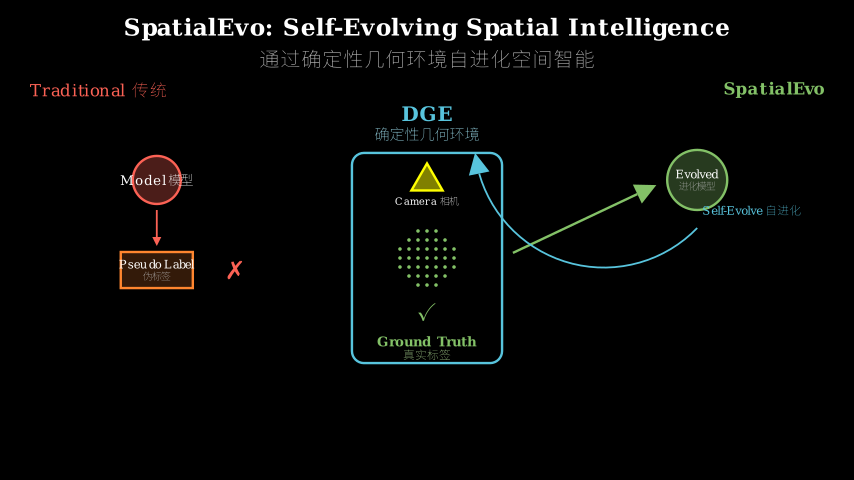
Paper: 2604.14144 Authors: Dinging Li, Yingxiu Zhao, Xinrui Cheng, Kangheng Lin, Hongbo Peng, Hongxing Li, Zixuan Wang, Yuhong Dai, Haodong Li, Jia Wang Categories: cs.CV, cs.CL
The Gap
Spatial reasoning over 3D scenes is critical for robots and embodied AI, but training these models hits a wall: geometric annotation is expensive. Self-evolving approaches (where models generate their own training data) seem promising, but they suffer from a fatal flaw — they use model consensus to create pseudo-labels, which means the model just learns to be confidently wrong in the same ways. Prior work like self-instruct and constitutional AI rely on the model’s own outputs as ground truth, creating an echo chamber where errors compound rather than correct.
This paper identifies something unique about 3D spatial reasoning: unlike subjective tasks, the correct answer is a deterministic consequence of geometry. You can compute it exactly from point clouds and camera poses without any model involvement. The gap is clear: existing self-evolution methods can’t escape their own biases, but spatial reasoning has an objective oracle that prior work hasn’t exploited.
Problem: Self-evolution reinforces model errors
         |
         v
Insight: 3D geometry provides deterministic ground truth
         |
         v
Method: Replace model consensus with physics-based validation
         |
         v
Evidence: Gains on 9 benchmarks without annotation
         |
         v
Conclusion: Self-evolution works when you have an objective oracle
The Increment
One sentence: Before this paper, self-evolving models were trapped in their own echo chambers; after, they can train on spatial reasoning by playing against the laws of physics instead of their own hallucinations.
Core Mechanism
SpatialEvo has three interlocking components. First, the Deterministic Geometric Environment (DGE) converts unannotated 3D scenes into interactive oracles. It formalizes 16 spatial reasoning task categories (distance, direction, containment, etc.) with explicit geometric validation rules. Given a question like “Is the chair closer to the table or the lamp?”, the DGE computes the exact answer from point cloud coordinates — no model needed.
Second, a single model plays two roles in alternation. As the questioner, it generates spatial questions grounded in scene observations. As the solver, it answers questions and receives feedback from the DGE. Both roles share parameters and co-evolve: the questioner learns to ask physically valid questions, the solver learns to answer correctly against ground truth.
Third, a task-adaptive scheduler tracks performance across the 16 task categories and dynamically allocates training compute to the model’s weakest areas. If the model struggles with “relative position” but excels at “distance estimation”, the scheduler generates more relative position questions. This creates an endogenous curriculum without manual design.
3D Scene + Camera Pose
         |
         v
    [   DGE   ]  <--- Geometric validation rules
         |
    +----+----+
    |         |
    v         v
Questioner  Solver  <--- Shared parameters
    |         |
    +----+----+
         |
         v
Task-Adaptive Scheduler
    (focuses on weak categories)
Think of SpatialEvo like a chess player training against a perfect referee. Traditional self-evolution is like two amateur players playing each other and calling their own fouls — they just reinforce bad habits. SpatialEvo is different: the DGE is like having Stockfish as a referee. The model plays both sides (questioner generates positions, solver finds moves), but the referee (DGE) provides objective feedback based on the rules of the game (geometry). The scheduler is like a coach who notices you’re weak at endgames and makes you practice those positions more. The key insight: you don’t need another model to judge correctness when the rules of physics can do it for you.
Key Concepts
-
Deterministic Geometric Environment (DGE): In most AI tasks, ground truth is fuzzy — what’s the “correct” caption for an image? But in 3D spatial reasoning, correctness is binary and computable. If I ask “Is object A above object B?”, the answer is determined entirely by their coordinates in 3D space. The DGE is a formalization of this idea: it takes unannotated 3D scenes (just point clouds and camera poses) and turns them into zero-noise oracles. For any spatial question, it can compute the exact answer by running geometric calculations. This breaks the self-evolution deadlock because the model isn’t learning from its own potentially wrong outputs — it’s learning from physics.
-
Questioner-Solver Co-evolution: Instead of training separate models, SpatialEvo uses one model that alternates between two roles. As the questioner, it looks at a 3D scene and generates spatial questions (“Which object is furthest from the camera?”). As the solver, it answers questions posed by its past self. Both roles share the same parameters, so improvements in one role transfer to the other. The questioner learns to ask questions that are physically valid (the DGE rejects nonsensical questions), while the solver learns to answer correctly against DGE-verified ground truth. This creates a virtuous cycle: better questions make the solver stronger, and a stronger solver can handle harder questions.
-
Task-Adaptive Scheduling: Not all spatial reasoning tasks are equally hard for the model. The scheduler tracks performance across 16 categories (distance, direction, containment, etc.) and dynamically adjusts the training distribution. If the model is weak at “relative position” questions, the scheduler tells the questioner to generate more of those. This happens automatically based on validation performance — no human needs to design a curriculum. The result is that training compute concentrates on the model’s actual weaknesses rather than being spread uniformly.
Framework Shift
Before (mainstream approach):        After (this paper):

Human annotates 3D scenes            Unannotated 3D scenes
         |                                    |
         v                                    v
   Training data                    [    DGE    ]
         |                           (computes GT)
         v                                    |
   Train model                          +----+----+
         |                              |         |
         v                              v         v
   Fixed model                     Questioner  Solver
                                        |         |
                                        +----+----+
                                             |
                                             v
                                    Self-evolving model
From human-in-the-loop annotation to physics-in-the-loop validation, the core shift is replacing expensive human judgment with deterministic geometric computation.
Expert Assessment
Problem choice: This is a real gap, not manufactured. Self-evolution has genuine promise for reducing annotation costs, but the echo chamber problem is well-documented. The insight that 3D geometry provides an objective oracle is clever and sits at a productive intersection of embodied AI and self-supervised learning. The timing is right — spatial reasoning is becoming critical as we move toward embodied agents.
Method maturity: The core idea is elegant, but the execution feels somewhat brute-force. The DGE with 16 task categories is comprehensive but also rigid — it’s unclear how well this generalizes beyond the predefined taxonomy. The questioner-solver co-evolution is clever, but the paper doesn’t deeply explore failure modes (what happens when the questioner learns to ask only easy questions?). The task-adaptive scheduler is straightforward curriculum learning, not particularly novel. That said, the combination is well-motivated and the deterministic validation is a genuine contribution.
Experimental integrity: The baselines are fair and the evaluation spans 9 benchmarks, which is thorough. The results show consistent gains on spatial reasoning tasks without degradation on general vision-language tasks, which is reassuring. However, the paper doesn’t deeply probe where the method fails or what types of spatial reasoning remain challenging. The ablations are present but somewhat surface-level — I’d want to see more analysis of the questioner’s behavior and whether it learns to game the system.
Writing quality: The abstract and introduction are clear, but the method section gets dense quickly. The DGE formalization is necessary but could be more intuitive — the paper jumps into mathematical definitions before building sufficient intuition. The experimental section is comprehensive but lacks qualitative analysis of failure cases. Rewriting the method section with more visual examples and intuitive explanations before the formal definitions would elevate the whole paper.
Verdict: weak accept — Solid contribution with a clever insight about deterministic validation, but the execution is somewhat mechanical and the analysis could be deeper.
Takeaways
The big transferable idea: when your domain has an objective oracle (physics, formal verification, game rules), you can break the self-evolution echo chamber. This applies beyond spatial reasoning — think code generation (compiler feedback), theorem proving (proof checkers), or robotics (simulation). The specific technique of co-evolving questioner and solver roles with shared parameters is also worth stealing for any domain where you can generate both problems and solutions.
The task-adaptive scheduler is a simple but effective way to create dynamic curricula without manual design. Track performance by category, allocate compute to weak areas — this works anywhere you have a natural task taxonomy.
The negative lesson: don’t over-engineer the taxonomy. The 16 task categories feel somewhat arbitrary, and it’s unclear whether this level of granularity is necessary or just adds complexity. Sometimes a simpler ontology is more robust.
论文: 2604.14144 作者: Dinging Li, Yingxiu Zhao, Xinrui Cheng, Kangheng Lin, Hongbo Peng, Hongxing Li, Zixuan Wang, Yuhong Dai, Haodong Li, Jia Wang 分类: cs.CV, cs.CL
缺口
对 3D 场景的空间推理是机器人和具身智能的核心能力,但训练这些模型遇到了瓶颈:几何标注成本高昂。
自进化方法(模型生成自己的训练数据)看起来很有前景,但有一个致命缺陷——它们用模型共识来创建伪标签,这意味着模型只是学会了以同样的方式自信地犯错。
之前的工作如 self-instruct 和 constitutional AI 依赖模型自己的输出作为真值,创造了一个回音室,错误不断累积而非纠正。
本文发现了 3D 空间推理的独特之处:与主观任务不同,正确答案是几何的确定性结果。
你可以从点云和相机姿态精确计算它,无需任何模型参与。
缺口很明确:现有的自进化方法无法逃脱自身偏见,但空间推理有一个客观的预言机,之前的工作没有利用。
问题:自进化强化模型错误
         |
         v
洞察:3D 几何提供确定性真值
         |
         v
方法:用基于物理的验证替代模型共识
         |
         v
证据:在 9 个基准上无标注提升
         |
         v
结论:有客观预言机时自进化有效
增量
一句话: 这篇论文之前,自进化模型困在自己的回音室里;之后,它们可以通过对抗物理定律而非自己的幻觉来训练空间推理。
核心机制
SpatialEvo 有三个互锁的组件。
首先,确定性几何环境(DGE)将未标注的 3D 场景转换为交互式预言机。
它将 16 个空间推理任务类别(距离、方向、包含等)形式化,配有明确的几何验证规则。
给定一个问题如”椅子离桌子近还是离灯近?“,DGE 从点云坐标计算精确答案——不需要模型。
其次,单个模型交替扮演两个角色。
作为提问者,它基于场景观察生成空间问题。
作为求解者,它回答问题并从 DGE 接收反馈。
两个角色共享参数并共同进化:提问者学会提出物理上有效的问题,求解者学会根据真值正确回答。
第三,任务自适应调度器跟踪 16 个任务类别的性能,动态分配训练算力到模型最弱的领域。
如果模型在”相对位置”上挣扎但在”距离估计”上表现出色,调度器会生成更多相对位置问题。
这创造了一个内生的课程,无需手动设计。
3D 场景 + 相机姿态
         |
         v
    [   DGE   ]  <--- 几何验证规则
         |
    +----+----+
    |         |
    v         v
提问者    求解者  <--- 共享参数
    |         |
    +----+----+
         |
         v
任务自适应调度器
    (聚焦弱类别)
把 SpatialEvo 想象成一个对着完美裁判训练的棋手。
传统的自进化就像两个业余棋手互相下棋并自己判罚——他们只是强化坏习惯。
SpatialEvo 不同:DGE 就像有 Stockfish 做裁判。
模型扮演双方(提问者生成局面,求解者找走法),但裁判(DGE)基于游戏规则(几何)提供客观反馈。
调度器就像教练,注意到你在残局上弱,让你多练这些局面。
关键洞察:当物理规则可以判断正确性时,你不需要另一个模型来评判。
关键概念
- 确定性几何环境(DGE): 在大多数 AI 任务中,真值是模糊的——一张图片的”正确”标题是什么?但在 3D 空间推理中,正确性是二元的且可计算的。
如果我问”物体 A 在物体 B 上方吗?“,答案完全由它们在 3D 空间中的坐标决定。
DGE 是这个想法的形式化:它接收未标注的 3D 场景(只有点云和相机姿态),将它们变成零噪声预言机。
对于任何空间问题,它可以通过运行几何计算来计算精确答案。
这打破了自进化的僵局,因为模型不是从自己可能错误的输出中学习——它是从物理中学习。
- 提问者-求解者共同进化: SpatialEvo 不训练独立的模型,而是使用一个在两个角色间交替的模型。
作为提问者,它观察 3D 场景并生成空间问题(“哪个物体离相机最远?”)。
作为求解者,它回答过去自己提出的问题。
两个角色共享相同的参数,所以一个角色的改进会迁移到另一个。
提问者学会提出物理上有效的问题(DGE 拒绝无意义的问题),而求解者学会根据 DGE 验证的真值正确回答。
这创造了一个良性循环:更好的问题让求解者更强,更强的求解者能处理更难的问题。
- 任务自适应调度: 并非所有空间推理任务对模型来说都同样困难。
调度器跟踪 16 个类别(距离、方向、包含等)的性能,动态调整训练分布。
如果模型在”相对位置”问题上较弱,调度器告诉提问者生成更多这类问题。
这基于验证性能自动发生——不需要人类设计课程。
结果是训练算力集中在模型的实际弱点上,而不是均匀分布。
框架转变
之前(主流方法):              之后(本文方法):

人工标注 3D 场景                未标注 3D 场景
         |                              |
         v                              v
     训练数据                      [    DGE    ]
         |                          (计算真值)
         v                              |
     训练模型                      +----+----+
         |                         |         |
         v                         v         v
     固定模型                  提问者    求解者
                                   |         |
                                   +----+----+
                                        |
                                        v
                                  自进化模型
从人在回路的标注到物理在回路的验证,核心转变是用确定性几何计算替代昂贵的人类判断。
专家评审
选题眼光: 这是真缺口,不是人造的。
自进化在降低标注成本方面确实有前景,但回音室问题有充分记录。
3D 几何提供客观预言机的洞察很巧妙,处于具身 AI 和自监督学习的富有成效的交叉点。
时机合适——随着我们走向具身智能体,空间推理变得至关重要。
方法成熟度: 核心想法优雅,但执行感觉有些蛮力。
有 16 个任务类别的 DGE 很全面但也很僵化——不清楚这在预定义分类法之外泛化得如何。
提问者-求解者共同进化很巧妙,但论文没有深入探索失败模式(当提问者学会只问简单问题时会发生什么?)。
任务自适应调度器是直接的课程学习,不是特别新颖。
话虽如此,组合动机充分,确定性验证是真正的贡献。
实验诚意: 基线公平,评估跨越 9 个基准,很全面。
结果显示在空间推理任务上持续提升,在通用视觉语言任务上没有退化,这令人放心。
然而,论文没有深入探究方法在哪里失败或什么类型的空间推理仍然具有挑战性。
消融实验存在但有些表面——我想看到更多关于提问者行为的分析以及它是否学会了钻系统的空子。
写作功力: 摘要和引言清晰,但方法部分很快变得密集。
DGE 形式化是必要的但可以更直观——论文在建立足够的直觉之前就跳入数学定义。
实验部分全面但缺乏失败案例的定性分析。
在正式定义之前用更多视觉示例和直观解释重写方法部分会提升整篇论文。
判决: 弱接收——有关于确定性验证的巧妙洞察的扎实贡献,但执行有些机械,分析可以更深入。
要点总结
可迁移的大想法:当你的领域有客观预言机(物理、形式验证、游戏规则)时,你可以打破自进化的回音室。
这适用于空间推理之外——想想代码生成(编译器反馈)、定理证明(证明检查器)或机器人(仿真)。
用共享参数共同进化提问者和求解者角色的具体技术也值得借鉴,适用于任何可以生成问题和解决方案的领域。
任务自适应调度器是一种简单但有效的方法,可以在没有手动设计的情况下创建动态课程。
按类别跟踪性能,将算力分配给弱领域——这在任何有自然任务分类法的地方都有效。
负面教训:不要过度设计分类法。
16 个任务类别感觉有些随意,不清楚这种粒度级别是必要的还是只是增加了复杂性。
有时更简单的本体论更稳健。