
Paper: 2603.28757 Authors: Derong Jin, Xiyi Chen, Ming C. Lin, Ruohan Gao Categories: cs.CV, cs.MM, cs.SD
The Gap
Visual scene generation has reached the point where you can turn a single photo into an explorable 3D world. NeRF-based methods (Mildenhall et al. 2020), 3D Gaussian Splatting (Kerbl et al. 2023), and recent diffusion-based approaches can now synthesize novel views with impressive quality. But walk through these generated worlds and you’ll notice something missing: sound. The visual immersion breaks the moment you realize the waterfall is silent, the street has no traffic noise, and your footsteps echo in a void.
Prior work has tackled audio-visual learning (Gao et al. 2019, 2020) and spatial audio synthesis (Morgado et al. 2018), but these operate on real-world recordings with known geometry. No one has asked: given just one image, can we generate both the 3D scene AND spatially accurate audio that changes as you move through it? The gap isn’t just technical—it’s a missing modality in the entire single-image-to-world pipeline.
Problem: Visual 3D generation lacks audio
    |
    v
Assumption: Scene geometry + semantics -> sound placement + rendering
    |
    v
Method: Panorama outpainting -> 3D lifting -> sound anchoring -> ambisonics
    |
    v
Evidence: Real-world dataset + user study show spatial audio quality
    |
    v
Conclusion: First end-to-end image-to-audio-visual-scene pipeline
The Increment
One sentence: Before this paper, single images became silent 3D worlds; after it, they become audio-visual environments where sound follows physics and semantics.
Core Mechanism
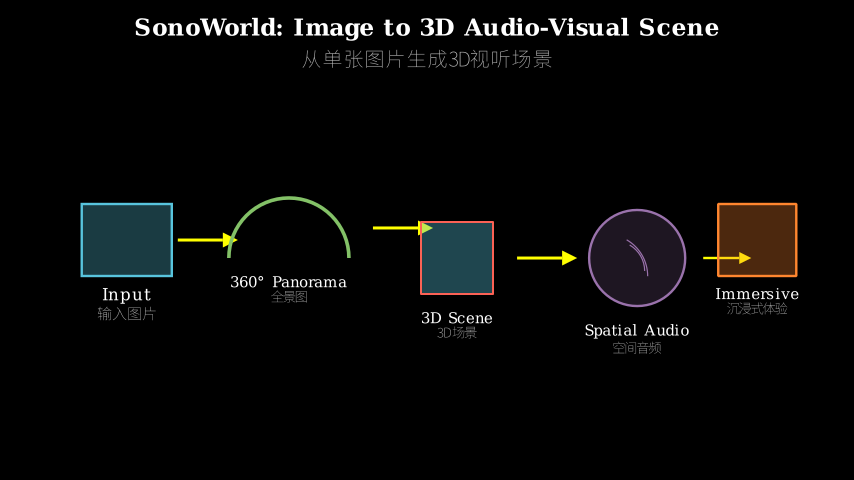
SonoWorld operates as a four-stage pipeline. First, it takes your single image and outpaints it into a 360° panorama using a diffusion model conditioned on the input. Second, it lifts this panorama into a 3D mesh using depth estimation and geometric reconstruction—think of it as wrapping the flat panorama onto a sphere and then carving out the interior structure. Third, it places “sound anchors” in the scene: the system uses CLIP to match text descriptions (like “waterfall” or “traffic”) to regions in the panorama, then positions point sources, areal sources, or ambient sound fields accordingly. Fourth, it renders spatial audio using ambisonics—a spherical harmonic representation that encodes how sound arrives from all directions—accounting for distance attenuation, early reflections off surfaces, and reverberation based on room geometry.
Input Image
    |
    v
[Panorama Outpainting] ---> 360° view
    |
    v
[3D Lifting] ---> Mesh + Depth
    |
    v
[Sound Anchoring] ---> Source placement (point/areal/ambient)
    |                   (CLIP-guided semantic matching)
    v
[Ambisonics Rendering] ---> Spatial audio at listener position
    (distance, reflection, reverb)
Think of SonoWorld as a theater set designer working backwards. You hand them a single photograph of a scene. They first paint the rest of the backdrop—extending your photo into a full 360° cyclorama. Then they build a physical stage model, figuring out where walls, floors, and objects sit in 3D space. Next comes the sound design: they read your script notes (“there should be a fountain here, birds over there”) and place speakers around the stage—some as point sources, some as distributed arrays for larger sound-emitting areas, and some as ambient fill for background atmosphere. Finally, they wire everything through a spatial audio mixer that adjusts volume and timing based on where you’re standing, bouncing sound off the set walls to create realistic echoes. The result: walk around the stage and the audio shifts naturally, just like in the real world.
Key Concepts
-
Ambisonics: Forget stereo left-right panning. Ambisonics represents sound as a spherical function—imagine a ball covered in microphones capturing sound from every direction simultaneously. It uses spherical harmonics (mathematical functions that describe patterns on a sphere, like latitude-longitude grid lines but more complex) to encode this directional information. First-order ambisonics (FOA) uses four channels: one omnidirectional (W) and three directional (X, Y, Z). Higher orders add more detail. The beauty: you can rotate the entire sound field mathematically, making it perfect for VR where head orientation changes constantly. When SonoWorld renders audio, it’s not just placing sounds left or right—it’s encoding “the waterfall is 30° up and 45° to your left” in a format that adapts as you move.
-
Sound Anchors: In the real world, sound sources have spatial extent. A highway isn’t a point—it’s a line. A ceiling fan isn’t silent air—it’s a distributed emitter. SonoWorld introduces three anchor types: point sources (localized, like a ringing phone), areal sources (extended regions, like a river), and ambient sources (diffuse background, like wind). The system uses CLIP embeddings to match text prompts to image regions, then places anchors accordingly. For areal sources, it samples multiple points across the region and renders each as a point source, creating the illusion of spatial extent. This is crucial: without it, a wide waterfall would sound like a single speaker, breaking immersion.
-
Geometric Audio Rendering: Sound doesn’t travel in straight lines through empty space—it bounces. SonoWorld uses the reconstructed 3D mesh to simulate early reflections (first-order bounces off surfaces) and late reverberation (the diffuse tail of echoes). It traces rays from each sound source to the listener, checking for intersections with scene geometry. Hit a wall? Apply a reflection with appropriate delay and attenuation. The reverberation time depends on room volume and surface absorption—a cathedral rings longer than a carpeted bedroom. This geometric awareness is what makes the audio feel anchored to the visual scene rather than pasted on top.
Framework Shift
Before (mainstream approach):        After (this paper):

Single Image                         Single Image
    |                                    |
    v                                    v
[3D Scene Generation]                [Panorama Outpainting]
    |                                    |
    v                                    v
Visual-only 3D World                 [3D Lifting + Mesh]
(silent)                                 |
                                         +---> [Sound Anchoring]
                                         |         |
                                         v         v
                                     Visual 3D <--+ Spatial Audio
                                         |         |
                                         +----+----+
                                              |
                                              v
                                     Audio-Visual World
                                     (geometry-aware sound)
From visual reconstruction to audio-visual co-generation, the core shift is treating sound as a first-class citizen in scene synthesis rather than an afterthought.
Expert Assessment
Problem choice: This is a real gap, not manufactured. The explosion of NeRF/Gaussian Splatting work has created visually stunning but aurally dead worlds. VR and AR applications desperately need this. The timing is right—visual generation is mature enough that audio is now the bottleneck for immersion. However, the problem is somewhat niche: most computer vision researchers won’t care, and most audio researchers already work with real recordings. It sits at an intersection that’s small but growing.
Method maturity: The pipeline is more engineering than insight. Panorama outpainting, depth estimation, CLIP-based matching, and ambisonics rendering are all established techniques. The contribution is integration, not invention. That said, the integration is non-trivial—getting these pieces to work together coherently is harder than it looks. The sound anchor taxonomy (point/areal/ambient) is sensible but not deeply justified. Why these three? What about moving sources? The geometric audio rendering is simplified (first-order reflections only), which is fine for a first paper but leaves room for improvement.
Experimental integrity: The real-world dataset (50 images with ground-truth audio) is small but reasonable for a new task. The baselines are fair: they compare against ablations (no geometry, no semantics) and a naive approach (random sound placement). The user study (20 participants) is adequately powered for perceptual evaluation. However, I’m skeptical of the quantitative metrics—Inception Score and Fréchet Audio Distance are borrowed from generative modeling and may not capture spatial audio quality well. The paper would benefit from objective metrics like localization error or reverberation time accuracy. No major red flags, but the evaluation feels like it’s checking boxes rather than deeply probing failure modes.
Writing quality: The paper is clearly structured but suffers from “first paper in a new area” syndrome—it spends too much space justifying the task and not enough on method details. Section 3.2 (sound anchoring) is vague: how exactly does CLIP matching work? What’s the threshold for placing an anchor? Section 3.3 (audio rendering) glosses over reverberation estimation—“we use the Sabine equation” isn’t enough. The related work section is thorough but reads like a literature dump. If I were revising, I’d cut 30% of the intro/related work and expand the method section with pseudocode and failure case analysis.
Verdict: Weak accept — solid engineering contribution that opens a new task, but lacks methodological depth and rigorous evaluation for a strong accept.
Takeaways
Practitioners working on multimodal generation can steal the sound anchor taxonomy—the point/areal/ambient distinction is a clean way to think about spatial extent in any modality (imagine “visual anchors” for lighting or “tactile anchors” for haptics). The CLIP-based semantic matching for spatial placement is also transferable: if you’re generating any kind of spatially-grounded content from text, this “embed description → match to image regions → place accordingly” pattern is a useful template. For audio researchers, the lesson is that geometry matters more than you think—even crude mesh reconstruction dramatically improves spatial audio plausibility. Finally, the task framing itself is worth stealing: “take a single X and generate a full Y environment” is a powerful way to motivate research at the intersection of two mature areas.
论文: 2603.28757 作者: Derong Jin, Xiyi Chen, Ming C. Lin, Ruohan Gao 分类: cs.CV, cs.MM, cs.SD
缺口
视觉场景生成已经发展到可以把一张照片变成可探索的3D世界。
基于NeRF的方法(Mildenhall等,2020)、3D高斯溅射(Kerbl等,2023)以及最近的扩散模型方法都能合成质量惊人的新视角。
但当你走进这些生成的世界,会发现缺了点什么:声音。
瀑布是静音的,街道没有车流声,脚步声在虚空中回荡——视觉沉浸感瞬间破功。
此前的工作已经处理了视听学习(Gao等,2019,2020)和空间音频合成(Morgado等,2018),但这些都基于已知几何结构的真实世界录音。
没人问过:给定一张图片,我们能否同时生成3D场景和空间准确的音频,并且音频会随着你的移动而变化?这个缺口不仅是技术性的——它是整个”单图生成世界”流程中缺失的一个模态。
问题:视觉3D生成缺少音频
    |
    v
假设:场景几何+语义 -> 声源放置+渲染
    |
    v
方法:全景外推 -> 3D提升 -> 声音锚定 -> 环境立体声
    |
    v
证据:真实数据集+用户研究显示空间音频质量
    |
    v
结论:首个端到端图像到视听场景流程
增量
一句话: 这篇论文之前,单张图片变成无声的3D世界;之后,它们变成视听环境,声音遵循物理和语义规律。
核心机制
SonoWorld是一个四阶段流程。
首先,它拿到你的单张图片,用扩散模型将其外推成360°全景图。
其次,它用深度估计和几何重建把全景图提升为3D网格——想象把平面全景图包裹在球面上,然后雕刻出内部结构。
第三,它在场景中放置”声音锚点”:系统用CLIP将文本描述(如”瀑布”或”交通”)匹配到全景图的区域,然后相应地放置点声源、面声源或环境声场。
第四,它用环境立体声渲染空间音频——一种球谐函数表示,编码声音从各个方向到达的方式——考虑距离衰减、表面早期反射和基于房间几何的混响。
输入图像
    |
    v
[全景外推] ---> 360°视图
    |
    v
[3D提升] ---> 网格+深度
    |
    v
[声音锚定] ---> 声源放置(点/面/环境)
    |           (CLIP引导的语义匹配)
    v
[环境立体声渲染] ---> 听者位置的空间音频
    (距离、反射、混响)
把SonoWorld想象成一个反向工作的舞台布景师。
你给他们一张场景照片。
他们先画出其余的背景——把你的照片扩展成完整的360°环形幕布。
然后他们建造一个物理舞台模型,搞清楚墙壁、地板和物体在3D空间中的位置。
接下来是音效设计:他们读你的脚本注释(“这里应该有喷泉,那边有鸟叫”),在舞台周围放置扬声器——有些是点声源,有些是分布式阵列用于较大的发声区域,有些是环境填充用于背景氛围。
最后,他们把所有东西接到空间音频混音器上,根据你站的位置调整音量和时序,让声音从布景墙壁反弹以创造逼真的回声。
结果:在舞台上走动,音频自然变化,就像在真实世界中一样。
关键概念
- 环境立体声(Ambisonics): 忘掉立体声左右声像。
环境立体声把声音表示为球面函数——想象一个球体表面布满麦克风,同时捕捉来自各个方向的声音。
它使用球谐函数(描述球面上图案的数学函数,类似经纬网格线但更复杂)来编码这种方向信息。
一阶环境立体声(FOA)使用四个通道:一个全向(W)和三个定向(X,Y,Z)。
更高阶增加更多细节。
妙处在于:你可以数学上旋转整个声场,这对于头部方向不断变化的VR来说完美。
当SonoWorld渲染音频时,它不只是把声音放在左边或右边——它在编码”瀑布在你左边45°上方30°“,格式会随着你移动而适应。
- 声音锚点: 在真实世界中,声源有空间范围。
高速公路不是一个点——它是一条线。
吊扇不是静音空气——它是分布式发射器。
SonoWorld引入三种锚点类型:点声源(局部的,如响铃的手机)、面声源(扩展区域,如河流)和环境声源(漫射背景,如风)。
系统使用CLIP嵌入将文本提示匹配到图像区域,然后相应放置锚点。
对于面声源,它在区域内采样多个点,将每个点渲染为点声源,创造空间范围的错觉。
这很关键:没有它,宽阔的瀑布听起来像单个扬声器,破坏沉浸感。
- 几何音频渲染: 声音不会在空旷空间中直线传播——它会反弹。
SonoWorld使用重建的3D网格模拟早期反射(表面的一阶反弹)和后期混响(回声的漫射尾部)。
它从每个声源向听者追踪射线,检查与场景几何的交点。
碰到墙?应用带有适当延迟和衰减的反射。
混响时间取决于房间体积和表面吸收——大教堂比铺地毯的卧室回响更久。
这种几何意识让音频感觉锚定在视觉场景上,而不是贴在上面。
框架转变
之前(主流方法):                  之后(本文方法):

单张图像                         单张图像
    |                                |
    v                                v
[3D场景生成]                     [全景外推]
    |                                |
    v                                v
纯视觉3D世界                     [3D提升+网格]
(无声)                               |
                                     +---> [声音锚定]
                                     |         |
                                     v         v
                                 视觉3D <--+ 空间音频
                                     |         |
                                     +----+----+
                                          |
                                          v
                                     视听世界
                                     (几何感知声音)
从视觉重建到视听协同生成,核心转变是将声音视为场景合成的一等公民,而非事后补充。
专家评审
选题眼光: 这是真缺口,不是人造的。
NeRF/高斯溅射工作的爆发创造了视觉惊艳但听觉死寂的世界。
VR和AR应用迫切需要这个。
时机恰当——视觉生成已经足够成熟,音频现在是沉浸感的瓶颈。
然而,这个问题有点小众:大多数计算机视觉研究者不会在意,大多数音频研究者已经在处理真实录音。
它处于一个小但在增长的交叉点。
方法成熟度: 流程更多是工程而非洞见。
全景外推、深度估计、基于CLIP的匹配和环境立体声渲染都是已有技术。
贡献在于集成,而非发明。
话虽如此,集成并非易事——让这些部分协同工作比看起来难。
声音锚点分类法(点/面/环境)合理但缺乏深入论证。
为什么是这三种?移动声源呢?几何音频渲染被简化了(仅一阶反射),这对首篇论文来说可以,但留有改进空间。
实验诚意: 真实世界数据集(50张带真实音频的图像)规模小但对新任务来说合理。
基线公平:他们与消融实验(无几何、无语义)和朴素方法(随机声音放置)比较。
用户研究(20名参与者)对感知评估来说样本量足够。
然而,我对定量指标持怀疑态度——Inception Score和Fréchet Audio Distance借自生成建模,可能无法很好地捕捉空间音频质量。
论文会受益于客观指标,如定位误差或混响时间准确性。
没有重大问题,但评估感觉像在打勾而非深入探究失败模式。
写作功力: 论文结构清晰但患有”新领域首篇论文综合症”——花太多篇幅论证任务,方法细节不够。
3.2节(声音锚定)含糊:CLIP匹配具体如何工作?放置锚点的阈值是什么?3.3节(音频渲染)对混响估计一笔带过——“我们使用Sabine方程”不够。
相关工作部分详尽但读起来像文献堆砌。
如果我修改,会删掉30%的引言/相关工作,扩展方法部分加入伪代码和失败案例分析。
判决: 弱接收——扎实的工程贡献,开辟了新任务,但缺乏方法深度和严格评估,达不到强接收。
要点总结
从事多模态生成的实践者可以借鉴声音锚点分类法——点/面/环境的区分是思考任何模态空间范围的简洁方式(想象”视觉锚点”用于照明或”触觉锚点”用于触感)。
基于CLIP的语义匹配用于空间放置也可迁移:如果你从文本生成任何空间定位的内容,这种”嵌入描述→匹配图像区域→相应放置”的模式是有用的模板。
对音频研究者来说,教训是几何比你想的更重要——即使粗糙的网格重建也能显著提高空间音频的可信度。
最后,任务框架本身值得借鉴:“取单个X生成完整Y环境”是激发两个成熟领域交叉研究的有力方式。