
Paper: 2602.22208 Authors: Georgy Savva, Oscar Michel, Daohan Lu, Suppakit Waiwitlikhit, Timothy Meehan, Dhairya Mishra, Srivats Poddar, Jack Lu, Saining Xie Categories: cs.CV
Abstract
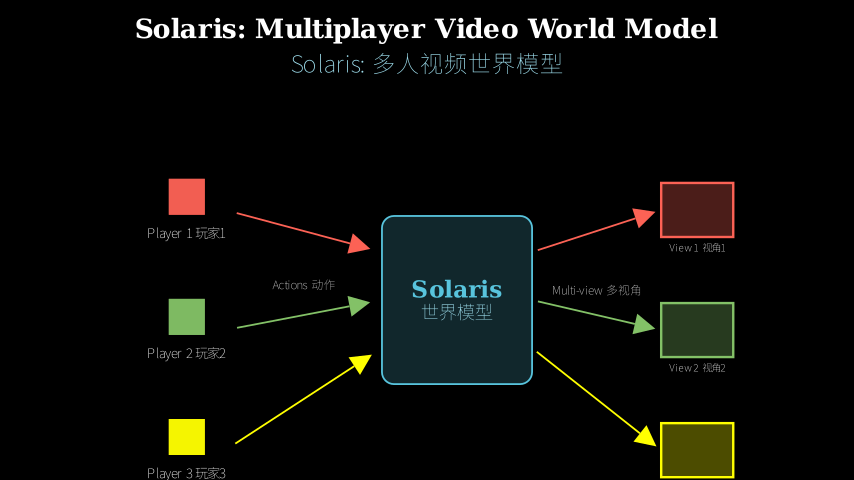
Solaris represents a significant advancement in video world modeling by extending beyond single-agent perspectives to capture multi-agent interactions. The model simulates consistent multi-view observations in multiplayer environments, specifically demonstrated in Minecraft. The research introduces a comprehensive data collection system that enables robust, continuous, and automated capture of synchronized videos and actions from multiple coordinated agents. Trained on 12.64 million multiplayer frames, Solaris employs a staged training pipeline that progressively transitions from single-player to multiplayer modeling, incorporating bidirectional, causal, and Self Forcing training techniques. The final stage introduces Checkpointed Self Forcing, a memory-efficient variant enabling longer-horizon teacher models. The work establishes a new evaluation framework covering multiplayer movement, memory, grounding, building, and view consistency.
Key Contributions
- First multiplayer video world model capable of simulating consistent multi-view observations across multiple agents
- Novel multiplayer data collection system supporting coordinated multi-agent interaction with synchronized video and action capture
- Large-scale dataset of 12.64 million multiplayer frames from Minecraft gameplay
- Comprehensive evaluation framework for assessing multiplayer capabilities: movement, memory, grounding, building, and view consistency
- Staged training pipeline progressively transitioning from single-player to multiplayer modeling
- Checkpointed Self Forcing technique for memory-efficient training with longer-horizon teachers
- Open-source release of both the data collection system and trained models
Technical Methodology
The Solaris architecture addresses the fundamental challenge of modeling multi-agent interactions through a carefully designed training pipeline. Unlike traditional video world models that operate from a single agent’s perspective, Solaris must maintain consistency across multiple viewpoints while capturing the complex dynamics of agent interactions.
The data collection system represents a critical innovation. Built on top of Minecraft, it enables automated, continuous data gathering from multiple agents simultaneously. The system captures synchronized video frames and action sequences, ensuring temporal alignment across all agent perspectives. This synchronization is essential for training a model that can generate coherent multi-view predictions.
The training methodology employs a three-stage approach. Initially, the model learns from single-player data to establish basic world dynamics and visual generation capabilities. The second stage introduces multi-agent scenarios but maintains simpler interaction patterns. The final stage focuses on complex multiplayer interactions, where Checkpointed Self Forcing becomes crucial. This technique addresses the memory constraints of Self Forcing training by checkpointing intermediate states, allowing the model to learn from longer temporal horizons without excessive memory consumption.
The model architecture itself must handle multiple input streams (one per agent) and generate corresponding output predictions. This requires careful attention to how information flows between agent representations and how the model maintains consistency across different viewpoints of the same scene.
Evaluation Framework and Results
The evaluation framework introduces five key dimensions for assessing multiplayer world model performance. Movement evaluation tests whether the model accurately predicts agent locomotion and navigation in response to actions. Memory evaluation assesses the model’s ability to maintain consistent world state over extended sequences. Grounding evaluation measures how well the model connects actions to their visual consequences. Building evaluation specifically tests construction and modification of the environment, a core Minecraft mechanic. View consistency evaluation ensures that predictions from different agent perspectives remain coherent with each other.
Results demonstrate that Solaris outperforms existing baselines across these metrics. The staged training approach proves essential, with models trained directly on multiplayer data showing inferior performance compared to those following the progressive curriculum. Checkpointed Self Forcing provides measurable improvements in temporal consistency, particularly for longer prediction horizons.
The model shows strong performance in maintaining view consistency, a particularly challenging aspect of multiplayer modeling. When multiple agents observe the same scene from different angles, Solaris generates predictions that remain geometrically and semantically consistent across viewpoints. This capability suggests the model has learned meaningful 3D scene representations rather than merely memorizing 2D patterns.
Implications and Future Directions
Solaris opens new possibilities for multi-agent AI systems and simulation. By demonstrating that video world models can scale to multiplayer scenarios, the work suggests pathways toward more sophisticated agent training environments. Future embodied AI systems could leverage such models for planning, exploration, and learning in complex multi-agent settings.
The open-source release of both the data collection system and trained models lowers barriers for researchers exploring multi-agent world modeling. The Minecraft platform provides a rich, controllable environment for experimentation, and the data collection infrastructure can be adapted for various research questions.
Several directions for future work emerge naturally. Scaling to more agents simultaneously, extending to other game environments or real-world scenarios, and improving the efficiency of multi-view generation all represent important challenges. Additionally, integrating language conditioning could enable more natural human-AI interaction in these multiplayer environments.
The work also raises questions about the relationship between world models and agent policies. While Solaris focuses on prediction, combining it with policy learning could yield agents that better anticipate and respond to multi-agent dynamics.
Takeaways
-
Solaris is the first video world model designed specifically for multiplayer scenarios, capable of generating consistent multi-view observations across multiple agents.
-
The staged training pipeline, progressing from single-player to complex multiplayer scenarios, proves essential for learning robust multi-agent dynamics.
-
Checkpointed Self Forcing enables memory-efficient training with longer-horizon teachers, improving temporal consistency in predictions.
-
The comprehensive evaluation framework covering movement, memory, grounding, building, and view consistency provides a rigorous benchmark for future multiplayer world models.
-
Open-sourcing the data collection system and models establishes infrastructure for advancing multi-agent AI research in interactive environments.
论文: 2602.22208 作者: Georgy Savva, Oscar Michel, Daohan Lu, Suppakit Waiwitlikhit, Timothy Meehan, Dhairya Mishra, Srivats Poddar, Jack Lu, Saining Xie 分类: cs.CV
摘要
Solaris代表了视频世界建模的重大进展,它突破了单智能体视角的局限,能够捕捉多智能体交互。该模型在多人环境中模拟一致的多视角观察,特别是在Minecraft中进行了演示。研究引入了一个全面的数据收集系统,能够从多个协调智能体中稳健、连续、自动地捕获同步视频和动作。Solaris使用1264万帧多人游戏数据进行训练,采用分阶段训练流程,逐步从单人建模过渡到多人建模,结合了双向、因果和自强制训练技术。最终阶段引入了检查点自强制(Checkpointed Self Forcing),这是一种内存高效的变体,支持更长时域的教师模型。该工作建立了涵盖多人移动、记忆、定位、建造和视角一致性的新评估框架。
主要贡献
- 首个能够跨多个智能体模拟一致多视角观察的多人视频世界模型
- 新颖的多人数据收集系统,支持协调的多智能体交互以及同步的视频和动作捕获
- 来自Minecraft游戏的大规模数据集,包含1264万帧多人游戏画面
- 全面的评估框架,用于评估多人能力:移动、记忆、定位、建造和视角一致性
- 分阶段训练流程,逐步从单人建模过渡到多人建模
- 检查点自强制技术,实现内存高效的长时域教师模型训练
- 开源发布数据收集系统和训练模型
技术方法论
Solaris架构通过精心设计的训练流程解决了多智能体交互建模的根本挑战。与从单个智能体视角运作的传统视频世界模型不同,Solaris必须在捕捉智能体交互的复杂动态的同时,保持多个视角之间的一致性。
数据收集系统代表了一项关键创新。该系统基于Minecraft构建,能够同时从多个智能体自动、连续地收集数据。系统捕获同步的视频帧和动作序列,确保所有智能体视角之间的时间对齐。这种同步对于训练能够生成连贯多视角预测的模型至关重要。
训练方法采用三阶段方法。最初,模型从单人数据中学习,建立基本的世界动态和视觉生成能力。第二阶段引入多智能体场景,但保持较简单的交互模式。最终阶段专注于复杂的多人交互,此时检查点自强制变得至关重要。该技术通过检查点保存中间状态来解决自强制训练的内存约束,使模型能够从更长的时间范围学习,而不会产生过多的内存消耗。
模型架构本身必须处理多个输入流(每个智能体一个)并生成相应的输出预测。这需要仔细考虑信息如何在智能体表示之间流动,以及模型如何在同一场景的不同视角之间保持一致性。
评估框架与结果
评估框架引入了五个关键维度来评估多人世界模型的性能。移动评估测试模型是否能准确预测智能体响应动作的运动和导航。记忆评估评估模型在扩展序列中维持一致世界状态的能力。定位评估衡量模型将动作与其视觉后果连接的能力。建造评估专门测试环境的构建和修改,这是Minecraft的核心机制。视角一致性评估确保来自不同智能体视角的预测彼此保持连贯。
结果表明,Solaris在这些指标上优于现有基线。分阶段训练方法被证明是必不可少的,直接在多人数据上训练的模型表现出不如遵循渐进式课程的模型。检查点自强制在时间一致性方面提供了可衡量的改进,特别是对于更长的预测时域。
模型在保持视角一致性方面表现出色,这是多人建模中特别具有挑战性的方面。当多个智能体从不同角度观察同一场景时,Solaris生成的预测在视角之间保持几何和语义一致性。这种能力表明模型已经学习了有意义的3D场景表示,而不仅仅是记忆2D模式。
影响与未来方向
Solaris为多智能体AI系统和仿真开辟了新的可能性。通过证明视频世界模型可以扩展到多人场景,这项工作为更复杂的智能体训练环境指明了路径。未来的具身AI系统可以利用这类模型在复杂的多智能体环境中进行规划、探索和学习。
数据收集系统和训练模型的开源发布降低了研究人员探索多智能体世界建模的门槛。Minecraft平台提供了一个丰富、可控的实验环境,数据收集基础设施可以适应各种研究问题。
几个未来工作方向自然浮现。同时扩展到更多智能体、扩展到其他游戏环境或真实世界场景、提高多视角生成的效率都代表着重要挑战。此外,集成语言条件可以在这些多人环境中实现更自然的人机交互。
这项工作还提出了关于世界模型与智能体策略之间关系的问题。虽然Solaris专注于预测,但将其与策略学习相结合可能产生更好地预测和响应多智能体动态的智能体。
要点总结
-
Solaris是首个专门为多人场景设计的视频世界模型,能够跨多个智能体生成一致的多视角观察。
-
从单人到复杂多人场景逐步推进的分阶段训练流程,对于学习稳健的多智能体动态至关重要。
-
检查点自强制实现了具有更长时域教师模型的内存高效训练,提高了预测的时间一致性。
-
涵盖移动、记忆、定位、建造和视角一致性的全面评估框架,为未来的多人世界模型提供了严格的基准。
-
开源数据收集系统和模型为在交互环境中推进多智能体AI研究建立了基础设施。