Paper: 2605.31597 Authors: Olaf Dünkel, Basavaraj Sunagad, Haoran Wang, David T. Hoffmann, Christian Theobalt, Adam Kortylewski Categories: cs.CV
The Gap
Vision foundation models claim to understand objects, but we lack a consistent way to test whether they grasp part-level structure. Existing semantic correspondence benchmarks suffer from inconsistent annotations, limited category coverage, and no way to evaluate vision-language models on fine-grained part understanding. We can measure ImageNet accuracy, but that doesn’t tell us if a model knows that a dog’s ear corresponds to a cat’s ear, or whether it can locate “the left front wheel” when asked in natural language.
Problem: How to measure structured object understanding?
   |
   v
Gap: Existing SC benchmarks have inconsistent protocols,
     limited categories, no language grounding
   |
   v
Assumption: Part-level correspondence ability reflects
            deeper semantic understanding
   |
   v
Method: SOCO benchmark with taxonomy of correspondence types,
        1M+ pairs across 100 categories, language descriptions
   |
   v
Evidence: (1) Models encode structure but fail cross-category transfer
          (2) LVLMs better at language prompts than visual matching
          (3) SC performance predicts downstream tasks > ImageNet
   |
   v
Conclusion: Correspondence is a better probe of representation
            quality than classification accuracy
The Increment
One sentence: Before SOCO, we evaluated vision models on classification; after SOCO, we can systematically test whether they understand that functionally similar parts correspond across objects, even when those objects look completely different.
Core Mechanism
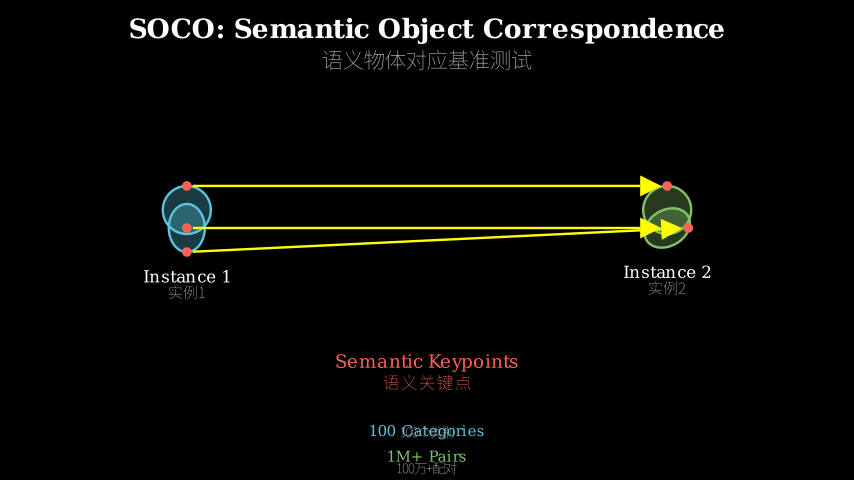
SOCO introduces a three-layer evaluation framework. First, it defines a taxonomy of correspondence types: within-instance (same object, different views), within-category (different instances of same class), and cross-category (functionally similar parts across different classes). Second, it provides dense keypoint annotations for 100 object categories with over 1 million correspondence pairs, where each keypoint has a functional semantic label like “left_front_wheel” or “beak_tip”. Third, it includes natural language descriptions for each keypoint, enabling evaluation of vision-language models through text-prompted localization tasks.
The evaluation protocol tests models in two modes. For vision-only models, given a keypoint in a source image, the model must locate the corresponding point in a target image—potentially of a different category. For vision-language models, given a text description like “the animal’s left ear”, the model must ground that description to pixel coordinates. The benchmark measures performance across the correspondence taxonomy, revealing where models succeed (within-category matching) and where they fail (cross-category transfer).
Input Pipeline:
  Source Image + Keypoint  ------>  Vision Encoder
       |                                  |
       v                                  v
  Target Image  ------------>  Feature Matching  ---> Predicted Keypoint
                                      |
  Text Description -------->  Language Grounding --> Predicted Location
                                      |
                                      v
                            Evaluate across taxonomy:
                            - Within-instance
                            - Within-category
                            - Cross-category
Think of SOCO as a language proficiency test, but for visual understanding. Just as we don’t test language ability by asking “can you read?”, we shouldn’t test vision models by asking “can you classify cats?” A real language test checks whether you understand that “perro” and “dog” refer to the same concept, whether you can use pronouns correctly across sentences, and whether you grasp metaphorical language. SOCO does the same for vision: it checks whether a model understands that a bicycle’s handlebar and a motorcycle’s handlebar serve the same function (cross-category correspondence), whether it can track a specific wheel across different viewing angles (within-instance), and whether it knows that “left front wheel” means something consistent across vehicles (language grounding). The taxonomy is like test sections (grammar, vocabulary, comprehension), the 1M pairs are like test questions, and the language descriptions are like the translation section.
Key Concepts
-
Semantic Correspondence: Imagine you’re looking at two photos of different dogs—one a golden retriever lying down, one a poodle standing up. Semantic correspondence is the ability to point at the retriever’s left ear and correctly identify where the poodle’s left ear is, despite differences in breed, pose, and appearance. It’s not about pixel similarity (the ears look nothing alike) but functional equivalence (both are left ears). This differs from feature matching in traditional computer vision, which finds visually similar patches. A model with good semantic correspondence understands object structure at a conceptual level—it knows what parts are, not just what they look like.
-
Correspondence Taxonomy: Not all matching tasks are equally hard. Matching a car’s wheel across two photos of the same car from different angles (within-instance) is easier than matching wheels across a sedan and a truck (within-category), which is easier than matching a car’s wheel to a bicycle’s wheel (cross-category). The taxonomy organizes these difficulty levels systematically. It’s like the difference between recognizing your friend’s face in different lighting (easy), recognizing a stranger who looks similar to your friend (medium), and recognizing that both humans and cartoon characters have “eyes” in analogous positions (hard). The taxonomy reveals which levels of abstraction a model has actually learned.
-
Language-Grounded Localization: This tests whether a model can connect text descriptions to visual locations. Given “the left front wheel” as text, can the model point to the correct wheel in an image? This is harder than it sounds because it requires understanding spatial relations (left vs right), part hierarchies (wheel is part of vehicle), and functional roles (front wheels steer). It’s the difference between a model that has memorized “wheel = round thing at bottom” versus one that understands vehicle structure. For vision-language models, this reveals whether their language grounding is truly fine-grained or just coarse object-level associations.
Framework Shift
Before (mainstream approach):        After (this paper):

Evaluate on ImageNet:                Evaluate on correspondence:

  Image --> Classifier --> Label       Source + Target --> Matcher
     |                                      |
     v                                      v
  "cat" or "dog"?                    "Where is the corresponding
                                      part in target image?"

  Measures: Top-1 accuracy            Measures: PCK across taxonomy
  Scope: Object-level recognition     Scope: Part-level structure
  Signal: Can distinguish classes     Signal: Understands part relations
From classification to correspondence, the core shift is from asking “what is this?” to “where is the equivalent part?”—moving evaluation from category labels to structural understanding.
Expert Assessment
Problem choice: This is a real gap. The field has been using ImageNet accuracy as a proxy for visual understanding for over a decade, but recent work shows models can ace ImageNet while failing at basic spatial reasoning. Semantic correspondence directly tests part-level structure, which matters for robotics, 3D reconstruction, and any task requiring geometric understanding. The timing is right—foundation models are mature enough that we need better diagnostics than classification.
Method maturity: The benchmark design is solid but not groundbreaking. Dense keypoint annotation across 100 categories is labor-intensive but straightforward. The taxonomy (within/cross instance/category) is intuitive and well-motivated. The language descriptions are a nice touch for evaluating LVLMs, though the paper doesn’t deeply explore how language grounding interacts with visual correspondence. The evaluation protocol is clean: percentage of correct keypoints (PCK) at multiple thresholds. No methodological red flags, but also no surprising technical insights—this is careful benchmark engineering, not algorithmic innovation.
Experimental integrity: The experiments are comprehensive and the findings are credible. Testing multiple vision backbones (ResNet, ViT, DINOv2) and LVLMs (GPT-4V, Gemini) with consistent protocols is good practice. The result that correspondence predicts downstream performance better than ImageNet is the paper’s strongest contribution, validated across segmentation, tracking, pose estimation, and 3D detection. However, the paper could be more critical about what “predicts downstream performance” actually means—correlation doesn’t tell us whether improving correspondence would improve those tasks, or whether both are driven by a third factor like model capacity.
Writing quality: The paper is well-structured but verbose in places. The introduction spends too much time motivating semantic correspondence (the CV community already knows why it matters) and not enough explaining what’s novel about SOCO versus prior benchmarks like SPair-71k. Section 3 (benchmark construction) could be condensed—readers don’t need paragraph-long descriptions of annotation procedures. The experimental section (Section 4) is where the paper shines, but even there, some results are presented without sufficient analysis. For example, why do LVLMs fail at cross-image matching but succeed at text-prompted localization? The paper notes this gap but doesn’t dig into mechanisms.
Verdict: weak accept — A useful benchmark that will likely see adoption, with solid experimental validation of correspondence as a better probe than classification, but limited conceptual novelty and some missed opportunities for deeper analysis.
Takeaways
For benchmark designers: The taxonomy of correspondence types (within/cross instance/category) is a clean way to organize evaluation difficulty. Steal this structure for other structured prediction tasks—it’s more informative than a single aggregate metric.
For model developers: If you’re building vision backbones, test on semantic correspondence early. The paper shows that models can have strong within-category performance but collapse on cross-category transfer, suggesting they’re memorizing category-specific part configurations rather than learning general part concepts. This is a concrete failure mode to target.
For practitioners: Don’t trust ImageNet accuracy as a proxy for downstream performance. The paper’s correlation analysis shows correspondence ability predicts task performance more reliably. If you’re choosing between pretrained models, run a quick correspondence eval on your domain—it’s more predictive than classification benchmarks.
For LVLM researchers: The gap between text-prompted localization (where LVLMs do well) and visual-reference matching (where they fail) suggests these models are better at language-to-vision grounding than vision-to-vision reasoning. This is actionable: if your task involves cross-image reasoning, don’t assume LVLM performance on language-grounded tasks will transfer.
论文: 2605.31597 作者: Olaf Dünkel, Basavaraj Sunagad, Haoran Wang, David T. Hoffmann, Christian Theobalt, Adam Kortylewski 分类: cs.CV
缺口
视觉基础模型声称能理解物体,但我们缺乏一致的方法来测试它们是否掌握了部件级结构。
现有的语义对应基准存在标注不一致、类别覆盖有限、无法评估视觉-语言模型在细粒度部件理解上的表现等问题。
我们能测量 ImageNet 准确率,但这无法告诉我们模型是否知道狗的耳朵对应猫的耳朵,或者当用自然语言询问”左前轮”时它能否定位。
问题:如何测量结构化物体理解能力?
   |
   v
缺口:现有 SC 基准协议不一致,
     类别有限,无语言基础
   |
   v
假设:部件级对应能力反映
      更深层的语义理解
   |
   v
方法:SOCO 基准,包含对应类型分类法,
      100 类别上 1M+ 对,语言描述
   |
   v
证据:(1) 模型编码结构但跨类别迁移失败
      (2) LVLM 在语言提示上优于视觉匹配
      (3) SC 性能预测下游任务 > ImageNet
   |
   v
结论:对应是比分类准确率更好的
      表示质量探针
增量
一句话:SOCO 之前,我们在分类任务上评估视觉模型;SOCO 之后,我们能系统地测试模型是否理解功能相似的部件在不同物体间的对应关系,即使这些物体看起来完全不同。
核心机制
SOCO 引入了三层评估框架。
首先,它定义了对应类型的分类法:实例内(同一物体,不同视角)、类别内(同一类的不同实例)、跨类别(不同类间功能相似的部件)。
其次,它为 100 个物体类别提供密集关键点标注,超过 100 万个对应对,每个关键点都有功能性语义标签,如”左前轮”或”喙尖”。
第三,它为每个关键点提供自然语言描述,使得能够通过文本提示定位任务评估视觉-语言模型。
评估协议以两种模式测试模型。
对于纯视觉模型,给定源图像中的一个关键点,模型必须在目标图像中定位对应点——可能是不同类别的。
对于视觉-语言模型,给定文本描述如”动物的左耳”,模型必须将该描述定位到像素坐标。
基准测量跨对应分类法的性能,揭示模型在哪里成功(类别内匹配)和在哪里失败(跨类别迁移)。
输入流程:
  源图像 + 关键点  ------>  视觉编码器
       |                        |
       v                        v
  目标图像  ------------>  特征匹配  ---> 预测关键点
                              |
  文本描述  -------->  语言定位 --> 预测位置
                              |
                              v
                    跨分类法评估:
                    - 实例内
                    - 类别内
                    - 跨类别
把 SOCO 想象成语言能力测试,但针对的是视觉理解。
正如我们不会通过问”你会读字吗?“来测试语言能力,我们也不应该通过问”你能分类猫吗?“来测试视觉模型。
真正的语言测试会检查你是否理解”perro”和”dog”指代同一概念,你是否能在句子间正确使用代词,你是否理解隐喻语言。
SOCO 对视觉做同样的事:它检查模型是否理解自行车的车把和摩托车的车把有相同功能(跨类别对应),它是否能在不同视角下追踪特定车轮(实例内),它是否知道”左前轮”在不同车辆间意味着一致的东西(语言定位)。
分类法就像测试章节(语法、词汇、理解),100 万对就像测试题目,语言描述就像翻译部分。
关键概念
- 语义对应:想象你在看两张不同狗的照片——一只金毛躺着,一只贵宾犬站着。
语义对应是指向金毛的左耳并正确识别贵宾犬左耳位置的能力,尽管品种、姿态和外观都不同。
这不是关于像素相似性(耳朵看起来完全不同)而是功能等价性(都是左耳)。
这与传统计算机视觉中的特征匹配不同,后者寻找视觉上相似的图像块。
具有良好语义对应能力的模型在概念层面理解物体结构——它知道部件是什么,而不仅仅是它们看起来像什么。
- 对应分类法:并非所有匹配任务都同样困难。
在同一辆车的两张不同角度照片间匹配车轮(实例内)比在轿车和卡车间匹配车轮(类别内)容易,后者又比在汽车车轮和自行车车轮间匹配(跨类别)容易。
分类法系统地组织这些难度级别。
这就像在不同光照下识别朋友的脸(容易)、识别长得像朋友的陌生人(中等)、识别人类和卡通角色都有”眼睛”在类似位置(困难)之间的区别。
分类法揭示模型实际学到了哪些抽象层次。
- 语言定位:这测试模型能否将文本描述连接到视觉位置。
给定”左前轮”作为文本,模型能指向图像中正确的车轮吗?这比听起来难,因为它需要理解空间关系(左 vs 右)、部件层次(车轮是车辆的一部分)和功能角色(前轮用于转向)。
这是记住”车轮 = 底部的圆形物”的模型与理解车辆结构的模型之间的区别。
对于视觉-语言模型,这揭示它们的语言定位是真正细粒度的还是只是粗糙的物体级关联。
框架转变
之前(主流方法):                之后(本文方法):

在 ImageNet 上评估:              在对应上评估:

  图像 --> 分类器 --> 标签           源 + 目标 --> 匹配器
     |                                    |
     v                                    v
  "猫"还是"狗"?                    "目标图像中对应部件
                                      在哪里?"

  测量:Top-1 准确率                 测量:跨分类法的 PCK
  范围:物体级识别                   范围:部件级结构
  信号:能区分类别                   信号:理解部件关系
从分类到对应,核心转变是从问”这是什么?“到”等价部件在哪里?“——将评估从类别标签转向结构理解。
专家评审
选题眼光:这是真实的缺口。
该领域十多年来一直用 ImageNet 准确率作为视觉理解的代理指标,但最近的工作表明模型可以在 ImageNet 上表现优异却在基本空间推理上失败。
语义对应直接测试部件级结构,这对机器人、3D 重建和任何需要几何理解的任务都很重要。
时机恰当——基础模型已经足够成熟,我们需要比分类更好的诊断工具。
方法成熟度:基准设计扎实但不算突破性。
100 个类别的密集关键点标注劳动密集但直接。
分类法(实例内/跨实例/类别)直观且动机充分。
语言描述是评估 LVLM 的好补充,尽管论文没有深入探讨语言定位如何与视觉对应交互。
评估协议简洁:多个阈值下的正确关键点百分比(PCK)。
没有方法学上的危险信号,但也没有令人惊讶的技术洞见——这是细致的基准工程,而非算法创新。
实验诚意:实验全面,发现可信。
用一致的协议测试多个视觉骨干(ResNet、ViT、DINOv2)和 LVLM(GPT-4V、Gemini)是良好实践。
对应预测下游性能优于 ImageNet 的结果是论文最强贡献,在分割、跟踪、姿态估计和 3D 检测上得到验证。
然而,论文对”预测下游性能”的实际含义可以更批判——相关性不能告诉我们改进对应是否会改进这些任务,或者两者是否由第三个因素如模型容量驱动。
写作功力:论文结构良好但有些冗长。
引言花太多时间论证语义对应的重要性(CV 社区已经知道为什么重要),而没有足够解释 SOCO 相比 SPair-71k 等先前基准的新颖之处。
第 3 节(基准构建)可以压缩——读者不需要段落级的标注程序描述。
实验部分(第 4 节)是论文的亮点,但即使在那里,一些结果呈现时缺乏充分分析。
例如,为什么 LVLM 在跨图像匹配上失败但在文本提示定位上成功?论文注意到这个差距但没有深入机制。
判决:弱接收 — 一个有用的基准,可能会被采用,对应作为比分类更好的探针有扎实的实验验证,但概念新颖性有限,错过了一些深入分析的机会。
要点总结
对基准设计者:对应类型分类法(实例内/跨实例/类别)是组织评估难度的简洁方式。
将这个结构迁移到其他结构化预测任务——它比单一聚合指标更有信息量。
对模型开发者:如果你在构建视觉骨干,尽早在语义对应上测试。
论文显示模型可以有强的类别内性能但在跨类别迁移上崩溃,表明它们在记忆类别特定的部件配置而非学习通用部件概念。
这是一个具体的失败模式,值得针对。
对实践者:不要相信 ImageNet 准确率作为下游性能的代理。
论文的相关性分析显示对应能力更可靠地预测任务性能。
如果你在预训练模型间选择,在你的领域上快速运行对应评估——它比分类基准更有预测性。
对 LVLM 研究者:文本提示定位(LVLM 表现好)和视觉参考匹配(它们失败)之间的差距表明这些模型在语言到视觉定位上优于视觉到视觉推理。
这是可操作的:如果你的任务涉及跨图像推理,不要假设 LVLM 在语言定位任务上的性能会迁移。