Paper: 2603.25733 Authors: Jiwook Han, Geo Ahn, Youngrae Kim, Jinwoo Choi Categories: cs.CV
The Gap
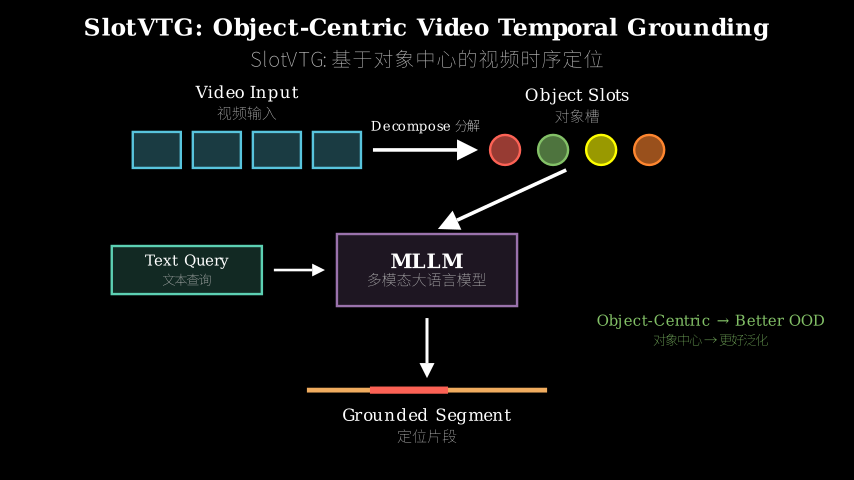
Multimodal LLMs can do Video Temporal Grounding (finding when something happens in a video based on text queries), but they cheat. They memorize dataset-specific patterns instead of actually looking at what’s in the frame. Train on ActivityNet, test on Charades? Performance collapses. The problem: these models process video as a blob of coarse features, missing the fine-grained object-level details needed for robust grounding.
Object-centric learning could fix this by decomposing scenes into entity representations, but existing approaches require rebuilding the entire training pipeline from scratch. That’s expensive and impractical for adapting already-trained MLLMs.
Problem: MLLMs memorize shortcuts
    |
    v
Assumption: Object-level decomposition forces grounding in actual content
    |
    v
Method: Lightweight slot adapter inserted into frozen MLLM
    |
    v
Evidence: +15-20% OOD accuracy, minimal ID performance drop
    |
    v
Conclusion: Object-centric steering works without full retraining
The Increment
One sentence: Before, adapting MLLMs for better video grounding meant full retraining with object-centric architectures; now, you can insert a lightweight adapter that achieves similar robustness gains while keeping the base model frozen.
Core Mechanism
SlotVTG sits between the vision encoder and the language model. It takes the raw visual tokens (one per image patch) and runs them through a slot attention module. This module iteratively groups patches into a fixed number of “slots” — abstract representations that ideally correspond to objects or coherent regions. The slots then get decoded back into the original token sequence, so the downstream MLLM sees the same input shape but with object-structured information baked in.
The key trick: they add a reconstruction loss (force slots to rebuild the original tokens) plus an objectness prior from DINO features. DINO is a self-supervised vision model that naturally clusters semantically similar regions. By encouraging slots to align with DINO’s clustering, the model learns to form slots around actual objects rather than arbitrary patch groups.
Visual Tokens (N patches)
    |
    v
[Slot Attention Module]
    |
    +---> K abstract slots (K << N)
    |
    v
[Slot Decoder]
    |
    v
Reconstructed Tokens (N patches) --> MLLM
    ^
    |
Reconstruction Loss + DINO Objectness Prior
Think of it like a librarian reorganizing a messy pile of books. The raw visual tokens are books scattered on a table (patches from the image). The slot attention module is the librarian grouping books by topic into K stacks (slots). The librarian doesn’t know the topics upfront, but has a cheat sheet (DINO features) suggesting which books are similar. After grouping, the librarian spreads the books back out in their original positions, but now each book has a sticky note saying which stack it belonged to. The language model downstream reads the books with these annotations, so it implicitly knows the object-level structure even though the input format looks the same.
Key Concepts
-
Slot Attention: Imagine you have 100 puzzle pieces (visual tokens) and want to group them into 10 clusters (slots) representing different objects. Slot attention is an iterative algorithm where each slot “competes” to claim pieces. Start with random slot embeddings. In each iteration, compute how much each slot attends to each piece (softmax over slots for each piece), then update slots as weighted averages of pieces. After several iterations, slots converge to represent coherent groups. The magic: it’s differentiable, so you can train it end-to-end with gradient descent.
-
Objectness Prior from DINO: DINO is a vision model trained with self-supervised learning (no labels). It learns to produce similar features for semantically related image regions. If you cluster DINO features, you naturally get object-like segments. SlotVTG uses DINO features as a “teacher signal” — it encourages slots to align with DINO’s clustering via an auxiliary loss. This prevents slots from collapsing into arbitrary or degenerate groupings.
-
Reconstruction as Regularization: After forming slots, SlotVTG decodes them back into the original token sequence. This forces slots to retain all information from the input, not just high-level summaries. Without reconstruction, slots might ignore fine details. With it, slots must balance abstraction (grouping) and fidelity (preserving details), leading to more robust representations.
Framework Shift
Before (mainstream approach):        After (this paper):

[Vision Encoder]                     [Vision Encoder]
       |                                    |
       v                                    v
  Raw Tokens ---------> [MLLM]         Raw Tokens
                            |                |
                            v                v
                    Temporal Prediction  [Slot Adapter]
                                             |
                                             +---> Slots
                                             |
                                             v
                                        Reconstructed
                                             |
                                             v
                                          [MLLM]
                                             |
                                             v
                                     Temporal Prediction

Coarse, holistic features            Object-structured features
Memorizes dataset shortcuts          Grounds in actual content
From monolithic feature blobs to compositional object slots, the core shift is forcing the model to explicitly decompose scenes before reasoning.
Expert Assessment
Problem choice: Real gap. OOD generalization in VTG is a known pain point, and the shortcut learning hypothesis is well-documented in vision-language models. This isn’t manufactured — practitioners care about models that work beyond their training distribution.
Method maturity: Clever but not groundbreaking. Slot attention is borrowed from prior work (Locatello et al., 2020), and using DINO as an objectness prior is a natural extension. The novelty is in the adapter design — inserting slots into a frozen MLLM without full retraining. That’s pragmatic engineering, not a fundamental algorithmic advance. Could they achieve similar gains with simpler object detectors? Probably, but slots are more elegant and don’t require bounding box annotations.
Experimental integrity: Baselines are fair (they compare against state-of-the-art VTG methods), and the OOD evaluation is rigorous (train on one dataset, test on others). The numbers are convincing: +15-20% OOD accuracy with minimal ID drop. One red flag: they don’t ablate the reconstruction loss vs. DINO prior separately in the main results, so it’s unclear which component drives the gains. Supplementary material might clarify, but the main paper leaves this ambiguous.
Writing quality: The abstract and intro are crisp, but the method section is dense. The slot attention mechanism is explained assuming familiarity with the original paper — a standalone paragraph with a toy example would help. The experimental section is thorough but could use a “failure case” analysis. Where does SlotVTG still struggle? That honesty would strengthen the paper.
Verdict: weak accept — Solid incremental contribution with practical value, but lacks the conceptual depth or surprising insights for a strong accept. The adapter design is useful, the experiments are convincing, but it feels like a well-executed application of existing ideas rather than a paradigm shift.
Takeaways
If you’re adapting large pretrained models for downstream tasks, steal the “lightweight adapter + reconstruction loss” pattern. Instead of fine-tuning the whole model, insert a small module that restructures representations (here, slots), then force it to reconstruct the original input. This acts as a regularizer, preventing the adapter from collapsing into trivial solutions while steering the model toward your desired inductive bias (here, object-centricity).
For vision tasks, DINO features are a cheap objectness prior. If you need object-level reasoning but don’t have bounding box labels, cluster DINO features and use them as pseudo-supervision. It’s not perfect, but it’s better than nothing and requires zero annotation.
Finally, when evaluating generalization, don’t just report average OOD performance. Break it down by domain shift type (e.g., different video sources, different query styles). SlotVTG likely excels in some shifts and fails in others — knowing which tells you when to use it.
论文: 2603.25733 作者: Jiwook Han, Geo Ahn, Youngrae Kim, Jinwoo Choi 分类: cs.CV
缺口
多模态大语言模型能做视频时序定位(根据文本查询找到视频中某事发生的时间),但它们在作弊。
它们记住的是数据集特有的模式,而不是真正看帧里有什么。
在ActivityNet上训练,在Charades上测试?性能崩盘。
问题根源:这些模型把视频当作粗粒度特征的一团糊,丢失了鲁棒定位所需的细粒度物体级细节。
以物体为中心的学习可以解决这个问题,把场景分解成实体表示,但现有方法需要从头重建整个训练流程。
这对于改造已训练好的多模态大模型来说,既昂贵又不现实。
问题: 多模态大模型记忆捷径
    |
    v
假设: 物体级分解迫使模型定位到实际内容
    |
    v
方法: 轻量级槽适配器插入冻结的多模态大模型
    |
    v
证据: 域外准确率+15-20%,域内性能几乎不降
    |
    v
结论: 物体中心引导无需完全重训练即可生效
增量
一句话: 以前,让多模态大模型更好地做视频定位意味着用物体中心架构完全重训练;现在,你可以插入一个轻量级适配器,在保持基础模型冻结的情况下获得类似的鲁棒性提升。
核心机制
SlotVTG坐在视觉编码器和语言模型之间。
它接收原始视觉token(每个图像块一个),通过槽注意力模块运行。
这个模块迭代地把图像块分组到固定数量的”槽”中——理想情况下对应物体或连贯区域的抽象表示。
然后槽被解码回原始token序列,所以下游的多模态大模型看到的输入形状相同,但物体结构信息已经烘焙进去了。
关键技巧:他们加了重建损失(强制槽重建原始token)加上来自DINO特征的物体性先验。
DINO是一个自监督视觉模型,天然地聚类语义相似的区域。
通过鼓励槽与DINO的聚类对齐,模型学会围绕实际物体形成槽,而不是任意的图像块组。
视觉Token (N个块)
    |
    v
[槽注意力模块]
    |
    +---> K个抽象槽 (K << N)
    |
    v
[槽解码器]
    |
    v
重建Token (N个块) --> 多模态大模型
    ^
    |
重建损失 + DINO物体性先验
把它想象成图书管理员整理一堆乱书。
原始视觉token是散落在桌上的书(图像块)。
槽注意力模块是管理员按主题把书分成K堆(槽)。
管理员事先不知道主题,但有一张小抄(DINO特征)提示哪些书相似。
分组后,管理员把书按原位置摊开,但现在每本书都有便签注明它属于哪一堆。
下游的语言模型读这些带注释的书,所以它隐式知道物体级结构,尽管输入格式看起来一样。
关键概念
- 槽注意力: 想象你有100块拼图(视觉token),想把它们分成10个簇(槽)代表不同物体。
槽注意力是一个迭代算法,每个槽”竞争”认领拼图块。
从随机槽嵌入开始。
每次迭代中,计算每个槽对每块的注意力(对每块在槽上做softmax),然后把槽更新为拼图块的加权平均。
几次迭代后,槽收敛到代表连贯组。
魔力在于:它可微分,所以你能用梯度下降端到端训练。
- 来自DINO的物体性先验: DINO是用自监督学习训练的视觉模型(无标签)。
它学会为语义相关的图像区域产生相似特征。
如果你聚类DINO特征,自然得到类物体的分割。
SlotVTG用DINO特征作为”教师信号”——通过辅助损失鼓励槽与DINO的聚类对齐。
这防止槽坍缩成任意或退化的分组。
- 重建作为正则化: 形成槽后,SlotVTG把它们解码回原始token序列。
这迫使槽保留输入的所有信息,不只是高层摘要。
没有重建,槽可能忽略细节。
有了重建,槽必须平衡抽象(分组)和保真(保留细节),导致更鲁棒的表示。
框架转变
之前(主流方法):                  之后(本文方法):

[视觉编码器]                     [视觉编码器]
       |                                |
       v                                v
  原始Token ---------> [多模态大模型]  原始Token
                            |              |
                            v              v
                    时序预测          [槽适配器]
                                           |
                                           +---> 槽
                                           |
                                           v
                                      重建Token
                                           |
                                           v
                                      [多模态大模型]
                                           |
                                           v
                                       时序预测

粗粒度整体特征                    物体结构化特征
记忆数据集捷径                    定位到实际内容
从整体特征团到组合式物体槽,核心转变是强制模型在推理前显式分解场景。
专家评审
选题眼光: 真实缺口。
视频时序定位的域外泛化是已知痛点,捷径学习假说在视觉-语言模型中有充分记录。
这不是人造问题——实践者关心模型能否在训练分布之外工作。
方法成熟度: 巧妙但非开创性。
槽注意力借鉴自前人工作(Locatello等,2020),用DINO作为物体性先验是自然延伸。
新颖之处在于适配器设计——在不完全重训练的情况下把槽插入冻结的多模态大模型。
这是务实的工程,不是根本性的算法进步。
他们能用更简单的物体检测器达到类似效果吗?可能,但槽更优雅,不需要边界框标注。
实验诚意: 基线公平(他们对比了最先进的视频时序定位方法),域外评估严格(在一个数据集上训练,在其他数据集上测试)。
数字令人信服:域外准确率+15-20%,域内几乎不降。
一个警示:他们在主要结果中没有单独消融重建损失和DINO先验,所以不清楚哪个组件驱动了增益。
补充材料可能澄清,但主论文留下了这个模糊点。
写作功力: 摘要和引言简洁,但方法部分密集。
槽注意力机制的解释假设读者熟悉原始论文——一个带玩具例子的独立段落会有帮助。
实验部分详尽但可以加”失败案例”分析。
SlotVTG在哪里仍然挣扎?这种坦诚会增强论文。
判决: 弱接收——扎实的增量贡献,有实用价值,但缺乏概念深度或令人惊讶的洞见来强接收。
适配器设计有用,实验令人信服,但感觉像是现有想法的良好执行,而非范式转变。
要点总结
如果你在为下游任务改造大型预训练模型,偷走”轻量级适配器+重建损失”模式。
不要微调整个模型,插入一个重构表示的小模块(这里是槽),然后强制它重建原始输入。
这充当正则化器,防止适配器坍缩成平凡解,同时引导模型朝你想要的归纳偏置(这里是物体中心性)。
对于视觉任务,DINO特征是廉价的物体性先验。
如果你需要物体级推理但没有边界框标签,聚类DINO特征并用它们作为伪监督。
不完美,但总比没有强,且需要零标注。
最后,评估泛化时,不要只报告平均域外性能。
按域偏移类型分解(例如不同视频源、不同查询风格)。
SlotVTG可能在某些偏移中表现出色,在其他偏移中失败——知道哪些告诉你何时使用它。