Paper: 2608.07468 Authors: Zongchuang Zhao, Xin Zhou, Tianyang Xu, Zhengyang Sun, Kaixuan Zhou, Honglin Li, Dingkang Liang, Xiang Bai Categories: cs.CV
The Gap
The end-to-end driving field has spent the last two years discovering that video generative models know something about physics. A model trained to predict the next 2 seconds of dashcam footage has implicitly learned that cars have momentum, that pedestrians don’t teleport, that lane markings constrain plausible motion. World-Action Models (WAMs) try to cash in that prior: generate the future, then act on it.
The problem is the “then.” In the dominant WAM designs, the future is on the critical path at inference. Drive-WM-style approaches roll out candidate futures and score them. Autoregressive interleaved models (the Doe-1 / GenAD lineage) emit future visual tokens and action tokens in the same sequence, so producing an action requires decoding the frames that precede it. Latent world models compress the future to save cost but still run a prediction head every step. All of them pay a generation bill at deployment time, which is exactly the wrong place to pay it — a planner needs to run at 10+ Hz on a car, not on an A100.
The alternative the field already tried is video pretraining plus finetuning: initialize from a video model, then finetune on trajectories. Cheap at inference, but the dynamics knowledge decays under a pure imitation objective, and there’s no mechanism keeping the representation predictive rather than merely discriminative.
SimWAM’s claim: you can keep the generative supervision during training and still ship a planner that never generates anything.
[Problem]  WAM planners need future-frame generation at inference
              |
              v
[Assumption] video priors are useful for *learning to see*,
             not required for *deciding to steer*
              |
              v
[Method]   two disjoint experts + joint flow matching
           + isolated (one-way) attention mask
              |
              +--- video expert  : gradient path, train only
              +--- action expert : self-contained, ships alone
              |
              v
[Evidence] 91.5 PDMS on NAVSIM, lower latency than WAM SOTA,
           zero-shot transfer to nuScenes
              |
              v
[Conclusion] generation belongs in the loss, not in the runtime
The Increment
One sentence: Before, using a video world model for planning meant paying for video generation forever; after, you pay once during training and delete the generator.
Core Mechanism
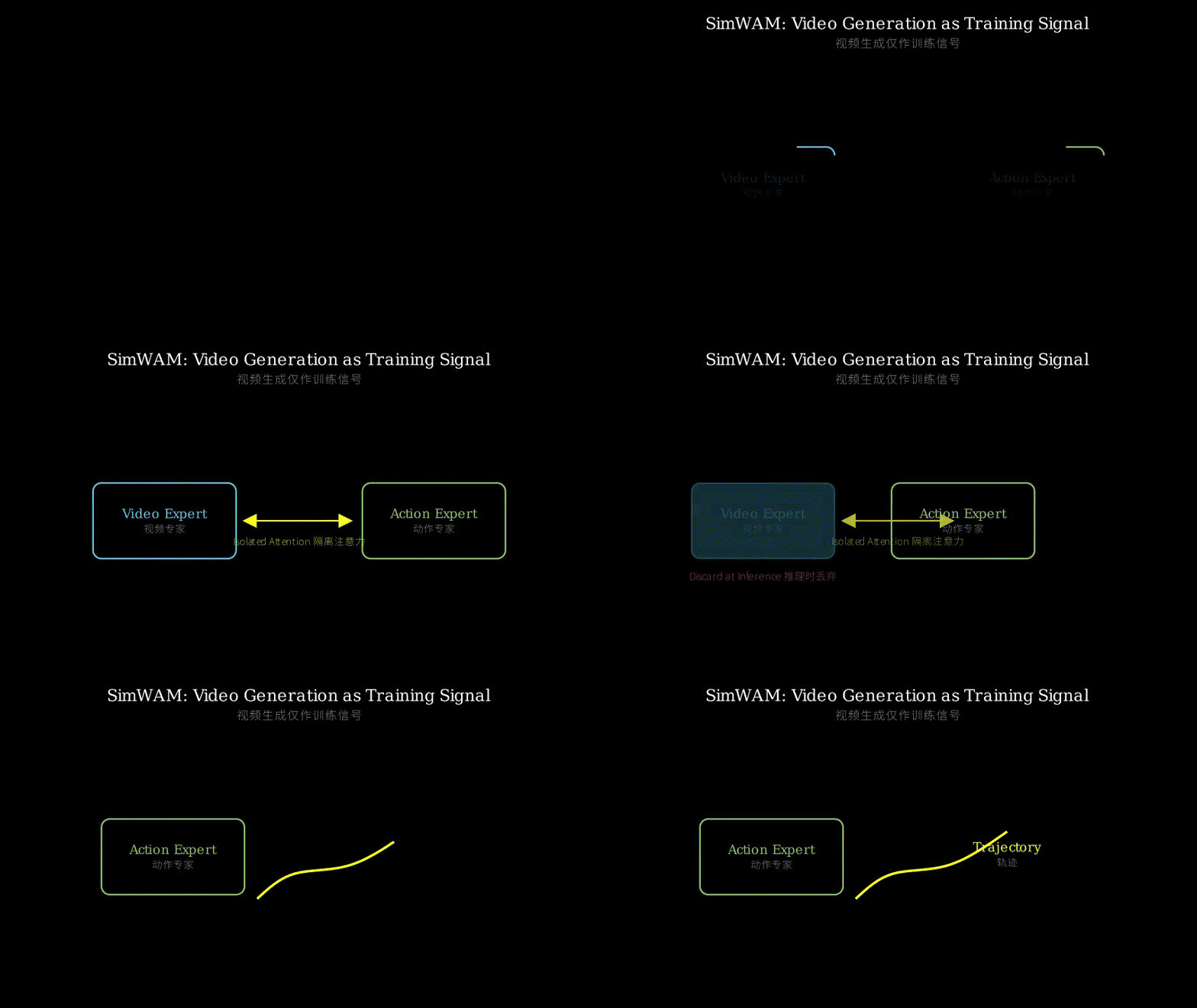
Three moving parts. First, a pretrained video expert — a large video diffusion/flow-matching transformer, the thing that carries the dynamics prior. Second, a lightweight action expert that takes noisy trajectory tokens and denoises them into a plan, conditioned on current sensor observations. Third, and this is the actual contribution, an attention interface that connects them without sharing a single weight.
The two experts are co-trained with a joint flow-matching objective: the video branch learns to produce future frames, the action branch learns to produce trajectories, both as velocity-field regression from noise to data. Because parameters are disjoint (a mixture-of-transformers arrangement rather than one shared trunk), the only channel between them is attention.
That channel is deliberately asymmetric. The video expert is allowed to attend to the action expert’s tokens; the action expert is forbidden from attending to future video tokens. This is the isolated attention mask. The consequence at training time: to generate a plausible future, the video expert must pull information out of the action branch’s representations, and gradients flow backwards accordingly — the action expert’s features get shaped until they encode enough about where the scene is going. The consequence at inference time: the action expert’s forward pass has no edge pointing at the video expert, so you can delete the video expert and the computation graph is unchanged. No distillation loss, no student-teacher alignment term, no feature-matching regularizer. Just a mask.
On top of imitation, they add an RL stage optimizing a compositional driving reward (collision, drivable area, comfort, progress — the usual decomposition), pushing the policy past what trajectory regression alone can express.
                  current observations (multi-view)
                              |
              +---------------+---------------+
              |                               |
      [ VIDEO EXPERT ]                [ ACTION EXPERT ]
      pretrained, large               lightweight, scalable
      flow-match future frames        flow-match trajectory
              ^                               |
              |                               |
              |  attends to action tokens     |  noisy traj tokens
              |  (K/V only, one direction)    v
              +-------------------------------+
                    unified attention interface
                    (no shared parameters)

   TRAINING:  L = L_video + L_action     (+ RL on driving reward)
              gradient path: L_video --> action expert features

   INFERENCE: [ VIDEO EXPERT ]  <-- deleted
              noise --> [ ACTION EXPERT ] --> trajectory
The metaphor: think of a junior analyst and a film director. The action expert is the analyst who watches the road and writes a one-page briefing. The video expert is a film director whose job is to shoot tomorrow’s footage — but he is not allowed on site. He can only read the analyst’s briefing. When the footage comes out wrong, the note goes back to the analyst, not the director: your briefing missed that the truck was merging. Over thousands of iterations the briefings become dense with dynamics, because they are the only input to a task that demands dynamics.
Crucially, the analyst never watches the director’s footage. That one-way rule is what lets the studio fire the director at release time — the analyst’s briefing was never conditioned on the film, so nothing breaks. And because the two never shared an office (no shared parameters), you can hire a better director next year — a stronger video backbone — without retraining the analyst’s job description or changing the objective.
Key Concepts
-
Flow matching (as used here): Imagine you want to turn random noise into a valid driving trajectory. Instead of learning to denoise in many carefully scheduled steps, you learn a *velocity field: for any point on the straight line between noise and the true answer, predict which direction to move. Training is a regression problem — sample a random time t, interpolate between noise and the ground-truth trajectory, and ask the network for the direction to the target. At inference you start from noise and follow the arrows. It’s used for both the video branch and the trajectory branch here, which is precisely why one objective can cover both modalities.
-
Isolated attention mask: Attention masks are usually thought of as bookkeeping (don’t look at the future token, don’t look at padding). Here the mask is a *deployment contract. If module B never appears in A’s attention keys, then A’s output is mathematically independent of B, so B can be removed. The mask turns “auxiliary task” from a soft idea into a hard architectural guarantee. Compare with the usual failure mode of auxiliary heads: they silently become load-bearing, and you can’t remove them without a performance cliff.
-
PDMS on NAVSIM: NAVSIM evaluates a planner by replaying the scene non-reactively and scoring the proposed trajectory on a composite: no at-fault collisions, staying in drivable area, time-to-collision, comfort, ego progress. It’s a middle ground between open-loop L2 error (too easy to game) and full closed-loop simulation (expensive, sim-gap). 91.5 is at the top of the current leaderboard region — which also means the metric is nearing saturation and small gaps mean less than they used to.
Framework Shift
Before (mainstream WAM):              After (SimWAM):

  obs                                   obs
   |                                     |
   v                                     v
 [world model]                     [action expert] --> traj
   |  generates future                   .
   v  frames / latents                   .  (training only)
 [future rollout]                        v
   |                               [video expert] --> future frames
   v                                     ^
 [policy head] --> traj                  |
                                    one-way attention:
  inference cost = generate            video <- action
  + plan, every step
                                    inference cost = plan only
From generate-then-act to learn-by-generating-then-forget, the core shift is moving the world model from the inference graph into the gradient graph.
Expert Assessment
Problem choice: Real gap, and well-timed. WAM latency is the single most cited objection to that whole line of work, and nobody wants to defend a planner that needs a video diffusion forward pass per control cycle. Where I’d temper the framing: “auxiliary future prediction, discarded at inference” is not a new idea in driving — latent world model papers (LAW and its descendants) already used future latent prediction as a training-time auxiliary task. SimWAM’s genuine increment is narrower and more practical: doing it with a *large pretrained video generator as the auxiliary branch, and enforcing the discardability architecturally rather than by convention.
Method maturity: This is a clever-not-brute contribution, and the cleverness is unusually cheap — an attention mask plus a parameter-disjoint layout. I like that there’s no distillation loss to tune. The modularity argument (swap the video backbone, scale the action expert, objective unchanged) is the kind of claim that only pays off if they actually demonstrate a swap; the abstract says “could be replaced,” which is weaker than “we replaced it.” Simpler baselines that deserve to be beaten explicitly: (a) plain video-pretrained-backbone plus trajectory finetuning, (b) feature distillation from a frozen video model, (c) latent future prediction as an aux head. If the mask trick only buys a point over (c), the story is thinner than it reads.
Experimental integrity: The latency comparison is the honest part and probably the strongest evidence — the architectural argument makes it hard to fake. My real concern is the RL stage. Optimizing a “compositional driving reward” whose components are the same sub-scores PDMS aggregates is very close to training on the test metric. It’s accepted practice in this subfield, but it makes the headline 91.5 non-comparable to imitation-only baselines, and the paper needs to report the imitation-only number prominently for the WAM claim to stand on its own. Second flag: zero-shot nuScenes transfer is a nice-sounding claim that depends entirely on the eval protocol — open-loop L2 on nuScenes is notoriously easy to win with ego-status shortcuts. Third: PDMS near 91 is in the saturated regime; I’d want NAVSIM v2 / EPDMS or reactive closed-loop numbers before believing the ordering against SOTA.
Writing quality: Judging from the abstract, the framing is disciplined and refreshingly unhyped — “simple yet solid baseline” is the right register. The section I’d demand be rewritten is the ablation of the attention mask itself. The entire paper rests on one design choice, so it needs the full matrix: bidirectional attention, action-attends-to-video, video-attends-to-action, and no interaction at all — plus what happens if you keep the video branch at inference (does it help? if yes, discardability is a tradeoff, not a free lunch). That table, done properly, is the difference between a workshop-grade trick and a paper people cite for the mechanism.
Verdict: weak accept — the mask-as-deployment-contract idea is genuinely useful and the efficiency claim is structurally sound, but the headline number is entangled with reward engineering on the eval metric and the novelty over latent-world-model aux tasks is incremental.
(Caveat: this reading is based on the abstract; the ablation table would move my confidence in either direction.)
Takeaways
- The mask is a contract, steal that. Any time you want a heavy expert to shape a light model during training, check whether a one-way attention mask replaces your distillation loss. If the light branch never attends to the heavy one, removability is a theorem, not a hope. This transfers directly to VLA robot policies, speech models with heavy acoustic teachers, and any “privileged information at train time” setup.
- Parameter-disjoint experts with an attention-only interface is an underrated modularity pattern. It means you can upgrade one side as the field improves — video generators are improving fast, planners are not — without touching the objective or the inference path. Worth adopting whenever one component’s ecosystem moves faster than yours.
- Same objective across modalities buys architectural freedom. Because flow matching covers both frames and trajectories, “joint training” needs no loss-balancing gymnastics between a diffusion loss and a regression loss. If you’re fusing modalities, picking a shared objective form first simplifies everything downstream.
- Read the RL reward before you read the leaderboard. When a paper’s reward decomposition mirrors the eval metric’s decomposition, the headline is a mix of method and metric alignment. Ask for the pre-RL number.
论文: 2608.07468 作者: Zongchuang Zhao, Xin Zhou, Tianyang Xu, Zhengyang Sun, Kaixuan Zhou, Honglin Li, Dingkang Liang, Xiang Bai 分类: cs.CV
缺口
过去两年,端到端驾驶圈子逐渐意识到一件事:视频生成模型懂一点物理。
一个被训练去预测未来两秒行车影像的模型,隐含地学会了车有惯性、行人不会瞬移、车道线约束了合理的运动方式。
World-Action Model(WAM)就是想把这份先验兑现:先生成未来,再据此行动。
问题出在那个”再”字上。
主流 WAM 设计把未来放在了推理的关键路径上。Drive-WM 一类要展开若干候选未来再打分;Doe-1 / GenAD 一脉的自回归交错模型把未来视觉 token 和动作 token 放进同一个序列,要出一个动作就得先解出它前面的帧;隐式世界模型压缩了未来以省算力,但每步仍要跑预测头。
所有这些都在部署阶段付生成的账单,而这恰恰是最不该付账的地方——规划器要在车上跑到 10 Hz 以上,不是在 A100 上跑。
领域里已有的替代方案是”视频预训练 + 微调”:用视频模型初始化,再在轨迹上微调。
推理便宜,但纯模仿目标下动力学知识会衰减,而且没有任何机制保证表征保持”可预测未来”,而不只是”够用来分类”。
SimWAM 的主张是:生成式监督可以只留在训练里,交付出去的规划器什么都不用生成。
[问题]   WAM 规划器推理时必须生成未来帧
            |
            v
[假设]   视频先验帮助的是 *学会看*,
         而不是 *决定怎么打方向*
            |
            v
[方法]   两个不共享参数的专家 + 联合 flow matching
         + 隔离式(单向)注意力掩码
            |
            +--- 视频专家: 只在训练时提供梯度通路
            +--- 动作专家: 自包含,单独出货
            |
            v
[证据]   NAVSIM 91.5 PDMS,延迟低于 WAM SOTA,
         零样本迁移到 nuScenes
            |
            v
[结论]   生成属于损失函数,不属于运行时
增量
一句话:以前想用视频世界模型做规划,就得永远为视频生成付费;现在只在训练时付一次,然后把生成器删掉。
核心机制
三个部件。
第一是预训练视频专家——一个大的视频 diffusion / flow matching transformer,动力学先验就装在它身上。
第二是轻量动作专家,输入带噪的轨迹 token,在当前传感器观测的条件下把它去噪成一条规划轨迹。
第三,也是真正的贡献,是一个注意力接口:把两者连起来,但一个权重都不共享。
两个专家用联合 flow matching 目标一起训练:视频分支学着生成未来帧,动作分支学着生成轨迹,两边都是”从噪声到数据的速度场回归”。
因为参数完全不交叠(是 mixture-of-transformers 式的排布,而不是共享主干),它们之间唯一的通道就是注意力。
而这个通道是故意做成不对称的。
视频专家可以注意到动作专家的 token;动作专家不允许去注意未来视频 token。这就是隔离式注意力掩码。
训练时的后果是:视频专家想生成一个合理的未来,就必须从动作分支的表征里把信息抽出来,梯度顺着这条路回流——动作专家的特征被反复塑形,直到它编码了足够多”场景要往哪儿走”的信息。
推理时的后果是:动作专家的前向计算图里没有任何一条边指向视频专家,所以你可以直接把视频专家删掉,计算图分毫不变。
不需要蒸馏损失,不需要师生对齐项,不需要特征匹配正则。就一个掩码。
在模仿之外,他们还加了一段 RL,优化一个组合式驾驶奖励(碰撞、可行驶区域、舒适性、行进距离这一套分解),把策略推到轨迹回归本身表达不出来的地方。
                   当前观测(多视角)
                            |
             +--------------+--------------+
             |                             |
      [ 视频专家 ]                   [ 动作专家 ]
      预训练,大                     轻量,可独立放大
      flow match 未来帧              flow match 轨迹
             ^                             |
             |                             |
             |  读取动作 token(只做 K/V)  |  带噪轨迹 token
             |  单向                        v
             +-----------------------------+
                     统一注意力接口
                     (零参数共享)

   训练:  L = L_video + L_action   (+ 驾驶奖励 RL)
          梯度路径: L_video --> 动作专家的特征

   推理:  [ 视频专家 ]  <-- 删除
          噪声 --> [ 动作专家 ] --> 轨迹
核喻:把它想成一个初级分析师和一个电影导演。
动作专家是分析师,看着路况写一页简报。视频专家是导演,任务是把”明天的画面”拍出来——但他不许到现场,只能读那份简报。
片子拍错了,问责单送到分析师手上,不是导演:你的简报漏了那辆卡车在并线。
几千个迭代之后,简报里塞满了动力学信息,因为它是一个必须依赖动力学的任务的唯一输入。
关键在于,分析师从来不看导演的片子。
正是这条单向规则让制片方在上映前可以直接把导演辞掉——分析师的简报从未以片子为条件,所以什么都不会坏。
而因为两人从不共用办公室(零参数共享),明年可以换一个更好的导演——一个更强的视频骨干——而分析师的岗位说明书和整个目标函数都不用动。
关键概念
-
Flow matching(本文的用法):想把随机噪声变成一条合法轨迹。与其学多步精心调度的去噪,不如学一个**速度场*:对噪声与真值之间那条直线上的任意一点,预测该往哪个方向走。训练就是回归:随机采一个时刻 t,在噪声和真值轨迹之间插值,问网络”朝目标的方向是什么”。推理时从噪声出发,顺着箭头走。本文视频分支和轨迹分支都用它,这正是”一个目标函数覆盖两种模态”的原因。
-
隔离式注意力掩码:注意力掩码平时被当成记账工具(别看未来 token、别看 padding)。这里它是一份**部署合约*。如果模块 B 从不出现在 A 的注意力键里,那么 A 的输出在数学上就与 B 无关,于是 B 可以被移除。掩码把”辅助任务”从一个软性想法变成了硬性的架构保证。对比一下辅助头常见的失败模式:它悄悄变成了承重结构,一拆掉性能就掉崖。
-
NAVSIM 的 PDMS:NAVSIM 用非反应式回放场景,然后对提出的轨迹打一个复合分:无责碰撞、是否在可行驶区域内、碰撞时间、舒适性、自车行进量。它介于开环 L2(太容易刷)和完整闭环仿真(贵、有 sim-gap)之间。91.5 已经在当前榜单的头部区间——这同时意味着指标接近饱和,小差距的含义比过去少了。
框架转变
之前(主流 WAM):                  之后(SimWAM):

  观测                                观测
   |                                   |
   v                                   v
 [世界模型]                       [动作专家] --> 轨迹
   |  生成未来帧/隐变量                 .
   v                                   .  (仅训练时)
 [未来 rollout]                        v
   |                              [视频专家] --> 未来帧
   v                                   ^
 [策略头] --> 轨迹                     |
                                  单向注意力:
  推理开销 = 每步生成 + 规划        视频 <- 动作

                                  推理开销 = 只规划
一句话:从”先生成再行动”到”靠生成来学、学完就忘”,核心转变是把世界模型从推理图搬进了梯度图。
专家评审
选题眼光:真缺口,而且时机对。
延迟是整条 WAM 路线被质疑得最多的一点,没人愿意去辩护一个每个控制周期都要跑一次视频扩散前向的规划器。
我要压一压的是叙事口径:“辅助未来预测、推理时丢掉”在驾驶领域并不新——隐式世界模型那批工作(LAW 及其后续)早就把未来隐变量预测当训练期辅助任务用了。
SimWAM 真正的增量更窄也更实用:把大规模预训练视频生成器当成那个辅助分支,并且用架构而非约定来保证”可丢弃”。
方法成熟度:这是巧劲不是蛮力,而且巧得便宜——一个注意力掩码加一个参数不交叠的布局。我喜欢它不需要调蒸馏损失。
模块化那套说法(换视频骨干、独立放大动作专家、目标函数不变)只有真做了一次替换才算兑现;摘要写的是”could be replaced”,这比”我们换了”要弱。
应该被明确打败的更简单基线有三个:(a) 纯视频预训练骨干 + 轨迹微调;(b) 从冻结视频模型做特征蒸馏;(c) 隐式未来预测辅助头。
如果掩码这一招相对 (c) 只多一个点,故事就比读起来要薄。
实验诚意:延迟对比是最诚实、也大概是最强的一块证据——架构论证让它很难注水。
我真正担心的是 RL 那一段。优化一个”组合式驾驶奖励”,而它的分项恰好就是 PDMS 聚合的那些子分数,这非常接近在测试指标上训练。
这在该子领域算通行做法,但它使 91.5 这个头条数字与纯模仿基线不可直接比较;要让 WAM 的论断独立站住,论文必须把纯模仿版的数字放在显眼位置。
第二个警示:零样本 nuScenes 迁移听起来漂亮,但完全取决于评测协议——nuScenes 开环 L2 众所周知可以靠 ego-status 捷径刷高。
第三:PDMS 到 91 已进入饱和区,我想看到 NAVSIM v2 / EPDMS 或反应式闭环的数字,才敢相信它与 SOTA 的排序。
写作功力:从摘要看,行文是克制的,“simple yet solid baseline”这个自我定位很得体,不浮夸。
必须重写的是注意力掩码自身的消融。
整篇论文压在这一个设计选择上,所以需要完整矩阵:双向注意力、动作看视频、视频看动作、完全不交互——再加上”推理时保留视频分支会怎样”(如果有帮助,那可丢弃就是权衡,不是免费午餐)。
那张表做扎实了,就是”workshop 级小技巧”和”被人引用其机制的论文”之间的分界线。
判决:弱接收 —— 掩码即部署合约这个思路确实有用,效率论证在结构上站得住;但头条数字与”在评测指标上做奖励工程”纠缠在一起,相对隐式世界模型辅助任务的新意也偏增量。
(说明:以上基于摘要判断;消融表会让我的信心朝任一方向移动。)
要点总结
- 掩码是合约,这一点值得偷。 任何时候你想让一个重专家在训练期塑形一个轻模型,先想想能不能用单向注意力掩码替掉蒸馏损失。轻分支从不注意重分支,“可移除”就是定理而不是祈祷。这条可以直接搬到 VLA 机器人策略、有重声学教师的语音模型,以及任何”训练期特权信息”的设定。
- 参数不交叠 + 只靠注意力对接,是一个被低估的模块化范式。它意味着你可以随领域进步单边升级——视频生成器进步很快,规划器不快——而不用碰目标函数和推理路径。凡是某个部件的生态比你自己迭代得快,都值得这么做。
- 跨模态统一目标能换来架构自由。 因为 flow matching 同时覆盖帧和轨迹,“联合训练”不需要在扩散损失和回归损失之间做权重体操。做多模态融合时,先把目标函数形式统一,后面全都省事。
- 看榜单前先看 RL 奖励。 当一篇论文的奖励分解和评测指标的分解长得一样,头条数字里就混着”方法”和”指标对齐”两份贡献。记得索要 RL 之前的数字。