
Paper: 2606.03994 Authors: Inhee Lee, Sangwon Baik, Sungjoo Kim, Hyeonwoo Kim, Hyunsoo Cha, Hanbyul Joo Categories: cs.CV, cs.RO
The Gap
Single-image 3D reconstruction has made strides in recovering individual object shapes. When you compose those objects into a scene, though, everything falls apart — literally. Objects interpenetrate, hover mid-air, or sink through tables when you drop them into a physics simulator. The root cause: existing methods treat physics as an afterthought, a post-processing step to nudge layouts into place after shapes are already frozen.
Prior work splits cleanly into two camps. Geometry-first methods (like those using neural radiance fields or single-view shape predictors) prioritize visual plausibility but ignore physical constraints during reconstruction. Physics-aware methods apply gravity settling or collision resolution after the fact, but by then the underlying geometry errors — a table that’s too thin, a mug bottom that’s concave — are baked in. You can shuffle objects around, but you can’t fix shapes that were never physically grounded to begin with.
Problem: Single-image 3D scenes collapse in simulation
   |
   v
Existing split:
   Geometry-first ----------> Beautiful but unstable
   Physics post-hoc ---------> Layout fixes, geometry errors remain
   |
   v
SimuScene assumption: Physics is a measurement tool, not a corrector
   |
   v
Method: Diagnostic simulation during reconstruction
   - Drop objects under gravity
   - Measure penetration/support failures
   - Feed back as correction signals
   |
   v
Evidence: Stability benchmarks + manipulation tasks
   |
   v
Conclusion: Physics-in-the-loop produces simulation-ready scenes
The Increment
One sentence: Before this paper, physics cleaned up bad geometry; after it, physics guides geometry creation.
Core Mechanism
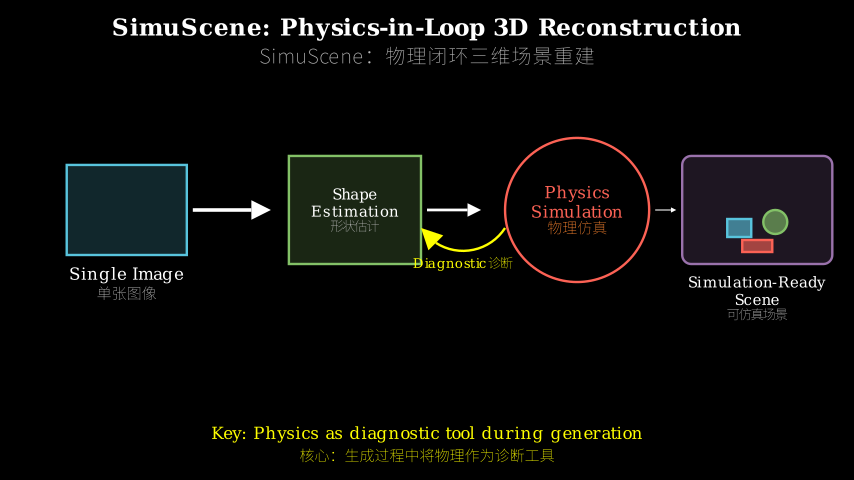
SimuScene is a feedback loop wrapped around a compositional 3D reconstruction pipeline. Start with a single RGB image. Use off-the-shelf detectors to segment objects and predict initial depth. Lift each object into 3D using a neural shape predictor, then compose them into a scene. Here’s where the departure happens: instead of declaring victory, SimuScene drops the reconstructed objects into a physics simulator under gravity and watches what breaks.
The simulator becomes a diagnostic instrument. Objects interpenetrating? The contact forces tell you where geometry overlaps. Object hovering? The gap distance quantifies the support failure. Object sinking? The penetration depth reveals where the supporting surface is too weak or misaligned. These aren’t just error flags — they’re structured correction signals with magnitudes and directions.
SimuScene closes the loop by converting these signals into shape and layout adjustments. For gravity-axis errors (sinking, hovering), it stretches or compresses object geometry along the vertical direction. For occlusion-related shape errors, it resamples the amodal (hidden) portions of objects using the shape prior but conditioned on the measured collision feedback. Iterate this diagnose-correct cycle until the scene stabilizes under simulation.
Single Image
    |
    v
[Segment + Depth] --> Object masks + initial 3D layout
    |
    v
[Lift to 3D] --> Per-object meshes (neural shape predictor)
    |
    v
[Compose Scene] --> Initial 3D scene
    |
    v
[Diagnostic Simulation] <--+
    |                       |
    | (drop under gravity)  |
    v                       |
[Measure Failures]          |
  - Penetration depth       |
  - Support gaps            |
  - Contact forces          |
    |                       |
    v                       |
[Generate Corrections] -----+
  - Gravity-axis stretch
  - Amodal shape resample
    |
    v
Stable, simulation-ready scene
Think of SimuScene as a sculptor working with clay under a heat lamp. Traditional methods sculpt the entire piece, let it dry, then try to glue the hardened parts together — cracks and gaps are inevitable. SimuScene keeps the clay soft. After each sculpting pass, the heat lamp (physics simulator) reveals where stress concentrates. The sculptor responds by adding material where gaps form and smoothing where pieces press too hard. The lamp isn’t just checking the final result; it’s part of the sculpting process itself, guiding each adjustment before anything hardens. The lamp’s feedback — heat distribution, shadow patterns — directly informs where the next sculpt happens.
Key Concepts
-
Diagnostic Simulation: Most systems use physics engines to check if a scene works (pass/fail). SimuScene uses the engine as a measuring device. When you drop objects under gravity, the simulator computes contact forces, penetration depths, and support gaps at every collision point. These aren’t binary flags; they’re continuous measurements with spatial structure. A table leg sinking 2cm into the floor at coordinates (x, y, z) with normal vector n is actionable feedback. SimuScene reads these measurements like a doctor reads lab results — each number suggests a specific intervention. This shifts physics from validator to instrument.
-
Gravity-Axis Stretching: When an object hovers 3cm above a table, you could move it down. But if the table’s geometric thickness is wrong, the object might then penetrate. SimuScene stretches the supporting object along the gravity axis (vertical) instead. If the gap is 3cm, extend the table upward by 3cm. If penetration is 2cm, compress downward by 2cm. Why does this work? Most household support structures (tables, shelves, floors) have their primary geometric variation in the horizontal plane; vertical thickness is relatively constant and less visually critical. Stretching along gravity preserves the visible horizontal structure while correcting the invisible vertical error.
-
Amodal Shape Resampling: When objects occlude each other in the input image, the shape predictor guesses the hidden parts. These guesses are often wrong in ways that cause collisions. Rather than editing the visible geometry (which must match the image), SimuScene resamples only the amodal (occluded) regions. It conditions the shape prior on the measured collision feedback: “regenerate the back half of this mug, but ensure it doesn’t penetrate the table at these contact points.” This preserves what the camera saw while fixing what the camera couldn’t see.
Framework Shift
Before (geometry-first + physics post-hoc):

Image --> [3D Lift] --> Objects --> [Compose] --> Scene
                                        |
                                        v
                                  [Physics Check]
                                        | (fails)
                                        v
                                  [Nudge Layouts]
                                        |
                                        v
                                  Stable but geometrically wrong


After (SimuScene, physics-in-the-loop):

Image --> [3D Lift] --> Objects --> [Compose] --> Scene
                            ^            |            |
                            |            v            |
                            |      [Diagnostic        |
                            |       Simulation] <-----+
                            |            |
                            +---- [Corrections]
                                  (shape + layout)
                                        |
                                        v
                                  Stable + geometrically grounded
From post-hoc validation to in-process guidance, the core shift is using physics as a generative constraint rather than a corrective filter.
Expert Assessment
Problem choice: This is a real gap, not manufactured. Robotics labs genuinely struggle with this: you can’t test grasping or manipulation policies in simulation if the reconstructed scenes collapse when you touch them. The timing is right — single-image 3D reconstruction has matured enough that the bottleneck has shifted from “can we get any 3D?” to “can we get physically valid 3D?”
Method maturity: The insight is elegant: physics simulation is differentiable and structured, so use it as a sensor. The execution, though, leans toward engineering integration rather than algorithmic novelty. Gravity-axis stretching is a heuristic (works for tables, less clear for curved surfaces). Amodal resampling depends heavily on the quality of the underlying shape prior. There’s a simpler baseline they don’t explore: direct optimization with physics loss terms from the start, rather than iterative correction. That said, the iterative approach is more modular and easier to debug.
Experimental integrity: The baselines are fair — they compare against recent single-image reconstructors plus physics post-processing. The stability metrics (penetration volume, support ratio) are well-defined. Red flag: the manipulation task results are compelling but lack ablations. How much of the success comes from physics-in-the-loop vs. just having better amodal completion? The paper would be stronger with a controlled ablation isolating each feedback mechanism’s contribution.
Writing quality: Section 3 (Method) front-loads implementation details before building intuition. If they moved the diagnostic simulation intuition forward and the algorithm pseudocode to an appendix, the core idea would land faster. The related work section undersells how much prior physics-aware work exists in robotics — they frame this as more novel than it is.
Verdict: Weak accept — solves a real problem with a clean idea, but the method is more integration than innovation, and the ablations don’t fully isolate the contributions.
Takeaways
Iterative measurement for generative tasks: When your output must satisfy constraints (physics, geometry, feasibility), don’t just check at the end. Build a measurement loop that quantifies violations and feeds them back as generation signals. This pattern transfers: use compiler errors to guide code generation, use runtime traces to guide program synthesis, use user interaction logs to guide UI generation.
Decompose corrections by visibility: SimuScene only edits amodal (hidden) geometry, preserving what the input image shows. Generalize this: when refining generated content, lock down the observable parts and iterate only on the unobservable. In video generation, fix the first frame and refine temporal consistency. In code refactoring, lock the API surface and optimize internals.
Heuristics with geometric priors: Gravity-axis stretching works because vertical thickness matters less than horizontal structure for furniture. Know your domain’s geometric priors. In typography, vertical spacing is more flexible than horizontal. In architecture, floor heights are more negotiable than room widths. Use these asymmetries to allocate your error budget.
论文: 2606.03994 作者: Inhee Lee, Sangwon Baik, Sungjoo Kim, Hyeonwoo Kim, Hyunsoo Cha, Hanbyul Joo 分类: cs.CV, cs.RO
缺口
单图三维重建在恢复单个物体形状上已有长足进步。
但当你把这些物体组合成场景时,一切都会崩塌——字面意义上的崩塌。
物体互相穿插、悬浮在半空、或者从桌面沉下去,一旦你把它们扔进物理模拟器。
根源在于:现有方法把物理当成马后炮,等形状已经固定了才用后处理步骤调整布局。
以往的工作分成两个阵营。
几何优先的方法(比如神经辐射场或单视角形状预测器)优先考虑视觉合理性,但在重建过程中忽略物理约束。
物理感知方法在事后应用重力沉降或碰撞解决,但到那时底层的几何错误——桌子太薄、杯底是凹的——已经烙进去了。
你可以挪动物体,但无法修复那些从一开始就不符合物理基础的形状。
问题:单图三维场景在仿真中崩溃
   |
   v
现有分野:
   几何优先 ----------> 漂亮但不稳定
   物理后处理 ---------> 布局修正,几何错误依旧
   |
   v
SimuScene 假设:物理是测量工具,不是修正器
   |
   v
方法:重建过程中的诊断仿真
   - 在重力下落物体
   - 测量穿透/支撑失败
   - 回馈为修正信号
   |
   v
证据:稳定性基准 + 操控任务
   |
   v
结论:物理闭环产生可仿真场景
增量
一句话:这篇论文之前,物理清理坏几何;之后,物理引导几何生成。
核心机制
SimuScene 是一个包裹着组合式三维重建管线的反馈回路。
从单张 RGB 图像开始。
用现成的检测器分割物体并预测初始深度。
用神经形状预测器把每个物体提升到三维,然后组合成场景。
分歧从这里开始:SimuScene 不是到此为止,而是把重建的物体扔进物理模拟器,在重力作用下看哪里出问题。
模拟器变成了诊断仪器。
物体互相穿透?接触力告诉你几何在哪里重叠。
物体悬浮?间隙距离量化了支撑失败。
物体下沉?穿透深度揭示了支撑表面太弱或未对齐的位置。
这些不只是错误标记——它们是带有大小和方向的结构化修正信号。
SimuScene 通过把这些信号转换为形状和布局调整来闭环。
对于重力轴错误(下沉、悬浮),它沿垂直方向拉伸或压缩物体几何。
对于遮挡相关的形状错误,它重新采样物体的非模态(隐藏)部分,使用形状先验但以测得的碰撞反馈为条件。
迭代这个诊断-修正循环,直到场景在仿真中稳定。
单张图像
    |
    v
[分割 + 深度] --> 物体掩码 + 初始三维布局
    |
    v
[提升到三维] --> 单物体网格(神经形状预测器)
    |
    v
[组合场景] --> 初始三维场景
    |
    v
[诊断仿真] <--+
    |          |
    | (重力下落)|
    v          |
[测量失败]      |
  - 穿透深度    |
  - 支撑间隙    |
  - 接触力     |
    |          |
    v          |
[生成修正] -----+
  - 重力轴拉伸
  - 非模态形状重采样
    |
    v
稳定、可仿真场景
把 SimuScene 想象成一个在热灯下用黏土工作的雕塑家。
传统方法是把整个作品雕完,让它变干,然后试图把硬化的部件粘在一起——裂缝和缝隙不可避免。
SimuScene 保持黏土柔软。
每一轮雕刻后,热灯(物理模拟器)揭示出应力集中的地方。
雕塑家的回应是在形成间隙的地方添加材料,在部件压得太紧的地方打磨。
热灯不只是检查最终结果;它本身就是雕刻过程的一部分,在任何东西变硬之前引导每次调整。
热灯的反馈——热量分布、阴影图案——直接告知下一轮雕刻发生在哪里。
关键概念
- 诊断仿真:大多数系统用物理引擎检查场景是否可行(通过/失败)。
SimuScene 把引擎当成测量设备。
当你在重力下落物体时,模拟器在每个碰撞点计算接触力、穿透深度和支撑间隙。
这些不是二元标志;它们是有空间结构的连续测量值。
桌腿在坐标 (x, y, z) 处沉入地板 2 厘米,法向量为 n,这是可操作的反馈。
SimuScene 读取这些测量值,就像医生读实验室结果——每个数字都提示特定的干预措施。
这把物理从验证器转变为仪器。
- 重力轴拉伸:当物体悬浮在桌子上方 3 厘米时,你可以把它往下移。
但如果桌子的几何厚度是错的,物体可能会穿透。
SimuScene 转而沿重力轴(垂直)拉伸支撑物体。
如果间隙是 3 厘米,把桌子向上延伸 3 厘米。
如果穿透是 2 厘米,向下压缩 2 厘米。
为什么有效?大多数家用支撑结构(桌子、架子、地板)的主要几何变化在水平面上;垂直厚度相对恒定且视觉上不太关键。
沿重力拉伸保留了可见的水平结构,同时修正了不可见的垂直错误。
- 非模态形状重采样:当输入图像中物体互相遮挡时,形状预测器猜测隐藏部分。
这些猜测经常以导致碰撞的方式出错。
SimuScene 不编辑可见几何(必须匹配图像),而是只重新采样非模态(被遮挡)区域。
它以测得的碰撞反馈为条件使用形状先验:“重新生成这个杯子的后半部分,但确保它在这些接触点不穿透桌子。
“这保留了相机看到的,同时修复了相机看不到的。
框架转变
之前(几何优先 + 物理后处理):

图像 --> [三维提升] --> 物体 --> [组合] --> 场景
                                    |
                                    v
                              [物理检查]
                                    | (失败)
                                    v
                              [调整布局]
                                    |
                                    v
                              稳定但几何错误


之后(SimuScene,物理闭环):

图像 --> [三维提升] --> 物体 --> [组合] --> 场景
                        ^            |        |
                        |            v        |
                        |      [诊断          |
                        |       仿真] <-------+
                        |            |
                        +---- [修正]
                              (形状 + 布局)
                                    |
                                    v
                              稳定 + 几何有根基
从事后验证到过程内引导,核心转变是把物理当成生成约束而非修正过滤器。
专家评审
选题眼光:这是真缺口,不是人造的。
机器人实验室确实在这上面挣扎:如果重建的场景一碰就崩溃,你就无法在仿真中测试抓取或操控策略。
时机也对——单图三维重建已经足够成熟,瓶颈已经从”能不能得到三维”转移到”能不能得到物理有效的三维”。
方法成熟度:洞见很优雅:物理仿真是可微且结构化的,所以把它当传感器用。
但执行上,更偏向工程整合而非算法创新。
重力轴拉伸是个启发式方法(对桌子有效,对曲面不太清楚)。
非模态重采样严重依赖底层形状先验的质量。
有个更简单的基线他们没探索:从一开始就用物理损失项直接优化,而非迭代修正。
话虽如此,迭代方法更模块化,更容易调试。
实验诚意:基线是公平的——他们跟最近的单图重建器加物理后处理做对比。
稳定性指标(穿透体积、支撑比率)定义明确。
值得警惕之处:操控任务结果令人信服,但缺少消融实验。
成功有多少来自物理闭环,有多少只是因为有更好的非模态补全?如果有受控消融实验隔离每个反馈机制的贡献,论文会更强。
写作功力:第 3 节(方法)在建立直觉之前就前置了实现细节。
如果他们把诊断仿真的直觉提前,把算法伪代码放到附录,核心想法会落地得更快。
相关工作部分低估了机器人领域中已有多少物理感知工作——他们把这个框架得比实际更新颖。
判决:弱接收——用清晰的想法解决了真问题,但方法更多是整合而非创新,消融实验没有完全隔离贡献。
要点总结
生成任务的迭代测量:当你的输出必须满足约束(物理、几何、可行性)时,不要只在最后检查。
建立一个测量回路,量化违规并把它们作为生成信号回馈。
这个模式可迁移:用编译器错误引导代码生成,用运行时轨迹引导程序合成,用用户交互日志引导 UI 生成。
按可见性分解修正:SimuScene 只编辑非模态(隐藏)几何,保留输入图像显示的内容。
推广这一点:当精炼生成内容时,锁定可观察部分,只迭代不可观察部分。
在视频生成中,固定第一帧并精炼时间一致性。
在代码重构中,锁定 API 表面并优化内部。
带几何先验的启发式:重力轴拉伸有效是因为对家具来说垂直厚度不如水平结构重要。
了解你领域的几何先验。
在排版中,垂直间距比水平间距更灵活。
在建筑中,楼层高度比房间宽度更可协商。
利用这些不对称性来分配你的错误预算。