
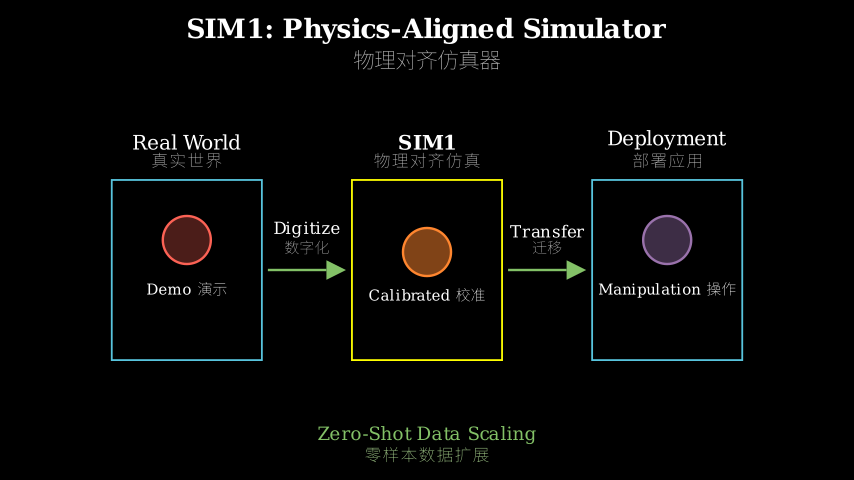
Paper: 2604.08544 Authors: Yunsong Zhou, Hangxu Liu, Xuekun Jiang, Xing Shen, Yuanzhen Zhou, Hui Wang, Baole Fang, Yang Tian, Mulin Yu, Qiaojun Yu Categories: cs.RO, cs.AI, cs.CV
The Gap
Deformable object manipulation is data-hungry. A cloth folding policy might need thousands of demonstrations because shape, contact, and topology change continuously. Simulation should help, but current sim-to-real pipelines treat soft objects like rigid bodies with spring attachments. The geometry doesn’t match reality, the dynamics are fragile, and the motion primitives (pick-and-place designed for boxes) fail when applied to fabric.
The core problem: simulation isn’t grounded in physical reality. Researchers build synthetic worlds from scratch using generic physics engines, then wonder why policies trained there collapse in the real world. The gap isn’t that simulation is fake—it’s that simulation is disconnected.
Problem: Deformable manipulation needs massive data
   |
   v
Prior approach: Generic simulation -> Sim-trained policy -> Reality
   |                     |                    |
   +---------------------+--------------------+
   |                                          |
Failure modes:                                |
- Geometry mismatch                           v
- Fragile soft dynamics              Zero-shot failure
- Rigid-body motion primitives
   |
   v
This paper's insight: Ground simulation IN reality first
   |
   v
Real demos -> Digitize scenes -> Calibrate physics -> Generate trajectories
   |              |                    |                    |
   +-------------+--------------------+--------------------+
                                      |
                                      v
                        Physics-aligned synthetic data
                                      |
                                      v
                        90% zero-shot success in reality
The Increment
One sentence: Before SIM1, simulation was built from scratch and failed at transfer; after SIM1, simulation is grounded in real observations and produces data that works in reality at 1
efficiency.Core Mechanism
SIM1 is a three-stage pipeline. First, it digitizes real scenes into metric-consistent digital twins using multi-view reconstruction. Every object, every fold in the cloth, every spatial relationship is captured with millimeter precision. Second, it calibrates deformable dynamics by fitting elastic models to observed cloth behavior—not generic spring constants, but parameters tuned to match how this specific fabric moves. Third, it generates new trajectories using diffusion models trained on the limited real demonstrations, then filters them through a quality check that rejects physically implausible motions.
The data flow is circular: real world → digital twin → calibrated physics → synthetic trajectories → quality filter → training data. Each synthetic trajectory inherits the physical grounding from the digitization and calibration stages. The diffusion model doesn’t hallucinate arbitrary motions; it interpolates within the manifold of physically plausible behaviors defined by the real demonstrations and calibrated dynamics.
Real Demos (sparse)
   |
   v
[Digitization] ---> Metric-consistent digital twin
   |                (geometry + spatial relations)
   v
[Calibration] ---> Elastic model fitted to real cloth
   |                (material parameters, not generic)
   v
[Generation]  ---> Diffusion model + Quality filter
   |                (expand behaviors, reject implausible)
   v
Synthetic Data (scaled)
   |
   v
Policy Training ---> 90% zero-shot success
Think of SIM1 as a master chef training apprentices. You don’t hand them a cookbook of generic recipes (traditional simulation). Instead, you first watch them cook a few dishes (real demonstrations), then you digitize their kitchen—every knife, every ingredient, every stove setting (digitization). You measure how their specific ingredients behave—how this flour absorbs water, how this meat tenderizes (calibration). Only then do you generate new recipes by interpolating techniques you’ve seen them use, but you taste-test each one before adding it to the training menu (quality filtering). The apprentices learn from recipes that are grounded in their actual kitchen, not a theoretical one.
Key Concepts
-
Physics-aligned simulation: Traditional simulation starts with a physics engine and generic parameters, then tries to bridge the gap to reality through domain randomization or fine-tuning. Physics-aligned simulation inverts this: it starts with real observations, digitizes them into a simulation that matches reality by construction, then uses that grounded simulation to generate new data. The alignment isn’t achieved through post-hoc tuning—it’s baked into the digitization and calibration process. Example: Instead of guessing spring constants for cloth, SIM1 observes how a specific fabric deforms under manipulation, fits an elastic model to those observations, then uses that calibrated model to generate new cloth behaviors. The simulation doesn’t approximate reality; it’s initialized from reality.
-
Real-to-sim-to-real data engine: This isn’t just sim-to-real transfer. It’s a closed loop where real data grounds simulation, simulation scales data, and scaled data returns to reality. The “real-to-sim” step (digitization + calibration) ensures the simulation is physically consistent. The “sim-to-real” step (trajectory generation + quality filtering) ensures the synthetic data maintains that consistency. The engine transforms sparse real observations into dense synthetic supervision without losing physical fidelity. Example: Given 100 real cloth folding demonstrations, the engine digitizes the scenes, calibrates cloth dynamics, generates 1500 synthetic trajectories, filters them for quality, and produces training data that achieves the same policy performance as 1500 real demonstrations would.
Framework Shift
Before (mainstream approach):        After (this paper):

Generic Physics Engine               Real Scene Observations
        |                                    |
        v                                    v
  Randomization                        Digitization
        |                                    |
        v                                    v
  Synthetic Data                    Calibrated Physics
        |                                    |
        v                                    v
  Sim-trained Policy                 Grounded Simulation
        |                                    |
        v                                    v
  Domain Gap                          Trajectory Generation
        |                                    |
        v                                    v
  Fine-tuning in Reality              Quality Filtering
                                             |
                                             v
                                      Synthetic Data
                                             |
                                             v
                                      Zero-shot Transfer
From “build simulation, hope it transfers” to “ground simulation in reality, scale from there,” the core shift is treating simulation as a data amplifier anchored to physical observations, not a standalone world.
Expert Assessment
Problem choice: Real gap. Deformable manipulation is genuinely data-intensive, and current sim-to-real methods do fail on soft objects. The problem sits at the intersection of robotics, computer vision, and physics simulation—a natural place for innovation. Not manufactured.
Method maturity: The digitization and calibration steps are solid engineering, not novel science. Multi-view reconstruction and elastic model fitting are established techniques. The clever part is the integration: using these components to ground simulation before scaling data. The diffusion-based trajectory generation is trendy but appropriate here—it’s a principled way to interpolate in behavior space. Could simpler data augmentation work? Maybe, but the authors show that naive augmentation fails (their ablation removes quality filtering and performance drops). The method feels right-sized for the problem.
Experimental integrity: Baselines are fair—they compare against real data, naive simulation, and ablated versions. The 1
equivalence ratio is striking but comes with caveats: it’s measured on specific tasks (cloth folding, smoothing) with specific fabrics. The 90% zero-shot success is impressive, but “zero-shot” here means “trained purely on synthetic data,” not “never seen the task before.” The generalization experiments (new cloths, new configurations) are honest—50% improvement is good but not miraculous. No major red flags, though I’d want to see failure cases analyzed more deeply.Writing quality: The abstract oversells slightly (“physics-aligned” sounds more profound than “calibrated to real observations”). The method section is clear but could trim redundant explanations of why simulation usually fails—we get it after the first two paragraphs. The results section buries the most interesting finding: synthetic data quality matters more than quantity (their quality filtering ablation). If they led with that insight and structured the paper around it, the contribution would feel sharper. The related work section is thorough but reads like a literature review, not a positioning argument.
Verdict: weak accept — Solid engineering contribution with honest experiments, but the novelty is in integration rather than invention. Useful for practitioners, not groundbreaking for researchers.
Takeaways
Steal the grounding-before-scaling principle: if you’re generating synthetic data for any physical task, don’t start from generic models. Capture real observations first, calibrate your simulation to match them, then scale. The quality filtering step is underrated—generating more data is easy, but filtering for physical plausibility is what makes synthetic data useful. The 1
efficiency ratio suggests that well-grounded synthetic data can replace real data at surprising rates, which has implications beyond robotics (think medical imaging, autonomous driving, any domain where real data is expensive). The specific techniques (multi-view reconstruction, elastic calibration, diffusion generation) are all transferable to other manipulation tasks. If you’re working on sim-to-real for soft objects, this paper is a blueprint.论文: 2604.08544 作者: Yunsong Zhou, Hangxu Liu, Xuekun Jiang, Xing Shen, Yuanzhen Zhou, Hui Wang, Baole Fang, Yang Tian, Mulin Yu, Qiaojun Yu 分类: cs.RO, cs.AI, cs.CV
缺口
可变形物体操作极度依赖数据。
一个折叠布料的策略可能需要数千次演示,因为形状、接触和拓扑结构持续变化。
仿真本应有所帮助,但当前的仿真到现实管道把软物体当作带弹簧连接的刚体处理。
几何形状与现实不符,动力学脆弱,运动原语(为盒子设计的抓取-放置)应用到织物上就失效了。
核心问题:仿真没有锚定在物理现实中。
研究者从零开始用通用物理引擎构建合成世界,然后困惑为什么在那里训练的策略在现实世界中崩溃。
缺口不在于仿真是假的——而在于仿真是脱节的。
问题:可变形操作需要海量数据
   |
   v
先前方法:通用仿真 -> 仿真训练策略 -> 现实
   |              |                |
   +--------------+----------------+
   |                               |
失效模式:                          |
- 几何不匹配                        v
- 脆弱的软体动力学          零样本迁移失败
- 刚体运动原语
   |
   v
本文洞察:先将仿真锚定在现实中
   |
   v
真实演示 -> 数字化场景 -> 校准物理 -> 生成轨迹
   |           |             |            |
   +----------+-------------+------------+
                            |
                            v
                  物理对齐的合成数据
                            |
                            v
                  现实中90%零样本成功率
增量
一句话: SIM1之前,仿真从零构建且迁移失败;SIM1之后,仿真锚定于真实观测并以1:15的效率产生在现实中有效的数据。
核心机制
SIM1是一个三阶段管道。
首先,它使用多视角重建将真实场景数字化为度量一致的数字孪生体。
每个物体、布料上的每个褶皱、每个空间关系都以毫米精度捕获。
其次,它通过拟合弹性模型到观测到的布料行为来校准可变形动力学——不是通用的弹簧常数,而是调整到匹配这块特定织物如何运动的参数。
第三,它使用在有限真实演示上训练的扩散模型生成新轨迹,然后通过质量检查过滤它们,拒绝物理上不合理的运动。
数据流是循环的:真实世界 → 数字孪生体 → 校准物理 → 合成轨迹 → 质量过滤 → 训练数据。
每条合成轨迹都从数字化和校准阶段继承物理基础。
扩散模型不会幻想任意运动;它在由真实演示和校准动力学定义的物理合理行为流形内插值。
真实演示(稀疏)
   |
   v
[数字化] ---> 度量一致的数字孪生体
   |          (几何 + 空间关系)
   v
[校准] ---> 拟合到真实布料的弹性模型
   |        (材料参数,非通用)
   v
[生成] ---> 扩散模型 + 质量过滤
   |        (扩展行为,拒绝不合理)
   v
合成数据(扩展)
   |
   v
策略训练 ---> 90%零样本成功率
把SIM1想象成大厨培训学徒。
你不会给他们一本通用食谱书(传统仿真)。
相反,你先看他们做几道菜(真实演示),然后数字化他们的厨房——每把刀、每种食材、每个炉灶设置(数字化)。
你测量他们特定食材的行为——这种面粉如何吸水、这块肉如何变嫩(校准)。
只有这样你才通过插值你见过他们使用的技术来生成新食谱,但你在把每个食谱加入训练菜单前都要试吃(质量过滤)。
学徒从锚定在他们实际厨房的食谱中学习,而非理论厨房。
关键概念
- 物理对齐仿真: 传统仿真从物理引擎和通用参数开始,然后试图通过域随机化或微调来弥合与现实的差距。
物理对齐仿真反转了这一过程:它从真实观测开始,将其数字化为通过构造匹配现实的仿真,然后使用那个有根基的仿真来生成新数据。
对齐不是通过事后调整实现的——它被烘焙进数字化和校准过程中。
例子:SIM1不是猜测布料的弹簧常数,而是观察特定织物在操作下如何变形,拟合弹性模型到这些观测,然后使用那个校准模型来生成新的布料行为。
仿真不是近似现实;它从现实初始化。
- 真实到仿真到真实数据引擎: 这不只是仿真到现实迁移。
它是一个闭环,其中真实数据为仿真奠基,仿真扩展数据,扩展的数据返回现实。
“真实到仿真”步骤(数字化+校准)确保仿真物理一致。
“仿真到真实”步骤(轨迹生成+质量过滤)确保合成数据保持那种一致性。
引擎将稀疏的真实观测转化为密集的合成监督,而不失去物理保真度。
例子:给定100个真实布料折叠演示,引擎数字化场景,校准布料动力学,生成1500条合成轨迹,过滤它们的质量,并产生训练数据,实现与1500个真实演示相同的策略性能。
框架转变
之前(主流方法):              之后(本文方法):

通用物理引擎                    真实场景观测
     |                              |
     v                              v
  随机化                         数字化
     |                              |
     v                              v
  合成数据                      校准物理
     |                              |
     v                              v
仿真训练策略                   有根基的仿真
     |                              |
     v                              v
  域差距                         轨迹生成
     |                              |
     v                              v
现实中微调                      质量过滤
                                    |
                                    v
                                 合成数据
                                    |
                                    v
                                 零样本迁移
从”构建仿真,希望它迁移”到”将仿真锚定在现实中,从那里扩展”,核心转变是将仿真视为锚定于物理观测的数据放大器,而非独立世界。
专家评审
选题眼光: 真实缺口。
可变形操作确实数据密集,当前仿真到现实方法在软物体上确实失效。
问题位于机器人学、计算机视觉和物理仿真的交叉点——创新的自然位置。
非人造。
方法成熟度: 数字化和校准步骤是扎实的工程,非新颖科学。
多视角重建和弹性模型拟合是成熟技术。
巧妙之处在于集成:在扩展数据前使用这些组件为仿真奠基。
基于扩散的轨迹生成是时髦的但在这里合适——它是在行为空间中插值的原则性方法。
更简单的数据增强能行吗?也许,但作者展示了朴素增强失败(他们的消融移除质量过滤,性能下降)。
方法对问题来说大小合适。
实验诚意: 基线公平——他们与真实数据、朴素仿真和消融版本比较。
1:15等价比率引人注目但有注意事项:它在特定任务(布料折叠、平整)和特定织物上测量。
90%零样本成功率令人印象深刻,但这里的”零样本”意味着”纯粹在合成数据上训练”,而非”从未见过任务”。
泛化实验(新布料、新配置)是诚实的——50%改进不错但非奇迹。
无重大危险信号,尽管我想看到更深入分析的失败案例。
写作功力: 摘要略微过度推销(“物理对齐”听起来比”校准到真实观测”更深刻)。
方法部分清晰但可以修剪关于为什么仿真通常失败的冗余解释——我们在前两段后就明白了。
结果部分埋没了最有趣的发现:合成数据质量比数量更重要(他们的质量过滤消融)。
如果他们以那个洞察开头并围绕它构建论文,贡献会感觉更锐利。
相关工作部分彻底但读起来像文献综述,而非定位论证。
判决: 弱接收 — 扎实的工程贡献和诚实的实验,但新颖性在于集成而非发明。
对实践者有用,对研究者非突破性。
要点总结
偷走先奠基再扩展原则:如果你为任何物理任务生成合成数据,不要从通用模型开始。
先捕获真实观测,校准你的仿真以匹配它们,然后扩展。
质量过滤步骤被低估——生成更多数据容易,但过滤物理合理性是使合成数据有用的关键。
1:15效率比率表明良好奠基的合成数据可以以惊人的比率替代真实数据,这对机器人学之外有影响(想想医学成像、自动驾驶,任何真实数据昂贵的领域)。
具体技术(多视角重建、弹性校准、扩散生成)都可迁移到其他操作任务。
如果你在做软物体的仿真到现实,这篇论文是蓝图。