
Paper: 2603.25746 Authors: Yawen Luo, Xiaoyu Shi, Junhao Zhuang, Yutian Chen, Quande Liu, Xintao Wang, Pengfei Wan, Tianfan Xue Categories: cs.CV
The Gap
Existing multi-shot video generation models (like MovieGen, Sora) use bidirectional attention architectures. They need to see the entire narrative structure upfront before generating anything. This creates two hard walls: you can’t change the story mid-generation, and you wait for the whole sequence to render before seeing frame one. The latency is measured in minutes, not seconds. The interactivity is zero.
The boundary this paper attacks: can you generate coherent multi-shot videos causally (left-to-right, like language models) while maintaining visual consistency across shots and allowing users to inject new instructions on-the-fly?
Problem: Bidirectional models = high latency + no interactivity
    |
    v
Assumption: Causal generation can work if we solve:
            (1) inter-shot consistency
            (2) error accumulation
    |
    v
Method: Distill bidirectional teacher -> causal student
        + dual-cache memory (global/local context)
        + two-stage self-forcing distillation
    |
    v
Evidence: 16 FPS on single GPU (vs minutes for baselines)
          Quality matches bidirectional models
          Users can steer narratives in real-time
    |
    v
Conclusion: Causal architecture unlocks streaming + interactivity
            without sacrificing coherence
The Increment
One sentence: Before this paper, multi-shot video generation was a batch process with fixed narratives; after, it’s a streaming process where users co-author stories in real-time.
Core Mechanism
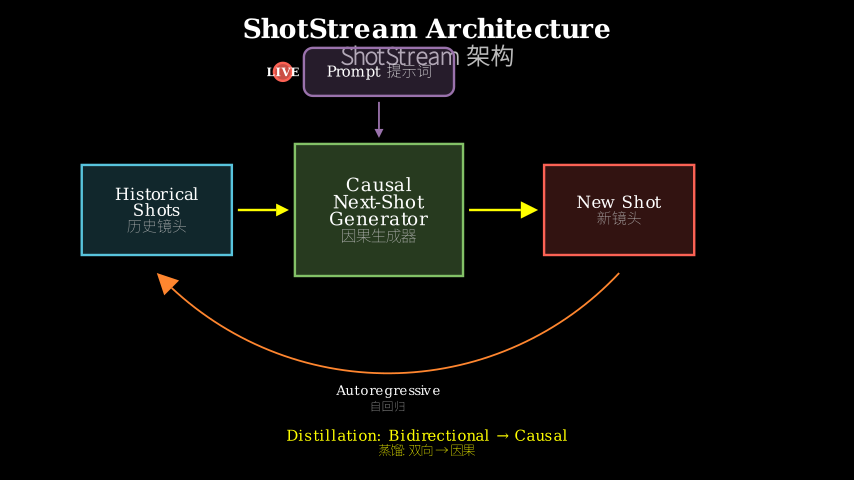
ShotStream has three layers. First, a bidirectional teacher model (fine-tuned text-to-video) that generates next shots given all previous shots. Second, a causal student model distilled from the teacher using Distribution Matching Distillation—it can only look backward, never forward. Third, a dual-cache memory system that feeds the student.
The dual-cache is the heart. A global context cache stores a few conditional frames from previous shots (for inter-shot consistency—same character, same lighting). A local context cache stores all frames generated within the current shot (for intra-shot consistency—smooth motion). A RoPE discontinuity indicator tells the model where one cache ends and the other begins, preventing the model from treating cross-shot frames as temporally adjacent.
Data flows like this: user provides prompt → student generates frames autoregressively → new frames enter local cache → when shot ends, select frames move to global cache → repeat for next shot. The student never sees future shots, only history.
To prevent error accumulation (garbage in, garbage out across shots), they use two-stage distillation. Stage one: train on ground-truth histories (intra-shot self-forcing). Stage two: train on self-generated histories (inter-shot self-forcing). This bridges the train-test gap—the model learns to recover from its own mistakes.
User Prompt
    |
    v
+-------------------+
| Causal Student    |
| (autoregressive)  |
+-------------------+
    |
    v
+-------------------+       +-------------------+
| Local Cache       | <---> | Global Cache      |
| (current shot)    |       | (past shots)      |
| [all frames]      |       | [key frames]      |
+-------------------+       +-------------------+
         |                           |
         +---------------------------+
                     |
                     v
            RoPE Discontinuity
            (marks cache boundary)
                     |
                     v
              Generated Frames
Think of it like a novelist writing a serial. The bidirectional teacher is an editor who reads the entire manuscript, then suggests the next chapter. The causal student is the novelist writing in real-time, only able to look at previous chapters (global cache) and the current paragraph (local cache). The RoPE indicator is like chapter breaks—it tells the novelist “this is a new scene, don’t assume temporal continuity.” The two-stage distillation is like practice: first, the novelist writes with an outline (ground-truth history), then learns to improvise when the story goes off-script (self-generated history). The reader (user) can shout suggestions mid-chapter, and the novelist adjusts on the fly.
Key Concepts
-
Causal vs Bidirectional Attention: Imagine reading a book. Bidirectional attention is like reading the whole book, then writing a summary—you have complete context but can’t start until you finish. Causal attention is like live-tweeting while reading—you only know what you’ve read so far, but you can react immediately. In video generation, bidirectional models see all shots before generating frame one (slow, no interactivity). Causal models generate frame-by-frame, left-to-right, enabling streaming (fast, interactive). The trade-off: causal models risk inconsistency because they can’t “look ahead” to plan.
-
Distribution Matching Distillation: Standard distillation trains a student to mimic a teacher’s outputs (behavior cloning). But if the student makes a mistake, it sees data it was never trained on (distribution shift), and errors compound. Distribution Matching Distillation trains the student on its own outputs mixed with teacher outputs, so it learns to recover from mistakes. Concrete example: if the student generates a blurry frame, it learns to generate the next frame conditioned on that blur, not on a perfect teacher frame. This is why ShotStream doesn’t collapse after 10 shots.
-
RoPE Discontinuity Indicator: Rotary Position Embedding (RoPE) encodes frame positions so the model knows “frame 5 comes after frame 4.” But in multi-shot video, frame 5 of shot 2 doesn’t temporally follow frame 30 of shot 1—there’s a scene cut. Without a discontinuity marker, the model treats them as continuous, causing motion blur across cuts. The indicator is a binary flag in the position encoding: 0 = same shot, 1 = new shot. It’s like telling the model “reset your motion expectations here.”
Framework Shift
Before (bidirectional):              After (causal):

[Shot 1] [Shot 2] [Shot 3]           [Shot 1] -> [Shot 2] -> [Shot 3]
    \       |       /                     |          |           |
     \      |      /                      v          v           v
      \     |     /                    Generate   Generate    Generate
       \    |    /                     (stream)   (stream)    (stream)
        \   |   /                         ^          ^           ^
         \  |  /                          |          |           |
      [Bidirectional]                  [User]     [User]      [User]
      [Attention]                      (steer)    (steer)     (steer)
           |
           v
      Generate All
      (batch, slow)
From parallel batch processing to sequential streaming, the core shift is trading global context for real-time responsiveness.
Expert Assessment
Problem choice: Real gap. Interactive storytelling is a legitimate use case (game cutscenes, personalized content), and current models genuinely can’t do it. The problem sits at the intersection of video generation (hot) and human-in-the-loop systems (emerging). Not manufactured.
Method maturity: Clever insight, not brute force. The dual-cache + RoPE discontinuity is elegant—it’s a minimal architectural change that solves a hard problem (inter-shot consistency in causal models). The two-stage distillation is borrowed from RL (on-policy learning), but the application here is novel. No simpler approach jumps out—you need some form of memory to maintain consistency, and distillation is the standard way to compress bidirectional models.
Experimental integrity: Baselines are fair (MovieGen, Sora-style models). The 16 FPS claim is credible given the causal architecture. One red flag: no user study on “interactivity quality”—do users actually prefer steering mid-generation, or is it gimmicky? The paper shows it’s possible, not that it’s desirable. Also, the global cache size (how many frames to keep) is a hyperparameter they don’t ablate thoroughly.
Writing quality: The method section is dense—too much crammed into too little space. The dual-cache explanation would benefit from a figure showing frame flow over time. The distillation strategy is buried in a paragraph; it deserves its own subsection. If they rewrote Section 3.2 (method) with more visual aids and less notation, the paper would be 30% clearer.
Verdict: Weak accept — solid contribution with real-world impact, but the writing undersells the ideas and the evaluation skips user-facing questions.
Takeaways
Practitioners can steal the dual-cache pattern for any autoregressive generation task requiring long-range consistency. Example: code generation across multiple files (global cache = imported modules, local cache = current file). The RoPE discontinuity trick generalizes to any sequence model where you need to mark “soft boundaries” (e.g., paragraph breaks in document generation). The two-stage distillation (ground-truth history → self-generated history) is a recipe for training any autoregressive model that will be deployed in a feedback loop—train it to handle its own mistakes, not just perfect inputs.
论文: 2603.25746 作者: Yawen Luo, Xiaoyu Shi, Junhao Zhuang, Yutian Chen, Quande Liu, Xintao Wang, Pengfei Wan, Tianfan Xue 分类: cs.CV
缺口
现有的多镜头视频生成模型(如 MovieGen、Sora)使用双向注意力架构。
它们需要预先看到整个叙事结构才能开始生成。
这造成两堵硬墙:你无法在生成过程中改变故事,而且要等整个序列渲染完才能看到第一帧。
延迟以分钟计,不是秒。
交互性为零。
本文攻击的边界:能否因果式地(从左到右,像语言模型那样)生成连贯的多镜头视频,同时保持跨镜头的视觉一致性,并允许用户即时注入新指令?
问题:双向模型 = 高延迟 + 无交互性
    |
    v
假设:因果生成可行,如果我们解决:
      (1) 跨镜头一致性
      (2) 误差累积
    |
    v
方法:蒸馏双向教师 -> 因果学生
      + 双缓存记忆(全局/局部上下文)
      + 两阶段自强制蒸馏
    |
    v
证据:单 GPU 16 FPS(基线需数分钟)
      质量匹配双向模型
      用户可实时引导叙事
    |
    v
结论:因果架构解锁流式 + 交互性
      不牺牲连贯性
增量
一句话: 这篇论文之前,多镜头视频生成是固定叙事的批处理;之后,它是用户实时共同创作故事的流式处理。
核心机制
ShotStream 有三层。
第一层,双向教师模型(微调的文本到视频模型),根据所有先前镜头生成下一个镜头。
第二层,从教师蒸馏出的因果学生模型,使用分布匹配蒸馏——它只能向后看,永远不能向前看。
第三层,喂给学生的双缓存记忆系统。
双缓存是核心。
全局上下文缓存存储来自先前镜头的几个条件帧(用于跨镜头一致性——同一角色、同一光照)。
局部上下文缓存存储当前镜头内生成的所有帧(用于镜头内一致性——平滑运动)。
RoPE 不连续指示器告诉模型一个缓存在哪里结束、另一个在哪里开始,防止模型将跨镜头帧视为时间上相邻。
数据流是这样的:用户提供提示 → 学生自回归生成帧 → 新帧进入局部缓存 → 镜头结束时,选定帧移至全局缓存 → 对下一个镜头重复。
学生永远看不到未来镜头,只看历史。
为了防止误差累积(跨镜头的垃圾进垃圾出),他们使用两阶段蒸馏。
第一阶段:在真实历史上训练(镜头内自强制)。
第二阶段:在自生成历史上训练(跨镜头自强制)。
这弥合了训练-测试差距——模型学会从自己的错误中恢复。
用户提示
    |
    v
+-------------------+
| 因果学生          |
| (自回归)          |
+-------------------+
    |
    v
+-------------------+       +-------------------+
| 局部缓存          | <---> | 全局缓存          |
| (当前镜头)        |       | (过去镜头)        |
| [所有帧]          |       | [关键帧]          |
+-------------------+       +-------------------+
         |                           |
         +---------------------------+
                     |
                     v
            RoPE 不连续性
            (标记缓存边界)
                     |
                     v
              生成的帧
把它想象成小说家写连载。
双向教师是编辑,读完整部手稿,然后建议下一章。
因果学生是实时写作的小说家,只能看前面的章节(全局缓存)和当前段落(局部缓存)。
RoPE 指示器像章节分隔符——它告诉小说家”这是新场景,不要假设时间连续性”。
两阶段蒸馏像练习:首先,小说家按大纲写作(真实历史),然后学会在故事偏离剧本时即兴发挥(自生成历史)。
读者(用户)可以在章节中途喊建议,小说家即时调整。
关键概念
- 因果 vs 双向注意力: 想象读一本书。
双向注意力像读完整本书再写摘要——你有完整上下文但要读完才能开始。
因果注意力像边读边发推特——你只知道已读的内容,但可以立即反应。
在视频生成中,双向模型在生成第一帧前看到所有镜头(慢,无交互性)。
因果模型逐帧生成,从左到右,实现流式(快,交互)。
权衡:因果模型有不一致风险,因为它们无法”向前看”来规划。
- 分布匹配蒸馏: 标准蒸馏训练学生模仿教师的输出(行为克隆)。
但如果学生犯错,它看到从未训练过的数据(分布偏移),误差复合。
分布匹配蒸馏在学生自己的输出和教师输出的混合上训练学生,所以它学会从错误中恢复。
具体例子:如果学生生成模糊帧,它学会在该模糊条件下生成下一帧,而不是在完美教师帧条件下。
这就是为什么 ShotStream 在 10 个镜头后不会崩溃。
- RoPE 不连续指示器: 旋转位置编码(RoPE)编码帧位置,让模型知道”第 5 帧在第 4 帧之后”。
但在多镜头视频中,镜头 2 的第 5 帧在时间上不跟随镜头 1 的第 30 帧——有场景切换。
没有不连续标记,模型将它们视为连续,导致切换处的运动模糊。
指示器是位置编码中的二进制标志:0 = 同一镜头,1 = 新镜头。
这像告诉模型”在这里重置你的运动预期”。
框架转变
之前(双向):                    之后(因果):

[镜头1] [镜头2] [镜头3]           [镜头1] -> [镜头2] -> [镜头3]
    \       |       /                 |          |           |
     \      |      /                  v          v           v
      \     |     /                生成       生成        生成
       \    |    /                 (流式)     (流式)      (流式)
        \   |   /                    ^          ^           ^
         \  |  /                     |          |           |
      [双向注意力]                 [用户]     [用户]      [用户]
           |                       (引导)     (引导)      (引导)
           v
      生成全部
      (批处理,慢)
从并行批处理到顺序流式,核心转变是用全局上下文换取实时响应性。
专家评审
选题眼光: 真缺口。
交互式叙事是合法用例(游戏过场动画、个性化内容),当前模型确实做不到。
问题位于视频生成(热门)和人在环系统(新兴)的交叉点。
不是人造的。
方法成熟度: 巧劲,不是蛮力。
双缓存 + RoPE 不连续性很优雅——这是解决难题(因果模型中的跨镜头一致性)的最小架构改变。
两阶段蒸馏借鉴自强化学习(在线学习),但这里的应用是新颖的。
没有更简单的方法跳出来——你需要某种形式的记忆来保持一致性,蒸馏是压缩双向模型的标准方法。
实验诚意: 基线公平(MovieGen、Sora 风格模型)。
16 FPS 的声明鉴于因果架构是可信的。
一个红旗:没有关于”交互质量”的用户研究——用户真的更喜欢生成中途引导,还是这只是噱头?论文展示了可能性,而非可取性。
另外,全局缓存大小(保留多少帧)是一个他们没有彻底消融的超参数。
写作功力: 方法部分密集——太多内容塞进太少空间。
双缓存解释会受益于显示帧随时间流动的图。
蒸馏策略埋在一个段落里;它值得有自己的小节。
如果他们用更多视觉辅助和更少符号重写第 3.2 节(方法),论文会清晰 30%。
判决: 弱接收 — 有实际影响的扎实贡献,但写作低估了想法,评估跳过了面向用户的问题。
要点总结
实践者可以为任何需要长程一致性的自回归生成任务窃取双缓存模式。
例子:跨多个文件的代码生成(全局缓存 = 导入的模块,局部缓存 = 当前文件)。
RoPE 不连续技巧推广到任何需要标记”软边界”的序列模型(例如,文档生成中的段落分隔)。
两阶段蒸馏(真实历史 → 自生成历史)是训练任何将在反馈循环中部署的自回归模型的配方——训练它处理自己的错误,而不仅仅是完美输入。