Paper: 2611.32946 — ShellBench: What Matters More for AI Agents, Models, or Harness for Everyday Tasks
Authors: Vincent Koc, Aditya Washikar, Rishab Naveen Venkataraman, Onur Solmaz, et al. (22 authors)
Categories: cs.AI, cs.CL, cs.SE
Reading scope: Original arXiv v1 HTML. All seven main sections and Appendices A–E were read, including Tables 1–9 from original cells and extracts. Hidden layout padding was excluded from table row checks. Figures 1–7 were visually inspected, including locally rendered original SVGs; text-form Figures 8–9 were read in Appendix E. Bibliographic entries, external cited papers, implementation and companion results were not independently audited. The experiments were not reproduced.
The Problem
Zainab wants one dinner spot after work, a concise note, the rejected alternatives and the exact files behind the budget and timing decision. The benchmark workspace has 180 files. An old saved page says Marlowe Bistro is open, a current email says it is closed for a private hire, and a promising Baan Thai booking belongs to the more distant branch. Allergies, travel time and voucher conditions also matter (§3.3; Appendix E).
In this constructed dinner task, 522 of 531 attempts choose the correct venue, Kesar Kitchen Clerkenwell. Only 152 pass all nine checks. 331 fail solely because the note does not name the required sources. A correct restaurant name therefore earns the same binary failure grade as a recommendation for a closed venue (§3.3; Figures 1–2).
That difference matters when choosing an agent. Is a score measuring a good central decision, a complete handoff with evidence, or safe handling of the surrounding constraints? ShellBench builds 100 everyday tasks and compares models, the software harnesses that give them tools and manage execution, and reasoning effort. Its contribution is a benchmark and a crossed measurement of those choices. The dinner example shows why the definition of “finished” must accompany the ranking (§§1–4).
The Explanation
Make the workspace part of the task
The tasks begin with scenarios derived from clusters of more than 10 million anonymized real user requests. Developers then construct environments and requests, followed by automated checks and four human reviewers across the environment and finished-task stages. These are authored benchmark worlds seeded by real requests, rather than replays of each original user’s machine (§3.1).
Workspaces contain a median of 188 files: messages, calendar exports, receipts, spreadsheets, saved pages and other records. Some information is obsolete or misleading. In the dinner task, the agent must combine a current booking, the group’s chat, a travel calendar, a usual-spend receipt and a voucher export to explain the recommendation. Naming a venue without those decisive records does not satisfy the requested handoff (Appendix E).
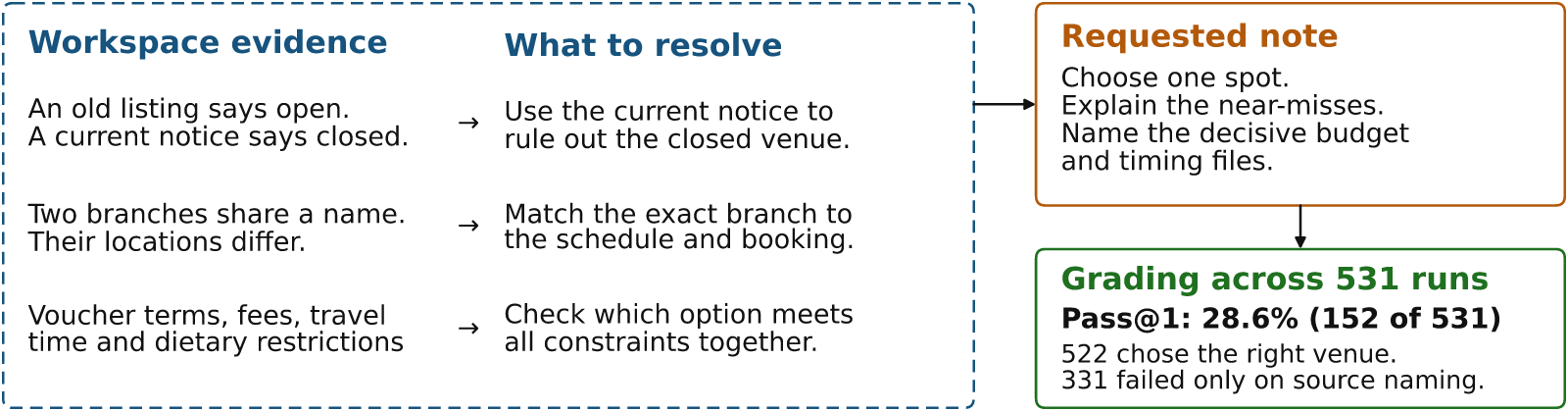
Original Figure 1, rendered from the paper’s SVG. It separates choosing the right venue from passing the full task.
Of the 100 tasks, 90 use written binary rubrics with 721 criteria: 340 correctness and 381 safety criteria. Eighty-six grade the final workspace, four grade an answer saved in an application, and the remaining ten tasks use code tests. Every required criterion must pass. An unresolved judgment also counts as a non-pass (§3.2; Table 2).
For the rubric tasks, GPT-6.1 Sol at high effort, running in Pi, opens the resulting artifacts and judges one criterion at a time. It does not see the reference answer. In the paper’s illustrated Claude Opus 5.5 dinner run, the judge passes eight checks but rejects the evidence check: the chat and usual-spend receipt appear in neither the note nor recorded tool output. The trace does not establish that the agent read them and simply forgot to cite them (Figure 2; Appendix E).
Compare the same tasks across configurations
The study runs twelve models in five harness versions, at three effort levels, with three attempts per task and level. A harness supplies prompts, tools and runtime behavior; swapping it can change what the same model sees and does. The versions are Claude Code 2.1.292, Codex 0.163.0, Hermes v2026.9.24, OpenClaw 2026.10.5 and Pi 1.3.0 (§4.1; Table 4).
DeepSeek V4.1 Flash is not run in Hermes because pinning its provider would require modifying that harness. The resulting 59 model–harness configurations produce 53,100 runs, evaluated between 7 and 20 November 2026. Effort levels are ordered within each model; some providers offer low, high and maximum. They are not equal amounts of computation across models (§4.1; Table 3).
Pass@1 is the fraction of individual attempts passing the full task. Under the original grading, the leading model averages and estimated token costs are:
| Model | Mean Pass@1 | Estimated token cost per attempt |
|---|---|---|
| GPT-6 Astra | 62.5% | $1.10 |
| Claude Fable 5.2 | 61.9% | $0.83 |
| GPT-6.1 Sol | 61.4% | $0.19 |
These averages weight the available harnesses equally and average effort levels. The leaders span 1.1 percentage points, while Astra’s estimated attempt cost is about six times Sol’s. Costs use recorded usage and list prices as of 18 November 2026, with cache estimates. They exclude grading and are not provider invoices or cost per successful job (§§4.2, 5.1, 5.3; Tables 5 and 7).
Across all tested models, mean scores range from 18.8% to 62.5%, while shared-model harness means stay between 42.9% and 45.2%. For the eleven models run in every harness, a statistical decomposition of 55 configuration means assigns 95.7% of their squared variation to model differences and 0.36% to harness differences. Its residual also contains interaction and sampling noise (§5.1).
That result depends on the model range. Restricting the analysis to the five highest-scoring models changes those shares to 65.6% and 16.5%. Individual pairings still matter: Sol averages 61.4% but scores 53.2% in Claude Code. The broad comparison supports prioritizing model choice; it does not make the harness irrelevant for a particular model (§§5.1–5.2; Figure 3).
Keep the submissions, change the definition of passing
The dinner request requires evidence, so source naming is part of its grade. What happens if that kind of requirement is removed from the comparison?
The paper rescores the same submissions on the 86 final-workspace tasks without source-use and stale-information criteria. It keeps the other fourteen tasks’ original grades. Harness averages use the eleven shared models (Table 6).
| Harness | Original full-benchmark Pass@1 | After both criterion groups are removed |
|---|---|---|
| OpenClaw | 45.2% | 61.2% |
| Pi | 45.2% | 61.9% |
| Hermes | 45.1% | 61.8% |
| Codex | 45.0% | 62.7% |
| Claude Code | 42.9% | 59.7% |
The paper reports Codex moving from fourth to first. The agents have not improved between these columns; the scoring requirements changed. Neither scoring choice is automatically right for every user. If the handoff must identify decisive evidence and reject stale records, those requirements belong in the comparison. Dropping them measures a different job.
Look beyond the single pass rate
More effort improves eleven of twelve models from their lowest to highest setting, but Gemini 4 Carbon falls 4.1 points. Harnesses also change costs and behavior: Pi’s median run takes 1.31 minutes, versus 2.86 in OpenClaw across the shared models. Returned file text, rewriting and tool use vary even when overall harness pass rates are close. OpenClaw is omitted from the file-text comparison because its traces redact long outputs (§§5.3–5.4; Figures 5–6).
Correctness and safety are separate requirements. Of 26,151 runs that pass every correctness criterion, 2,589—9.9%—still fail a safety requirement. Some criteria concern harmful recommendations; others require an answer to state a necessary safeguard, so silence can fail. These counts measure compliance with the benchmark’s rubric, which does not assign a severity to real-world harm (§§5.5–5.6; Appendix C).
Core Concepts
A binary contract can hide different kinds of failure. In the dinner task, missing the named budget sources and choosing a closed venue both fail the task. The overall score is useful for the complete request, but criterion-level results explain what the user would still need to check or repair.
One success and consistent success are different events. Across 59 configurations, mean single-attempt success is 44.4%. At least one of three attempts succeeds in 61.2% of task–configuration–effort groups, while all three succeed in 28.2%. These are empirical results from repeated attempts. Finding one usable answer also requires a way to recognize it; repetition is not automatically a reliable handoff (§§4.1, 5.1).
A configuration score includes its surrounding software. The model runs through prompts, tools and runtime supplied by its harness. The study changes those together and measures the result. Its harness differences do not identify which individual component caused them (§6.2).
The Insight
The dinner task makes the ranking’s contract visible. Selecting Kesar answers one question; delivering a usable note with current evidence and the right constraints answers the full request. The rescoring experiment shows that this distinction can change which harness leads.
A useful agent comparison therefore starts with what the user must be able to do with the output. Keep the required evidence and constraints in the test, then compare model, harness, effort and cost under that contract. A leaderboard average becomes informative when its definition of completion matches the work.
A Critical Reading
Task review and output review are different. The paper reports four reviewers of task construction, but it does not obtain independent human grades for whole submissions. Its blinded, stratified check finds judge agreement on 250 of 278 reference-labeled criterion decisions, or 89.9%. Some references have only one human rating. This is criterion agreement in that sample, not whole-task grading accuracy (§§3.1, 4.3, 6.1).
In a separate check, six of forty unchanged submissions receive both pass and fail in repeated automated judging. GPT-6.1 Sol also participates in task screening and the model comparison while serving as the rubric judge. Those facts do not establish favoritism, but they make independent whole-submission review particularly useful before interpreting the leaders’ 1.1-point spread (§§3.1, 4.3, 7).
The safety statistic needs its counting rules. Tasks without safety criteria automatically pass that group. The paper’s “no-file” category uses failure of every criterion as its operational definition. Binary safety compliance also combines harmful choices and missing safeguards; it is not a graded measure of consequences (Appendix C; §6.2).
Finally, the public scope is smaller than the headline evaluation. Twenty tasks are designated for release, with aggregate grades for 10,620 runs; the full comparison covers 100 tasks. Costs include estimation and missing-usage limits, and the results cover the specified harness versions and serving routes. The companion results were not independently audited in this reading (§§1, 4, 6; Appendices A–C).
What You Can Use
Write down the handoff requirements before choosing an agent configuration. For a dinner recommendation, that means the venue, rejected near-misses, current decisive sources, timing and dietary constraints—not just a plausible restaurant name. Keep source handling and safety checks visible beside the overall pass rate.
Compare candidate model–harness pairings on the same representative tasks and effort settings. Measure single-attempt success, repeated-attempt consistency and cost, including whatever judging or human checking is needed to recognize a good output. Inspect actual failures before interpreting a small difference in averages.
Changing the grading rules can clarify what a score means. Use that analysis to identify which requirements change the choice, while retaining the requirements the user actually needs. For Zainab, finishing the job includes handing over enough evidence to trust the dinner plan.
论文: 2611.32946 — ShellBench: What Matters More for AI Agents, Models, or Harness for Everyday Tasks
作者: Vincent Koc、Aditya Washikar、Rishab Naveen Venkataraman、Onur Solmaz 等,共22位作者
分类: cs.AI、cs.CL、cs.SE
阅读范围: arXiv v1 原始 HTML。
读过七个正文节及附录 A–E,表1–9按原始单元格和提取文本读取,核对行值时去掉隐藏的排版占位。
图1–7已目视检查,其中原始 SVG 在本地渲染;文字式图8–9按附录 E 的 HTML 内容阅读。
未逐项独立核查参考文献、外部论文、实现代码及配套结果,没有复现实验。
问题
Zainab 想下班后吃顿饭,要一个地点、一份简短说明、被排除的备选,以及决定预算和时间的确切文件。 基准给智能体 180个文件:旧网页说 Marlowe Bistro 营业,当前邮件说当晚包场;Baan Thai 看起来有桌,预约却属于更远的另一家分店。 过敏限制、路程和优惠券条件,也要同时算进去(§3.3;附录 E)。
这项构造出来的晚餐任务,531次尝试里,522次选对了 Kesar Kitchen Clerkenwell。 全部九项检查都通过的,只有 152次。 331次仅因没有写出要求的证据来源而失败,与推荐一家已经关闭的餐厅拿到同一个二元失败分(§3.3;图1–2)。
选智能体时,这个区别不能藏在分数后面。 你看重的是核心选择正确,还是证据交齐、约束照顾周全,拿到手就能使用? ShellBench 建了 100项日常任务,比较模型、给模型提供工具并管理执行的软件外壳,以及推理投入。 贡献是一套基准和交叉比较;晚餐这个例子,说明“完成”怎么定义,必须跟排名一起读(§§1–4)。
翻译
把工作区也做成题目的一部分
题目从 一千多万条匿名真实请求的聚类场景出发。 开发者再构造环境和请求,经过自动检查,以及环境、成品任务两个阶段的四位人工审核者。 这些是由真实需求启发、再编制出来的基准世界,没有逐一回放原用户的电脑(§3.1)。
每个工作区有中位 188个文件,包括消息、日历导出、收据、表格、保存的网页等。 有些记录过时,有些会误导。 晚餐任务要求把当前预订、群聊、出行日历、平常消费收据和优惠券导出合起来,解释为什么这样选。 只交一个餐厅名字,没有完成要求的交接(附录 E)。
原论文图1,由原始 SVG 渲染。它把“餐厅选对”与“整项任务通过”分开。
100项任务里,90项使用书面的二元评分条款,共有 721项,其中340项检查正确性,381项检查安全要求。 86项任务看最终工作区,四项看应用里保存的答案,另外十项使用代码测试。 每条要求都通过,任务才通过;判断仍有歧义,也算未通过(§3.2;表2)。
这些条款题由 Pi 外壳里的高推理投入 GPT-6.1 Sol 打分,逐项打开产物检查,不看参考答案。 论文展示的一次 Claude Opus 5.5 晚餐执行,八项通过,只在证据项失败:群聊和常规消费收据,既没有出现在说明里,也没有出现在记录下来的工具输出中。 这条轨迹没有证明智能体读过它们、只是忘了引用(图2;附录 E)。
让相同任务经过不同配置
作者把 十二个模型放进五种外壳版本,每个模型设三个投入档位,每项任务、每个档位尝试三次。 外壳提供提示、工具和运行方式,换它会改变同一模型看见什么、怎样执行。 版本是 Claude Code 2.1.292、Codex 0.163.0、Hermes v2026.9.24、OpenClaw 2026.10.5 和 Pi 1.3.0(§4.1;表4)。
DeepSeek V4.1 Flash 没有在 Hermes 中测试,因为固定服务提供方需要修改外壳。 最终是 59组模型与外壳组合,53,100次执行,时间在 2026年11月7日至20日。 投入档位只在同一模型内部有次序;部分服务提供方给的是低、高、最大,跨模型不等于同量计算(§4.1;表3)。
Pass@1 就是单次尝试通过整项任务的比例。 原始评分下,领先模型的平均分和估计词元费用如下:
| 模型 | 平均 Pass@1 | 每次尝试的估计词元费用 |
|---|---|---|
| GPT-6 Astra | 62.5% | 1.10美元 |
| Claude Fable 5.2 | 61.9% | 0.83美元 |
| GPT-6.1 Sol | 61.4% | 0.19美元 |
平均时,各可用外壳权重相同,投入档位也一起计入。 三者相差 1.1个百分点,Astra 的估计单次费用却约为 Sol 的六倍。 费用按记录的使用量、缓存估计和 2026年11月18日的公开标价计算,不计评分成本;它不是服务方账单,也不是每项成功任务的费用(§§4.2、5.1、5.3;表5、7)。
全部受测模型的平均分从 18.8%到62.5%,共同模型上的五种外壳平均分,则在 **42.9%到45.2%**之间。 对全部五种外壳都测过的十一个模型,作者分解55个配置均值的变动:模型项占 95.7%,外壳项占 0.36%,残差还混有交互和抽样波动(§5.1)。
这项结果受模型范围影响。 只保留得分最高的五个模型,两项比例变成 65.6%和16.5%。 具体搭配也仍重要:Sol 总平均61.4%,在 Claude Code里只有53.2%。 宽范围比较支持先重视模型选择,不能据此把某个模型的外壳选择省掉(§§5.1–5.2;图3)。
提交不动,换一下通过标准
晚餐请求要求交证据,来源命名因此算进分数。 若把这类要求从比较里拿走,结果怎样?
论文给 同一批提交重新评分:86项最终工作区任务去掉来源使用和过时信息条款,另外十四项保留原分。 外壳平均只用共同的十一个模型(表6)。
| 外壳 | 原始完整基准 Pass@1 | 去掉两组条款后 |
|---|---|---|
| OpenClaw | 45.2% | 61.2% |
| Pi | 45.2% | 61.9% |
| Hermes | 45.1% | 61.8% |
| Codex | 45.0% | 62.7% |
| Claude Code | 42.9% | 59.7% |
作者报告,Codex 从第四升到第一。 两列之间智能体没有进步,变的是评分要求。 哪套评分适合,要看用户的交接要求。 若必须说清决定性的证据、排除过时记录,就该把它们放进比较;拿掉以后,测的是另一份工作。
单次通过率之外,还要看什么
从最低档到最高档,十二个模型里有十一个提高,Gemini 4 Carbon 却降 4.1个百分点。 外壳也改变成本和行为:共同模型的执行耗时中位数,Pi 是 1.31分钟,OpenClaw 是 2.86分钟。 外壳平均通过率接近,返回的文件文字、改写和工具调用仍能差很多。 OpenClaw 轨迹会遮掉长工具输出,因此没有纳入文件文字量比较(§§5.3–5.4;图5–6)。
正确性与安全要求还要分开。 26,151次通过全部正确性条款的执行里,2,589次,约9.9%,仍未通过安全要求。 有些条款检查危险建议,有些要求写出必要保障,所以沉默也会失败。 这些数衡量基准条款的遵守情况,论文没有给真实伤害的后果分级(§§5.5–5.6;附录 C)。
核心概念
同一个失败分,可能对应不同收尾工作。 晚餐说明漏写预算来源,与推荐已关闭餐厅,都会令任务失败。 总分适合检查完整请求,逐条结果则告诉用户还得补查或修正什么。
成功一次,与稳定成功,是两项事件。 59组配置的单次成功率平均 44.4%;同一任务、配置、投入档位尝试三次,至少一次成功的比例为 61.2%,三次全成功的比例为 28.2%。 这些是重复尝试得到的经验结果。 从中挑出可用答案,还得能认出哪次正确;多试本身不自动变成可靠交接(§§4.1、5.1)。
配置分数包含外层软件。 模型在外壳提供的提示、工具和运行方式里工作。 实验把这些一起改变,再测结果,不能从外壳差异单独认定是哪一个部件导致的(§6.2)。
洞见
晚餐任务把排名背后的交差标准亮出来。 选 Kesar 回答了其中一个问题;交出有当前证据、照顾约束、能够使用的说明,才完成整个请求。 重新评分的实验表明,这项区别能改变哪种外壳领先。
比较智能体,先确定用户拿到输出后要能做什么。 把所需证据和约束留在测试里,再比较模型、外壳、投入和费用。 排行榜的“完成”,对上实际工作,平均分才有用。
博导审稿
任务审核与输出审核,是两回事。 论文报告了四位任务构造审核者,却没有给整份提交取得独立人工评分。 盲测、分层抽样的检查中,评判模型与参考标签在 278项条款判断里一致250项,约89.9%;部分参考标签仅有一次人工打分。 这是该样本里的单条判断一致率,不是整项任务评分准确率(§§3.1、4.3、6.1)。
另一项检查中,四十份不变的提交,有六份在重复自动评判中既拿过通过,也拿过失败。 GPT-6.1 Sol 还参与任务筛选和模型比较,同时担任条款评判者。 这些事实没有证明偏袒,但解释前三名1.1个百分点的差距之前,独立检查完整提交会更有帮助(§§3.1、4.3、7)。
安全统计还带着计数规则。 没有安全条款的任务自动通过该组;论文把全部条款都失败作为“没有文件产出”类别的操作定义。 二元安全遵守情况混合了危险选择和保障缺失,没有度量后果严重度(附录 C;§6.2)。
公开范围也小于总评测。 二十项任务指定公开,配套包报告其 10,620次执行的汇总成绩;总比较用了一百项。 费用有估计和缺失使用量的限制,结果对应列出的外壳版本与服务路由。 这次阅读没有独立审计配套结果(§§1、4、6;附录 A–C)。
启发
选配置之前,先写清交接要求。 晚餐建议要包括地点、排除的备选、当前决定性来源、时间和饮食约束。 整体通过率旁边,把来源处理和安全检查也摆出来。
用相同、且有代表性的任务与投入设置,比较候选模型和外壳搭配。 记单次成功、重复尝试的稳定性和成本,包括识别好输出所需的评分或人工检查。 平均分只差一点时,先看看实际失败在哪里。
换评分,可以帮助读懂分数。 用这项分析找到哪些要求改变了选择,同时保留用户真正需要的要求。 对 Zainab,交差还包括拿出足够证据,让她能信任这顿饭的安排。