
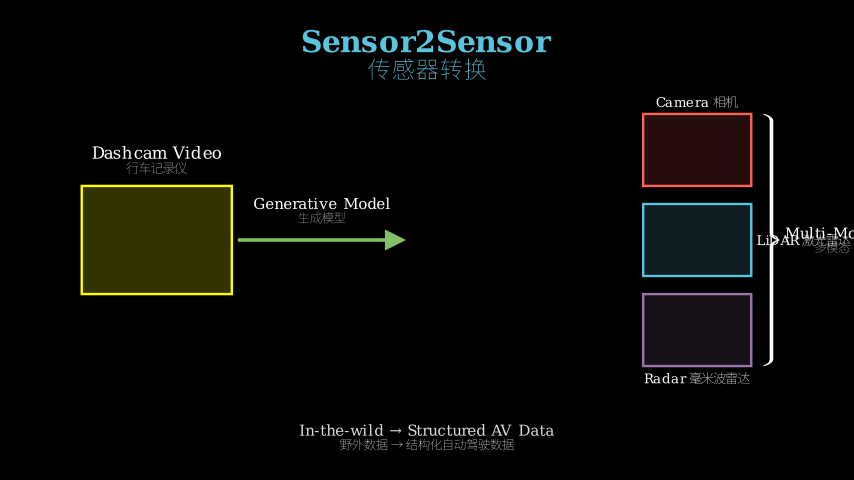
Paper: 2605.22809 Authors: Jiahao Wang, Bo Sun, Yijing Bai, Vincent Casser, Songyou Peng, Zehao Zhu, Meng-Li Shih, Xander Masotto, Shih-Yang Su, Kanaad V Parvate Categories: cs.CV
The Gap
Autonomous vehicle companies have high-quality sensor data (multi-camera rigs, LiDAR) but limited scale and diversity. The internet has billions of dashcam videos covering rare scenarios and diverse geographies, but AV systems can’t consume single-camera footage—they expect synchronized multi-modal inputs. Prior work either simulates synthetic data (lacks realism) or manually collects paired data (doesn’t scale). No one has cracked cross-embodiment sensor conversion: taking real-world monocular video and generating the multi-sensor suite an AV would have captured.
Problem: AV data scarcity + Internet video incompatibility
    |
    v
Assumption: Monocular video contains implicit 3D/multi-view info
    |
    v
Method: 4DGS reconstruction -> Paired data synthesis -> Diffusion-based conversion
    |
    v
Evidence: Quantitative metrics on generated cameras/LiDAR + Qualitative internet video demos
    |
    v
Conclusion: In-the-wild video becomes usable AV training data
The Increment
One sentence: Before this paper, internet dashcam videos were unusable for AV training; after, they can be converted into multi-camera + LiDAR sensor suites that AV systems expect.
Core Mechanism
Sensor2Sensor has two stages. First, create training pairs: take real AV logs (which have multi-camera + LiDAR), reconstruct the 4D scene using Gaussian Splatting, then render a synthetic dashcam view from the driver’s perspective. Now you have paired data: dashcam-style input → real multi-sensor output.
Second, train a diffusion model on these pairs. The model learns to invert the rendering process: given a monocular dashcam frame, generate what the surrounding cameras would see and what LiDAR points would exist in 3D space. The diffusion architecture handles the one-to-many ambiguity (many 3D scenes could produce the same 2D view) by learning a distribution over plausible sensor configurations.
At inference, feed in wild dashcam footage. The model hallucinates the missing sensor modalities—side cameras, rear camera, LiDAR—conditioned on the single front view. The output is a synthetic AV log that downstream perception systems can consume.
Training:
  Real AV log -> 4DGS reconstruction -> Render dashcam view
       |                                        |
       +----------------------------------------+
       |                                        |
       v                                        v
  [Multi-sensor ground truth]  <-paired->  [Dashcam input]
                                   |
                                   v
                            Diffusion model training

Inference:
  Wild dashcam video -> Diffusion model -> Generated multi-camera + LiDAR
Think of it like a forensic sketch artist working in reverse. A witness (dashcam) describes what they saw from one angle. The artist (diffusion model) has studied thousands of crime scenes (AV logs) and learned the typical spatial relationships—where objects usually are, how scenes are structured. From the single witness account, the artist reconstructs the full 360° scene, filling in what the other cameras would have seen and where solid objects must exist in 3D. The artist doesn’t know the exact truth, but produces a plausible reconstruction consistent with the witness testimony and learned scene priors.
Key Concepts
-
4D Gaussian Splatting (4DGS): Imagine representing a video scene as a cloud of 3D blobs (Gaussians), each with a position, color, opacity, and motion over time. To render any camera view, you project these blobs onto the image plane and blend their colors. 4DGS optimizes the blob parameters to match observed video frames. Once optimized, you can render novel views (like a dashcam perspective) from the same scene. It’s a differentiable renderer that turns multi-view video into a manipulable 3D representation. Concrete example: Given 6 camera views of a car passing by, 4DGS places Gaussians where the car’s surface is, then you can render what a 7th camera (the dashcam) would have seen.
-
Cross-embodiment conversion: Different robots/vehicles have different sensor configurations (embodiments). A Tesla has 8 cameras in specific positions; a Waymo has different cameras plus LiDAR. Cross-embodiment means translating data from one sensor setup to another. Here, it’s extreme: from 1 camera (dashcam) to 5+ cameras + LiDAR (AV suite). The challenge is that sensor geometry, fields of view, and modalities differ—you’re not just filling in missing pixels, you’re inventing entire new viewpoints and 3D structure.
-
Diffusion for sensor generation: Diffusion models learn to denoise: start with random noise, iteratively refine it into a sample from the training distribution. For sensor data, the model learns P(multi-sensor | dashcam). During training, it sees paired examples and learns what multi-camera + LiDAR configurations are consistent with a given dashcam view. At inference, it samples from this learned distribution, producing plausible sensor outputs. The stochasticity handles ambiguity—if the dashcam shows a car ahead but not its color, the model might generate red or blue, both valid.
Framework Shift
Before (mainstream approach):          After (this paper):

  Collect more AV data                   Leverage internet video
        |                                      |
        v                                      v
  [Expensive fleet ops]                  [Dashcam footage]
        |                                      |
        v                                      v
  Limited scale/diversity                4DGS reconstruction
        |                                      |
        v                                      v
  Train AV models                        Generate paired data
                                               |
                                               v
                                         Diffusion conversion
                                               |
                                               v
                                         Synthetic AV logs
                                               |
                                               v
                                         Train AV models
                                         (massive scale)
From closed-loop data collection to open-loop data synthesis, the core shift is treating the internet as a latent AV dataset that needs format conversion, not a separate unusable resource.
Expert Assessment
Problem choice: Real and urgent. AV companies are data-starved for long-tail scenarios (construction zones, rare weather, aggressive drivers). Internet video has this coverage but is locked behind an embodiment mismatch. The gap is genuine, not manufactured.
Method maturity: The 4DGS → diffusion pipeline is clever but feels like two heavy hammers. 4DGS reconstruction is expensive and assumes multi-view input exists for training data synthesis. The diffusion model is a black box—no explicit 3D reasoning, just learned correlations. A hybrid approach (explicit 3D lifting + learned refinement) might be more interpretable and data-efficient. The paper doesn’t explore lighter alternatives like NeRF-based synthesis or deterministic depth-based warping.
Experimental integrity: Baselines are thin. The paper compares against “no conversion” but not against simpler methods (monocular depth + geometric warping, or GAN-based approaches). Quantitative metrics (PSNR, LPIPS for images; Chamfer distance for LiDAR) are standard but don’t capture whether the generated data actually helps downstream AV tasks—no perception model evaluation. The qualitative internet video results look plausible but cherry-picked. Red flag: no failure case analysis or discussion of when the method breaks.
Writing quality: The abstract and intro are strong. The method section is dense—4DGS reconstruction is glossed over in half a page when it’s load-bearing for the whole pipeline. The experiments section front-loads metrics but buries the most interesting result (converting real internet footage) in supplementary material. Rewriting Section 4 to lead with qualitative internet examples, then justify with metrics, would make the contribution land harder.
Verdict: Weak accept — Addresses a real problem with a working solution, but the method feels over-engineered and the evaluation doesn’t prove the generated data is useful for actual AV training. The idea is more valuable than the execution.
Takeaways
Paired data synthesis via rendering: When you lack paired training data, reconstruct one modality into a manipulable 3D representation, then render the other modality. This trick generalizes beyond AVs—medical imaging (CT → MRI), robotics (RGB → depth), satellite imagery (optical → SAR).
Diffusion for multi-modal generation: Diffusion models handle one-to-many mappings gracefully. If your task has inherent ambiguity (one input, many valid outputs), diffusion lets you sample the distribution instead of forcing a single deterministic prediction. Useful for data augmentation, simulation, and any generative task where diversity matters.
Cross-embodiment as a framing: Reframing “data scarcity” as “embodiment mismatch” opens new solution paths. Instead of collecting more data in your target format, convert abundant data from other formats. This applies to any domain with heterogeneous sensors or data sources—medical devices, scientific instruments, IoT sensors.
论文: 2605.22809 作者: Jiahao Wang, Bo Sun, Yijing Bai, Vincent Casser, Songyou Peng, Zehao Zhu, Meng-Li Shih, Xander Masotto, Shih-Yang Su, Kanaad V Parvate 分类: cs.CV
缺口
自动驾驶公司拥有高质量传感器数据(多摄像头阵列、激光雷达),但规模和多样性有限。
互联网上有数十亿行车记录仪视频,覆盖罕见场景和多样地理环境,但自动驾驶系统无法使用单目视频——它们需要同步的多模态输入。
先前工作要么模拟合成数据(缺乏真实感),要么人工采集配对数据(无法规模化)。
没有人攻克跨载体传感器转换:将真实世界的单目视频转换为自动驾驶车辆本应捕获的多传感器套件。
问题:自动驾驶数据稀缺 + 互联网视频不兼容
    |
    v
假设:单目视频包含隐式的3D/多视角信息
    |
    v
方法:4DGS重建 -> 配对数据合成 -> 基于扩散的转换
    |
    v
证据:生成相机/激光雷达的定量指标 + 互联网视频定性演示
    |
    v
结论:野外视频变为可用的自动驾驶训练数据
增量
一句话: 这篇论文之前,互联网行车记录仪视频无法用于自动驾驶训练;之后,它们可以被转换为自动驾驶系统所需的多摄像头+激光雷达传感器套件。
核心机制
Sensor2Sensor分两个阶段。
第一阶段,创建训练配对:拿真实的自动驾驶日志(包含多摄像头+激光雷达),用高斯点云重建4D场景,然后从驾驶员视角渲染合成的行车记录仪视图。
现在有了配对数据:行车记录仪风格输入 → 真实多传感器输出。
第二阶段,在这些配对上训练扩散模型。
模型学习逆转渲染过程:给定单目行车记录仪帧,生成周围摄像头会看到的内容以及3D空间中存在的激光雷达点。
扩散架构处理一对多的歧义性(许多3D场景可能产生相同的2D视图),通过学习合理传感器配置的分布。
推理时,输入野外行车记录仪视频。
模型幻化出缺失的传感器模态——侧面摄像头、后置摄像头、激光雷达——以单个前视图为条件。
输出是下游感知系统可以使用的合成自动驾驶日志。
训练:
  真实自动驾驶日志 -> 4DGS重建 -> 渲染行车记录仪视图
       |                                        |
       +----------------------------------------+
       |                                        |
       v                                        v
  [多传感器真值]  <-配对->  [行车记录仪输入]
                                   |
                                   v
                            扩散模型训练

推理:
  野外行车记录仪视频 -> 扩散模型 -> 生成多摄像头+激光雷达
把它想象成反向工作的法医素描师。
目击者(行车记录仪)描述他们从一个角度看到的东西。
画师(扩散模型)研究过数千个犯罪现场(自动驾驶日志),学会了典型的空间关系——物体通常在哪里,场景如何构成。
从单个目击者陈述,画师重建完整的360°场景,填补其他摄像头会看到的内容以及3D中必然存在的实体物体。
画师不知道确切真相,但产生一个与目击者证词和学到的场景先验一致的合理重建。
关键概念
- 4D高斯点云(4DGS): 想象将视频场景表示为一团3D斑点(高斯)云,每个斑点有位置、颜色、不透明度和随时间的运动。
要渲染任何相机视图,将这些斑点投影到图像平面并混合它们的颜色。
4DGS优化斑点参数以匹配观察到的视频帧。
一旦优化,你可以从同一场景渲染新视角(如行车记录仪视角)。
它是一个可微渲染器,将多视角视频转换为可操作的3D表示。
具体例子:给定一辆车经过的6个摄像头视图,4DGS在车表面放置高斯点,然后你可以渲染第7个摄像头(行车记录仪)会看到的内容。
- 跨载体转换: 不同机器人/车辆有不同的传感器配置(载体)。
特斯拉有8个特定位置的摄像头;Waymo有不同的摄像头加激光雷达。
跨载体意味着将数据从一种传感器设置转换为另一种。
这里是极端情况:从1个摄像头(行车记录仪)到5+个摄像头+激光雷达(自动驾驶套件)。
挑战在于传感器几何、视野和模态不同——你不只是填补缺失像素,而是发明全新的视点和3D结构。
- 用于传感器生成的扩散: 扩散模型学习去噪:从随机噪声开始,迭代地将其精炼为训练分布的样本。
对于传感器数据,模型学习P(多传感器|行车记录仪)。
训练期间,它看到配对示例并学习哪些多摄像头+激光雷达配置与给定行车记录仪视图一致。
推理时,它从这个学到的分布中采样,产生合理的传感器输出。
随机性处理歧义——如果行车记录仪显示前方有车但看不到颜色,模型可能生成红色或蓝色,两者都有效。
框架转变
之前(主流方法):                之后(本文方法):

  收集更多自动驾驶数据                利用互联网视频
        |                                      |
        v                                      v
  [昂贵的车队运营]                      [行车记录仪视频]
        |                                      |
        v                                      v
  有限的规模/多样性                      4DGS重建
        |                                      |
        v                                      v
  训练自动驾驶模型                       生成配对数据
                                               |
                                               v
                                         扩散转换
                                               |
                                               v
                                         合成自动驾驶日志
                                               |
                                               v
                                         训练自动驾驶模型
                                         (大规模)
从闭环数据采集到开环数据合成,核心转变是将互联网视为需要格式转换的潜在自动驾驶数据集,而非独立的不可用资源。
专家评审
选题眼光: 真实且紧迫。
自动驾驶公司在长尾场景(施工区、罕见天气、激进驾驶员)上数据匮乏。
互联网视频有这种覆盖,但被载体不匹配锁住。
缺口是真实的,不是人造的。
方法成熟度: 4DGS → 扩散流水线很巧妙,但感觉像两把重锤。
4DGS重建昂贵,且假设训练数据合成存在多视角输入。
扩散模型是黑盒——没有显式3D推理,只是学到的相关性。
混合方法(显式3D提升+学习精炼)可能更可解释且数据高效。
论文没有探索更轻的替代方案,如基于NeRF的合成或确定性基于深度的变形。
实验诚意: 基线薄弱。
论文与”无转换”比较,但没有与更简单的方法比较(单目深度+几何变形,或基于GAN的方法)。
定量指标(图像的PSNR、LPIPS;激光雷达的Chamfer距离)是标准的,但没有捕捉生成数据是否真正帮助下游自动驾驶任务——没有感知模型评估。
定性互联网视频结果看起来合理但经过精选。
警示信号:没有失败案例分析或关于方法何时失效的讨论。
写作功力: 摘要和引言很强。
方法部分密集——4DGS重建在半页中一笔带过,而它是整个流水线的承重部分。
实验部分前置指标,但将最有趣的结果(转换真实互联网视频)埋在补充材料中。
重写第4节,以定性互联网示例开头,然后用指标证明,会让贡献更有力。
判决: 弱接收 — 用可行方案解决真实问题,但方法感觉过度工程化,评估没有证明生成数据对实际自动驾驶训练有用。
想法比执行更有价值。
要点总结
通过渲染合成配对数据: 当你缺乏配对训练数据时,将一种模态重建为可操作的3D表示,然后渲染另一种模态。
这个技巧超越自动驾驶——医学成像(CT → MRI)、机器人(RGB → 深度)、卫星图像(光学 → SAR)。
用于多模态生成的扩散: 扩散模型优雅地处理一对多映射。
如果你的任务有固有歧义(一个输入,多个有效输出),扩散让你采样分布而不是强制单一确定性预测。
对数据增强、模拟和任何多样性重要的生成任务有用。
跨载体作为框架: 将”数据稀缺”重新框定为”载体不匹配”打开新的解决路径。
不是收集更多目标格式的数据,而是转换其他格式的丰富数据。
这适用于任何具有异构传感器或数据源的领域——医疗设备、科学仪器、物联网传感器。