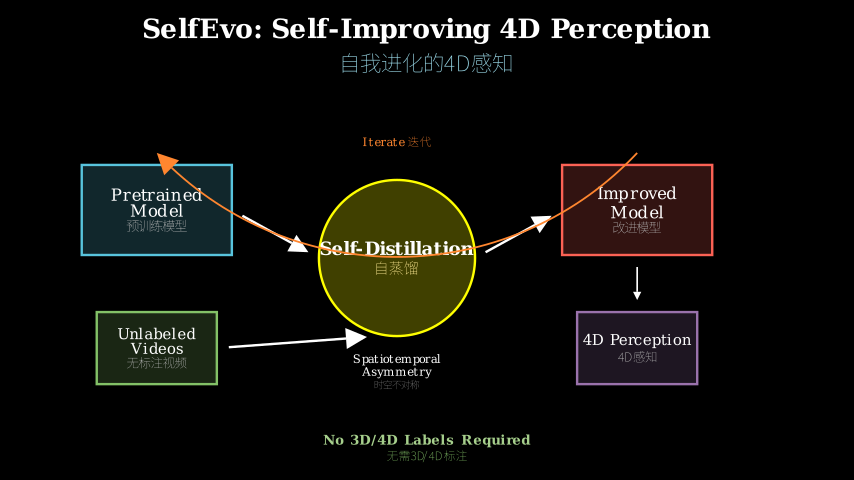
Paper: 2604.08532 Authors: Nan Huang, Pengcheng Yu, Weijia Zeng, James M. Rehg, Angjoo Kanazawa, Haiwen Feng, Qianqian Wang Categories: cs.CV
The Gap
Multi-view reconstruction models (like VGGT and π³) have gotten good at estimating depth and camera poses from videos, but they hit a wall: they need expensive 3D/4D ground-truth annotations to train. For dynamic scenes—people moving, objects deforming—these annotations are especially scarce. You can’t just slap LiDAR on everything. Prior self-supervised methods exist but rely on photometric consistency, which breaks down with moving objects and lighting changes. The field is stuck: models plateau after pretraining because there’s no scalable way to improve them without more labeled data.
Problem: Models plateau after pretraining
   |
   v
Constraint: 3D/4D labels scarce for dynamic scenes
   |
   v
Assumption: Spatiotemporal context asymmetry = free supervision signal
   |
   v
Method: Self-distillation with asymmetric views (teacher sees more context)
   |
   v
Evidence: 36.5% depth improvement, 20.1% camera improvement (8 benchmarks)
   |
   v
Conclusion: Unlabeled videos sufficient for continual 4D perception improvement
The Increment
One sentence: Before, you needed labeled 3D data to improve reconstruction models; after, you can keep improving them indefinitely using any unlabeled video by having the model teach itself through asymmetric context.
Core Mechanism
SelfEvo works by creating a teacher-student setup where both are the same model, but the teacher gets to “cheat” by seeing more context. During training, the student sees a limited spatiotemporal window (say, 3 frames, small crop), while the teacher sees a larger window (say, 7 frames, full image). The teacher generates pseudo-labels—depth maps, camera poses—from its richer context. The student learns to match these pseudo-labels from its limited view.
The key insight: if your model already works reasonably well, giving it more context makes its predictions more reliable. Those better predictions become training signal for the limited-context version. It’s bootstrapping, but the asymmetry prevents collapse—the teacher isn’t just parroting the student’s mistakes back.
The training loop is simple: sample a video clip, create two views (limited and rich context), freeze the teacher’s weights (exponential moving average of student), generate pseudo-labels from teacher, train student to match them. Repeat on millions of unlabeled video frames. The model gradually learns to extract more information from less context by mimicking what it does when it has more context.
Video Clip
    |
    +---> Student View (3 frames, crop) ---> Depth_s, Pose_s
    |                                              |
    +---> Teacher View (7 frames, full) ---> Depth_t, Pose_t
                                                   |
                                                   v
                                            Pseudo-labels
                                                   |
                                                   v
                                            Loss = |Depth_s - Depth_t|
                                                   + |Pose_s - Pose_t|
                                                   |
                                                   v
                                            Update Student Weights
                                                   |
                                                   v
                                            EMA Update Teacher
Think of it like learning to navigate a city. The teacher is you with Google Maps, GPS, and a bird’s-eye view. The student is you with just street-level vision and a vague memory of the last few blocks. The teacher says “you’re at coordinates X, the building is Y meters away.” The student learns to infer those same facts from limited cues—shadows, building heights, street signs. Over time, the student gets better at navigation even when the map is taken away. The teacher keeps improving too (EMA updates), so it’s not teaching stale knowledge. The asymmetry is crucial: if both had the same view, the student would just memorize the teacher’s current mistakes. The richer context forces the teacher to be more accurate, creating a gradient the student can climb.
Key Concepts
-
Spatiotemporal Context Asymmetry: The teacher model sees more frames (temporal) and larger image regions (spatial) than the student. This isn’t just data augmentation—it’s a structured information gap. When you see 7 frames instead of 3, motion patterns become clearer. When you see the full image instead of a crop, you get more geometric constraints. The teacher leverages this extra information to produce more accurate predictions, which become training targets for the student. Without asymmetry, you get mode collapse: the student and teacher converge to the same mediocre solution. With asymmetry, the teacher is always slightly “smarter” because it has more evidence.
-
Self-Distillation Without External Labels: Traditional distillation has a fixed, pretrained teacher. Here, the teacher evolves alongside the student (via exponential moving average of student weights). This creates a moving target that prevents overfitting to early mistakes. The “distillation” part means the student learns from soft targets (the teacher’s predictions) rather than hard ground-truth labels. The “self” part means no external supervision—the model generates its own training signal by exploiting the fact that more context = better predictions. It’s a closed loop: better student → better teacher (via EMA) → better pseudo-labels → better student.
-
Pseudo-Label Quality via Context: Not all pseudo-labels are equal. A depth map predicted from 7 frames with full image context is more reliable than one from 3 frames and a crop. SelfEvo doesn’t explicitly filter pseudo-labels; instead, it relies on the statistical fact that richer context reduces prediction variance. Over millions of training samples, the student learns to ignore noise and extract the consistent signal. This works because the base model (VGGT or π³) is already decent—it’s not learning from scratch. The pseudo-labels are noisy but biased toward correctness, and gradient descent averages out the noise.
Framework Shift
Before (supervised training):        After (SelfEvo):

  Labeled Data                        Unlabeled Videos
      |                                      |
      v                                      v
  Train Model                         Pretrained Model
      |                                      |
      v                                      +---> Teacher (more context)
  Fixed Performance                          |          |
  (plateau)                                  |          v
                                             |    Pseudo-labels
                                             |          |
                                             +---> Student (less context)
                                                        |
                                                        v
                                                  Continual Improvement
From static supervised learning to continual self-improvement, the core shift is replacing expensive human annotations with free spatiotemporal asymmetry as the supervision signal.
Expert Assessment
Problem choice: Real gap. The scarcity of 4D annotations is a genuine bottleneck, especially for dynamic scenes. This isn’t a manufactured problem—it’s why most reconstruction models are trained on static datasets like ScanNet. The timing is right: pretrained models are good enough that self-improvement is feasible, but not so good that gains are marginal.
Method maturity: Clever insight, not brute force. The spatiotemporal asymmetry idea is elegant—it’s a structured way to create supervision from unlabeled data without relying on brittle photometric assumptions. The EMA teacher is borrowed from semi-supervised learning (FixMatch, etc.), but the application to 4D perception is novel. One concern: the method assumes the base model is already decent. If you start with a terrible model, asymmetry won’t save you—garbage in, garbage out. The paper doesn’t explore the lower bound of base model quality needed for SelfEvo to work.
Experimental integrity: Baselines are fair. They compare against the pretrained models (VGGT, π³) and show consistent gains across 8 benchmarks. The ablations are thorough—they test different forms of asymmetry (temporal only, spatial only, both), loss functions, and training strategies. One red flag: the gains are larger on dynamic scenes (Sintel, DAVIS) than static ones (ScanNet). This makes sense given the motivation, but it also means the method’s value is domain-dependent. The paper could be clearer about when SelfEvo helps vs. when it’s overkill.
Writing quality: The abstract and intro are strong—clear motivation, crisp claims. The method section is dense but readable. The weakest part is the related work: it’s a laundry list of citations without enough contrast. A rewrite that clusters prior work into “why they fail on dynamic scenes” would elevate the paper. Also, the ablation tables are hard to parse—too many numbers, not enough visual summaries.
Verdict: weak accept — Solid contribution with clear practical value, but the novelty is more in application than in algorithmic innovation. The experimental work is convincing, and the gains are non-trivial. It’s a paper that will get cited by practitioners, even if it doesn’t shift paradigms.
Takeaways
The big idea you can steal: asymmetry as free supervision. Anytime you have a model that benefits from more context (more frames, larger crops, higher resolution), you can create a self-improvement loop by training a limited-context version to mimic the full-context version. This applies beyond 4D perception—think video understanding, long-context language models, or any domain where “more data = better predictions” but inference needs to be fast/cheap.
Specific technique: the EMA teacher update schedule matters. The paper uses a momentum of 0.999, which means the teacher changes slowly. Too fast, and the teacher just tracks the student’s mistakes. Too slow, and the teacher becomes stale. If you’re adapting this to another domain, tune that momentum carefully.
Practical insight: self-improvement works best when the base model is already in the “good but not great” regime. If your model is random, asymmetry won’t help. If it’s already near-optimal, gains will be marginal. The sweet spot is when the model has learned the basics but still makes systematic errors that more context can correct.
论文: 2604.08532 作者: Nan Huang, Pengcheng Yu, Weijia Zeng, James M. Rehg, Angjoo Kanazawa, Haiwen Feng, Qianqian Wang 分类: cs.CV
缺口
多视角重建模型(如VGGT和π³)在从视频估计深度和相机位姿方面已经做得不错,但它们遇到了瓶颈:需要昂贵的3D/4D真值标注来训练。
对于动态场景——人在移动、物体在变形——这些标注尤其稀缺。
你不可能给所有东西都装上激光雷达。
现有的自监督方法依赖光度一致性,但在移动物体和光照变化面前会失效。
该领域陷入困境:模型在预训练后就停滞不前,因为没有可扩展的方法在不增加标注数据的情况下继续改进它们。
问题:模型预训练后停滞
   |
   v
约束:动态场景的3D/4D标注稀缺
   |
   v
假设:时空上下文不对称 = 免费监督信号
   |
   v
方法:用不对称视图自蒸馏(教师看到更多上下文)
   |
   v
证据:深度提升36.5%,相机提升20.1%(8个基准)
   |
   v
结论:无标注视频足以持续改进4D感知
增量
一句话: 之前需要标注3D数据才能改进重建模型;
之后可以用任何无标注视频持续改进,方法是让模型通过不对称上下文自我教学。
核心机制
SelfEvo通过创建师生设置来工作,两者是同一个模型,但教师可以”作弊”看到更多上下文。
训练时,学生看到有限的时空窗口(比如3帧,小裁剪),而教师看到更大的窗口(比如7帧,完整图像)。
教师从其更丰富的上下文生成伪标签——深度图、相机位姿。
学生学习从其有限视图匹配这些伪标签。
关键洞察:如果你的模型已经工作得相当好,给它更多上下文会使其预测更可靠。
那些更好的预测成为有限上下文版本的训练信号。
这是自举,但不对称性防止了崩溃——教师不只是把学生的错误鹦鹉学舌地重复回去。
训练循环很简单:采样视频片段,创建两个视图(有限和丰富上下文),冻结教师权重(学生的指数移动平均),从教师生成伪标签,训练学生匹配它们。
在数百万无标注视频帧上重复。
模型通过模仿它在有更多上下文时的做法,逐渐学会从更少上下文中提取更多信息。
视频片段
    |
    +---> 学生视图(3帧,裁剪)---> 深度_s,位姿_s
    |                                      |
    +---> 教师视图(7帧,完整)---> 深度_t,位姿_t
                                           |
                                           v
                                      伪标签
                                           |
                                           v
                                    损失 = |深度_s - 深度_t|
                                           + |位姿_s - 位姿_t|
                                           |
                                           v
                                    更新学生权重
                                           |
                                           v
                                    EMA更新教师
把它想象成学习在城市中导航。
教师是带着谷歌地图、GPS和鸟瞰视角的你。
学生是只有街道视角和对过去几个街区模糊记忆的你。
教师说”你在坐标X,建筑物距离Y米”。
学生学会从有限线索推断这些事实——阴影、建筑高度、街道标志。
随着时间推移,即使地图被拿走,学生也能更好地导航。
教师也在持续改进(EMA更新),所以它不是在教陈旧的知识。
不对称性至关重要:如果两者有相同视图,学生只会记住教师当前的错误。
更丰富的上下文迫使教师更准确,创造了学生可以攀登的梯度。
关键概念
- 时空上下文不对称:教师模型比学生看到更多帧(时间)和更大图像区域(空间)。
这不只是数据增强——这是一个结构化的信息差距。
当你看7帧而不是3帧时,运动模式变得更清晰。
当你看完整图像而不是裁剪时,你得到更多几何约束。
教师利用这些额外信息产生更准确的预测,这些预测成为学生的训练目标。
没有不对称性,你会得到模式崩溃:学生和教师收敛到同样平庸的解决方案。
有了不对称性,教师总是稍微”更聪明”,因为它有更多证据。
- 无外部标签的自蒸馏:传统蒸馏有一个固定的、预训练的教师。
这里,教师与学生一起进化(通过学生权重的指数移动平均)。
这创造了一个移动目标,防止对早期错误的过拟合。
“蒸馏”部分意味着学生从软目标(教师的预测)而不是硬真值标签学习。
“自我”部分意味着没有外部监督——模型通过利用更多上下文=更好预测这一事实生成自己的训练信号。
这是一个闭环:更好的学生→更好的教师(通过EMA)→更好的伪标签→更好的学生。
- 通过上下文的伪标签质量:并非所有伪标签都相等。
从7帧和完整图像上下文预测的深度图比从3帧和裁剪预测的更可靠。
SelfEvo不显式过滤伪标签;
相反,它依赖于更丰富上下文减少预测方差这一统计事实。
在数百万训练样本上,学生学会忽略噪声并提取一致信号。
这有效是因为基础模型(VGGT或π³)已经相当不错——它不是从零开始学习。
伪标签有噪声但偏向正确,梯度下降平均掉噪声。
框架转变
之前(监督训练):              之后(SelfEvo):

  标注数据                        无标注视频
      |                                |
      v                                v
  训练模型                        预训练模型
      |                                |
      v                                +---> 教师(更多上下文)
  固定性能                             |          |
  (停滞)                             |          v
                                       |    伪标签
                                       |          |
                                       +---> 学生(更少上下文)
                                                  |
                                                  v
                                            持续改进
从静态监督学习到持续自我改进,核心转变是用免费的时空不对称性作为监督信号替代昂贵的人工标注。
专家评审
选题眼光:真实缺口。
4D标注的稀缺性是一个真正的瓶颈,尤其是对动态场景。
这不是人造问题——这就是为什么大多数重建模型在ScanNet等静态数据集上训练。
时机恰当:预训练模型已经足够好,自我改进是可行的,但还没有好到收益微不足道。
方法成熟度:巧劲,不是蛮力。
时空不对称性的想法很优雅——这是一种从无标注数据创建监督的结构化方法,不依赖脆弱的光度假设。
EMA教师借鉴自半监督学习(FixMatch等),但应用到4D感知是新颖的。
一个担忧:该方法假设基础模型已经相当不错。
如果你从一个糟糕的模型开始,不对称性救不了你——垃圾进,垃圾出。
论文没有探索SelfEvo工作所需的基础模型质量下限。
实验诚意:基线公平。
他们与预训练模型(VGGT、π³)比较,在8个基准上显示一致的收益。
消融实验很彻底——他们测试了不同形式的不对称性(仅时间、仅空间、两者),损失函数和训练策略。
一个值得警惕之处:在动态场景(Sintel、DAVIS)上的收益大于静态场景(ScanNet)。
考虑到动机这说得通,但也意味着该方法的价值依赖于领域。
论文可以更清楚地说明SelfEvo何时有帮助vs何时是过度设计。
写作功力:摘要和引言很强——清晰的动机,简洁的主张。
方法部分密集但可读。
最弱的部分是相关工作:它是一个引用清单,没有足够的对比。
重写成将先前工作聚类为”为什么它们在动态场景上失败”会提升论文。
此外,消融表格难以解析——太多数字,没有足够的视觉总结。
判决:弱接收——扎实的贡献,有明确的实用价值,但新颖性更多在应用而非算法创新。
实验工作令人信服,收益非平凡。
这是一篇会被实践者引用的论文,即使它不会转变范式。
要点总结
你能偷走的大想法:不对称性作为免费监督。
任何时候你有一个从更多上下文(更多帧、更大裁剪、更高分辨率)受益的模型,你都可以通过训练有限上下文版本模仿完整上下文版本来创建自我改进循环。
这适用于4D感知之外——想想视频理解、长上下文语言模型,或任何”更多数据=更好预测”但推理需要快速/便宜的领域。
具体技术:EMA教师更新计划很重要。
论文使用0.999的动量,这意味着教师变化缓慢。
太快,教师只是跟踪学生的错误。
太慢,教师变得陈旧。
如果你要将此适配到另一个领域,仔细调整那个动量。
实用洞察:当基础模型已经处于”好但不是很好”的状态时,自我改进效果最好。
如果你的模型是随机的,不对称性不会有帮助。
如果它已经接近最优,收益将是边际的。
最佳点是当模型已经学会基础但仍然犯更多上下文可以纠正的系统性错误时。