
Paper: 2603.16869 Authors: Lin Li, Haoran Feng, Zehuan Huang, Haohua Chen, Wenbo Nie, Shaohua Hou, Keqing Fan, Pan Hu, Sheng Wang, Buyu Li Categories: cs.CV
The Gap
Existing 3D part segmentation methods split into two camps. The 2D-to-3D camp lifts strong 2D vision models (like SAM) into 3D through distillation or multi-view aggregation, but suffers from cross-view inconsistencies and blurred boundaries where views disagree. The native 3D camp trains discriminative models directly on 3D data, but requires massive labeled 3D datasets and substantial compute resources—both scarce commodities.
Meanwhile, 3D generative models (like diffusion models trained on 3D shapes) have learned rich structural priors about how objects decompose into parts. These priors sit unused for segmentation tasks. The gap: no one’s figured out how to repurpose a generative model’s internal understanding of part structure for the discriminative task of segmentation.
Problem: 3D part segmentation needs labels + compute
   |
   v
Observation: 3D generators already encode part structure
   |
   v
Assumption: Generative priors can induce segmentation
   |
   v
Method: Colorize parts distinctively via generator
   |
   v
Evidence: 40% better with 0.32% training data
   |
   v
Conclusion: Generative priors transfer to segmentation
The Increment
One sentence: Before, you needed massive labeled 3D datasets to segment parts; after, you can repurpose a pretrained 3D generator to do it with minimal supervision.
Core Mechanism
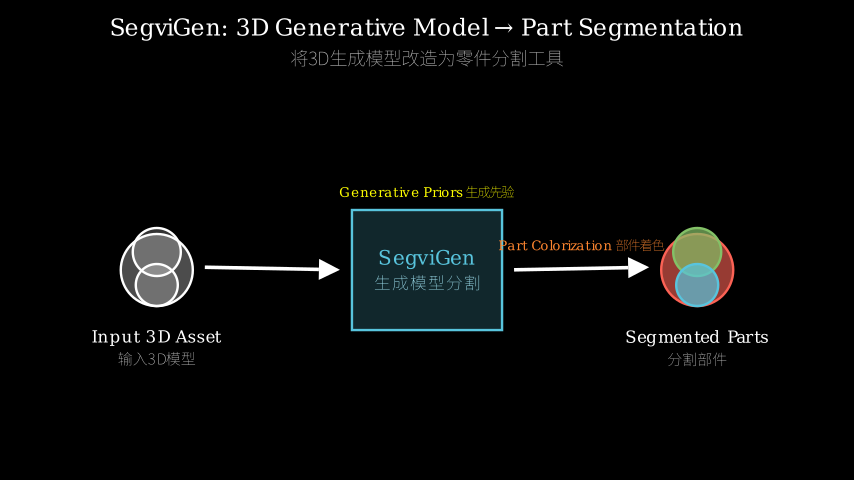
SegviGen takes a pretrained 3D generative model (specifically, a voxel-based diffusion model) and adds a lightweight segmentation head. The key insight: instead of predicting discrete part labels, predict distinctive colors for each part. The generator’s decoder, trained to reconstruct realistic 3D shapes, naturally respects part boundaries because it learned that chairs have distinct legs, backs, and seats.
The pipeline works in three stages. First, encode the input 3D shape into the generator’s latent space. Second, the segmentation head predicts per-voxel colors on the geometry-aligned reconstruction—active voxels only, no wasted computation on empty space. Third, cluster these colors into discrete segments. The generator’s structural priors do the heavy lifting; the segmentation head just learns to colorize parts distinctively.
The framework handles three modes: interactive (user clicks a point, system segments that part), full segmentation (segment everything), and guided (use 2D masks from SAM to guide 3D segmentation). All three share the same colorization backbone.
Input 3D Shape
      |
      v
[Pretrained Generator Encoder]
      |
      v
   Latent Code
      |
      v
[Generator Decoder] <------ Frozen weights
      |              \
      v               \
Reconstructed Voxels  [Segmentation Head] <-- Lightweight
      |                      |
      v                      v
Active Voxels -----> Part Colors (continuous)
                           |
                           v
                    Color Clustering
                           |
                           v
                    Part Segments
Think of it like a paint-by-numbers kit. The pretrained generator is an artist who already knows how to draw chairs—where legs end and seats begin. You’re not teaching the artist anatomy from scratch; you’re just handing them a palette and saying “paint each part a different color.” The artist’s existing knowledge of structure ensures the colors don’t bleed across part boundaries. Your job (the segmentation head) is minimal: just learn which colors to assign. The artist (generator) handles the hard part of respecting boundaries.
Key Concepts
-
Generative Priors for Discriminative Tasks: Generative models learn to synthesize realistic data, which requires understanding structure. A 3D shape generator that can create convincing chairs must internally represent that chairs have legs, backs, and seats as distinct components. This structural knowledge is a “prior”—a built-in understanding. SegviGen’s insight is that this prior, learned for generation, transfers to segmentation. Instead of training a segmentation model from scratch on labeled data, you leverage the structure already encoded in a pretrained generator. It’s like using a novelist’s understanding of story structure to teach plot analysis—the generative skill contains the discriminative knowledge.
-
Part-Indicative Colorization: Instead of predicting discrete labels (leg=1, back=2, seat=3), SegviGen predicts continuous RGB colors for each voxel. Why? Colors are easier to learn because they’re continuous and the generator’s decoder already outputs colors. The segmentation head learns to assign distinctive colors to different parts—red for legs, blue for backs, green for seats. Then a simple clustering algorithm groups similar colors into discrete segments. This sidesteps the need for large labeled datasets because the generator’s decoder provides strong supervision: it won’t let you paint across part boundaries because it learned realistic shapes have distinct parts.
-
Geometry-Aligned Reconstruction: The generator reconstructs the input shape in voxel space, but only active voxels (occupied by geometry) matter. SegviGen aligns the reconstruction with the input geometry, then predicts colors only on active voxels. This is efficient—no computation wasted on empty space—and ensures the segmentation matches the actual shape, not a blurry reconstruction. Think of it as painting only the surface of a sculpture, not the air around it.
Framework Shift
Before (2D-to-3D or Native 3D):        After (SegviGen):

2D Model (SAM)                         Pretrained 3D Generator
     |                                        |
     v                                        v
Multi-view Masks                       Encode Input Shape
     |                                        |
     v                                        v
Aggregate to 3D                        Colorize Parts
     |                                        |
     v                                        v
Inconsistent Boundaries                Cluster Colors
                                             |
OR                                           v
                                       Part Segments
Large 3D Dataset
     |
     v
Train Discriminative Model
     |
     v
Expensive Training
From lifting 2D priors or training from scratch to repurposing generative structure, the core shift is treating segmentation as colorization guided by pretrained priors.
Expert Assessment
Problem choice: Real gap. 3D part segmentation is bottlenecked by data scarcity and annotation cost. Repurposing generative models is a natural next step after their success in 2D (e.g., using CLIP for segmentation). The timing is right—3D generative models are maturing.
Method maturity: Clever insight, not brute force. The colorization trick is elegant: it leverages the generator’s decoder without retraining it, and continuous colors are easier to learn than discrete labels. However, the reliance on voxel-based generators limits resolution. The paper doesn’t explore whether this transfers to other 3D representations (meshes, point clouds, NeRFs).
Experimental integrity: Strong results but limited baselines. The 40% improvement on interactive segmentation is impressive, but the comparison is mostly against SAM-based methods. Missing: comparisons with recent native 3D methods like PointNet++ variants or transformer-based segmentation. The “0.32% training data” claim is compelling but needs context—what’s the absolute performance gap to fully supervised methods? The paper shows SegviGen beats prior work, but doesn’t clearly show where it sits relative to the ceiling.
Writing quality: The abstract and introduction are crisp, but the method section buries the key insight (colorization) under implementation details. Section 3.2 should lead with “we predict colors, not labels” and explain why. The experiments are thorough but the ablation studies (Section 4.3) feel rushed—more analysis of what the generator learned would strengthen the claims.
Verdict: weak accept — Solid idea with strong empirical results, but limited exploration of when/why it works and narrow scope (voxel-only).
Takeaways
The colorization trick is transferable: if you have a pretrained generative model for any structured data (images, audio, molecules), you can add a lightweight head that predicts continuous features (colors, embeddings) instead of discrete labels, then cluster. The generator’s decoder provides implicit supervision.
For practitioners working with limited labeled data: check if a generative model exists for your domain. Repurposing it for discriminative tasks might beat training from scratch. The key is finding a continuous output space (like colors) that the generator already handles well.
The geometry-aligned reconstruction idea applies beyond segmentation: any task where you need dense predictions on 3D shapes can benefit from computing only on active voxels/points, not the full grid.
论文: 2603.16869 作者: Lin Li, Haoran Feng, Zehuan Huang, Haohua Chen, Wenbo Nie, Shaohua Hou, Keqing Fan, Pan Hu, Sheng Wang, Buyu Li 分类: cs.CV
缺口
现有的3D零件分割方法分为两派。
2D转3D派将强大的2D视觉模型(如SAM)通过蒸馏或多视图聚合提升到3D,但遭遇跨视图不一致和边界模糊的问题——不同视角的预测相互矛盾时就会出现模糊边界。
原生3D派直接在3D数据上训练判别模型,但需要海量标注3D数据集和大量计算资源——两者都是稀缺资源。
与此同时,3D生成模型(如在3D形状上训练的扩散模型)已经学到了关于物体如何分解为零件的丰富结构先验。
这些先验在分割任务中闲置未用。
缺口在于:没人搞清楚如何将生成模型内部对零件结构的理解改造用于分割这一判别任务。
问题:3D零件分割需要标注+算力
   |
   v
观察:3D生成器已编码零件结构
   |
   v
假设:生成先验可诱导分割
   |
   v
方法:通过生成器给零件着色
   |
   v
证据:用0.32%数据提升40%
   |
   v
结论:生成先验可迁移到分割
增量
一句话: 之前需要海量标注3D数据才能分割零件;
现在可以用极少监督改造预训练3D生成器来完成。
核心机制
SegviGen拿一个预训练3D生成模型(具体是基于体素的扩散模型),加上一个轻量级分割头。
核心洞察:不预测离散的零件标签,而是为每个零件预测独特的颜色。
生成器的解码器训练用于重建真实3D形状,自然会尊重零件边界,因为它学到了椅子有不同的腿、靠背和座位。
流程分三阶段。
首先,将输入3D形状编码到生成器的潜空间。
其次,分割头在几何对齐的重建上预测每个体素的颜色——只在活跃体素上,不在空白空间浪费计算。
第三,将这些颜色聚类成离散分段。
生成器的结构先验承担重活;
分割头只需学会给零件着上独特的颜色。
框架支持三种模式:交互式(用户点击一个点,系统分割该零件)、完整分割(分割所有零件)、引导式(用SAM的2D掩码引导3D分割)。
三种模式共享同一个着色骨干。
输入3D形状
      |
      v
[预训练生成器编码器]
      |
      v
   潜码
      |
      v
[生成器解码器] <------ 冻结权重
      |              \
      v               \
重建体素            [分割头] <-- 轻量级
      |                      |
      v                      v
活跃体素 -----> 零件颜色(连续)
                           |
                           v
                    颜色聚类
                           |
                           v
                    零件分段
把它想象成数字填色游戏。
预训练生成器是个已经会画椅子的画家——知道腿在哪里结束、座位从哪里开始。
你不是从零教画家解剖学;
你只是递给他们一个调色板说”给每个零件涂不同颜色”。
画家现有的结构知识确保颜色不会跨越零件边界渗透。
你的工作(分割头)很轻:只需学会分配哪些颜色。
画家(生成器)处理尊重边界这个难活。
关键概念
- 用于判别任务的生成先验: 生成模型学习合成真实数据,这需要理解结构。
一个能创造逼真椅子的3D形状生成器必须在内部表征椅子有腿、靠背和座位这些不同组件。
这种结构知识是”先验”——内置的理解。
SegviGen的洞察是这个为生成而学的先验可以迁移到分割。
不用在标注数据上从零训练分割模型,而是利用预训练生成器中已编码的结构。
就像用小说家对故事结构的理解来教情节分析——生成技能包含判别知识。
- 零件指示性着色: 不预测离散标签(腿=1,靠背=2,座位=3),SegviGen为每个体素预测连续RGB颜色。
为什么?
颜色更容易学,因为它们是连续的,而且生成器的解码器本来就输出颜色。
分割头学会给不同零件分配独特颜色——腿用红色,靠背用蓝色,座位用绿色。
然后简单的聚类算法将相似颜色分组为离散分段。
这绕过了对大型标注数据集的需求,因为生成器的解码器提供强监督:它不会让你跨零件边界涂色,因为它学到了真实形状有不同的零件。
- 几何对齐重建: 生成器在体素空间重建输入形状,但只有活跃体素(被几何占据的)才重要。
SegviGen将重建与输入几何对齐,然后只在活跃体素上预测颜色。
这很高效——不在空白空间浪费计算——并确保分割匹配实际形状,而非模糊重建。
把它想象成只在雕塑表面涂色,不涂周围的空气。
框架转变
之前(2D转3D或原生3D):          之后(SegviGen):

2D模型(SAM)                     预训练3D生成器
     |                                   |
     v                                   v
多视图掩码                          编码输入形状
     |                                   |
     v                                   v
聚合到3D                            给零件着色
     |                                   |
     v                                   v
边界不一致                          聚类颜色
                                        |
或                                      v
                                   零件分段
大型3D数据集
     |
     v
训练判别模型
     |
     v
昂贵训练
从提升2D先验或从零训练到改造生成结构,核心转变是将分割视为由预训练先验引导的着色。
专家评审
选题眼光: 真实缺口。
3D零件分割被数据稀缺和标注成本卡住。
改造生成模型是2D成功(如用CLIP做分割)后的自然下一步。
时机成熟——3D生成模型正在成熟。
方法成熟度: 巧劲,非蛮力。
着色技巧很优雅:它利用生成器的解码器而不重训,连续颜色比离散标签更易学。
但对基于体素的生成器的依赖限制了分辨率。
论文未探索这是否迁移到其他3D表征(网格、点云、NeRF)。
实验诚意: 结果强劲但基线有限。
交互式分割上40%的提升令人印象深刻,但对比主要针对基于SAM的方法。
缺失:与最近原生3D方法(如PointNet++变体或基于transformer的分割)的对比。
“0.32%训练数据”的说法很有说服力,但需要上下文——与完全监督方法的绝对性能差距是多少?
论文显示SegviGen击败先前工作,但未清楚展示它相对天花板的位置。
写作功力: 摘要和引言简洁,但方法部分将关键洞察(着色)埋在实现细节下。
3.2节应该以”我们预测颜色而非标签”开头并解释原因。
实验很全面,但消融研究(4.3节)感觉仓促——更多关于生成器学到什么的分析会强化论断。
判决: 弱接收 — 扎实想法配强实证结果,但对何时/为何有效的探索有限,范围狭窄(仅体素)。
要点总结
着色技巧可迁移:如果你有任何结构化数据(图像、音频、分子)的预训练生成模型,可以加一个轻量级头预测连续特征(颜色、嵌入)而非离散标签,然后聚类。
生成器的解码器提供隐式监督。
对于标注数据有限的实践者:检查你的领域是否存在生成模型。
改造它用于判别任务可能胜过从零训练。
关键是找到生成器已经处理得很好的连续输出空间(如颜色)。
几何对齐重建的想法超越分割:任何需要在3D形状上密集预测的任务都能受益于只在活跃体素/点上计算,而非整个网格。