
Paper: 2603.28733 Authors: Ikechukwu Uchendu, Swati Goel, Karly Hou, Ebrahim Songhori, Kuang-Huei Lee, Joe Wenjie Jiang, Vijay Janapa Reddi, Vincent Zhuang Categories: cs.LG
The Gap
Chip floorplanning—arranging macro blocks on a silicon canvas—is fundamentally a spatial reasoning task. Human experts excel at it because they see the chip layout and reason about component relationships visually. Recent ML approaches (reinforcement learning like MaskPlace, graph neural networks) treat it as an abstract optimization problem, encoding the chip as graphs or sequences. They learn from scratch, ignoring that foundation models already possess strong visual reasoning capabilities. The gap: no one has asked whether VLMs, trained on billions of images, can understand chip layouts as visual problems without domain-specific training.
Problem: ML placers ignore spatial reasoning
   |
   v
Observation: Humans use visual intuition
   |
   v
Hypothesis: VLMs have visual reasoning built-in
   |
   v
Method: VLM proposes regions -> Base placer executes -> Evolve proposals
   |
   v
Evidence: 32% wirelength reduction, generalizes across placers
   |
   v
Conclusion: Visual reasoning transfers to chip design
The Increment
One sentence: Before—ML placers learned chip placement from scratch as abstract optimization; after—off-the-shelf VLMs guide placement through visual reasoning without any training.
Core Mechanism
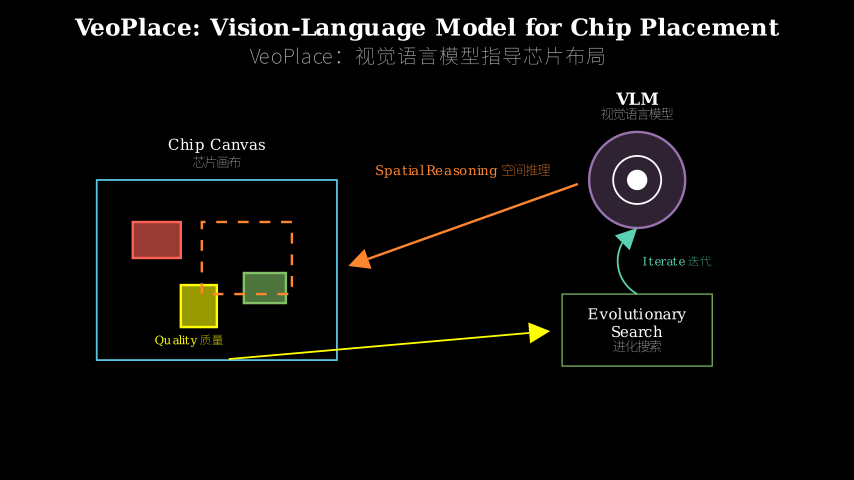
VeoPlace has three components working in a loop. First, a VLM (GPT-4V or Gemini) receives a visual rendering of the current chip layout—macros drawn as colored rectangles on a canvas. The VLM proposes which macro to place next and suggests a subregion of the canvas (e.g., “place macro M3 in the top-left quadrant”). Second, a base placer (could be any existing placer like MaskPlace or DREAMPlace) executes this constrained placement—it only searches within the VLM’s suggested region. Third, an evolutionary optimizer maintains a population of VLM prompts, mutates them (changing phrasing, adding constraints), evaluates resulting placements, and keeps the best-performing prompts for the next generation.
   [Chip Layout Image]
          |
          v
   +-------------+
   |    VLM      |  "Place M3 in top-left,
   | (GPT-4V)    |   near power grid"
   +-------------+
          |
          v
   [Region Constraint: x<0.5, y<0.5]
          |
          v
   +-------------+
   | Base Placer |  Searches only in
   | (MaskPlace) |  constrained region
   +-------------+
          |
          v
   [New Layout + Wirelength Score]
          |
          v
   +------------------+
   | Evolutionary     |  Mutate prompts,
   | Optimizer (CMA)  |  keep best ones
   +------------------+
          |
          v
   [Next Generation Prompts] ---> Loop back to VLM
Think of VeoPlace as a design studio with three roles. The VLM is the creative director who looks at the current design mockup and sketches rough zones (“put the memory blocks here, logic there”). The base placer is the junior designer who takes those sketches and works out exact coordinates within the suggested zones. The evolutionary optimizer is the studio manager who reviews all the creative director’s sketches over time, notices which phrasing leads to better designs (“when we say ‘cluster near power’ we get 10% better results”), and coaches the creative director to use more effective language. The key insight: the creative director doesn’t need chip design training—their general visual reasoning (learned from millions of images) transfers directly because chip layouts are just spatial arrangements.
Key Concepts
-
Vision-Language Model as Spatial Reasoner: VLMs like GPT-4V were trained on diverse images with captions—photos, diagrams, maps, floor plans. They learned to parse spatial relationships: “the red object is left of the blue one,” “these items cluster in the corner.” A chip layout is just another spatial diagram. When you show a VLM a chip canvas with colored rectangles (macros) and ask “where should this new block go?”, it applies the same spatial reasoning it uses for arranging furniture in a room photo. No chip-specific training needed—the visual reasoning is already there. The paper’s bet: spatial reasoning is domain-agnostic.
-
Evolutionary Prompt Optimization: The VLM’s suggestions depend heavily on how you phrase the prompt. “Place macro M3” might yield different results than “Place M3 near the power grid to minimize wire length.” But which phrasing works best? VeoPlace treats prompts as genes in an evolutionary algorithm. Start with a population of prompt variations. Evaluate each by running the full placement pipeline and measuring wirelength. Mutate the best prompts (change words, add constraints, swap phrasing). Repeat for generations. This searches the space of natural language instructions to find phrasings that guide the VLM toward better placements. It’s like A/B testing prompts, but with genetic algorithms instead of manual trials.
-
Constrained Placement as Hierarchical Decomposition: Instead of placing all macros at once (a massive search space), VeoPlace decomposes the problem. The VLM proposes a subregion for one macro at a time. The base placer only searches within that subregion—drastically reducing the search space for each decision. This is hierarchical: high-level spatial reasoning (VLM) constrains low-level optimization (placer). It’s like solving a jigsaw puzzle by first sorting pieces into corner/edge/middle groups (high-level), then fitting pieces within each group (low-level). The constraint makes each sub-problem tractable.
Framework Shift
Before (MaskPlace, GNN placers):        After (VeoPlace):

  [Graph/Sequence Encoding]               [Visual Chip Layout]
           |                                       |
           v                                       v
  +-------------------+                   +--------------+
  | Train RL/GNN      |                   | VLM (GPT-4V) |
  | from scratch      |                   | zero-shot    |
  | on chip data      |                   +--------------+
  +-------------------+                           |
           |                              [Region Proposal]
           v                                       |
  [Learned Policy]                                 v
           |                              +----------------+
           v                              | Base Placer    |
  [Place All Macros]                      | (constrained)  |
                                          +----------------+
                                                  |
                                                  v
                                          [Evolve Prompts]

Abstract optimization                    Visual reasoning
Learn from scratch                       Transfer from foundation model
Monolithic placement                     Hierarchical decomposition
From training domain-specific models to leveraging pre-trained visual reasoning, the core shift is treating chip layout as a visual problem that foundation models already understand.
Expert Assessment
Problem choice: Real gap. The field has been stuck in a local optimum—throwing more compute at training specialized models while ignoring that foundation models have relevant capabilities. The observation that human designers use visual reasoning is obvious in hindsight but genuinely unexplored in ML-based EDA. This sits at the intersection of two trends: foundation models eating specialized tasks, and EDA desperately needing better automation.
Method maturity: Clever insight with straightforward execution. The evolutionary prompt optimization is a bit brute-force (CMA-ES over prompt space is expensive), but it works. A simpler approach might be gradient-based prompt tuning or few-shot learning with good examples, but the authors chose robustness over elegance. The real contribution is the observation that VLMs can do this at all—the engineering around it is competent but not groundbreaking.
Experimental integrity: Baselines are fair (MaskPlace is state-of-the-art learning-based), and the generalization test to DREAMPlace (analytical placer) is strong evidence. The 32% wirelength reduction is impressive, but I’d want to see compute cost comparisons—evolutionary search isn’t free. One red flag: no ablation on VLM choice beyond GPT-4V vs Gemini. What about open-source VLMs? The paper hints at “strong visual reasoning” being key but doesn’t isolate which VLM capabilities matter. Also, the evolutionary optimization section is thin—how many generations? How sensitive to hyperparameters?
Writing quality: The intro and related work are solid. The method section rushes through evolutionary optimization details—this is where I’d want pseudocode and hyperparameter tables. The results section is thorough but could use failure case analysis. Which benchmarks does VeoPlace struggle with, and why? The discussion hand-waves about “future work” without addressing obvious questions: Does this scale to modern chips with thousands of macros? What about timing constraints beyond wirelength?
Verdict: Weak accept—the core idea is novel and results are strong, but the paper feels like an early-stage exploration rather than a mature system. It opens a door (VLMs for EDA) but doesn’t fully walk through it.
Takeaways
Practitioners can steal the hierarchical decomposition pattern: use a high-level reasoner (doesn’t have to be a VLM—could be a heuristic, a coarse model, or human input) to propose constraints, then let a specialized optimizer work within those constraints. This reduces search space and makes optimization tractable. The specific technique: evolutionary prompt optimization is broadly applicable—if you’re using LLMs/VLMs in a pipeline and prompt engineering matters, treat prompts as parameters to optimize rather than hand-tuning them. Finally, the meta-lesson: before training a specialized model, check if a foundation model already has the capability you need. Visual reasoning, spatial understanding, and common-sense physics are increasingly “free” in large VLMs—exploit that before reinventing the wheel.
论文: 2603.28733 作者: Ikechukwu Uchendu, Swati Goel, Karly Hou, Ebrahim Songhori, Kuang-Huei Lee, Joe Wenjie Jiang, Vijay Janapa Reddi, Vincent Zhuang 分类: cs.LG
缺口
芯片布图规划——在硅片画布上排列宏单元——本质上是空间推理任务。
人类专家擅长这个,因为他们看着芯片布局,用视觉推理组件关系。
最近的机器学习方法(强化学习如MaskPlace、图神经网络)把它当作抽象优化问题,将芯片编码为图或序列。
它们从零学习,忽略了基础模型已经具备强大的视觉推理能力。
缺口在于:没人问过,在数十亿图像上训练的视觉语言模型,能否在不做领域特定训练的情况下,将芯片布局理解为视觉问题。
问题:机器学习布局器忽略空间推理
   |
   v
观察:人类使用视觉直觉
   |
   v
假设:视觉语言模型内置视觉推理
   |
   v
方法:VLM提议区域 -> 基础布局器执行 -> 进化提议
   |
   v
证据:线长缩减32%,跨布局器泛化
   |
   v
结论:视觉推理迁移到芯片设计
增量
一句话:之前——机器学习布局器从零学习芯片布局作为抽象优化;
之后——现成的视觉语言模型通过视觉推理指导布局,无需任何训练。
核心机制
VeoPlace有三个组件在循环工作。
首先,视觉语言模型(GPT-4V或Gemini)接收当前芯片布局的视觉渲染——宏单元画成画布上的彩色矩形。
VLM提议下一个要放置的宏单元,并建议画布的子区域(例如”将宏单元M3放在左上象限”)。
其次,基础布局器(可以是任何现有布局器如MaskPlace或DREAMPlace)执行这个受约束的布局——它只在VLM建议的区域内搜索。
第三,进化优化器维护一个VLM提示词种群,对它们进行变异(改变措辞、添加约束),评估生成的布局,并保留表现最好的提示词用于下一代。
   [芯片布局图像]
          |
          v
   +-------------+
   |    VLM      |  "将M3放在左上,
   | (GPT-4V)    |   靠近电源网格"
   +-------------+
          |
          v
   [区域约束: x<0.5, y<0.5]
          |
          v
   +-------------+
   | 基础布局器  |  只在约束
   | (MaskPlace) |  区域内搜索
   +-------------+
          |
          v
   [新布局 + 线长分数]
          |
          v
   +------------------+
   | 进化优化器       |  变异提示词,
   | (CMA)            |  保留最优
   +------------------+
          |
          v
   [下一代提示词] ---> 循环回VLM
把VeoPlace想象成一个设计工作室,有三个角色。
VLM是创意总监,看着当前设计稿,勾勒粗略区域(“把存储块放这儿,逻辑放那儿”)。
基础布局器是初级设计师,拿着那些草图,在建议区域内算出精确坐标。
进化优化器是工作室经理,审查创意总监随时间产生的所有草图,注意到哪种措辞带来更好的设计(“当我们说’靠近电源聚类’时结果好10%”),并指导创意总监使用更有效的语言。
关键洞察:创意总监不需要芯片设计训练——他们的通用视觉推理(从数百万图像中学到)直接迁移,因为芯片布局只是空间排列。
关键概念
- 视觉语言模型作为空间推理器:像GPT-4V这样的VLM在多样化图像和标注上训练——照片、图表、地图、平面图。
它们学会解析空间关系:“红色物体在蓝色左边”,“这些物品聚集在角落”。
芯片布局只是另一种空间图表。
当你给VLM展示一个有彩色矩形(宏单元)的芯片画布,问”这个新块应该放哪儿?“,它应用的是同样的空间推理,就像它用于在房间照片中排列家具一样。
不需要芯片特定训练——视觉推理已经在那儿了。
论文的赌注:空间推理是领域无关的。
- 进化式提示词优化:VLM的建议严重依赖于你如何措辞提示。
“放置宏单元M3”可能产生不同于”将M3放在电源网格附近以最小化线长”的结果。
但哪种措辞最有效?
VeoPlace将提示词视为进化算法中的基因。
从提示词变体种群开始。
通过运行完整布局流程并测量线长来评估每个。
变异最佳提示词(改变词语、添加约束、交换措辞)。
重复多代。
这搜索自然语言指令空间,找到引导VLM走向更好布局的措辞。
就像A/B测试提示词,但用遗传算法而非手动试验。
- 受约束布局作为层次分解:VeoPlace不是一次放置所有宏单元(巨大的搜索空间),而是分解问题。
VLM一次为一个宏单元提议子区域。
基础布局器只在该子区域内搜索——大幅减少每个决策的搜索空间。
这是层次化的:高层空间推理(VLM)约束低层优化(布局器)。
就像解拼图,先把碎片分成角落/边缘/中间组(高层),然后在每组内拼接碎片(低层)。
约束使每个子问题变得可处理。
框架转变
之前(MaskPlace、GNN布局器):      之后(VeoPlace):

  [图/序列编码]                       [视觉芯片布局]
           |                                   |
           v                                   v
  +-------------------+               +--------------+
  | 从零训练RL/GNN    |               | VLM (GPT-4V) |
  | 在芯片数据上      |               | 零样本       |
  +-------------------+               +--------------+
           |                                   |
           v                          [区域提议]
  [学习的策略]                                 |
           |                                   v
           v                          +----------------+
  [放置所有宏单元]                    | 基础布局器     |
                                      | (受约束)       |
                                      +----------------+
                                              |
                                              v
                                      [进化提示词]

抽象优化                            视觉推理
从零学习                            从基础模型迁移
整体式布局                          层次分解
从训练领域特定模型到利用预训练视觉推理,核心转变是将芯片布局视为基础模型已经理解的视觉问题。
专家评审
选题眼光:真实缺口。
该领域一直困在局部最优——向训练专用模型投入更多算力,却忽略基础模型已有相关能力。
观察到人类设计师使用视觉推理,事后看来显而易见,但在基于机器学习的EDA中确实未被探索。
这处于两个趋势的交叉点:基础模型吞噬专用任务,以及EDA迫切需要更好的自动化。
方法成熟度:巧妙洞察配上直接执行。
进化式提示词优化有点蛮力(在提示词空间上做CMA-ES很昂贵),但有效。
更简单的方法可能是基于梯度的提示词调优或用好例子做少样本学习,但作者选择了鲁棒性而非优雅。
真正的贡献是观察到VLM根本能做这个——围绕它的工程称职但不突破性。
实验诚意:基线公平(MaskPlace是最先进的基于学习的方法),对DREAMPlace(分析式布局器)的泛化测试是强有力证据。
32%的线长缩减令人印象深刻,但我想看计算成本比较——进化搜索不是免费的。
一个警示:除了GPT-4V对比Gemini,没有VLM选择的消融实验。
开源VLM呢?
论文暗示”强视觉推理”是关键,但没有隔离哪些VLM能力重要。
另外,进化优化部分很薄——多少代?
对超参数有多敏感?
写作功力:引言和相关工作扎实。
方法部分匆匆带过进化优化细节——这里我想要伪代码和超参数表。
结果部分详尽但可以加失败案例分析。
VeoPlace在哪些基准上挣扎,为什么?
讨论部分对”未来工作”一笔带过,没解决明显问题:这能扩展到有数千宏单元的现代芯片吗?
除了线长,时序约束呢?
判决:弱接收——核心想法新颖,结果强劲,但论文感觉像早期探索而非成熟系统。
它打开了一扇门(VLM用于EDA),但没完全走进去。
要点总结
实践者可以偷走层次分解模式:用高层推理器(不必是VLM——可以是启发式、粗糙模型或人类输入)提议约束,然后让专用优化器在这些约束内工作。
这减少搜索空间,使优化可处理。
具体技术:进化式提示词优化广泛适用——如果你在流程中使用LLM/VLM且提示词工程重要,将提示词视为要优化的参数,而非手工调优。
最后,元教训:在训练专用模型之前,检查基础模型是否已有你需要的能力。
视觉推理、空间理解和常识物理在大型VLM中越来越”免费”——在重新发明轮子之前利用它。