
Paper: 2603.12238 Authors: Jun Luo, Jiaxiang Tang, Ruijie Lu, Gang Zeng Categories: cs.CV
The Gap
Text-to-3D scene generation has two dominant failure modes. The first is domain restriction: methods like SceneWiz3D or Set-the-Scene are trained on specific categories (indoor rooms, outdoor landscapes) and fall apart the moment you ask for something outside that distribution. The second is relational rigidity: methods that do generalize tend to rely on predefined spatial relationship templates — “object A is to the left of object B” — which means the system can’t reason about novel or complex spatial configurations it hasn’t seen before.
The deeper issue is that most pipelines are open-loop. They generate a layout, place objects, and ship it. There’s no mechanism to look at what was actually rendered and say “that chair is clipping through the table, let me fix it.” Humans composing 3D scenes do this constantly — it’s the core of the workflow. Prior work skips it entirely.
Problem: Open-vocab 3D scene gen without layout priors
    |
    v
Assumption: VLMs can reason spatially IF given rendered visual feedback
    |
    v
Method: Agent loop -- render -> VLM sees image -> issues atomic ops -> re-render
    |
    v
Evidence: Human eval + qualitative results vs SceneWiz3D, Set-the-Scene, etc.
    |
    v
Conclusion: Closed-loop visual feedback enables coherent open-vocab scene synthesis
The Increment
One sentence: Before this paper, text-to-3D scene systems were blind to their own output; after it, a VLM can look at what it built and fix it.
Core Mechanism
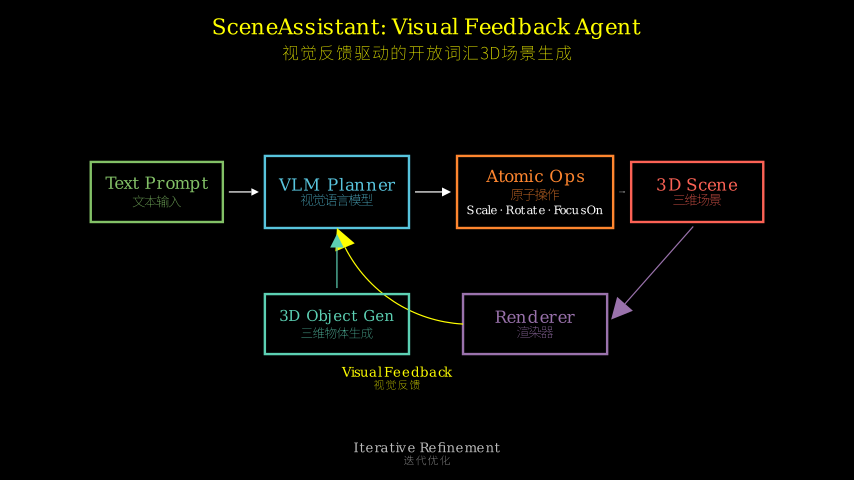
SceneAssistant has three moving parts. First, a 3D object generation backbone (they use a modern text-to-3D model, likely something in the Shap-E / One-2-3-45 family) that takes a text description of a single object and produces a 3D mesh or NeRF. This handles the per-object generation — the system doesn’t try to generate the whole scene at once.
Second, a set of atomic spatial operations: Scale, Rotate, Translate, FocusOn, and a few others. These are the only verbs the VLM is allowed to use. The VLM doesn’t output raw coordinates or transformation matrices — it calls these operations like API functions. This is a deliberate design choice that constrains the action space to something a language model can reason about reliably.
Third, the feedback loop itself. After each round of operations, the scene is rendered from one or more viewpoints and the image is fed back to the VLM alongside the original text prompt. The VLM then decides what to do next — move this object, scale that one, rotate another — and the loop continues until the VLM decides the scene is done. The whole thing is iterative refinement driven by visual grounding.
Text Prompt
    |
    v
+------------------+
| Object Generator |  <-- per-object text-to-3D
+------------------+
    | (3D assets)
    v
+------------------+
|  Scene Composer  |  <-- places objects in world space
+------------------+
    |
    v
+------------------+
|    Renderer      |  <-- produces image(s)
+------------------+
    | (rendered view)
    v
+------------------+
|   VLM Agent      |  <-- sees image + prompt, issues ops
+------------------+
    | Scale / Rotate / Translate / FocusOn ...
    v
+------------------+
|  Scene Composer  |  <-- applies ops, loop back to renderer
+------------------+
    |
    v (converged)
Final 3D Scene
Think of it like a film director working with a set designer over walkie-talkie. The director (VLM) can’t physically move props — they can only issue instructions: “move the lamp two feet left,” “make the couch bigger,” “zoom in on the fireplace.” The set designer (atomic operations layer) executes those instructions precisely. After each change, someone takes a Polaroid of the set (the renderer) and hands it to the director. The director looks at the photo, compares it to the script (text prompt), and issues the next round of instructions. The session ends when the director says “that’s the shot.” The key insight is that the director doesn’t need to know the exact coordinates of every prop — they reason from what they see, which is exactly what VLMs are good at.
Key Concepts
-
Atomic operations as action vocabulary: Instead of letting the VLM output freeform code or raw numbers, the system defines a small fixed set of operations the VLM can call. This is important because LLMs/VLMs are notoriously bad at precise numerical reasoning but quite good at deciding *which operation to apply and roughly how much. By constraining the action space, you get reliable execution without needing the model to be a geometry engine. It’s the same reason you give a junior dev a well-documented API instead of asking them to write the underlying library.
-
Visual feedback as grounding: The VLM receives the rendered image at each step, not just the text prompt. This matters because spatial relationships — “the table is too close to the wall,” “the objects are floating” — are much easier to detect visually than to infer from a list of coordinates. The rendered image is the ground truth of what the scene actually looks like, and feeding it back closes the perception-action loop that open-loop methods lack.
-
Open-vocabulary generation: This just means the system isn’t restricted to a fixed set of object categories or scene types. You can ask for “a cozy wizard’s study with a crystal ball and a sleeping cat” and the system will attempt it, because each object is generated independently by a general text-to-3D model, and the spatial reasoning is handled by a general-purpose VLM. The “vocabulary” of possible scenes is as large as the VLMs and object generators can handle.
Framework Shift
Before (mainstream approach):        After (this paper):

Text Prompt                          Text Prompt
    |                                    |
    v                                    v
Layout Planner                       Object Generator (per object)
(predefined relations)                   |
    |                                    v
    v                               Initial Scene
Object Retrieval / Gen                   |
(domain-specific)                        v
    |                               Renderer
    v                                    |
Final Scene  <-- no feedback             v
(open loop, no correction)          VLM Agent (sees image)
                                         |
                                    Atomic Ops
                                         |
                                         v
                                    Updated Scene
                                         |
                                    (loop until done)
                                         |
                                         v
                                    Final Scene
From rigid open-loop layout planning to iterative closed-loop visual refinement, the core shift is: the system now sees what it builds.
Expert Assessment
Problem choice: This is a real gap. The open-loop problem in 3D scene generation is genuine and under-addressed. The framing around “open-vocabulary” is slightly oversold — the bottleneck is often the underlying object generator, not the scene composition logic — but the visual feedback loop is a legitimate contribution. The field is clearly moving toward agentic pipelines, and this paper is well-positioned in that trajectory.
Method maturity: It’s a clever assembly of existing components rather than a fundamentally new algorithm. The VLM-as-agent-with-visual-feedback idea has been explored in 2D (think GPT-4V-based GUI agents), and the atomic operations design is borrowed from robotics task planning. The novelty is in the specific combination and application to 3D scene generation. That’s fine — good engineering contributions are real contributions — but don’t expect a theoretical breakthrough here.
Experimental integrity: The reliance on human evaluation as the primary quantitative metric is a yellow flag. Human evals are expensive to run rigorously and easy to run sloppily. Without knowing the exact protocol — how many raters, what instructions, inter-annotator agreement — it’s hard to trust the numbers. The baselines (SceneWiz3D, Set-the-Scene) are reasonable choices, but they’re also not the strongest possible competitors. A comparison against a simple GPT-4V + layout-from-scratch baseline would have been more convincing.
Writing quality: The atomic operations section is underspecified. The paper lists the operations but doesn’t give enough detail about how the VLM is prompted to use them, what happens when the VLM issues a malformed call, or how many iterations the loop typically runs before convergence. That section, if rewritten with concrete examples and ablation numbers, would significantly strengthen the paper’s credibility.
Verdict: weak accept — the visual feedback loop is a genuine and useful idea, but the experimental rigor doesn’t fully support the claims made.
Takeaways
The atomic operations design pattern is the most transferable idea here. If you’re building any agent that needs to manipulate a structured environment — 3D scenes, UI layouts, code refactoring, document editing — defining a small, well-scoped action vocabulary and letting the LLM/VLM call those operations is a much more reliable architecture than asking the model to output raw parameters. The model reasons about what to do; your code handles how to do it precisely.
The render-feedback loop is also worth stealing for any generative pipeline where the output has a visual representation. If you’re generating slides, diagrams, or UI mockups, feeding a screenshot back to a VLM for iterative refinement is a low-cost way to catch obvious errors that open-loop generation misses. The infrastructure cost is a render call per iteration, which is usually cheap.
论文: 2603.12238 作者: Jun Luo, Jiaxiang Tang, Ruijie Lu, Gang Zeng 分类: cs.CV
缺口
文本驱动的3D场景生成有两种典型的失败模式。
第一种是领域限制:SceneWiz3D、Set-the-Scene 这类方法在特定类别(室内场景、室外景观)上训练,一旦你要求生成训练分布之外的内容,效果就会崩塌。
第二种是关系刚性:那些泛化能力稍强的方法,往往依赖预定义的空间关系模板——“物体A在物体B的左边”——这意味着系统无法处理它没见过的新颖或复杂的空间配置。
更深层的问题是:大多数流水线是开环的。 它们生成一个布局,放置物体,然后直接输出结果。 没有任何机制能让系统看一眼自己渲染出来的画面,然后说”那把椅子穿模了,我来修一下”。 人类在做3D场景合成时,这种”看-改”循环是工作流的核心。 而现有方法完全跳过了这一步。
问题:无布局先验的开放词汇3D场景生成
    |
    v
假设:如果给VLM渲染后的视觉反馈,它能进行空间推理
    |
    v
方法:智能体循环 -- 渲染 -> VLM看图 -> 发出原子操作 -> 再渲染
    |
    v
证据:人工评估 + 与SceneWiz3D等方法的定性对比
    |
    v
结论:闭环视觉反馈能实现连贯的开放词汇场景合成
增量
一句话:这篇论文之前,文本转3D场景的系统对自己的输出是盲目的;之后,VLM 可以看着自己建出来的东西,然后修它。
核心机制
SceneAssistant 有三个核心模块。
第一个是3D物体生成骨干网络(论文使用了一个现代文本转3D模型,大概率是 Shap-E 或 One-2-3-45 一类的方案),负责把单个物体的文字描述转化为3D网格或 NeRF。 这个模块处理逐物体的生成——系统不会试图一次性生成整个场景。
第二个是一组原子空间操作:Scale(缩放)、Rotate(旋转)、Translate(平移)、FocusOn(聚焦)等。 这是 VLM 被允许使用的全部”动词”。 VLM 不输出原始坐标或变换矩阵,而是像调用 API 函数一样调用这些操作。 这是一个刻意的设计选择,把动作空间约束到语言模型能可靠推理的范围内。
第三个是反馈循环本身。 每轮操作之后,场景会从一个或多个视角渲染成图像,连同原始文本提示一起送回给 VLM。 VLM 决定下一步做什么——移动这个物体、缩放那个、旋转另一个——循环持续,直到 VLM 判断场景已经完成。 整个过程是由视觉接地驱动的迭代精化。
文本提示
    |
    v
+------------------+
|  物体生成模块    |  <-- 逐物体文本转3D
+------------------+
    | (3D资产)
    v
+------------------+
|  场景合成模块    |  <-- 将物体放置到世界坐标系
+------------------+
    |
    v
+------------------+
|    渲染器        |  <-- 生成图像
+------------------+
    | (渲染视图)
    v
+------------------+
|   VLM 智能体     |  <-- 看图+提示,发出操作指令
+------------------+
    | Scale / Rotate / Translate / FocusOn ...
    v
+------------------+
|  场景合成模块    |  <-- 执行操作,循环回渲染器
+------------------+
    |
    v (收敛)
最终3D场景
用一个核喻来理解这个系统:把它想象成一位导演通过对讲机指挥布景师。
导演(VLM)不能亲手移动道具,只能发指令:“把台灯往左移两英尺”、“把沙发放大一点”、“聚焦到壁炉”。 布景师(原子操作层)精确执行这些指令。 每次调整之后,有人用宝丽来相机拍一张布景照片(渲染器),递给导演。 导演看着照片,对照剧本(文本提示),发出下一轮指令。 导演说”就这个镜头了”,拍摄结束。
关键洞察在于:导演不需要知道每件道具的精确坐标——他们从看到的画面出发进行推理,而这正是 VLM 擅长的事情。
关键概念
-
原子操作作为动作词汇表:系统不让 VLM 输出自由格式的代码或原始数字,而是定义一个小型固定操作集供 VLM 调用。这很重要,因为 LLM/VLM 在精确数值推理上出了名地不可靠,但在决定”用哪个操作”和”大概用多少”上表现相当好。约束动作空间,就能在不要求模型充当几何引擎的前提下获得可靠执行。这就像给初级开发者一个文档完善的 API,而不是让他们去写底层库。
-
视觉反馈作为接地信号:VLM 在每一步都能看到渲染图像,而不只是文本提示。这很关键,因为空间关系——“桌子离墙太近了”、“物体在漂浮”——从视觉上比从坐标列表中更容易判断。渲染图像是场景实际外观的真实呈现,把它反馈回去,就闭合了开环方法所缺失的感知-动作循环。
-
开放词汇生成:这只是说系统不受限于固定的物体类别或场景类型。你可以要求”一间摆着水晶球和一只睡着的猫的温馨巫师书房”,系统会尝试生成,因为每个物体由通用文本转3D模型独立生成,空间推理由通用 VLM 处理。可能场景的”词汇量”,取决于 VLM 和物体生成器的能力上限。
框架转变
之前(主流方法):                    之后(本文方法):

文本提示                              文本提示
    |                                     |
    v                                     v
布局规划器                            物体生成器(逐物体)
(预定义关系)                             |
    |                                     v
    v                                 初始场景
物体检索/生成                              |
(特定领域)                               v
    |                                 渲染器
    v                                     |
最终场景 <-- 无反馈                        v
(开环,无纠错)                       VLM 智能体(看图)
                                           |
                                       原子操作
                                           |
                                           v
                                       更新后的场景
                                           |
                                      (循环直到收敛)
                                           |
                                           v
                                       最终场景
从刚性的开环布局规划到迭代的闭环视觉精化,核心转变是:系统现在能看见自己建出来的东西了。
专家评审
选题眼光:这是一个真实的缺口。 3D场景生成中的开环问题是真实存在且被严重低估的。 “开放词汇”这个标签有些过度渲染——瓶颈往往在底层物体生成器,而不是场景合成逻辑——但视觉反馈循环本身是一个合理的贡献。 整个领域正在明显向智能体化流水线迁移,这篇论文在这条轨迹上站位不错。
方法成熟度:这是对现有组件的巧妙组合,而非从头设计的新算法。 VLM-作为-带视觉反馈的智能体这个思路在2D领域已有探索(想想基于 GPT-4V 的 GUI 智能体),原子操作设计借鉴自机器人任务规划。 创新点在于这种特定组合及其在3D场景生成上的应用。 这没什么问题——好的工程贡献就是真实贡献——但不要期待理论突破。
实验诚意:以人工评估作为主要定量指标是一个黄色警告。 人工评估要做得严谨代价很高,做得马虎却很容易。 在不知道具体协议的情况下——评估者数量、指导语、标注者间一致性——很难信任这些数字。 基线选择(SceneWiz3D、Set-the-Scene)是合理的,但也不是最强的竞争对手。 如果能加一个”GPT-4V + 从零开始的布局”这样的简单基线对比,说服力会强得多。
写作功力:原子操作那一节写得太粗糙。 论文列出了操作名称,但没有给出足够的细节:VLM 是怎么被提示去使用这些操作的?VLM 发出格式错误的调用时怎么处理?循环通常跑几轮才收敛? 如果把这一节重写,加入具体示例和消融实验数字,整篇论文的可信度会显著提升。
判决:弱接收——视觉反馈循环是一个真实且有用的想法,但实验严谨性不足以完全支撑论文的主张。
要点总结
原子操作设计模式是这篇论文最值得迁移的想法。 如果你在构建任何需要操控结构化环境的智能体——3D场景、UI布局、代码重构、文档编辑——定义一个小而精的动作词汇表,让 LLM/VLM 调用这些操作,比让模型直接输出原始参数可靠得多。 模型负责推理”做什么”,你的代码负责精确地”怎么做”。
渲染反馈循环也值得借鉴,适用于任何输出有视觉表示的生成流水线。 如果你在生成幻灯片、图表或 UI 原型,把截图反馈给 VLM 做迭代精化,是一种低成本的方式,能捕捉到开环生成必然会漏掉的明显错误。 基础设施成本只是每轮迭代多一次渲染调用,通常很便宜。