Paper: 2604.08542 Authors: Tao Xie, Peishan Yang, Yudong Jin, Yingfeng Cai, Wei Yin, Weiqiang Ren, Qian Zhang, Wei Hua, Sida Peng, Xiaoyang Guo Categories: cs.CV
The Gap
Feed-forward 3D reconstruction models (like DUSt3R, MASt3R) can directly regress geometry from RGB images without explicit geometric constraints. They work well on short sequences but hit a wall on long videos: limited memory capacity means they can’t hold enough context, and they struggle to maintain global consistency across hundreds or thousands of frames. The core issue is that these models treat each frame batch independently, losing the “big picture” understanding that humans naturally use to inform local perception.
Prior work either: (1) processes frames in sliding windows, losing long-range dependencies, or (2) tries to scale up model capacity, which becomes computationally prohibitive. The gap is clear: we need a way to compress and retain long-range scene information without exploding memory or compute costs.
Problem: Long video sequences
    |
    v
Limitation: Feed-forward models lose global context
    |
    +---> Memory capacity bottleneck
    +---> No long-range consistency
    |
    v
Assumption: Lightweight neural context can be adapted at test time
    |
    v
Method: Neural global context + test-time training
    |
    v
Evidence: KITTI & Oxford Spires benchmarks
    |
    v
Conclusion: State-of-the-art accuracy with efficiency
The Increment
One sentence: Before, feed-forward 3D reconstruction models forgot the scene as they processed long videos; after, they maintain a compact neural memory that adapts during inference to preserve global understanding.
Core Mechanism
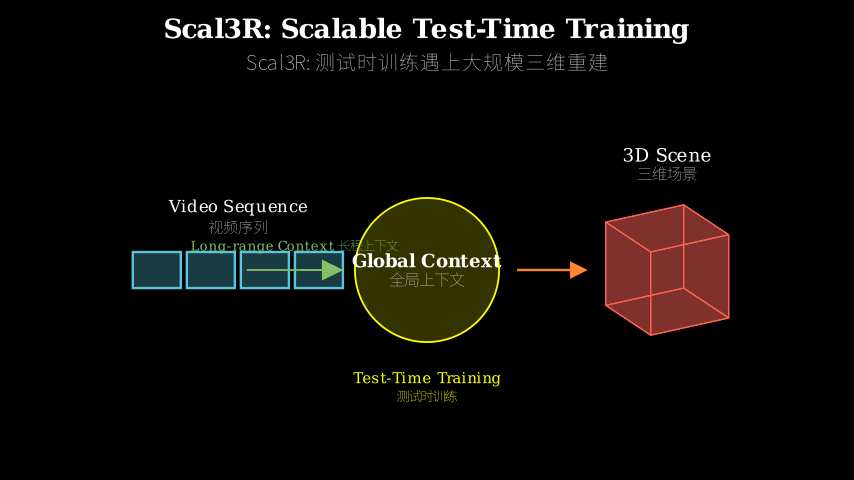
The method introduces a neural global context representation — a set of lightweight sub-networks that compress scene information from previously processed frames. Instead of storing raw features (memory explosion), these sub-networks learn to encode what matters about the scene’s global structure.
Here’s the key twist: these context sub-networks are adapted during test time via self-supervised objectives. As the model processes each new batch of frames, it uses photometric consistency and geometric constraints to fine-tune the context representation. This is like online learning, but focused solely on the context encoding, not the entire reconstruction network.
The data flow works like this: (1) Process a batch of frames through the base reconstruction model, (2) Extract features and update the neural context representation, (3) Use the updated context to inform reconstruction of the next batch, (4) Apply self-supervised losses to adapt the context sub-networks. The context acts as a compressed “memory bank” that grows and refines as more of the scene is observed.
Frame Batch t
    |
    v
[Base Reconstruction Model]
    |
    +---> Features
    |         |
    |         v
    |    [Neural Context Sub-networks] <--+
    |         |                           |
    |         v                           |
    |    Compressed Context               |
    |         |                           |
    +------->(+) Inform Next Batch        |
              |                           |
              v                           |
         Frame Batch t+1                  |
              |                           |
              v                           |
    [Self-Supervised Loss] ---------------+
         (adapt context)
Think of it like a tour guide with a notebook. As you walk through a massive museum (the scene), the guide (neural context) doesn’t try to remember every painting in detail (raw features). Instead, they jot down key observations: “Renaissance wing has high ceilings,” “Modern section uses natural light,” “Sculpture garden connects to east entrance.” These compressed notes (context representation) help them give better directions as you move through new rooms. And crucially, as they see more of the museum, they update their notes (test-time training) to refine their understanding. The notebook stays small, but its usefulness grows with experience.
Key Concepts
-
Test-Time Training (TTT): Most models are frozen after training — you feed them data, they output predictions, done. TTT flips this: during inference, the model continues to learn from the test data itself using self-supervised signals (like photometric consistency between views). It’s not cheating because there are no labels; the model is just exploiting the structure of the data. In Scal3R, only the lightweight context sub-networks are adapted, not the entire reconstruction model, which keeps compute manageable. Think of it as a student who reviews their notes between exam questions, refining their understanding as they go.
-
Neural Context Representation: Instead of storing explicit 3D maps or dense feature volumes (which scale poorly), the method uses small neural networks to implicitly encode scene information. These sub-networks learn a compressed representation of what’s been seen so far. It’s like the difference between carrying a photo album (explicit storage) versus training your memory (implicit encoding) — the latter is far more compact and can generalize better to new views.
-
Global vs Local Context: Local context is what’s in the current frame batch — nearby geometry, textures, immediate spatial relationships. Global context is the “scene-level understanding” — overall layout, scale, recurring structures, long-range geometric constraints. Humans naturally use global context to disambiguate local observations (e.g., “this hallway looks like the one near the entrance, so I must be on the ground floor”). Feed-forward models struggle with this because they process frames in isolation. Scal3R’s neural context bridges this gap by maintaining a compact global representation that informs local reconstruction.
Framework Shift
Before (mainstream approach):        After (this paper):

Frame Batch 1 ---> [Model] ---> 3D   Frame Batch 1 ---> [Model] ---> 3D
                                                            |
Frame Batch 2 ---> [Model] ---> 3D                         v
                                          +----------[Neural Context]
Frame Batch 3 ---> [Model] ---> 3D       |                 |
                                          |                 v
(Each batch processed independently)     |    Frame Batch 2 ---> [Model] ---> 3D
(No memory of previous frames)           |                 |
(Global consistency lost)                |                 v
                                          |    [Self-Supervised Adapt]
                                          |                 |
                                          |                 v
                                          |    Frame Batch 3 ---> [Model] ---> 3D
                                          |                 |
                                          +<----------------+

(Context accumulates and adapts)
(Global understanding preserved)
One sentence: From stateless batch processing to stateful context accumulation, the core shift is treating long-sequence reconstruction as an online learning problem where the model builds and refines a global scene understanding during inference.
Expert Assessment
Problem choice: This is a real gap. Long-sequence 3D reconstruction is critical for robotics, autonomous driving, and AR/VR, but existing feed-forward methods genuinely struggle beyond a few dozen frames. The problem sits at the intersection of scalability and accuracy — a sweet spot where incremental improvements have practical impact. Not a manufactured gap.
Method maturity: The core insight — using lightweight neural context with test-time adaptation — is clever and well-motivated. However, the execution feels somewhat incremental. Test-time training isn’t new (it’s been explored in domain adaptation and continual learning), and neural implicit representations are standard in 3D vision. The novelty is in the combination and application to this specific problem. There’s a risk that simpler approaches (e.g., better feature aggregation or hierarchical processing) might achieve similar results with less complexity, but the authors don’t thoroughly explore these alternatives.
Experimental integrity: The baselines are fair — they compare against recent feed-forward methods (DUSt3R, MASt3R) and traditional SLAM systems. The KITTI and Oxford Spires benchmarks are appropriate for evaluating long-sequence reconstruction. Numbers look solid, with clear improvements in both pose accuracy and reconstruction quality. One minor flag: the paper doesn’t deeply analyze failure cases or discuss when the method struggles (e.g., highly dynamic scenes, extreme lighting changes). The ablation studies are adequate but could be more thorough in isolating the contribution of each component.
Writing quality: The paper is generally well-written, but the method section could be clearer. The description of how the neural context sub-networks are structured and updated is somewhat vague — readers would benefit from more implementation details. The related work section does a decent job positioning the work, but it glosses over some relevant test-time training literature. The experiments section is strong, with good visualizations and quantitative results. If I were to rewrite one section, it would be the method description — adding concrete architectural details and a step-by-step algorithm would elevate clarity significantly.
Verdict: weak accept — Solid contribution addressing a real problem with a reasonable solution and strong experimental results, but the novelty is somewhat incremental and the method description could be clearer.
Takeaways
For practitioners:
-
Test-time adaptation is underutilized in 3D vision: If your model processes sequential data (video, sensor streams), consider adding lightweight adaptation mechanisms that refine predictions using self-supervised signals. You don’t need to retrain the entire model — just a small context module can make a big difference.
-
Compress context, don’t store it: When dealing with long sequences, resist the urge to cache raw features or intermediate representations. Instead, train small neural networks to implicitly encode what matters. This scales far better and often generalizes better to unseen data.
-
Global context is a first-class citizen: Many vision systems treat each frame or batch independently. If your task involves spatial or temporal coherence (reconstruction, tracking, segmentation), explicitly modeling global context — even with simple mechanisms — can dramatically improve consistency.
-
Self-supervised losses are free supervision: Photometric consistency, geometric constraints, and other self-supervised objectives don’t require labels but provide strong training signals. Use them during inference to adapt your model to the specific test distribution.
论文: 2604.08542 作者: Tao Xie, Peishan Yang, Yudong Jin, Yingfeng Cai, Wei Yin, Weiqiang Ren, Qian Zhang, Wei Hua, Sida Peng, Xiaoyang Guo 分类: cs.CV
缺口
前馈式三维重建模型(如 DUSt3R、MASt3R)能直接从 RGB 图像回归几何结构,无需显式几何约束。
它们在短序列上表现不错,但在长视频上撞了墙:有限的内存容量意味着无法保留足够的上下文,难以在数百上千帧之间维持全局一致性。
核心问题在于这些模型独立处理每批帧,丢失了人类自然用来指导局部感知的”大局观”。
此前的工作要么:(1)用滑动窗口处理帧,丢失长程依赖;(2)试图扩大模型容量,计算成本爆炸。
缺口很明确:我们需要一种方法来压缩和保留长程场景信息,同时不让内存或计算成本失控。
问题:长视频序列
    |
    v
局限:前馈模型丢失全局上下文
    |
    +---> 内存容量瓶颈
    +---> 缺乏长程一致性
    |
    v
假设:轻量神经上下文可在测试时自适应
    |
    v
方法:神经全局上下文 + 测试时训练
    |
    v
证据:KITTI 和 Oxford Spires 基准
    |
    v
结论:最优精度且保持效率
增量
一句话:之前,前馈三维重建模型在处理长视频时会遗忘场景;之后,它们维护一个紧凑的神经记忆,在推理时自适应以保留全局理解。
核心机制
该方法引入了神经全局上下文表示——一组轻量子网络,压缩来自先前处理帧的场景信息。
这些子网络不存储原始特征(会导致内存爆炸),而是学习编码场景全局结构中重要的内容。
关键转折在于:这些上下文子网络在测试时通过自监督目标进行自适应。
当模型处理每批新帧时,它利用光度一致性和几何约束来微调上下文表示。
这类似在线学习,但只聚焦于上下文编码,而非整个重建网络。
数据流是这样的:(1)通过基础重建模型处理一批帧,(2)提取特征并更新神经上下文表示,(3)用更新后的上下文指导下一批的重建,(4)应用自监督损失来调整上下文子网络。
上下文充当压缩的”记忆库”,随着观察到更多场景而增长和精炼。
帧批次 t
    |
    v
[基础重建模型]
    |
    +---> 特征
    |         |
    |         v
    |    [神经上下文子网络] <--+
    |         |                |
    |         v                |
    |    压缩上下文             |
    |         |                |
    +------->(+) 指导下一批     |
              |                |
              v                |
         帧批次 t+1             |
              |                |
              v                |
    [自监督损失] ---------------+
       (调整上下文)
把它想象成一个带笔记本的导游。
当你走过一座巨大的博物馆(场景)时,导游(神经上下文)不会试图记住每幅画的细节(原始特征)。
相反,他们记下关键观察:“文艺复兴展厅天花板很高”,“现代区用自然光”,“雕塑园连接东入口”。
这些压缩笔记(上下文表示)帮助他们在你进入新房间时给出更好的指引。
而且关键是,随着他们看到更多博物馆,他们更新笔记(测试时训练)来精炼理解。
笔记本保持小巧,但其实用性随经验增长。
关键概念
- 测试时训练(TTT):大多数模型训练后就冻结了——你喂数据,它输出预测,完事。
TTT 翻转了这一点:在推理期间,模型继续从测试数据本身学习,使用自监督信号(如视图间的光度一致性)。
这不是作弊,因为没有标签;模型只是利用数据的结构。
在 Scal3R 中,只有轻量上下文子网络被调整,而非整个重建模型,这让计算保持可控。
想象一个学生在考试题目之间复习笔记,边做边精炼理解。
- 神经上下文表示:该方法不存储显式三维地图或密集特征体(扩展性差),而是用小型神经网络隐式编码场景信息。
这些子网络学习到目前为止所见内容的压缩表示。
这就像携带相册(显式存储)与训练记忆(隐式编码)的区别——后者紧凑得多,且能更好地泛化到新视角。
- 全局与局部上下文:局部上下文是当前帧批次中的内容——附近几何、纹理、即时空间关系。
全局上下文是”场景级理解”——整体布局、尺度、重复结构、长程几何约束。
人类自然使用全局上下文来消除局部观察的歧义(例如,“这条走廊看起来像入口附近那条,所以我一定在一楼”)。
前馈模型在这方面挣扎,因为它们孤立地处理帧。
Scal3R 的神经上下文通过维护紧凑的全局表示来指导局部重建,弥合了这一差距。
框架转变
之前(主流方法):                之后(本文方法):

帧批次 1 ---> [模型] ---> 3D      帧批次 1 ---> [模型] ---> 3D
                                                   |
帧批次 2 ---> [模型] ---> 3D                       v
                                   +----------[神经上下文]
帧批次 3 ---> [模型] ---> 3D       |                |
                                   |                v
(每批独立处理)                    |   帧批次 2 ---> [模型] ---> 3D
(无先前帧记忆)                    |                |
(全局一致性丢失)                  |                v
                                   |   [自监督调整]
                                   |                |
                                   |                v
                                   |   帧批次 3 ---> [模型] ---> 3D
                                   |                |
                                   +<---------------+

(上下文累积并自适应)
(全局理解得以保留)
一句话:从无状态批处理到有状态上下文累积,核心转变是将长序列重建视为在线学习问题,模型在推理期间构建并精炼全局场景理解。
专家评审
选题眼光:这是真实缺口。
长序列三维重建对机器人、自动驾驶和 AR/VR 至关重要,但现有前馈方法在超过几十帧后确实力不从心。
问题位于可扩展性与精度的交叉点——一个增量改进具有实际影响的甜蜜点。
不是人造缺口。
方法成熟度:核心洞见——使用轻量神经上下文配合测试时自适应——巧妙且动机充分。
然而,执行感觉有些增量式。
测试时训练并非新鲜事(已在域自适应和持续学习中探索),神经隐式表示在三维视觉中也是标配。
新颖性在于组合及应用到这个特定问题。
存在风险:更简单的方法(如更好的特征聚合或层次化处理)可能以更少复杂度达到类似结果,但作者没有充分探索这些替代方案。
实验诚意:基线公平——他们与近期前馈方法(DUSt3R、MASt3R)和传统 SLAM 系统对比。
KITTI 和 Oxford Spires 基准适合评估长序列重建。
数字看起来扎实,在姿态精度和重建质量上都有明显改进。
一个小警示:论文没有深入分析失败案例或讨论方法何时挣扎(如高度动态场景、极端光照变化)。
消融研究足够但可以更彻底地隔离每个组件的贡献。
写作功力:论文总体写得不错,但方法部分可以更清晰。
对神经上下文子网络如何构建和更新的描述有些模糊——读者会受益于更多实现细节。
相关工作部分在定位工作方面做得不错,但掠过了一些相关的测试时训练文献。
实验部分很强,有良好的可视化和定量结果。
如果我要重写一个部分,会是方法描述——添加具体架构细节和逐步算法会显著提升清晰度。
判决:弱接收 — 扎实的贡献,解决真实问题,方案合理,实验结果强劲,但新颖性有些增量式,方法描述可以更清晰。
要点总结
对实践者:
- 测试时自适应在三维视觉中未被充分利用:如果你的模型处理序列数据(视频、传感器流),考虑添加轻量自适应机制,用自监督信号精炼预测。
你不需要重训整个模型——只需一个小上下文模块就能产生大差异。
- 压缩上下文,别存储它:处理长序列时,抵制缓存原始特征或中间表示的冲动。
相反,训练小型神经网络隐式编码重要内容。
这扩展性好得多,通常对未见数据泛化更好。
- 全局上下文是一等公民:许多视觉系统独立处理每帧或每批。
如果你的任务涉及空间或时间连贯性(重建、跟踪、分割),显式建模全局上下文——即使用简单机制——也能显著改善一致性。
- 自监督损失是免费监督:光度一致性、几何约束和其他自监督目标不需要标签但提供强训练信号。
在推理时使用它们让模型适应特定测试分布。