Paper: 2605.04039 Authors: Sebastian Wind, Tri-Thien Nguyen, Jeta Sopa, Mahshad Lotfinia, Sebastian Bickelhaup, Michael Uder, Harald Köstler, Gerhard Wellein, Sven Nebelung, Daniel Truhn Categories: cs.CL, cs.AI, cs.LG
The Gap
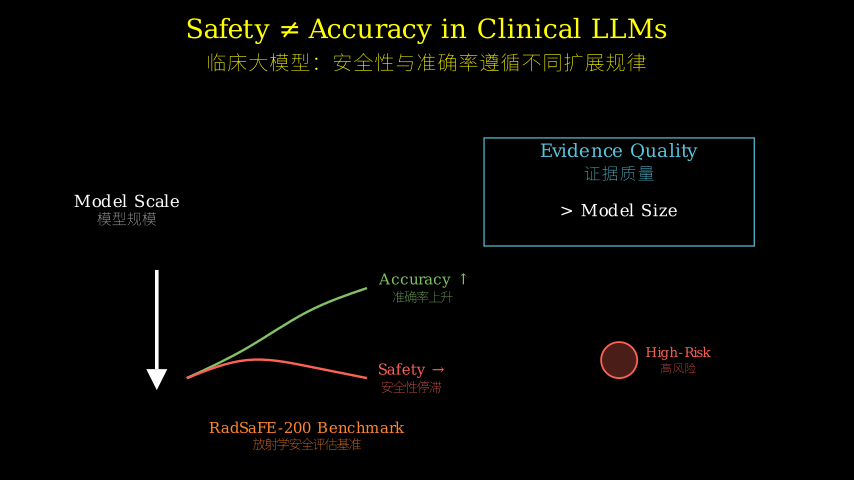
The field assumes that scaling clinical LLMs (bigger models, longer context, fancier RAG) produces safer behavior because accuracy improves. But in medicine, average performance hides what matters: a single confident misdiagnosis can kill. Prior work measures accuracy on benchmarks but doesn’t track whether errors are high-risk, contradict evidence, or concentrate in dangerous patterns. The gap: we scale for accuracy without measuring whether safety scales the same way.
Problem: Clinical LLM deployment assumes accuracy = safety
   |
   v
Assumption: Bigger models / better RAG -> fewer errors -> safer
   |
   v
Reality check: What if high-risk errors don't follow accuracy curves?
   |
   v
Method: SaFE-Scale framework + RadSaFE-200 benchmark
         (measure safety separately across scale dimensions)
   |
   v
Evidence: Clean evidence cuts high-risk errors 78%
          RAG improves accuracy but keeps dangerous failures
   |
   v
Conclusion: Safety is a deployment property, not a scaling byproduct
The Increment
One sentence: Before this paper, we scaled clinical LLMs assuming safety followed accuracy; after, we know evidence quality and retrieval design shape safety independently, and dangerous errors concentrate in ways scaling doesn’t fix.
Core Mechanism
SaFE-Scale is a measurement framework, not a new model. It evaluates how safety metrics change across five dimensions: model size, context length, evidence quality (clean vs conflicted), retrieval strategy (no RAG, standard RAG, agentic RAG), and inference-time compute. The authors instantiate this with RadSaFE-200, a radiology benchmark where each question has clinician-labeled clean evidence, conflict evidence, and option-level tags for high-risk error, unsafe answer, and evidence contradiction.
The evaluation pipeline works like this: take 34 LLMs, run them in six conditions (zero-shot, clean evidence, conflict evidence, standard RAG, agentic RAG, max-context), and measure four safety metrics alongside accuracy. High-risk error tracks whether the model picks a clinically dangerous option. Evidence contradiction checks if the answer contradicts provided evidence. Dangerous overconfidence flags high-confidence wrong answers on high-risk questions. Worst-case analysis identifies questions where most models fail dangerously.
Input: Question + Evidence (clean / conflict / retrieved)
   |
   v
LLM (34 models x 6 conditions = 204 configurations)
   |
   v
Output: Answer + Confidence
   |
   v
Evaluation:
  - Accuracy (standard metric)
  - High-risk error (picked dangerous option?)
  - Contradiction (answer vs evidence mismatch?)
  - Dangerous overconfidence (confident + wrong + high-risk?)
  - Worst-case (questions where >50% of models fail badly?)
Think of this like crash-testing cars. Accuracy is average fuel efficiency across all roads. Safety metrics are: does the airbag deploy in head-on collisions (high-risk error), does the car ignore road signs (contradiction), does the speedometer show 60 when you’re doing 90 (dangerous overconfidence), and which intersections cause the most fatal accidents (worst-case). You can improve fuel efficiency without fixing the airbag. The paper shows clinical LLMs have the same problem: scaling improves the average but leaves the airbag broken.
Key Concepts
-
High-risk error: Not all wrong answers matter equally. If a model misses a subtle finding, a radiologist might catch it. If the model confidently recommends discharging a patient with an aortic dissection, someone dies. High-risk error measures whether the model picked an option clinicians labeled as dangerous. This isn’t about being wrong—it’s about being wrong in a way that causes harm. Example: Question asks about chest pain + widened mediastinum. Correct answer: “aortic dissection, urgent imaging.” High-risk wrong answer: “musculoskeletal pain, discharge home.” Standard wrong answer: “pneumonia, antibiotics.” The first kills, the second just delays treatment.
-
Evidence contradiction: In medicine, you don’t just answer questions—you justify answers with evidence. A model that says “no fracture” when the radiology report explicitly describes a fracture is contradicting evidence, even if “no fracture” happens to be correct for a different reason. This metric checks whether the model’s answer aligns with the provided evidence, independent of ground truth. It’s the difference between a student who gets the right answer by ignoring the textbook versus one who reads and reasons correctly.
-
Dangerous overconfidence: Confidence should correlate with correctness. A model that’s 95% confident in a high-risk wrong answer is worse than one that’s 60% confident in the same mistake, because humans trust and act on high-confidence outputs. This metric isolates the intersection of three failures: wrong answer, high confidence (>80%), and high-risk question. It’s the “confidently wrong about something that kills people” failure mode.
Framework Shift
Before (mainstream approach):        After (this paper):

Scale model size                     Measure safety separately
     |                                    |
     v                                    v
Accuracy improves                    Accuracy improves
     |                                    |
     v                                    v
Assume safety improves               Check: high-risk errors?
                                          contradictions?
                                          overconfidence?
                                          worst-case clusters?
                                          |
                                          v
                                     Safety != accuracy
                                     (evidence quality matters more)
From “scale and hope” to “measure and design,” the core shift is treating safety as an independent deployment property shaped by evidence quality and retrieval design, not a passive consequence of model scale.
Expert Assessment
Problem choice: Real gap. Clinical AI deployment is happening now, and the field genuinely assumes bigger models are safer because benchmarks improve. The authors correctly identify that medicine has a different error distribution than general tasks—tail risk matters more than average performance. This isn’t manufactured; it’s an urgent question as hospitals adopt LLMs.
Method maturity: The framework is straightforward measurement, not algorithmic innovation. The insight is in *what to measure (safety metrics decoupled from accuracy) and how to construct the benchmark (clinician-labeled evidence and risk levels). The execution is solid: 34 models, 6 conditions, 204 configurations. The weakness is that RadSaFE-200 is small (200 questions) and radiology-specific. Generalization to other specialties is assumed, not proven. The agentic RAG implementation is underspecified—hard to reproduce.
Experimental integrity: Baselines are fair. The authors compare zero-shot, clean evidence, conflict evidence, standard RAG, agentic RAG, and max-context on the same questions. The clean evidence condition is the key control: it shows what’s possible when retrieval works perfectly. The numbers are credible: clean evidence produces a 20.6 percentage point accuracy gain and cuts high-risk error from 12.0% to 2.6%. The worst-case analysis (identifying questions where most models fail) is a smart addition. One concern: the paper doesn’t report inter-rater reliability for clinician labels. If two radiologists disagree on what’s “high-risk,” the metric is noisy.
Writing quality: The abstract and introduction are clear. The results section is dense with tables—Figure 2 (safety vs accuracy scatter plots) does more explanatory work than three pages of text. The discussion is where the paper weakens: it lists implications but doesn’t deeply explore *why RAG fails to reproduce clean evidence safety. Is it retrieval precision? Chunk boundaries? Model instruction-following? The authors hint at “evidence quality” but don’t operationalize it. Rewriting Section 4.3 to dissect RAG failure modes would elevate the paper from “important measurement” to “actionable diagnosis.”
Verdict: Strong accept — this is the right question at the right time, with credible evidence that challenges a widespread assumption. The framework will be cited, and the finding (safety doesn’t scale like accuracy) will shape how people deploy clinical LLMs.
Takeaways
For practitioners: Don’t assume your RAG system is safe because it’s accurate. Measure high-risk errors and evidence contradictions separately. If you can’t curate clean evidence, you’re not ready to deploy in clinical settings—agentic RAG won’t save you.
For researchers: The worst-case analysis (questions where most models fail) is a transferable technique. Apply it to your domain: find the questions where scaling doesn’t help, then study why. That’s where the next algorithmic insight lives.
For evaluators: Accuracy is not enough for high-stakes domains. Build benchmarks with option-level risk labels and evidence-contradiction checks. The SaFE-Scale framework (measure safety across scale dimensions) generalizes beyond medicine—try it for legal, financial, or safety-critical engineering tasks.
Concrete steal: The “clean evidence vs RAG” comparison is a diagnostic tool. If clean evidence fixes the problem but RAG doesn’t, your issue is retrieval quality, not model capacity. Stop scaling the model and fix your retrieval pipeline.
论文: 2605.04039 作者: Sebastian Wind, Tri-Thien Nguyen, Jeta Sopa, Mahshad Lotfinia, Sebastian Bickelhaup, Michael Uder, Harald Köstler, Gerhard Wellein, Sven Nebelung, Daniel Truhn 分类: cs.CL, cs.AI, cs.LG
缺口
业界假设扩展临床大模型(更大的模型、更长的上下文、更复杂的RAG)会产生更安全的行为,因为准确率提高了。
但在医学中,平均表现掩盖了真正重要的东西:一次自信的误诊就能致命。
先前工作在基准测试上衡量准确率,但不追踪错误是否高风险、是否与证据矛盾、或是否以危险模式集中出现。
缺口在于:我们为准确率扩展,却不衡量安全性是否以同样方式扩展。
问题:临床大模型部署假设 准确率 = 安全性
   |
   v
假设:更大模型 / 更好RAG -> 更少错误 -> 更安全
   |
   v
现实检验:如果高风险错误不遵循准确率曲线呢?
   |
   v
方法:SaFE-Scale框架 + RadSaFE-200基准
     (在扩展维度上单独衡量安全性)
   |
   v
证据:干净证据将高风险错误减少78%
      RAG提高准确率但保留危险失效
   |
   v
结论:安全性是部署属性,不是扩展副产品
增量
一句话: 这篇论文之前,我们扩展临床大模型时假设安全性跟随准确率;
之后,我们知道证据质量和检索设计独立地塑造安全性,危险错误以扩展无法修复的方式集中出现。
核心机制
SaFE-Scale是一个测量框架,不是新模型。
它评估安全性指标如何在五个维度上变化:模型大小、上下文长度、证据质量(干净vs冲突)、检索策略(无RAG、标准RAG、智能体RAG)、推理时计算。
作者用RadSaFE-200实例化这个框架,这是一个放射学基准,每个问题都有临床医生标注的干净证据、冲突证据,以及选项级别的高风险错误、不安全答案、证据矛盾标签。
评估流程是这样的:拿34个大模型,在六种条件下运行(零样本、干净证据、冲突证据、标准RAG、智能体RAG、最大上下文),在准确率之外测量四个安全性指标。
高风险错误追踪模型是否选择了临床上危险的选项。
证据矛盾检查答案是否与提供的证据矛盾。
危险过度自信标记高置信度错误答案在高风险问题上的情况。
最坏情况分析识别大多数模型都危险失效的问题。
输入:问题 + 证据(干净 / 冲突 / 检索得到)
   |
   v
大模型(34个模型 x 6种条件 = 204个配置)
   |
   v
输出:答案 + 置信度
   |
   v
评估:
  - 准确率(标准指标)
  - 高风险错误(选了危险选项?)
  - 矛盾(答案与证据不匹配?)
  - 危险过度自信(自信 + 错误 + 高风险?)
  - 最坏情况(>50%模型严重失效的问题?)
把这想象成汽车碰撞测试。
准确率是所有道路上的平均油耗。
安全性指标是:正面碰撞时安全气囊会展开吗(高风险错误),汽车会忽略路标吗(矛盾),时速表显示60但实际开90吗(危险过度自信),哪些路口导致最多致命事故(最坏情况)。
你可以提高油耗而不修安全气囊。
论文表明临床大模型有同样的问题:扩展改善了平均值,但安全气囊还是坏的。
关键概念
- 高风险错误: 不是所有错误答案都同等重要。
如果模型漏掉一个细微发现,放射科医生可能会发现。
如果模型自信地建议让主动脉夹层患者出院,就会死人。
高风险错误衡量模型是否选择了临床医生标记为危险的选项。
这不是关于错误——而是关于以造成伤害的方式错误。
例子:问题问胸痛+纵隔增宽。
正确答案:“主动脉夹层,紧急影像学检查。”
高风险错误答案:“肌肉骨骼疼痛,回家。”
标准错误答案:“肺炎,抗生素。”
第一个会致命,第二个只是延误治疗。
- 证据矛盾: 在医学中,你不只是回答问题——你用证据证明答案。
一个模型说”无骨折”,而放射学报告明确描述了骨折,这就是与证据矛盾,即使”无骨折”因为其他原因碰巧正确。
这个指标检查模型的答案是否与提供的证据一致,独立于真实答案。
这是学生忽略教科书得到正确答案,与正确阅读和推理的区别。
- 危险过度自信: 置信度应该与正确性相关。
一个模型对高风险错误答案有95%置信度,比对同样错误有60%置信度更糟,因为人类信任并根据高置信度输出行动。
这个指标隔离三个失效的交集:错误答案、高置信度(>80%)、高风险问题。
这是”对会致命的事情自信地错误”的失效模式。
框架转变
之前(主流方法):              之后(本文方法):

扩展模型大小                    单独衡量安全性
     |                               |
     v                               v
准确率提高                      准确率提高
     |                               |
     v                               v
假设安全性提高                  检查:高风险错误?
                                     矛盾?
                                     过度自信?
                                     最坏情况聚类?
                                     |
                                     v
                                安全性 != 准确率
                                (证据质量更重要)
从”扩展并希望”到”测量并设计”,核心转变是将安全性视为由证据质量和检索设计塑造的独立部署属性,而不是模型扩展的被动后果。
专家评审
选题眼光: 真实缺口。
临床AI部署正在发生,业界确实假设更大的模型更安全,因为基准测试改善了。
作者正确识别出医学有不同于通用任务的错误分布——尾部风险比平均表现更重要。
这不是人造的;
随着医院采用大模型,这是一个紧迫的问题。
方法成熟度: 框架是直接的测量,不是算法创新。
洞察在于测量什么(与准确率解耦的安全性指标)和如何构建基准(临床医生标注的证据和风险级别)。
执行是扎实的:34个模型,6种条件,204个配置。
弱点是RadSaFE-200很小(200个问题)且特定于放射学。
对其他专科的泛化是假设的,未经证明。
智能体RAG实现描述不足——难以复现。
实验诚意: 基线公平。
作者在相同问题上比较零样本、干净证据、冲突证据、标准RAG、智能体RAG、最大上下文。
干净证据条件是关键对照:它显示检索完美工作时可能达到什么效果。
数字可信:干净证据产生20.6个百分点的准确率增益,将高风险错误从12.0%降至2.6%。
最坏情况分析(识别大多数模型失效的问题)是聪明的补充。
一个担忧:论文没有报告临床医生标签的评分者间信度。
如果两个放射科医生对什么是”高风险”有分歧,指标就有噪声。
写作功力: 摘要和引言清晰。
结果部分表格密集——图2(安全性vs准确率散点图)比三页文字做了更多解释工作。
讨论是论文变弱的地方:它列出影响但没有深入探索为什么RAG无法复现干净证据的安全性。
是检索精度?
分块边界?
模型指令遵循?
作者暗示”证据质量”但没有操作化它。
重写4.3节来剖析RAG失效模式,会将论文从”重要测量”提升到”可操作诊断”。
判决: 强接收 — 这是在正确时间提出的正确问题,有可信证据挑战广泛假设。
框架会被引用,发现(安全性不像准确率那样扩展)会塑造人们如何部署临床大模型。
要点总结
对实践者: 不要因为你的RAG系统准确就假设它安全。
单独衡量高风险错误和证据矛盾。
如果你不能策划干净证据,你还没准备好在临床环境部署——智能体RAG救不了你。
对研究者: 最坏情况分析(大多数模型失效的问题)是可迁移的技术。
应用到你的领域:找到扩展无济于事的问题,然后研究为什么。
那是下一个算法洞察所在。
对评估者: 准确率对高风险领域不够。
构建带有选项级风险标签和证据矛盾检查的基准。
SaFE-Scale框架(在扩展维度上衡量安全性)泛化到医学之外——在法律、金融或安全关键工程任务上试试。
具体可偷: “干净证据vs RAG”比较是诊断工具。
如果干净证据修复了问题但RAG没有,你的问题是检索质量,不是模型容量。
停止扩展模型,修复你的检索管道。