Paper: 2603.04071 Authors: Jinlong Cui, Fenghua Liang, Guo Yang, Chengcheng Tang, Jianxun Cui Categories: cs.RO, cs.AI
The Gap
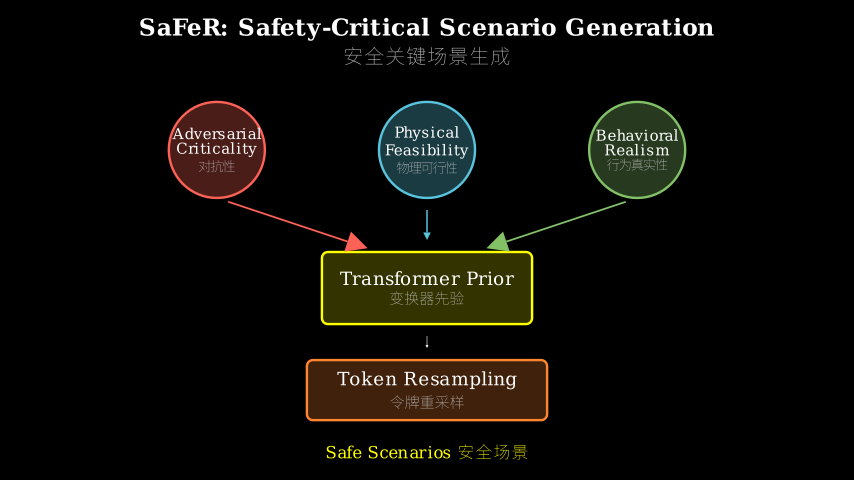
Testing autonomous vehicles requires scenarios that are dangerous enough to expose failures, realistic enough to matter in the real world, and physically possible to execute. Prior work falls into three camps: adversarial optimization methods (like TrafficBots, KING) generate challenging scenarios but produce physically impossible maneuvers or unnatural behaviors; data-driven generative models (like Wayformer, TrafficGen) create realistic traffic but lack adversarial pressure; hybrid approaches try to balance both but still generate inevitable collisions where no control input could prevent a crash, making the test meaningless.
The core issue: these methods treat realism and adversariality as competing objectives to balance, when they should be constraints on a feasible solution space.
Problem: Need dangerous + realistic + possible scenarios
    |
    v
Assumption: Realism is a distribution to sample from,
            Feasibility is a hard constraint to enforce
    |
    v
Method: Resampling within high-probability regions
        + Feasibility constraint from offline RL
    |
    v
Evidence: Higher solution rate (fewer inevitable collisions)
          + Better kinematic realism + Strong adversarial effect
    |
    v
Conclusion: Treating feasibility as constraint > treating it as objective
The Increment
One sentence: Before SaFeR, you had to choose between realistic-but-boring or challenging-but-impossible test scenarios; after SaFeR, you can generate scenarios that are simultaneously adversarial, naturalistic, and physically executable.
Core Mechanism
SaFeR has three components working in sequence. First, a Transformer-based “realism prior” learns the distribution of natural driving behaviors from real-world data, using a novel differential attention mechanism to reduce noise when modeling multi-agent interactions. This model predicts the next token (discretized position/velocity) for each vehicle at each timestep.
Second, instead of sampling directly from this model, SaFeR implements a resampling strategy: it generates multiple candidate tokens, scores them by how adversarial they are to the ego vehicle (using a criticality metric), but only considers candidates within a “trust region” of high probability under the realism prior. This keeps behaviors naturalistic while steering toward dangerous situations.
Third, before accepting a token, SaFeR checks a feasibility constraint: it queries a learned approximation of the “Largest Feasible Region” (LFR) — the set of states from which a collision can still be avoided through some control sequence. This LFR is pre-computed via offline reinforcement learning. If a candidate token would put the scenario into an inevitable collision state (outside the LFR), it’s rejected and resampling continues.
Real traffic data
    |
    v
[Realism Prior: Transformer]  <-- Learns P(next_token | history)
    |
    v
Generate K candidate tokens
    |
    v
[Adversarial Scoring] --> Rank by criticality to ego
    |
    v
[Trust Region Filter] --> Keep only high-probability candidates
    |
    v
[LFR Feasibility Check] --> Reject if inevitable collision
    |
    v
Accept token --> Next timestep
Think of SaFeR like a movie director choreographing a dangerous stunt. The realism prior is the stunt coordinator who knows what movements look natural for each actor. The resampling strategy is the director saying “make it more dramatic, but stay in character” — pushing actors toward conflict while keeping their actions believable. The LFR constraint is the safety officer who stops the scene if someone’s about to get actually hurt, ensuring the stunt remains executable with proper timing and control.
The director doesn’t ask the safety officer to “balance” danger with safety — safety is a hard line. Similarly, SaFeR doesn’t balance feasibility with adversariality; it enforces feasibility as a constraint while maximizing adversariality within that constraint.
Key Concepts
-
Largest Feasible Region (LFR): Imagine you’re driving and a car suddenly swerves into your lane. There’s a boundary in space-time: on one side, you can still brake or steer to avoid collision; on the other side, no matter what you do, physics guarantees a crash. The LFR is the “safe side” of that boundary — the set of all states where collision is still avoidable. SaFeR learns this boundary offline using RL: it trains agents to find escape maneuvers from various dangerous states, then marks states where no escape exists as outside the LFR. During scenario generation, if a proposed vehicle position would cross this boundary, SaFeR rejects it. This prevents generating tests where the autonomous vehicle is “doomed from the start” — scenarios that look like failures but are actually impossible to pass.
-
Token Resampling with Trust Region: Standard language models sample the next token from a probability distribution. SaFeR does something different: it samples multiple candidates, then picks the most adversarial one — but only from candidates that have reasonably high probability (the “trust region”). Concretely, if the realism model says “there’s a 40% chance the car continues straight, 30% it changes lanes, 5% it brakes hard,” SaFeR might pick “brakes hard” if that’s most dangerous to the ego vehicle, even though it’s less likely. But it won’t pick “drives backward at 100 mph” even if that’s maximally adversarial, because that has near-zero probability under natural driving. The trust region threshold (they use top-p sampling with p=0.9) defines “reasonably high probability.”
-
Differential Attention: In multi-agent scenarios, standard attention mechanisms in Transformers can get confused by noise — irrelevant vehicles far away or in different lanes still contribute to attention scores, diluting the signal from truly interactive agents. Differential attention computes two separate attention maps and subtracts them, effectively canceling out the common noise pattern while amplifying the signal from agents that matter for the current prediction. Think of it like noise-canceling headphones: they don’t just block all sound, they specifically cancel the ambient hum while letting through the voice you want to hear.
Framework Shift
Before (mainstream approach):        After (this paper):

Adversarial Optimization:            Realism Prior (Transformer)
  max criticality                           |
  s.t. soft realism penalty                 v
       soft feasibility penalty        Sample candidates
                                             |
         OR                                  v
                                        Resample by criticality
Data-Driven Generation:                   (within trust region)
  sample from P(realistic)                   |
  hope some are adversarial                  v
                                        Hard feasibility check (LFR)
                                             |
(Both treat feasibility as                   v
 objective to optimize)              Accept if feasible, else retry

                                    (Feasibility as constraint,
                                     not objective)
From treating feasibility as a soft penalty to optimize, to treating it as a hard constraint to enforce — the core shift is recognizing that “physically impossible” isn’t a matter of degree, it’s a binary boundary.
Expert Assessment
Problem choice: This is a real gap. The autonomous driving industry genuinely struggles with test scenario generation — too adversarial and you get false failures from impossible situations, too realistic and you miss edge cases. The three-way tension (adversarial/realistic/feasible) is well-motivated. However, the framing slightly overstates the novelty: the idea of using learned realism priors with adversarial resampling has been explored (e.g., in game AI, robotics simulation), though not with the LFR feasibility constraint in this specific form.
Method maturity: The LFR approximation via offline RL is clever and well-executed. The differential attention mechanism feels like a minor incremental improvement rather than a breakthrough — it’s essentially a specific form of attention noise reduction that could probably be achieved with simpler architectural choices (e.g., better positional encodings, explicit lane-based masking). The resampling strategy is straightforward once you have the LFR; the real contribution is showing this combination works in practice.
Experimental integrity: The baselines are fair and comprehensive (TrafficBots, KING, Wayformer, TrafficGen). The metrics are appropriate: solution rate (% of scenarios that are feasible), kinematic realism (jerk, acceleration distributions), and adversarial effectiveness (collision rate, time-to-collision). One concern: the LFR is learned offline on the same dataset used to train the realism prior, which could lead to overfitting to dataset-specific dynamics. The paper doesn’t discuss how the LFR generalizes to out-of-distribution scenarios or different vehicle dynamics models. Also, the closed-loop evaluation uses the same planner (PDM-Closed) for both training the LFR and testing — this is somewhat circular.
Writing quality: The paper is dense and assumes significant background in both autonomous driving and generative modeling. The LFR concept is introduced abruptly without sufficient intuition-building. The differential attention mechanism is oversold — it gets a dedicated subsection but contributes minimally to the core insight. If I were revising, I’d cut the differential attention details to an appendix and expand the LFR section with more intuitive examples and failure case analysis.
Verdict: weak accept — Solid engineering contribution with a clever feasibility constraint mechanism, but the core ideas aren’t deeply novel and the experimental setup has some circularity concerns.
Takeaways
The resampling-with-constraint pattern is broadly applicable: whenever you need to generate adversarial examples from a learned distribution while maintaining some hard property, consider (1) training a generative model on real data, (2) sampling multiple candidates and reranking by adversariality, (3) enforcing the hard property as a binary filter rather than a soft penalty. This pattern transfers to security testing (adversarial inputs that are realistic but trigger bugs), medical simulation (rare but plausible patient trajectories), and game testing (challenging but fair opponent behaviors).
The LFR concept — precomputing the boundary of “still salvageable” states — is useful beyond autonomous driving. In any sequential decision problem where you want to generate challenging scenarios, you can use offline RL to map out which states have escape routes and which are dead ends, then use that map to avoid generating impossible tests.
The differential attention mechanism is probably not worth adopting unless you’re already deep in multi-agent Transformer architectures and have exhausted simpler noise reduction strategies.
论文: 2603.04071 作者: Jinlong Cui, Fenghua Liang, Guo Yang, Chengcheng Tang, Jianxun Cui 分类: cs.RO, cs.AI
缺口
测试自动驾驶需要的场景必须足够危险以暴露失效,足够真实以在现实世界有意义,且物理上可执行。 现有工作分三类:对抗优化方法(如TrafficBots、KING)生成挑战性场景但产生物理上不可能的操作或不自然的行为;数据驱动生成模型(如Wayformer、TrafficGen)创建真实交通但缺乏对抗压力;混合方法试图平衡两者但仍会生成不可避免碰撞——即无论如何控制都无法阻止的撞车,使测试失去意义。
核心问题:这些方法把真实性和对抗性当作需要平衡的竞争目标,而它们本应是可行解空间上的约束。
问题: 需要危险+真实+可能的场景
    |
    v
假设: 真实性是采样的分布,
      可行性是强制执行的硬约束
    |
    v
方法: 在高概率区域内重采样
      + 来自离线RL的可行性约束
    |
    v
证据: 更高求解率(更少不可避免碰撞)
      + 更好运动学真实性 + 强对抗效果
    |
    v
结论: 将可行性作为约束 > 将其作为目标
增量
一句话: SaFeR之前,你必须在真实但无聊和挑战但不可能的测试场景间选择;SaFeR之后,你能生成同时具有对抗性、自然性和物理可执行性的场景。
核心机制
SaFeR有三个顺序工作的组件。 首先,基于Transformer的”真实性先验”从真实世界数据学习自然驾驶行为的分布,使用新颖的差分注意力机制减少建模多智能体交互时的噪声。 这个模型预测每个时间步每辆车的下一个token(离散化的位置/速度)。
其次,SaFeR不直接从这个模型采样,而是实现重采样策略:生成多个候选token,按它们对自车的对抗程度评分(使用危险度指标),但只考虑在真实性先验下高概率的”信任区域”内的候选。 这在转向危险情况的同时保持行为自然。
第三,接受token前,SaFeR检查可行性约束:查询”最大可行区域”(LFR)的学习近似——从中仍可通过某些控制序列避免碰撞的状态集合。 这个LFR通过离线强化学习预计算。 如果候选token会让场景进入不可避免碰撞状态(LFR外),就拒绝它并继续重采样。
真实交通数据
    |
    v
[真实性先验: Transformer]  <-- 学习 P(next_token | history)
    |
    v
生成K个候选token
    |
    v
[对抗性评分] --> 按对自车的危险度排序
    |
    v
[信任区域过滤] --> 只保留高概率候选
    |
    v
[LFR可行性检查] --> 拒绝不可避免碰撞
    |
    v
接受token --> 下一时间步
把SaFeR想象成电影导演编排危险特技。 真实性先验是特技协调员,知道每个演员什么动作看起来自然。 重采样策略是导演说”让它更戏剧化,但保持角色”——推动演员走向冲突同时保持动作可信。 LFR约束是安全官,如果有人真要受伤就停止场景,确保特技在适当时机和控制下可执行。
导演不会要求安全官”平衡”危险与安全——安全是硬线。 类似地,SaFeR不平衡可行性与对抗性;它将可行性作为约束强制执行,同时在该约束内最大化对抗性。
关键概念
-
最大可行区域(LFR): 想象你在开车,一辆车突然并入你的车道。 时空中存在一个边界:一侧你仍能刹车或转向避免碰撞;另一侧无论你做什么,物理定律保证撞车。 LFR是那个边界的”安全侧”——所有碰撞仍可避免的状态集合。 SaFeR使用RL离线学习这个边界:训练智能体从各种危险状态寻找逃脱操作,然后标记没有逃脱路径的状态为LFR外。 场景生成期间,如果提议的车辆位置会越过这个边界,SaFeR拒绝它。 这防止生成自动驾驶车辆”从一开始就注定失败”的测试——看起来像失效但实际不可能通过的场景。
-
带信任区域的token重采样: 标准语言模型从概率分布采样下一个token。 SaFeR做法不同:采样多个候选,然后选最对抗的一个——但只从有合理高概率的候选(即”信任区域”)中选。 具体地,如果真实性模型说”车辆继续直行40%概率,变道30%,急刹5%“,SaFeR可能选”急刹”如果那对自车最危险,即使它概率较低。 但它不会选”以100mph倒车”即使那最大对抗,因为那在自然驾驶下概率接近零。 信任区域阈值(他们用p=0.9的top-p采样)定义”合理高概率”。
-
差分注意力: 多智能体场景中,Transformer的标准注意力机制会被噪声混淆——远处或不同车道的无关车辆仍贡献注意力分数,稀释来自真正交互智能体的信号。 差分注意力计算两个独立的注意力图并相减,有效抵消共同噪声模式同时放大对当前预测重要的智能体信号。 想象降噪耳机:它们不只是阻挡所有声音,而是专门抵消环境嗡嗡声同时让你想听的声音通过。
框架转变
之前(主流方法):                  之后(本文方法):

对抗优化:                        真实性先验(Transformer)
  max 危险度                            |
  s.t. 软真实性惩罚                     v
       软可行性惩罚                 采样候选
                                        |
         或                             v
                                   按危险度重采样
数据驱动生成:                      (信任区域内)
  从P(真实)采样                         |
  希望有些对抗                          v
                                   硬可行性检查(LFR)
                                        |
(两者都将可行性                         v
 作为优化目标)                   可行则接受,否则重试

                                 (可行性作为约束,
                                  非目标)
从将可行性作为优化的软惩罚,到将其作为强制执行的硬约束——核心转变是认识到”物理上不可能”不是程度问题,而是二元边界。
专家评审
选题眼光: 这是真实缺口。 自动驾驶行业确实在测试场景生成上挣扎——太对抗会从不可能情况得到假失效,太真实会错过边缘案例。 三方张力(对抗/真实/可行)动机充分。 但框架略微夸大新颖性:使用学习的真实性先验加对抗重采样的想法已被探索(如游戏AI、机器人仿真),虽然没有这种特定形式的LFR可行性约束。
方法成熟度: 通过离线RL近似LFR巧妙且执行良好。 差分注意力机制感觉像小幅增量改进而非突破——本质上是特定形式的注意力噪声减少,可能用更简单的架构选择实现(如更好的位置编码、显式基于车道的掩码)。 有了LFR后重采样策略很直接;真正贡献是展示这个组合在实践中有效。
实验诚意: 基线公平全面(TrafficBots、KING、Wayformer、TrafficGen)。 指标恰当:求解率(可行场景百分比)、运动学真实性(加加速度、加速度分布)、对抗有效性(碰撞率、碰撞时间)。 一个担忧:LFR在用于训练真实性先验的同一数据集上离线学习,可能导致过拟合到数据集特定动力学。 论文未讨论LFR如何泛化到分布外场景或不同车辆动力学模型。 另外,闭环评估对训练LFR和测试都使用同一规划器(PDM-Closed)——这有些循环。
写作功力: 论文密集且假设读者在自动驾驶和生成建模方面有大量背景。 LFR概念引入突兀,缺乏足够的直觉构建。 差分注意力机制被过度推销——有专门小节但对核心洞察贡献极小。 如果我修订,会把差分注意力细节移到附录,扩展LFR部分加入更多直观例子和失效案例分析。
判决: 弱接收——扎实的工程贡献,有巧妙的可行性约束机制,但核心思想不够深刻新颖,实验设置有些循环性担忧。
要点总结
带约束的重采样模式广泛适用:当你需要从学习分布生成对抗样本同时维持某些硬性质时,考虑(1)在真实数据上训练生成模型,(2)采样多个候选并按对抗性重排,(3)将硬性质作为二元过滤器而非软惩罚强制执行。 这个模式迁移到安全测试(真实但触发bug的对抗输入)、医疗仿真(罕见但合理的患者轨迹)、游戏测试(挑战但公平的对手行为)。
LFR概念——预计算”仍可挽救”状态的边界——在自动驾驶之外有用。 任何你想生成挑战场景的序列决策问题中,可以用离线RL映射哪些状态有逃脱路径哪些是死胡同,然后用那个地图避免生成不可能的测试。
差分注意力机制可能不值得采用,除非你已深入多智能体Transformer架构且穷尽了更简单的噪声减少策略。