Paper: 2605.12476 Authors: Sagi Ahrac, Noya Hochwald, Mor Geva Categories: cs.LG, cs.CL
The Gap
Sparse Mixture-of-Experts (SMoE) models scale language models efficiently by routing tokens to specialized experts, but training them is fragile. Routing often collapses onto a few experts, leaving others idle. The standard fix—auxiliary load-balancing losses—spreads tokens more evenly but reduces expert specialization, hurting performance. Prior work treats routing as a black box: tune the loss coefficients, hope for balance, and accept the specialization-diversity tradeoff. No one has asked why routers make the decisions they do or what structure emerges during training that makes routing work at all.
This paper opens the black box. It shows that routers and experts are geometrically coupled: they learn aligned weight directions because they receive gradients along the same input vectors. This coupling explains routing dynamics, reveals why auxiliary losses hurt specialization, and suggests simpler alternatives.
Problem: Routing collapse + auxiliary losses hurt specialization
   |
   v
Assumption: Routers and experts share gradient structure
   |
   v
Method: Analyze gradient directions, measure alignment, test parameter-free router
   |
   v
Evidence: Matched directions accumulate same token history; K-Means router works
   |
   v
Conclusion: Geometric coupling is the core mechanism; auxiliary losses break it
The Increment
One sentence: Before this paper, we knew auxiliary losses balance load but hurt specialization; after, we know *why—they break the geometric coupling between routers and experts that enables effective routing.
Core Mechanism
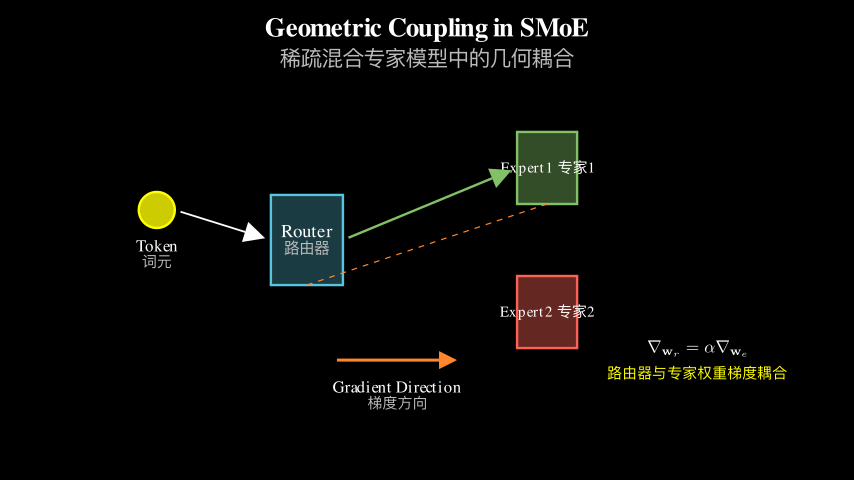
The paper’s core insight is that for a selected expert, the router weights and expert weights receive gradients along the same input direction, differing only in scalar coefficients. When a token is routed to an expert, both the router (deciding which expert) and the expert (processing the token) update based on the same input vector. Over time, this shared gradient direction aligns the router’s weight vector for that expert with the expert’s internal weight directions.
This creates a feedback loop: the router learns to score experts highly when the input aligns with what the expert has specialized on, and the expert continues to specialize on inputs the router sends it. The result is geometric coupling—router scores predict expert neuron activations, and matched router-expert directions accumulate the same routed token history.
Token x arrives
   |
   v
Router computes scores: w_r^T x  (for each expert)
   |
   v
Select top-k experts based on scores
   |
   v
Expert processes: w_e^T x  (expert weights)
   |
   v
Gradients flow back:
  - Router gradient: proportional to x
  - Expert gradient: proportional to x
   |
   v
Both w_r and w_e shift along direction x
   |
   v
Over time: w_r and w_e align geometrically
Think of it like a restaurant recommendation system and the restaurants themselves. The recommender (router) learns which restaurant to suggest based on a customer’s preferences (input token). Each restaurant (expert) develops a specialty based on the customers it serves. Crucially, both the recommender and the restaurant learn from the same customer feedback. If a customer who loves spicy food gets routed to Restaurant A, both the recommender’s “spicy → Restaurant A” weight and Restaurant A’s “make it spicy” skill get reinforced. Over time, the recommender’s internal map of “what Restaurant A is good at” mirrors Restaurant A’s actual menu, because they’ve been shaped by the same stream of customers.
Key Concepts
-
Geometric coupling: The router weight vector for expert *i and the expert’s internal weight vectors point in similar directions in the input space. This happens because both receive gradients proportional to the same input tokens—those routed to expert i. It’s not a design choice; it’s an emergent property of gradient descent. Concretely, if tokens about “sports” consistently get routed to Expert 3, both the router’s “sports → Expert 3” direction and Expert 3’s internal “sports processing” directions will align with the “sports” region of the input space.
-
Auxiliary load-balancing losses: These are extra loss terms added during training to prevent routing collapse (all tokens going to one expert). A common approach penalizes uneven expert usage. The problem: these losses inject gradients into the router that are *not aligned with the input tokens being routed. Instead of “route this token based on what the expert knows,” the gradient says “route this token to balance the load.” This breaks geometric coupling by spreading input-directed gradients across all router weights, making distinct router directions nearly three times more similar to each other.
-
Parameter-free K-Means router: Instead of learning router weights, each expert maintains a running average (centroid) of the hidden states routed to it. New tokens are assigned to the expert whose centroid has the highest cosine similarity. This is parameter-free because the centroids are computed from data, not learned. The paper shows this achieves low load imbalance with only modest perplexity increase, demonstrating that geometric coupling—not learned router parameters—captures most of what makes routing work.
Framework Shift
Before (mainstream approach):        After (this paper):

Router (learned weights)             Router (learned weights)
   |                                    |
   v                                    v  (gradients along input x)
Select experts                       Select experts
   |                                    |
   v                                    v
Experts process tokens               Experts process tokens
   ^                                    ^  (gradients along input x)
   |                                    |
Auxiliary loss (balance load)        Geometric coupling emerges
   |                                    |
   v                                    v
Breaks specialization                Router-expert alignment
                                        |
                                        v
                                     K-Means router (parameter-free)
From treating routing as a learned black box requiring auxiliary losses, to understanding it as a geometric alignment process where routers and experts naturally couple through shared gradient directions.
Expert Assessment
Problem choice: Real gap. Routing collapse and the specialization-diversity tradeoff are well-documented pain points in SMoE training. Prior work has thrown various auxiliary losses at the problem without understanding the underlying mechanism. This paper asks the right question: *why does routing work when it works, and why do auxiliary losses hurt when they hurt?
Method maturity: Clever insight, not brute force. The gradient analysis is straightforward linear algebra, but the connection to routing dynamics is non-obvious. The K-Means router is elegant—it strips away learned parameters to isolate the geometric coupling effect. However, the paper could have explored whether other parameter-free methods (e.g., nearest-neighbor with different distance metrics) also work, which would strengthen the claim that geometry is the key.
Experimental integrity: Baselines are fair. The 1B parameter SMoE trained from scratch is a reasonable scale for mechanistic analysis. The empirical measurements (router-expert alignment, neuron activation prediction) directly test the theoretical claims. One weakness: the K-Means router is tested only on perplexity and load balance, not on downstream tasks. It’s unclear whether the “modest perplexity increase” translates to acceptable performance in practice.
Writing quality: The gradient derivation in the theory section is dense and could benefit from a worked example with concrete numbers. The empirical section jumps between different experiments without always connecting them back to the central thesis. Rewriting Section 4 to follow a single narrative thread—“here’s the coupling, here’s how auxiliary losses break it, here’s what happens when we remove learned parameters”—would make the paper much stronger.
Verdict: weak accept — Solid mechanistic insight into a real problem, but the practical implications (can we train SMoEs without auxiliary losses?) are underexplored.
Takeaways
-
Diagnostic tool: Measure cosine similarity between router weight vectors and expert activation patterns. If they’re misaligned, your routing is broken. This is cheaper than waiting for training to collapse.
-
Rethink auxiliary losses: If your auxiliary loss is spreading gradients across all router weights (not just the selected expert), it’s fighting geometric coupling. Consider losses that only affect the selected expert’s router weight, or use parameter-free routing.
-
Transfer to other routing problems: The geometric coupling principle applies beyond SMoEs. Any system where a selector (router) and processors (experts) are jointly trained on the same data will exhibit this alignment. Think: attention heads in transformers, modular neural networks, or even ensemble methods with learned weighting.
-
Simplicity baseline: Before adding complex routing mechanisms, try K-Means or nearest-neighbor routing with running centroids. If it works nearly as well, your learned router might be doing less than you think.
论文: 2605.12476 作者: Sagi Ahrac, Noya Hochwald, Mor Geva 分类: cs.LG, cs.CL
缺口
稀疏混合专家(SMoE)模型通过将token路由到专门的专家来高效扩展语言模型,但训练过程很脆弱。
路由经常坍缩到少数几个专家上,其他专家闲置。
标准的修复方法——辅助负载均衡损失——能更均匀地分配token,但会降低专家的专业化程度,损害性能。
先前的工作把路由当作黑箱:调整损失系数,期待平衡,接受专业化与多样性的权衡。
没人问过路由器为什么做出这些决策,或者训练过程中出现了什么结构使路由能够工作。
本文打开了黑箱。
它表明路由器和专家在几何上是耦合的:它们学习对齐的权重方向,因为它们沿着相同的输入向量接收梯度。
这种耦合解释了路由动态,揭示了辅助损失为何损害专业化,并提出了更简单的替代方案。
问题:路由坍缩 + 辅助损失损害专业化
   |
   v
假设:路由器和专家共享梯度结构
   |
   v
方法:分析梯度方向,测量对齐度,测试无参数路由器
   |
   v
证据:匹配的方向累积相同的token历史;K-Means路由器有效
   |
   v
结论:几何耦合是核心机制;辅助损失破坏了它
增量
一句话: 这篇论文之前,我们知道辅助损失能平衡负载但损害专业化;之后,我们知道**原因*——它们破坏了路由器与专家之间实现有效路由的几何耦合。
核心机制
本文的核心洞察是:对于被选中的专家,路由器权重和专家权重沿着相同的输入方向接收梯度,仅在标量系数上有所不同。
当一个token被路由到某个专家时,路由器(决定哪个专家)和专家(处理token)都基于相同的输入向量进行更新。
随着时间推移,这种共享的梯度方向使路由器针对该专家的权重向量与专家的内部权重方向对齐。
这创造了一个反馈循环:当输入与专家专业化的内容对齐时,路由器学会给该专家高分,而专家继续在路由器发送给它的输入上专业化。
结果是几何耦合——路由器分数预测专家神经元激活,匹配的路由器-专家方向累积相同的路由token历史。
Token x 到达
   |
   v
路由器计算分数:w_r^T x(对每个专家)
   |
   v
基于分数选择 top-k 专家
   |
   v
专家处理:w_e^T x(专家权重)
   |
   v
梯度回流:
  - 路由器梯度:与 x 成比例
  - 专家梯度:与 x 成比例
   |
   v
w_r 和 w_e 都沿方向 x 移动
   |
   v
随时间:w_r 和 w_e 几何对齐
把它想象成餐厅推荐系统和餐厅本身。
推荐者(路由器)根据顾客的偏好(输入token)学习推荐哪家餐厅。
每家餐厅(专家)根据它服务的顾客发展出专长。
关键是,推荐者和餐厅都从相同的顾客反馈中学习。
如果一个喜欢辣味的顾客被路由到餐厅A,推荐者的”辣味→餐厅A”权重和餐厅A的”做辣”技能都会得到强化。
随着时间推移,推荐者对”餐厅A擅长什么”的内部地图会镜像餐厅A的实际菜单,因为它们被相同的顾客流塑造。
关键概念
- 几何耦合:专家**i*的路由器权重向量和专家的内部权重向量在输入空间中指向相似的方向。
这是因为两者都接收与相同输入token成比例的梯度——那些被路由到专家i的token。
这不是设计选择;这是梯度下降的涌现属性。
具体来说,如果关于”体育”的token持续被路由到专家3,路由器的”体育→专家3”方向和专家3的内部”体育处理”方向都会与输入空间的”体育”区域对齐。
- 辅助负载均衡损失:这些是训练期间添加的额外损失项,用于防止路由坍缩(所有token都去一个专家)。
常见方法是惩罚专家使用不均。
问题在于:这些损失向路由器注入的梯度不与被路由的输入token对齐。
梯度不是说”根据专家知道的内容路由这个token”,而是说”路由这个token以平衡负载”。
这通过将输入导向的梯度分散到所有路由器权重上来破坏几何耦合,使不同的路由器方向彼此相似度提高近三倍。
- 无参数K-Means路由器:不学习路由器权重,而是每个专家维护被路由到它的隐藏状态的运行平均值(质心)。
新token被分配给质心余弦相似度最高的专家。
这是无参数的,因为质心是从数据计算的,而非学习的。
本文表明这能实现低负载不平衡,困惑度仅略有增加,证明几何耦合——而非学习的路由器参数——捕获了使路由工作的大部分内容。
框架转变
之前(主流方法):                之后(本文方法):

路由器(学习的权重)              路由器(学习的权重)
   |                                 |
   v                                 v(沿输入 x 的梯度)
选择专家                           选择专家
   |                                 |
   v                                 v
专家处理 token                     专家处理 token
   ^                                 ^(沿输入 x 的梯度)
   |                                 |
辅助损失(平衡负载)               几何耦合涌现
   |                                 |
   v                                 v
破坏专业化                         路由器-专家对齐
                                     |
                                     v
                                  K-Means路由器(无参数)
从将路由视为需要辅助损失的学习黑箱,到理解它是一个几何对齐过程,路由器和专家通过共享梯度方向自然耦合。
专家评审
选题眼光:真实缺口。
路由坍缩和专业化-多样性权衡是SMoE训练中有充分记录的痛点。
先前工作向问题投掷各种辅助损失,却不理解底层机制。
本文问了正确的问题:路由为什么在有效时有效,辅助损失为什么在损害时损害?
方法成熟度:巧劲,非蛮力。
梯度分析是直接的线性代数,但与路由动态的联系并不显而易见。
K-Means路由器很优雅——它剥离学习参数以隔离几何耦合效应。
然而,本文可以探索其他无参数方法(例如,使用不同距离度量的最近邻)是否也有效,这会加强几何是关键的主张。
实验诚意:基线公平。
从头训练的1B参数SMoE是机制分析的合理规模。
实证测量(路由器-专家对齐、神经元激活预测)直接测试理论主张。
一个弱点:K-Means路由器仅在困惑度和负载平衡上测试,未在下游任务上测试。
不清楚”适度的困惑度增加”在实践中是否转化为可接受的性能。
写作功力:理论部分的梯度推导很密集,可以从带具体数字的示例中受益。
实证部分在不同实验间跳跃,并不总是将它们连回中心论点。
重写第4节以遵循单一叙事线——“这是耦合,这是辅助损失如何破坏它,这是移除学习参数后发生的事”——会使论文更强。
判决:弱接收 — 对真实问题的扎实机制洞察,但实际影响(我们能否不用辅助损失训练SMoE?)探索不足。
要点总结
- 诊断工具:测量路由器权重向量与专家激活模式之间的余弦相似度。
如果它们不对齐,你的路由坏了。
这比等待训练坍缩更便宜。
- 重新思考辅助损失:如果你的辅助损失将梯度分散到所有路由器权重上(不仅是被选中的专家),它在对抗几何耦合。
考虑仅影响被选中专家的路由器权重的损失,或使用无参数路由。
- 迁移到其他路由问题:几何耦合原理适用于SMoE之外。
任何选择器(路由器)和处理器(专家)在相同数据上联合训练的系统都会表现出这种对齐。
想想:transformer中的注意力头、模块化神经网络,甚至带学习权重的集成方法。
- 简单性基线:在添加复杂路由机制之前,尝试带运行质心的K-Means或最近邻路由。
如果它几乎同样有效,你的学习路由器可能做的比你想的少。