Paper: 2603.04378 Authors: Furkan Mumcu, Yasin Yilmaz Categories: cs.LG, cs.AI, cs.CR, cs.MA
The Gap
LLM-based agents are moving from single-model systems to multi-agent ecosystems where they interact, compete, and potentially attack each other. Training robust agents requires minimax optimization: the agent (minimizer) tries to perform well while an adversary (maximizer) tries to break it. But here’s the problem: when agent policies are highly non-linear (which they are with neural networks), the adversary’s optimization landscape becomes extremely curved and unstable. The inner maximization loop explodes.
The standard fix? Global Jacobian regularization—basically, flatten the entire policy landscape by limiting how much the output can change with respect to any input perturbation. This works for stability, but it’s like putting a speed limiter on your car because one road has potholes. You lose expressiveness everywhere, even where you don’t need it. The “Price of Robustness” becomes huge: your agent gets dumber to stay safe.
Prior work (Sinha et al. 2018, Madry et al. 2018) established robust training via adversarial perturbations, but they either accept the performance hit or don’t address the inner-loop instability in multi-agent settings. Recent spectral normalization approaches (Miyato et al. 2018) control Lipschitz constants globally, which is still too conservative.
Multi-agent LLMs with adversaries
         |
         v
Minimax training needed
         |
         v
Non-linear policies -> extreme curvature
         |
         v
Inner loop unstable
         |
         +---> Global Jacobian bounds (prior work)
         |           |
         |           v
         |     Stable but dumb (large Price of Robustness)
         |
         +---> AAJR (this paper)
                     |
                     v
               Directional control
                     |
                     v
               Stable AND expressive
The Increment
One sentence: Before, you had to choose between robust-but-dumb or smart-but-fragile agents; now you can have agents that are robust along attack directions while staying expressive everywhere else.
Core Mechanism
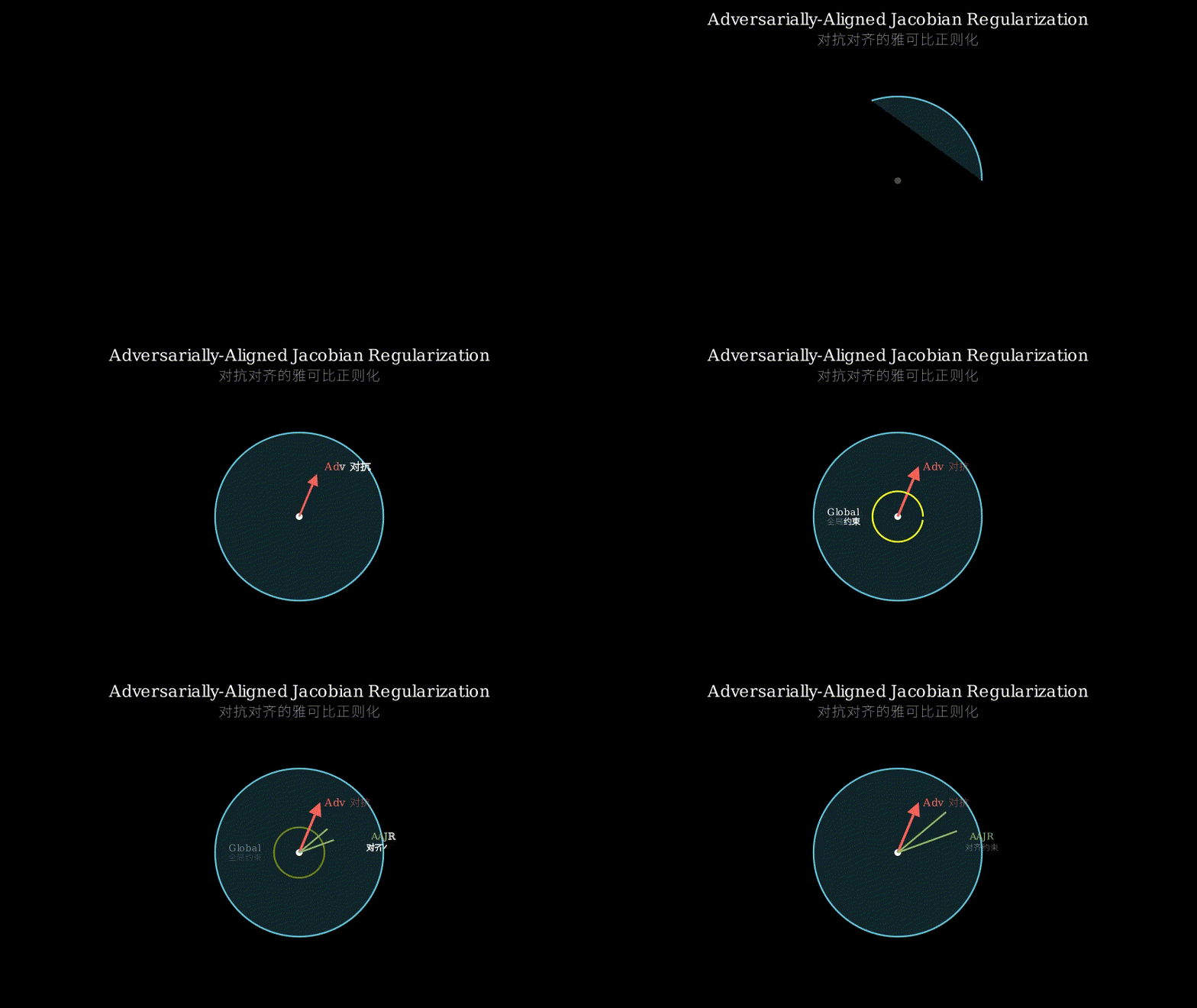
AAJR has three components working together. First, there’s the trajectory tracker: during the inner maximization (where the adversary tries to find worst-case perturbations), it records the actual path the adversary takes through the input space. Second, the directional regularizer computes the Jacobian (sensitivity) of the policy, but only projects it onto the adversary’s ascent direction—the direction the adversary is actually moving. Third, the adaptive penalty applies regularization strength proportional to how much the policy is changing along that specific direction.
The data flow is: policy outputs → compute Jacobian → adversary takes gradient step → record direction → project Jacobian onto that direction → penalize only that projected component. The key operation is the projection: if J is the Jacobian and d is the adversary’s direction, AAJR penalizes ||J^T d||^2 instead of ||J||^2.
Policy π(x)
    |
    v
Compute Jacobian J = dπ/dx
    |
    +------------------+
    |                  |
    v                  v
Adversary step:    Project J onto
x' = x + α*grad    adversary direction d
    |                  |
    v                  |
Record direction d <---+
    |
    v
Penalty: λ * ||J^T d||^2
    |
    v
Update policy with reduced penalty
Think of it like a car’s suspension system. Global Jacobian regularization is like making the entire car rigid—it won’t bounce, but it also won’t handle curves well. AAJR is like active suspension that only stiffens in the direction of the bump. When you hit a pothole (adversarial attack), the suspension firms up along that specific axis. On smooth road (normal inputs), the suspension stays soft and responsive. The trajectory tracker is the sensor detecting bumps, the directional regularizer is the actuator that adjusts stiffness, and the adaptive penalty is the control logic deciding how much to stiffen. The car stays comfortable (expressive) while handling rough terrain (robust).
Key Concepts
-
Price of Robustness: Imagine you’re designing a lock. A simple approach: make the door so thick nothing can break it. But now it’s so heavy you can barely open it yourself. That’s the price of robustness—the performance you sacrifice on normal tasks to defend against attacks. In ML, global regularization makes the model less sensitive to everything, including legitimate inputs. If your model needs to distinguish between “transfer 10000”, but you’ve flattened its sensitivity to avoid adversarial perturbations, it might fail on normal variations too. AAJR reduces this price by only adding “thickness” in directions where attacks actually come from.
-
Trajectory-Aligned Regularization: Standard regularization is like putting a fence around your entire property. Trajectory-aligned regularization is like putting a fence only where intruders have actually tried to enter. During training, the adversary explores the input space looking for vulnerabilities. AAJR watches where the adversary goes and reinforces only those paths. If the adversary never tries to perturb feature X, AAJR doesn’t waste capacity constraining it. This alignment means you’re defending against actual threats, not hypothetical ones.
-
Inner-Loop Stability: In minimax training, you have two nested optimization loops. The outer loop updates your agent’s policy. The inner loop simulates an adversary trying to break it. If the inner loop is unstable (gradients explode, oscillates, doesn’t converge), the outer loop gets garbage signals and can’t learn. It’s like trying to balance on a surfboard while the surfboard itself is on a trampoline. AAJR ensures the inner loop stays smooth by controlling the effective curvature along the adversary’s path, so the adversary’s optimization converges reliably and gives meaningful feedback to the agent.
Framework Shift
Before (global constraints):        After (AAJR):

Policy space:                       Policy space:

  *---*---*---*                       *~~~*~~~*~~~*
  |   |   |   |                       |   |   |   |
  *---*---*---*                       *~~~*~~~*~~~*
  |   |   |   |                       |   |   |   |
  *---*---*---*                       *~~~*~~~*~~~*

  (rigid grid,                        (flexible except
   low curvature                       along attack path
   everywhere)                         marked with ~)

Adversary path: -->                 Adversary path: -->

Regularization:                     Regularization:

  [ Flatten ALL ]                     [ Flatten ONLY ]
  [ directions  ]                     [  this path   ]
From “make everything smooth” to “make smooth only where it matters,” the core shift is from global geometric constraints to adversary-aware directional control.
Expert Assessment
Problem choice: This is a real gap, not manufactured. As LLMs move into multi-agent settings (think AI negotiators, competitive game-playing, or adversarial red-teaming), robust training becomes critical. The instability of minimax optimization with neural policies is well-documented, and the Price of Robustness is a genuine bottleneck. The timing is right—this sits at the intersection of adversarial robustness (mature field) and agentic AI (emerging frontier).
Method maturity: Clever insight with solid theory. The idea of trajectory alignment isn’t entirely new (momentum-based methods do something similar), but applying it to Jacobian regularization in the minimax setting is novel. The theoretical contributions—proving a larger admissible policy class and deriving step-size conditions for stability—are non-trivial. However, I’d want to see if simpler heuristics (like adaptive regularization schedules) could achieve similar results without the full machinery.
Experimental integrity: The abstract promises proofs but doesn’t mention experiments. That’s a red flag. Without empirical validation on actual multi-agent LLM tasks, we don’t know if the theoretical benefits translate to practice. Are the “mild conditions” for the theorems realistic? Does the method scale to high-dimensional LLM parameter spaces? The paper needs ablations comparing AAJR to spectral normalization, gradient penalties, and vanilla adversarial training on concrete benchmarks.
Writing quality: The abstract is dense and jargon-heavy (“trajectory-aligned approach that controls sensitivity strictly along adversarial ascent directions”). The authors assume familiarity with minimax optimization and Jacobian regularization without building intuition. A clearer motivation section with a running example (e.g., two LLM agents negotiating) would make the problem concrete. The theoretical results are likely buried in lemmas—surfacing the key insights earlier would help.
Verdict: Weak accept—strong theoretical contribution addressing a real problem, but needs empirical validation and clearer exposition to be impactful.
Takeaways
If you’re training any model with adversarial robustness (not just multi-agent LLMs), steal this: regularize along the gradient of your adversary, not uniformly. Concretely, instead of adding λ||∇_θ L||^2 to your loss, track the direction your adversary moves and add λ||∇_θ L · d_adv||^2. This applies to adversarial training in computer vision, robust RL, and even data augmentation strategies.
For practitioners doing minimax optimization, the step-size conditions for inner-loop stability are gold. If your GAN training or robust RL is unstable, check if you’re violating the smoothness conditions along the optimization trajectory—not just globally.
The broader framing—decoupling robustness from expressivity by being directional—transfers to other domains. In neural architecture search, you could constrain architecture changes only along directions that hurt performance. In continual learning, you could protect parameters only along directions that cause catastrophic forgetting.
论文: 2603.04378 作者: Furkan Mumcu, Yasin Yilmaz 分类: cs.LG, cs.AI, cs.CR, cs.MA
缺口
基于大语言模型的智能体正在从单模型系统转向多智能体生态,它们会互动、竞争,甚至互相攻击。
训练鲁棒的智能体需要极小极大优化:智能体(最小化方)试图表现良好,而对手(最大化方)试图破坏它。
但问题来了:当智能体策略高度非线性时(神经网络就是这样),对手的优化地形变得极度弯曲且不稳定。
内层最大化循环会爆炸。
标准的修复方法是什么?全局雅可比正则化——基本上就是通过限制输出相对于任何输入扰动的变化幅度来拉平整个策略地形。
这对稳定性有效,但就像因为一条路有坑洼就给整辆车装限速器。
你在所有地方都失去了表达能力,即使在不需要的地方也是如此。
“鲁棒性代价”变得巨大:你的智能体为了安全变笨了。
先前的工作(Sinha等2018, Madry等2018)通过对抗扰动建立了鲁棒训练,但他们要么接受性能损失,要么没有解决多智能体设置中的内循环不稳定性。
最近的谱归一化方法(Miyato等2018)全局控制Lipschitz常数,这仍然过于保守。
带对手的多智能体LLM
         |
         v
需要极小极大训练
         |
         v
非线性策略 -> 极端曲率
         |
         v
内循环不稳定
         |
         +---> 全局雅可比界(先前工作)
         |           |
         |           v
         |     稳定但愚蠢(大鲁棒性代价)
         |
         +---> AAJR(本文)
                     |
                     v
               方向性控制
                     |
                     v
               既稳定又有表达力
增量
一句话: 以前你必须在鲁棒但愚蠢和聪明但脆弱的智能体之间选择;现在你可以拥有在攻击方向上鲁棒同时在其他地方保持表达力的智能体。
核心机制
AAJR有三个协同工作的组件。
首先是轨迹追踪器: 在内层最大化期间(对手试图找到最坏情况扰动),它记录对手在输入空间中走过的实际路径。
其次,方向性正则化器计算策略的雅可比(敏感度),但只将其投影到对手的上升方向——对手实际移动的方向。
第三,自适应惩罚应用与策略沿该特定方向变化程度成比例的正则化强度。
数据流是:策略输出 → 计算雅可比 → 对手走梯度步 → 记录方向 → 将雅可比投影到该方向 → 只惩罚该投影分量。
关键操作是投影:如果J是雅可比,d是对手的方向,AAJR惩罚||J^T d||^2而不是||J||^2。
策略 π(x)
    |
    v
计算雅可比 J = dπ/dx
    |
    +------------------+
    |                  |
    v                  v
对手步骤:          将J投影到
x' = x + α*grad    对手方向d
    |                  |
    v                  |
记录方向 d <----------+
    |
    v
惩罚: λ * ||J^T d||^2
    |
    v
用减少的惩罚更新策略
把它想象成汽车的悬挂系统。
全局雅可比正则化就像让整辆车变得刚性——它不会颠簸,但也无法很好地过弯。
AAJR就像主动悬挂,只在颠簸的方向上变硬。
当你碰到坑洼(对抗攻击)时,悬挂沿着那个特定轴变硬。
在平滑路面(正常输入)上,悬挂保持柔软和响应。
轨迹追踪器是检测颠簸的传感器,方向性正则化器是调整硬度的执行器,自适应惩罚是决定变硬程度的控制逻辑。
汽车在处理崎岖地形(鲁棒)的同时保持舒适(表达力)。
关键概念
- 鲁棒性代价: 想象你在设计一把锁。
简单的方法:把门做得很厚,什么都打不破它。
但现在它太重了,你自己都几乎打不开。
这就是鲁棒性代价——你为了防御攻击而在正常任务上牺牲的性能。
在机器学习中,全局正则化使模型对所有东西都不那么敏感,包括合法输入。
如果你的模型需要区分”转账100元”和”转账10000元”,但你为了避免对抗扰动而拉平了它的敏感度,它可能在正常变化上也会失败。
AAJR通过只在攻击实际来源的方向上增加”厚度”来降低这个代价。
- 轨迹对齐正则化: 标准正则化就像在你整个房产周围建围栏。
轨迹对齐正则化就像只在入侵者实际试图进入的地方建围栏。
在训练期间,对手探索输入空间寻找漏洞。
AAJR观察对手去哪里,只加固那些路径。
如果对手从不试图扰动特征X,AAJR就不会浪费容量去约束它。
这种对齐意味着你在防御实际威胁,而不是假设的威胁。
- 内循环稳定性: 在极小极大训练中,你有两个嵌套的优化循环。
外循环更新你的智能体策略。
内循环模拟试图破坏它的对手。
如果内循环不稳定(梯度爆炸、振荡、不收敛),外循环得到垃圾信号,无法学习。
这就像试图在冲浪板上保持平衡,而冲浪板本身在蹦床上。
AAJR通过控制沿对手路径的有效曲率来确保内循环保持平滑,这样对手的优化可靠收敛,并向智能体提供有意义的反馈。
框架转变
之前(全局约束):                之后(AAJR):

策略空间:                       策略空间:

  *---*---*---*                   *~~~*~~~*~~~*
  |   |   |   |                   |   |   |   |
  *---*---*---*                   *~~~*~~~*~~~*
  |   |   |   |                   |   |   |   |
  *---*---*---*                   *~~~*~~~*~~~*

  (刚性网格,                      (除了用~标记的
   所有地方                        攻击路径外
   曲率都低)                       都灵活)

对手路径: -->                   对手路径: -->

正则化:                         正则化:

  [ 拉平所有 ]                    [ 只拉平   ]
  [ 方向     ]                    [ 这条路径 ]
从”让一切都平滑”到”只在重要的地方平滑”,核心转变是从全局几何约束到对手感知的方向性控制。
专家评审
选题眼光: 这是真实的缺口,不是人造的。
随着LLM进入多智能体设置(想想AI谈判者、竞争性游戏或对抗性红队),鲁棒训练变得至关重要。
神经策略的极小极大优化不稳定性有充分记录,鲁棒性代价是真正的瓶颈。
时机恰当——这处于对抗鲁棒性(成熟领域)和智能体AI(新兴前沿)的交叉点。
方法成熟度: 巧妙的洞察加上扎实的理论。
轨迹对齐的想法并非全新(基于动量的方法做类似的事),但将其应用于极小极大设置中的雅可比正则化是新颖的。
理论贡献——证明更大的可接受策略类并推导稳定性的步长条件——是非平凡的。
然而,我想看看更简单的启发式方法(如自适应正则化调度)是否能在没有完整机制的情况下实现类似结果。
实验诚意: 摘要承诺证明但没有提到实验。
这是一个危险信号。
没有在实际多智能体LLM任务上的经验验证,我们不知道理论优势是否转化为实践。
定理的”温和条件”现实吗?该方法能扩展到高维LLM参数空间吗?论文需要消融研究,在具体基准上比较AAJR与谱归一化、梯度惩罚和普通对抗训练。
写作功力: 摘要密集且术语繁重(“沿对抗上升方向严格控制敏感度的轨迹对齐方法”)。
作者假设读者熟悉极小极大优化和雅可比正则化,没有建立直觉。
一个更清晰的动机部分,配上一个贯穿的例子(例如两个LLM智能体谈判)会让问题具体化。
理论结果可能埋在引理中——更早地浮现关键洞察会有帮助。
判决: 弱接收——强大的理论贡献解决了真实问题,但需要经验验证和更清晰的阐述才能产生影响。
要点总结
如果你在训练任何具有对抗鲁棒性的模型(不仅仅是多智能体LLM),偷走这个:沿着对手的梯度正则化,而不是均匀正则化。
具体来说,不要在损失中添加λ||∇_θ L||^2,而是追踪对手移动的方向并添加λ||∇_θ L · d_adv||^2。
这适用于计算机视觉中的对抗训练、鲁棒强化学习,甚至数据增强策略。
对于做极小极大优化的实践者,内循环稳定性的步长条件是金子。
如果你的GAN训练或鲁棒强化学习不稳定,检查你是否违反了沿优化轨迹的平滑性条件——不仅仅是全局的。
更广泛的框架——通过方向性将鲁棒性与表达力解耦——可以迁移到其他领域。
在神经架构搜索中,你可以只沿着损害性能的方向约束架构变化。
在持续学习中,你可以只沿着导致灾难性遗忘的方向保护参数。