Paper: 2604.25889 Authors: Minh-Khoa Le-Phan, Minh-Hoang Le, Trong-Le Do, Minh-Triet Tran Categories: cs.CV
The Gap
Deepfake detectors trained on pristine datasets achieve 99%+ accuracy in the lab but collapse in the wild. The culprit: spatial attention drift. When images undergo compound degradations (blur + compression + noise), models trained on high-frequency artifacts lose their anchor. Attention wanders from facial regions to irrelevant backgrounds. Prior work either ignores degradation robustness or applies generic augmentation without addressing the attention stability problem directly.
Problem: Lab detectors fail in wild
         |
         v
Diagnosis: Attention drifts under degradation
         |
         v
Root cause: Models rely on fragile high-freq artifacts
         |
         v
Solution: Multi-stream ensemble with geometric anchors
         |
         v
Evidence: Stable attention entropy + 4th place NTIRE'26
         |
         v
Conclusion: Complementary features + calibrated voting = robustness
The Increment
One sentence: Before this paper, deepfake detectors were brittle single-stream models that broke under real-world noise; after, we have multi-stream ensembles that maintain stable attention by fusing complementary geometric and semantic priors.
Core Mechanism
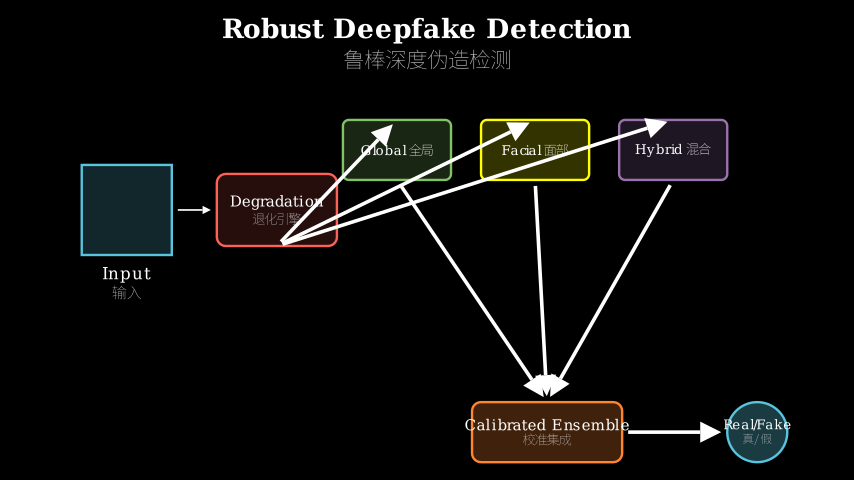
The method has three parallel processing streams feeding into a calibrated voting system. First, an extreme degradation engine destroys high-frequency artifacts during training—blur, compression, noise, all stacked—forcing the DINOv2-Giant backbone to extract invariant features. Then three specialized streams process each image: a Global Texture stream captures full-image patterns, a Localized Facial stream focuses on cropped face regions, and a Hybrid Semantic Fusion stream combines DINOv2 with CLIP embeddings for semantic context.
Each stream produces an independent prediction. The key innovation is the calibrated discretized voting mechanism: instead of naive averaging, predictions are discretized into confidence bins and weighted by stream reliability. This suppresses noisy predictions from streams that are uncertain while amplifying confident ones. The ensemble acts as a geometric anchor—when one stream’s attention drifts, others compensate.
Input Image
    |
    +---> [Extreme Degradation Engine]
    |           |
    |           v
    |     DINOv2-Giant Backbone
    |           |
    +-----+-----+-----+
    |     |     |     |
    v     v     v     v
 Global Facial Hybrid
 Texture Local Semantic
 Stream Stream  Fusion
    |     |     |
    v     v     v
 [Pred1][Pred2][Pred3]
    |     |     |
    +-----+-----+
          |
          v
  [Calibrated Voting]
          |
          v
   Final Decision
Think of it like a jury deliberation system. Each juror (stream) examines the same case from a different angle: one focuses on physical evidence (texture), another on witness testimony (facial features), a third on circumstantial context (semantics). When the courtroom is noisy (degraded images), individual jurors might mishear or misinterpret. But the voting system is calibrated—confident jurors get more weight, uncertain ones less. If the texture juror is confused by blur, the facial juror’s clear signal dominates. The verdict emerges from complementary perspectives, not unanimous agreement.
Key Concepts
-
Spatial Attention Drift: When a model’s focus shifts from relevant regions (faces) to irrelevant ones (backgrounds) under input perturbations. Imagine a security guard trained to watch doors. Under good lighting, they’re perfect. But add fog, and suddenly they’re staring at trees instead. The guard hasn’t forgotten what doors look like—the signal-to-noise ratio changed, and their attention mechanism latched onto the wrong cues. In deepfake detection, models trained on pristine images learn to spot compression artifacts around eyes. Add real-world blur, those artifacts vanish, and attention drifts to whatever high-contrast regions remain—often backgrounds.
-
Calibrated Discretized Voting: A voting mechanism where continuous predictions are binned into discrete confidence levels, then weighted by each voter’s reliability. Standard ensemble averaging treats all predictions equally: if three models output [0.6, 0.4, 0.5], the average is 0.5. But what if the first model is highly confident (0.95) while others are guessing (0.51, 0.49)? Discretization bins these into [HIGH, LOW, LOW], then weights by stream reliability. The confident prediction dominates. It’s like polling experts: you don’t average “maybe” and “definitely”—you give more weight to certainty.
-
Complementary Feature Representations: Features that capture different, non-overlapping aspects of the input. The authors verify complementarity using cosine similarity—low similarity means streams aren’t redundant. Think of describing a person: height, voice, and handwriting are complementary (knowing height tells you nothing about handwriting). But height and weight are correlated (tall people tend to weigh more). In this paper, global texture, local facial geometry, and semantic context are complementary—blur might destroy texture but leave geometry intact, or vice versa.
Framework Shift
Before (mainstream approach):        After (this paper):

    Input                                Input
      |                                    |
      v                                    v
 [Single CNN]                    [Degradation Engine]
      |                                    |
      v                                    v
 [Softmax]                         [DINOv2 Backbone]
      |                                    |
      v                            +-------+-------+
   Prediction                      |       |       |
                                   v       v       v
                                Stream1 Stream2 Stream3
                                   |       |       |
                                   +-------+-------+
                                           |
                                           v
                                  [Calibrated Voting]
                                           |
                                           v
                                      Prediction
From monolithic single-path classification to multi-perspective ensemble with explicit attention stabilization, the core shift is from artifact detection to geometric anchoring.
Expert Assessment
Problem choice: Real gap. The lab-to-wild performance cliff is well-documented in deepfake detection, and attention drift is a precise diagnosis. This isn’t manufactured—NTIRE challenges exist because industry needs robust detectors. The problem sits at the intersection of adversarial robustness and domain generalization, both active areas.
Method maturity: Mostly engineering, some insight. The multi-stream architecture is solid but not novel—ensemble methods are standard. The clever bit is the calibrated voting mechanism and the extreme degradation engine. However, the paper doesn’t explore why DINOv2 specifically is the right backbone, or whether simpler degradation-aware training would suffice. The reliance on foundation models (DINOv2, CLIP) feels like throwing compute at the problem rather than understanding it deeply.
Experimental integrity: Strong empirical validation. Score-CAM visualizations and cosine similarity analysis provide evidence that streams are truly complementary. The NTIRE 4th place finish is credible external validation. But the paper lacks ablations on the voting mechanism itself—how much does calibration matter vs. simple averaging? Baselines are fair but not exhaustive (no comparison to other ensemble strategies like stacking or boosting).
Writing quality: The abstract oversells (“foundation-driven forensic framework” is jargon soup). The method section is clear but verbose—Figure 1 could replace two paragraphs. The analysis section (Score-CAM, cosine similarity) is the paper’s strength and should be front-loaded. If the authors rewrote the introduction to lead with “attention drift under degradation” and showed Score-CAM heatmaps immediately, the narrative would be much tighter.
Verdict: weak accept — Solid engineering with credible validation, but limited conceptual novelty. The attention stability analysis is valuable, but the method is incremental over existing ensemble techniques.
Takeaways
Extreme degradation as regularization: Training with stacked degradations (blur + compression + noise) forces models to learn invariant features. This is transferable beyond deepfakes—any vision task where deployment conditions are harsher than training conditions (medical imaging, satellite imagery, industrial inspection).
Calibrated voting over naive averaging: When ensembling models with varying confidence, discretize predictions into bins and weight by reliability. Simple but effective. Applicable to any ensemble where you have uncertainty estimates.
Verify complementarity quantitatively: Don’t assume ensemble members are diverse—measure it. Cosine similarity between feature representations is a cheap sanity check. If similarity is high, you’re wasting compute on redundant models.
Attention stability as a metric: Beyond accuracy, track where models look (via Score-CAM or Grad-CAM) across degradation levels. If attention entropy spikes, the model is guessing. This diagnostic applies to any spatial attention mechanism.
论文: 2604.25889 作者: Minh-Khoa Le-Phan, Minh-Hoang Le, Trong-Le Do, Minh-Triet Tran 分类: cs.CV
缺口
在干净数据集上训练的深度伪造检测器能达到99%以上的准确率,但在真实场景中却崩溃了。
罪魁祸首是空间注意力漂移。
当图像经历复合退化(模糊+压缩+噪声)时,依赖高频伪影训练的模型失去了锚点。
注意力从面部区域游离到无关的背景。
先前工作要么忽视退化鲁棒性,要么应用通用数据增强而不直接解决注意力稳定性问题。
问题:实验室检测器在野外失效
         |
         v
诊断:退化条件下注意力漂移
         |
         v
根因:模型依赖脆弱的高频伪影
         |
         v
方案:带几何锚点的多流集成
         |
         v
证据:稳定的注意力熵 + NTIRE'26第4名
         |
         v
结论:互补特征 + 校准投票 = 鲁棒性
增量
一句话: 这篇论文之前,深度伪造检测器是在真实噪声下会崩溃的脆弱单流模型;
之后,我们有了通过融合互补几何和语义先验来维持稳定注意力的多流集成。
核心机制
该方法有三条并行处理流,输入到一个校准投票系统。
首先,极端退化引擎在训练期间破坏高频伪影——模糊、压缩、噪声全部叠加——迫使DINOv2-Giant骨干网络提取不变特征。
然后三条专门的流处理每张图像:全局纹理流捕获全图模式,局部面部流聚焦于裁剪的面部区域,混合语义融合流结合DINOv2和CLIP嵌入提供语义上下文。
每条流产生独立预测。
关键创新是校准离散化投票机制:不是简单平均,而是将预测离散化到置信度区间,并按流的可靠性加权。
这抑制了不确定流的噪声预测,同时放大了自信的预测。
集成充当几何锚点——当一条流的注意力漂移时,其他流会补偿。
输入图像
    |
    +---> [极端退化引擎]
    |           |
    |           v
    |     DINOv2-Giant骨干
    |           |
    +-----+-----+-----+
    |     |     |     |
    v     v     v     v
 全局  面部  混合
 纹理  局部  语义
 流    流    融合
    |     |     |
    v     v     v
 [预测1][预测2][预测3]
    |     |     |
    +-----+-----+
          |
          v
  [校准投票]
          |
          v
   最终决策
把它想象成陪审团审议系统。
每个陪审员(流)从不同角度审查同一案件:一个关注物证(纹理),另一个关注证人证词(面部特征),第三个关注间接证据(语义)。
当法庭嘈杂(退化图像)时,个别陪审员可能听错或误解。
但投票系统是校准的——自信的陪审员获得更多权重,不确定的获得更少。
如果纹理陪审员被模糊搞糊涂了,面部陪审员的清晰信号就占主导。
判决来自互补视角,而非一致同意。
关键概念
- 空间注意力漂移: 当模型的焦点在输入扰动下从相关区域(面部)转移到无关区域(背景)。
想象一个训练来看门的保安。
在良好照明下,他们很完美。
但加上雾,他们突然盯着树看。
保安没有忘记门长什么样——信噪比变了,他们的注意力机制锁定了错误的线索。
在深度伪造检测中,在干净图像上训练的模型学会识别眼睛周围的压缩伪影。
加上真实世界的模糊,这些伪影消失,注意力漂移到任何剩余的高对比度区域——通常是背景。
- 校准离散化投票: 一种投票机制,将连续预测分箱到离散置信度级别,然后按每个投票者的可靠性加权。
标准集成平均对所有预测一视同仁:如果三个模型输出[0.6, 0.4, 0.5],平均值是0.5。
但如果第一个模型高度自信(0.95)而其他模型在猜测(0.51, 0.49)呢?
离散化将这些分箱为[高,低,低],然后按流可靠性加权。
自信的预测占主导。
这就像民意调查专家:你不会平均”也许”和”肯定”——你给确定性更多权重。
- 互补特征表示: 捕获输入的不同、非重叠方面的特征。
作者使用余弦相似度验证互补性——低相似度意味着流不冗余。
想想描述一个人:身高、声音和笔迹是互补的(知道身高不会告诉你笔迹)。
但身高和体重是相关的(高个子往往更重)。
在本文中,全局纹理、局部面部几何和语义上下文是互补的——模糊可能破坏纹理但保留几何,反之亦然。
框架转变
之前(主流方法):                之后(本文方法):

    输入                                输入
      |                                    |
      v                                    v
 [单一CNN]                        [退化引擎]
      |                                    |
      v                                    v
 [Softmax]                         [DINOv2骨干]
      |                                    |
      v                            +-------+-------+
   预测                            |       |       |
                                   v       v       v
                                流1     流2     流3
                                   |       |       |
                                   +-------+-------+
                                           |
                                           v
                                  [校准投票]
                                           |
                                           v
                                      预测
从单体单路径分类到具有显式注意力稳定化的多视角集成,核心转变是从伪影检测到几何锚定。
专家评审
选题眼光: 真实缺口。
深度伪造检测中从实验室到野外的性能悬崖有充分记录,注意力漂移是精确诊断。
这不是人造的——NTIRE挑战存在是因为工业界需要鲁棒检测器。
问题位于对抗鲁棒性和领域泛化的交叉点,两者都是活跃领域。
方法成熟度: 主要是工程,有些洞见。
多流架构扎实但不新颖——集成方法是标准做法。
巧妙之处在于校准投票机制和极端退化引擎。
然而,论文没有探讨为什么DINOv2具体是正确的骨干,或者更简单的退化感知训练是否足够。
对基础模型(DINOv2、CLIP)的依赖感觉像是用算力砸问题而不是深入理解它。
实验诚意: 强有力的经验验证。
Score-CAM可视化和余弦相似度分析提供了流确实互补的证据。
NTIRE第4名是可信的外部验证。
但论文缺少对投票机制本身的消融——校准比简单平均重要多少?
基线公平但不详尽(没有与其他集成策略如堆叠或提升的比较)。
写作功力: 摘要过度推销(“基础驱动的取证框架”是术语汤)。
方法部分清晰但冗长——图1可以替代两段文字。
分析部分(Score-CAM、余弦相似度)是论文的优势,应该前置。
如果作者重写引言,以”退化下的注意力漂移”开头并立即展示Score-CAM热图,叙事会紧凑得多。
判决: 弱接收 — 扎实的工程加可信的验证,但概念新颖性有限。
注意力稳定性分析有价值,但方法相对现有集成技术是增量式的。
要点总结
极端退化作为正则化: 用叠加退化(模糊+压缩+噪声)训练迫使模型学习不变特征。
这可迁移到深度伪造之外——任何部署条件比训练条件更恶劣的视觉任务(医学成像、卫星图像、工业检测)。
校准投票优于简单平均: 当集成置信度不同的模型时,将预测离散化到区间并按可靠性加权。
简单但有效。
适用于任何有不确定性估计的集成。
定量验证互补性: 不要假设集成成员是多样的——测量它。
特征表示之间的余弦相似度是廉价的健全性检查。
如果相似度高,你在冗余模型上浪费算力。
注意力稳定性作为指标: 除了准确率,跟踪模型在退化级别上看哪里(通过Score-CAM或Grad-CAM)。
如果注意力熵飙升,模型在猜测。
这种诊断适用于任何空间注意力机制。