Paper: 2603.05504 Authors: Junjie Fang, Wendi Chen, Han Xue, Fangyuan Zhou, Tian Le, Yi Wang, Yuting Zhang, Jun Lv, Chuan Wen, Cewu Lu Categories: cs.RO, cs.AI, cs.LG
The Gap
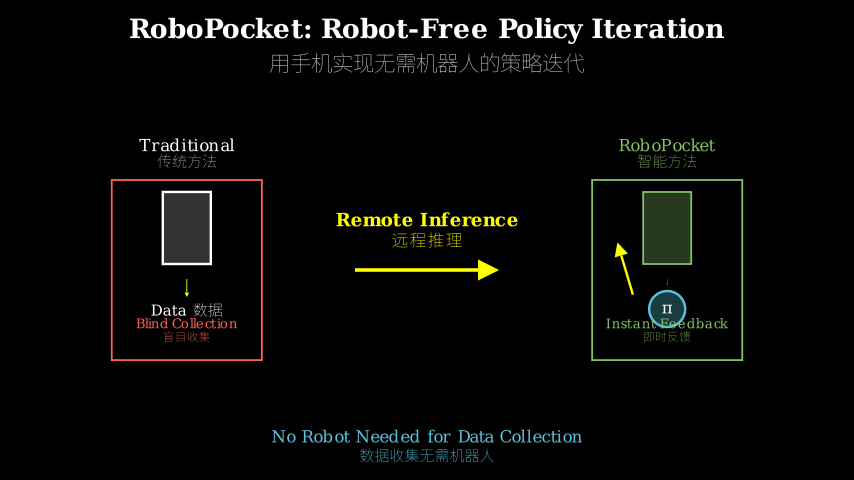
Robot imitation learning has hit a data collection wall. Two camps exist: handheld teleoperation (scalable but blind—you collect demos without knowing where the policy struggles) and interactive methods like DAgger (targeted but expensive—requires running the actual robot to find failures). The first wastes effort on redundant data, the second can’t scale beyond lab settings.
The core tension: you need to see policy weaknesses to collect useful data, but seeing weaknesses traditionally requires deploying the policy on hardware, which kills scalability.
Problem: Blind data collection vs expensive interactive learning
    |
    v
Assumption: Can simulate policy execution visually without hardware
    |
    v
Method: AR visualization + remote inference + async training loop
    |
    v
Evidence: 2x data efficiency, minutes-scale iteration, distributed scaling
    |
    v
Conclusion: Closed-loop learning without physical robot deployment
The Increment
One sentence: Before, you either collected data blindly or needed a robot to find failures; now you see the policy’s predicted trajectory through your phone’s camera and fix it on the spot.
Core Mechanism
RoboPocket has three interlocking pieces. First, Remote Inference runs the current policy on a server and streams predicted trajectories back to your phone. Second, AR Visual Foresight overlays these predictions onto your camera view—you literally see a ghost trajectory showing where the robot thinks it should move. Third, Online Finetuning continuously ingests corrections you make when the ghost trajectory looks wrong, updating the policy asynchronously while you keep collecting.
The data flow works like this: you point your phone at a scene, the policy predicts actions, those actions get rendered as a visual trajectory in AR, you either approve (by following it) or correct (by demonstrating the right path), and corrections immediately enter a training queue. The policy updates happen in the background, so by the time you’ve collected a few dozen corrections, you’re already working with an improved model.
[Phone Camera] --scene--> [Remote Server]
                               |
                          [Policy Model]
                               |
                          predictions
                               |
                               v
[AR Overlay] <--trajectory-- [Renderer]
     |
  human sees ghost path
     |
     v
[Correction?] --yes--> [Training Queue] --> [Async Finetuning]
     |                                            |
     no                                           |
     |                                            v
[Follow ghost] ----------------------> [Updated Policy]
Think of it like a driving instructor with X-ray vision. The instructor (policy) sits in the passenger seat but can’t touch the wheel. Instead, they project a glowing path on the windshield showing where they’d steer. You (the data collector) drive and watch this ghost path. When it veers toward a curb, you don’t follow it—you steer correctly and the instructor immediately takes notes. By the time you’ve driven a few blocks, the instructor has already updated their mental model and the ghost path gets better. The key insight: the instructor never needs to actually drive the car to learn from mistakes, because you can see their intended path before it happens.
Key Concepts
-
Covariate Shift: Imagine teaching someone to ride a bike by only showing them videos of perfect rides on smooth roads. When they encounter gravel, they’ve never seen how to handle it—the training data doesn’t cover the states they’ll actually visit. In robot learning, if you collect demos in one distribution but the policy drifts into different states during execution, it fails catastrophically. Traditional solutions require running the robot to discover these drift states, but RoboPocket sidesteps this by visualizing drift before it happens.
-
AR Visual Foresight: Instead of waiting for the robot to execute and fail, you see the policy’s intended actions projected into the real world through your phone. It’s like seeing a chess opponent’s planned moves hovering over the board before they make them. If the plan looks bad, you demonstrate the correct move immediately. This converts policy inspection from a post-execution analysis into a pre-execution intervention.
-
Asynchronous Online Learning: Most interactive learning is synchronous—collect data, stop, train, deploy, repeat. RoboPocket decouples these: while you’re collecting demonstration N, the model is already training on demonstrations 1 through N-5. By the time you finish a collection session, you’re working with a policy that’s already seen your earlier corrections. It’s like editing a document where your spell-checker learns your writing style in real-time rather than waiting for you to finish the whole draft.
Framework Shift
Before (mainstream approach):        After (this paper):

[Human] --> [Demos]                  [Human + Phone]
              |                            |
              v                            v
         [Offline Training]           [AR Foresight]
              |                            |
              v                            v
         [Deploy to Robot]            [See Policy Plan]
              |                            |
              v                            v
         [Find Failures]              [Correct Immediately]
              |                            |
              v                            v
         [Collect More]               [Async Training]
              |                            |
              +----> repeat                +----> loop closes
                     (hours/days)                 (minutes)
From sequential batch learning to continuous visual debugging, the core shift is making policy weaknesses observable without hardware execution.
Expert Assessment
Problem choice: This is a real gap. The data efficiency bottleneck in imitation learning is well-documented, and the trade-off between scalability and interactivity is genuine. The problem sits at a practical inflection point—robot learning is moving from labs to real-world deployment, and data collection is the limiting factor. Not manufactured.
Method maturity: The insight is clever rather than brute force. AR visualization of policy predictions is conceptually simple but non-obvious—most work focuses on better policies or better teleoperation, not on making policy internals visible during collection. The asynchronous training pipeline is solid engineering but not novel algorithmically. One overlooked simpler approach: why not just show uncertainty heatmaps instead of full trajectory predictions? That might be cheaper to compute and equally informative.
Experimental integrity: Baselines are fair—they compare against standard offline scaling and DAgger variants. The 2x efficiency claim holds across multiple tasks. One yellow flag: the experiments are all in simulation or controlled lab settings. Real in-the-wild performance (the stated motivation) isn’t demonstrated. The distributed scaling experiments are thin—only 3-5 people, not the “crowd-scale” the framing suggests.
Writing quality: The paper front-loads motivation well but buries implementation details. The AR rendering pipeline and network architecture get one paragraph each—these deserve more space since they’re critical to reproducibility. The related work section is perfunctory. Rewriting the “System Design” section with clearer component diagrams and latency analysis would elevate the whole paper from “interesting idea” to “deployable system.”
Verdict: weak accept — solves a real problem with a clean insight, but experimental scope doesn’t fully match the ambitious framing, and system details are underspecified.
Takeaways
The transferable idea: make model predictions observable in the data collection interface, not just during evaluation. This applies beyond robotics—imagine labeling medical images where the current model’s segmentation appears as you annotate, letting you focus on cases where it’s uncertain. Or debugging recommender systems by visualizing what the model would suggest before deploying.
The specific technique to steal: asynchronous training loops that update models while humans are still working. Most interactive ML systems are synchronous (collect, train, deploy, repeat), but decoupling these with a queue and background training can collapse iteration time from hours to minutes. The implementation is straightforward—just a training worker that polls a data buffer.
The framing to remember: “robot-free policy iteration.” The insight that you can close interactive learning loops without hardware execution generalizes. Anywhere you have expensive deployment (A/B tests, clinical trials, physical prototypes), ask whether you can simulate enough of the deployment to get signal without the full cost.
论文: 2603.05504 作者: Junjie Fang, Wendi Chen, Han Xue, Fangyuan Zhou, Tian Le, Yi Wang, Yuting Zhang, Jun Lv, Chuan Wen, Cewu Lu 分类: cs.RO, cs.AI, cs.LG
缺口
机器人模仿学习撞上了数据收集的墙。
现在有两个阵营:手持遥操作(可扩展但盲目——你收集演示时不知道策略在哪里挣扎)和交互式方法如DAgger(有针对性但昂贵——需要运行真实机器人才能发现失败)。
前者在冗余数据上浪费精力,后者无法扩展到实验室之外。
核心矛盾:你需要看到策略的弱点才能收集有用数据,但看到弱点传统上需要在硬件上部署策略,这扼杀了可扩展性。
问题: 盲目数据收集 vs 昂贵的交互式学习
    |
    v
假设: 可以在没有硬件的情况下视觉化模拟策略执行
    |
    v
方法: AR可视化 + 远程推理 + 异步训练循环
    |
    v
证据: 2倍数据效率, 分钟级迭代, 分布式扩展
    |
    v
结论: 无需物理机器人部署的闭环学习
增量
一句话: 以前你要么盲目收集数据,要么需要机器人才能发现失败;现在你通过手机摄像头看到策略的预测轨迹,当场修正。
核心机制
RoboPocket有三个互锁的部分。
首先,远程推理在服务器上运行当前策略,将预测轨迹流式传输回你的手机。
其次,AR视觉预见将这些预测叠加到你的相机视图上——你真的能看到一条幽灵轨迹,显示机器人认为它应该移动到哪里。
第三,在线微调持续摄取你在幽灵轨迹看起来不对时做出的修正,在你继续收集时异步更新策略。
数据流是这样工作的:你用手机对准一个场景,策略预测动作,这些动作被渲染为AR中的视觉轨迹,你要么批准(通过跟随它)要么修正(通过演示正确路径),修正立即进入训练队列。
策略更新在后台发生,所以当你收集了几十个修正时,你已经在使用改进的模型了。
[手机摄像头] --场景--> [远程服务器]
                          |
                     [策略模型]
                          |
                       预测
                          |
                          v
[AR叠加层] <--轨迹-- [渲染器]
     |
  人类看到幽灵路径
     |
     v
[需要修正?] --是--> [训练队列] --> [异步微调]
     |                                |
     否                               |
     |                                v
[跟随幽灵] -----------------> [更新后的策略]
把它想象成一个有透视眼的驾驶教练。
教练(策略)坐在副驾驶座上但不能碰方向盘。
相反,他们在挡风玻璃上投射一条发光的路径,显示他们会怎么转向。
你(数据收集者)开车并观察这条幽灵路径。
当它偏向路边时,你不跟随它——你正确转向,教练立即记笔记。
当你开了几个街区后,教练已经更新了他们的心智模型,幽灵路径变得更好了。
关键洞察:教练永远不需要真正开车就能从错误中学习,因为你可以在它发生之前看到他们的预期路径。
关键概念
- 协变量偏移: 想象通过只展示在平滑道路上完美骑行的视频来教某人骑自行车。
当他们遇到碎石时,他们从未见过如何处理——训练数据不覆盖他们实际会访问的状态。
在机器人学习中,如果你在一个分布中收集演示,但策略在执行期间漂移到不同状态,它会灾难性地失败。
传统解决方案需要运行机器人来发现这些漂移状态,但RoboPocket通过在漂移发生之前可视化它来绕过这个问题。
- AR视觉预见: 不是等待机器人执行并失败,你通过手机看到策略的预期动作投射到现实世界中。
这就像在对手移动之前看到他们计划的棋步悬停在棋盘上。
如果计划看起来不好,你立即演示正确的移动。
这将策略检查从执行后分析转换为执行前干预。
- 异步在线学习: 大多数交互式学习是同步的——收集数据,停止,训练,部署,重复。
RoboPocket解耦了这些:当你在收集演示N时,模型已经在训练演示1到N-5了。
当你完成收集会话时,你正在使用已经看过你早期修正的策略。
这就像编辑一个文档,你的拼写检查器实时学习你的写作风格,而不是等你完成整个草稿。
框架转变
之前(主流方法):                之后(本文方法):

[人类] --> [演示]                [人类+手机]
            |                         |
            v                         v
       [离线训练]                  [AR预见]
            |                         |
            v                         v
       [部署到机器人]               [看到策略计划]
            |                         |
            v                         v
       [发现失败]                  [立即修正]
            |                         |
            v                         v
       [收集更多]                  [异步训练]
            |                         |
            +----> 重复                +----> 循环闭合
                   (小时/天)                  (分钟)
从顺序批量学习到连续视觉调试,核心转变是使策略弱点在没有硬件执行的情况下可观察。
专家评审
选题眼光: 这是一个真实的缺口。
模仿学习中的数据效率瓶颈有充分记录,可扩展性和交互性之间的权衡是真实的。
这个问题处于一个实际的拐点——机器人学习正在从实验室转向现实世界部署,数据收集是限制因素。
不是人造的。
方法成熟度: 洞察是巧妙的而不是蛮力。
策略预测的AR可视化在概念上简单但不明显——大多数工作关注更好的策略或更好的遥操作,而不是在收集期间使策略内部可见。
异步训练管道是扎实的工程但在算法上不新颖。
一个被忽视的更简单方法:为什么不只显示不确定性热图而不是完整的轨迹预测?那可能计算更便宜且同样有信息量。
实验诚意: 基线是公平的——他们与标准离线扩展和DAgger变体进行比较。
2倍效率声明在多个任务中成立。
一个黄旗:实验都在模拟或受控实验室环境中。
真实的野外性能(声明的动机)没有被证明。
分布式扩展实验很薄——只有3-5个人,不是框架暗示的”人群规模”。
写作功力: 论文前置动机很好但埋没了实现细节。
AR渲染管道和网络架构各得到一段——这些值得更多空间,因为它们对可重复性至关重要。
相关工作部分是敷衍的。
用更清晰的组件图和延迟分析重写”系统设计”部分将把整篇论文从”有趣的想法”提升到”可部署的系统”。
判决: 弱接收——用干净的洞察解决了一个真实问题,但实验范围与雄心勃勃的框架不完全匹配,系统细节规定不足。
要点总结
可迁移的想法:在数据收集界面中使模型预测可观察,而不仅仅是在评估期间。
这适用于机器人之外——想象标记医学图像,当前模型的分割在你注释时出现,让你专注于它不确定的案例。
或者通过在部署前可视化模型会建议什么来调试推荐系统。
要偷的具体技术:在人类仍在工作时更新模型的异步训练循环。
大多数交互式ML系统是同步的(收集,训练,部署,重复),但用队列和后台训练解耦这些可以将迭代时间从小时压缩到分钟。
实现很简单——只是一个轮询数据缓冲区的训练工作器。
要记住的框架:“无机器人策略迭代”。
你可以在没有硬件执行的情况下关闭交互式学习循环的洞察是可推广的。
在任何你有昂贵部署的地方(A/B测试,临床试验,物理原型),问问你是否可以模拟足够的部署来获得信号而无需全部成本。