
Paper: 2603.04356 Authors: Soroush Nasiriany, Sepehr Nasiriany, Abhiram Maddukuri, Yuke Zhu Categories: cs.RO, cs.AI, cs.LG
The Gap
Robot learning has made real progress on generalist policies — models that can handle multiple household tasks without task-specific training. We’ve seen impressive demos: robots folding laundry, loading dishwashers, organizing shelves. But here’s the problem: every lab tests on their own setup with their own tasks. RT-1 uses one kitchen, RT-2 uses another, academic labs build custom environments. There’s no shared yardstick. You can’t tell if a new method actually generalizes better or just fits its particular test kitchen better.
Prior benchmarks like RLBench or Meta-World offer task diversity but lack the scale and environmental variation needed to stress-test generalization. They’re like practicing driving in an empty parking lot — useful, but not the real test. The field needs something closer to a standardized driving exam: consistent evaluation across diverse, realistic scenarios.
Problem: Fragmented evaluation landscape
   |
   v
Assumption: Generalization requires testing across
            task diversity + environment diversity + scale
   |
   v
Method: Build 365 tasks x 2500 environments
        + 600h human demos + 1600h synthetic demos
   |
   v
Evidence: Systematic experiments show task diversity
          matters more than dataset scale alone
   |
   v
Conclusion: Standardized benchmark enables
            reproducible progress measurement
The Increment
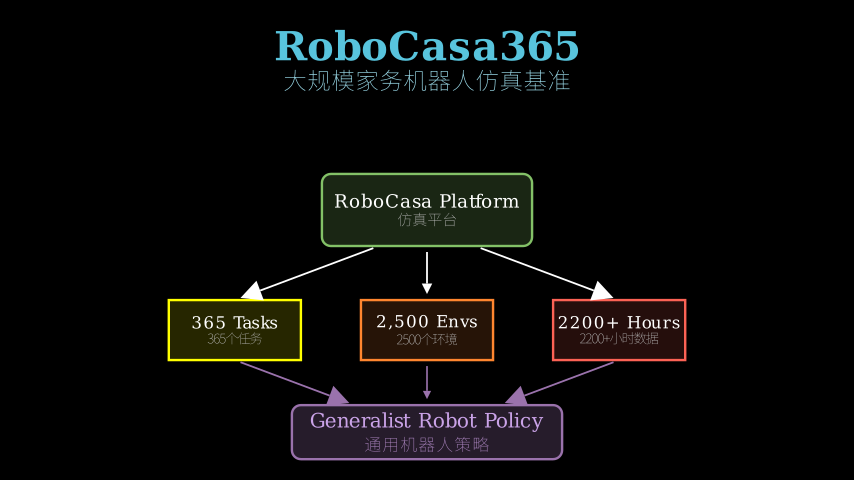
One sentence: Before RoboCasa365, researchers tested generalist robots on custom setups with incomparable results; after, they have a shared benchmark with 365 tasks and 2,500 environments to measure progress systematically.
Core Mechanism
RoboCasa365 isn’t a new algorithm — it’s infrastructure. The framework has three layers working together. At the base, there’s a procedural generation engine that creates 2,500 distinct kitchen layouts by varying cabinet configurations, appliance placements, countertop materials, and lighting conditions. Think of it as a kitchen randomizer that ensures no two test environments look identical.
The middle layer defines 365 household tasks spanning different complexity levels. Simple tasks like “pick up the mug” require basic grasping. Medium tasks like “place the pot on the stove” need spatial reasoning. Complex tasks like “prepare coffee” chain multiple sub-goals together. Each task comes with programmatic success criteria — not human judgment, but measurable conditions like “object X is in container Y and upright.”
The top layer provides demonstration data in two flavors. Human teleoperation gives 600 hours of real behavioral data showing how humans solve these tasks. Synthetic demonstrations add 1,600 hours generated by scripted policies and motion planning algorithms. This dual approach lets researchers study whether models learn better from human priors or can bootstrap from synthetic data.
   [Procedural Kitchen Generator]
            |
            | spawns
            v
   [2500 Environment Instances]
            |
            | hosts
            v
      [365 Task Definitions]
            |
            | evaluated via
            v
   [Success Criteria Checker]
            ^
            | trained on
            |
   [Human Demos] + [Synthetic Demos]
      (600h)         (1600h)
Think of RoboCasa365 as a flight simulator for robots. Real pilot training uses simulators that generate thousands of scenarios — different weather, airports, emergencies — so pilots see edge cases without crashing real planes. The procedural generator is like the weather/airport randomizer. The 365 tasks are the flight maneuvers pilots must master (takeoff, landing, emergency procedures). The demonstration data is the instructor showing proper technique. And the success criteria? That’s the pass/fail checklist. Just as pilots can’t graduate without proving competence across diverse conditions, robot policies can’t claim generalization without passing this standardized test.
Key Concepts
-
Procedural Environment Generation: Instead of hand-designing each kitchen, you write rules that randomly combine elements. Imagine building LEGO houses — you don’t design 2,500 houses individually; you define rules like “place sink on one wall, stove on another, add 3-6 cabinets randomly.” Each time you run the generator, you get a valid but unique kitchen. This matters because robots trained in one kitchen often fail in another due to overfitting to specific layouts. Procedural generation forces policies to learn general principles rather than memorizing one environment. Concrete example: if a robot learns “the mug is always in the top-left cabinet,” it fails when tested in a kitchen where that cabinet doesn’t exist. Procedural generation prevents this by ensuring no fixed patterns.
-
Task Compositionality: Complex tasks decompose into simpler sub-tasks that can be recombined. “Make coffee” breaks down into: grasp coffee bag → open bag → pour into filter → place filter in machine → press start. Each sub-task is a building block. This matters because you can test whether a policy truly understands primitives or just memorized the full sequence. If a robot can “grasp mug” and “place object in sink” separately, can it combine them for “put mug in sink”? Compositionality reveals whether learning transfers. Concrete example: a policy trained on “pick apple, place in bowl” should handle “pick orange, place in bowl” without retraining if it learned the compositional structure rather than memorizing apple-specific motions.
-
Synthetic vs Human Demonstrations: Human demos capture natural strategies but are expensive to collect. Synthetic demos (generated by motion planners or scripted policies) are cheap and scalable but may lack human-like efficiency. The key insight: you need both. Humans show what good solutions look like; synthetic data provides volume for learning robust features. Think of learning to cook: watching a chef (human demo) teaches technique, but practicing with a recipe generator (synthetic) builds pattern recognition across ingredients. RoboCasa365 provides 600h human + 1600h synthetic, letting researchers study the tradeoff: does 100h human data beat 1000h synthetic? Or do you need human data to bootstrap, then scale with synthetic?
Framework Shift
Before (mainstream approach):        After (this paper):

  Lab A: Custom Kitchen               Shared Benchmark
         20 tasks
         |                                [Generator]
         v                                    |
    [Policy A]                               v
         |                            +---------------+
         |                            | 2500 Kitchens |
  Lab B: Different Kitchen            |  365 Tasks    |
         30 tasks                     +---------------+
         |                                    |
         v                                    v
    [Policy B]                        [Policy A] [Policy B]
         |                                    |       |
         X (incomparable)                     v       v
                                          [Comparable Scores]
From isolated custom testbeds to a shared standardized benchmark, the core shift is making generalization claims falsifiable through reproducible evaluation.
Expert Assessment
Problem choice: This is a real infrastructure gap, not manufactured. The field genuinely suffers from evaluation fragmentation — every paper claims “generalization” but tests on incomparable setups. RoboCasa365 sits at a critical juncture: generalist policies are maturing enough that we need standardized measurement, similar to how ImageNet arrived when computer vision needed a shared benchmark. Timing is right.
Method maturity: This is infrastructure work, not algorithmic innovation, so “method maturity” means engineering quality. The procedural generation approach is solid but not novel — game engines have done this for decades. The real contribution is curating 365 meaningful tasks and ensuring they’re neither trivially easy nor impossibly hard. The dual human/synthetic demo strategy is pragmatic. No clever insights here, just good engineering and thoughtful design choices.
Experimental integrity: The baseline experiments are fair and comprehensive. They test multiple state-of-the-art methods (Diffusion Policy, ACT, RT-1-style transformers) and systematically ablate task diversity, dataset scale, and environment variation. The key finding — task diversity matters more than raw data volume — is well-supported. One minor concern: the synthetic demo quality isn’t deeply analyzed. If synthetic demos are low-quality, conclusions about their effectiveness could be misleading. But overall, the experiments are honest and avoid cherry-picking.
Writing quality: The paper is clear and well-structured, but the related work section is too generous — it lists every vaguely relevant benchmark without critically distinguishing what makes RoboCasa365 different. The results section could be tightened; some ablations feel redundant. If I were reviewing, I’d ask them to cut 20% of the results and add more failure case analysis. What tasks do all methods fail on? That would be more valuable than another scaling curve.
Verdict: strong accept — The field needs this infrastructure, the execution is solid, and the experiments provide actionable insights about what drives generalization in robot learning.
Takeaways
If you’re building benchmarks in any domain, steal the dual data strategy: combine expensive high-quality human data with cheap scalable synthetic data, then explicitly study the tradeoff. RoboCasa365 shows that 600h human + 1600h synthetic beats either alone, which transfers to other domains like autonomous driving (expert drivers + simulation) or medical imaging (radiologist labels + augmented data).
The procedural generation approach is worth adopting if your domain has combinatorial structure. Instead of hand-crafting test cases, define generative rules and sample diverse instances. This works for software testing (generate random valid programs), game AI (procedural level generation), or even dataset auditing (generate edge cases systematically).
The compositionality insight — testing whether models understand primitives vs memorizing sequences — applies broadly. In NLP, can a model that learned “translate English to French” and “summarize text” combine them for “translate then summarize”? In robotics, can grasping + placing transfer to new object combinations? RoboCasa365’s task hierarchy provides a template for designing compositional benchmarks in other domains.
论文: 2603.04356 作者: Soroush Nasiriany, Sepehr Nasiriany, Abhiram Maddukuri, Yuke Zhu 分类: cs.RO, cs.AI, cs.LG
缺口
机器人学习在通用策略上取得了实质进展——那些无需针对特定任务训练就能处理多种家务的模型。 我们见过令人印象深刻的演示:机器人叠衣服、装洗碗机、整理货架。 但问题在于:每个实验室都在自己的环境里用自己的任务测试。 RT-1用一个厨房,RT-2用另一个,学术实验室搭建定制环境。 没有共享的标尺。 你无法判断新方法是真的泛化更好,还是只是更适配它特定的测试厨房。
之前的基准如RLBench或Meta-World提供了任务多样性,但缺乏压力测试泛化所需的规模和环境变化。 它们像在空停车场练车——有用,但不是真正的考验。 该领域需要更接近标准化驾照考试的东西:在多样化、现实化场景中进行一致评估。
问题:评估环境碎片化
   |
   v
假设:泛化需要跨越
    任务多样性+环境多样性+规模 进行测试
   |
   v
方法:构建365个任务 x 2500个环境
    + 600小时人类演示 + 1600小时合成演示
   |
   v
证据:系统实验显示任务多样性
    比单纯数据集规模更重要
   |
   v
结论:标准化基准使
    可复现的进展测量成为可能
增量
一句话: RoboCasa365之前,研究者在定制环境上测试通用机器人,结果无法比较;之后,他们有了一个包含365个任务和2500个环境的共享基准来系统测量进展。
核心机制
RoboCasa365不是新算法——它是基础设施。 框架有三层协同工作。 底层是程序化生成引擎,通过变化橱柜配置、电器摆放、台面材质和光照条件来创建2500个不同的厨房布局。 把它想象成厨房随机器,确保没有两个测试环境看起来相同。
中间层定义了365个跨越不同复杂度级别的家务任务。 简单任务如”拿起杯子”需要基本抓取。 中等任务如”把锅放在炉子上”需要空间推理。 复杂任务如”准备咖啡”将多个子目标串联起来。 每个任务都配有程序化成功标准——不是人类判断,而是可测量的条件,如”物体X在容器Y中且直立”。
顶层提供两种风格的演示数据。 人类遥操作给出600小时真实行为数据,展示人类如何解决这些任务。 合成演示添加1600小时由脚本策略和运动规划算法生成的数据。 这种双重方法让研究者研究模型是从人类先验学得更好,还是能从合成数据自举。
   [程序化厨房生成器]
            |
            | 生成
            v
   [2500个环境实例]
            |
            | 承载
            v
      [365个任务定义]
            |
            | 通过...评估
            v
   [成功标准检查器]
            ^
            | 训练于
            |
   [人类演示] + [合成演示]
      (600h)       (1600h)
把RoboCasa365想象成机器人的飞行模拟器。 真实飞行员训练使用模拟器生成数千种场景——不同天气、机场、紧急情况——让飞行员见识边缘案例而不会坠毁真飞机。 程序化生成器就像天气/机场随机器。 365个任务是飞行员必须掌握的飞行动作(起飞、降落、紧急程序)。 演示数据是教练展示正确技术。 成功标准呢?那是通过/失败检查清单。 正如飞行员不能在没有证明跨越多样条件的能力前毕业,机器人策略不能在没有通过这个标准化测试前声称泛化。
关键概念
-
程序化环境生成: 不是手工设计每个厨房,而是编写随机组合元素的规则。 想象搭建乐高房子——你不会单独设计2500座房子;你定义规则如”在一面墙上放水槽,另一面放炉子,随机添加3-6个橱柜”。 每次运行生成器,你得到一个有效但独特的厨房。 这很重要,因为在一个厨房训练的机器人常因过拟合特定布局而在另一个厨房失败。 程序化生成迫使策略学习通用原则而非记忆一个环境。 具体例子:如果机器人学到”杯子总在左上角橱柜”,当在一个那个橱柜不存在的厨房测试时它就失败了。 程序化生成通过确保没有固定模式来防止这种情况。
-
任务组合性: 复杂任务分解为可重组的更简单子任务。 “煮咖啡”分解为:抓取咖啡袋→打开袋子→倒入滤纸→将滤纸放入机器→按启动。 每个子任务是一个构建块。 这很重要,因为你可以测试策略是否真正理解原语还是只记住了完整序列。 如果机器人能分别”抓取杯子”和”将物体放入水槽”,它能组合它们完成”把杯子放进水槽”吗?组合性揭示学习是否迁移。 具体例子:在”拿苹果,放进碗”上训练的策略应该能处理”拿橙子,放进碗”,如果它学到了组合结构而非记忆苹果特定动作,就无需重新训练。
-
合成vs人类演示: 人类演示捕获自然策略但收集成本高。 合成演示(由运动规划器或脚本策略生成)便宜且可扩展但可能缺乏人类般的效率。 关键洞察:你两者都需要。 人类展示好的解决方案是什么样;合成数据提供学习鲁棒特征的量。 想象学做饭:观看厨师(人类演示)教技术,但用食谱生成器练习(合成)建立跨食材的模式识别。 RoboCasa365提供600小时人类+1600小时合成,让研究者研究权衡:100小时人类数据胜过1000小时合成吗?还是你需要人类数据来自举,然后用合成扩展?
框架转变
之前(主流方法):                  之后(本文方法):

  实验室A:定制厨房                 共享基准
         20个任务
         |                              [生成器]
         v                                  |
    [策略A]                                 v
         |                          +---------------+
         |                          | 2500个厨房    |
  实验室B:不同厨房                  |  365个任务    |
         30个任务                   +---------------+
         |                                  |
         v                                  v
    [策略B]                        [策略A] [策略B]
         |                                  |       |
         X (无法比较)                       v       v
                                        [可比较分数]
从孤立的定制测试台到共享标准化基准,核心转变是通过可复现评估使泛化声明可证伪。
专家评审
选题眼光: 这是真实的基础设施缺口,不是人造的。 该领域确实遭受评估碎片化之苦——每篇论文都声称”泛化”但在无法比较的环境上测试。 RoboCasa365处于关键节点:通用策略已足够成熟,我们需要标准化测量,类似于计算机视觉需要共享基准时ImageNet的到来。 时机恰当。
方法成熟度: 这是基础设施工作,不是算法创新,所以”方法成熟度”意味着工程质量。 程序化生成方法扎实但不新颖——游戏引擎几十年来一直这样做。 真正的贡献是策划365个有意义的任务并确保它们既不琐碎简单也不不可能困难。 双重人类/合成演示策略是务实的。 这里没有巧妙洞察,只是良好的工程和深思熟虑的设计选择。
实验诚意: 基线实验公平且全面。 他们测试多个最先进方法(Diffusion Policy、ACT、RT-1风格transformer)并系统消融任务多样性、数据集规模和环境变化。 关键发现——任务多样性比原始数据量更重要——得到充分支持。 一个小担忧:合成演示质量没有深入分析。 如果合成演示质量低,关于其有效性的结论可能误导。 但总体而言,实验诚实且避免挑选结果。
写作功力: 论文清晰且结构良好,但相关工作部分过于慷慨——它列出每个模糊相关的基准而没有批判性地区分RoboCasa365的不同之处。 结果部分可以收紧;一些消融感觉冗余。 如果我在审稿,我会要求他们删减20%的结果并添加更多失败案例分析。 所有方法都在哪些任务上失败?那会比另一条缩放曲线更有价值。
判决: 强接收——该领域需要这个基础设施,执行扎实,实验提供关于什么驱动机器人学习泛化的可操作洞察。
要点总结
如果你在任何领域构建基准,偷走双重数据策略:结合昂贵的高质量人类数据和便宜的可扩展合成数据,然后明确研究权衡。 RoboCasa365显示600小时人类+1600小时合成胜过单独任何一个,这迁移到其他领域如自动驾驶(专家司机+仿真)或医学影像(放射科医生标签+增强数据)。
程序化生成方法值得采用,如果你的领域有组合结构。 不是手工制作测试用例,而是定义生成规则并采样多样实例。 这适用于软件测试(生成随机有效程序)、游戏AI(程序化关卡生成),甚至数据集审计(系统生成边缘案例)。
组合性洞察——测试模型是否理解原语vs记忆序列——广泛适用。 在NLP中,学会”英译法”和”总结文本”的模型能组合它们完成”翻译然后总结”吗?在机器人中,抓取+放置能迁移到新物体组合吗?RoboCasa365的任务层次为在其他领域设计组合基准提供了模板。