
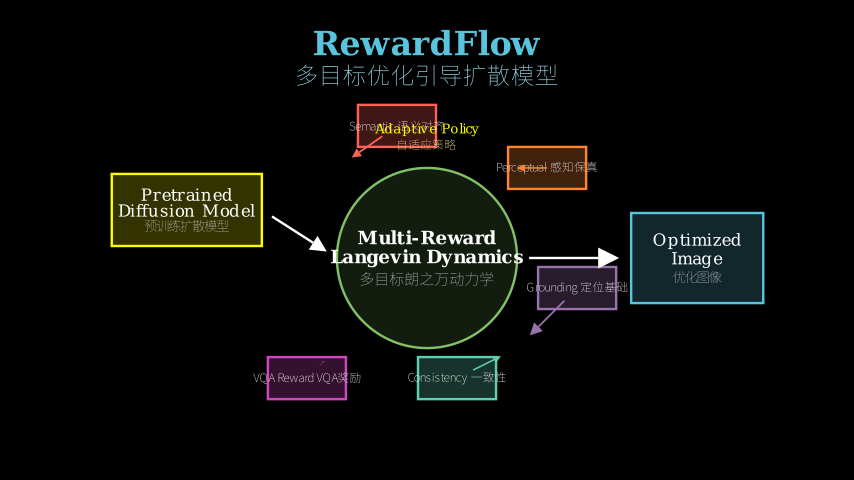
Paper: 2604.08536 Authors: Onkar Susladkar, Dong-Hwan Jang, Tushar Prakash, Adheesh Juvekar, Vedant Shah, Ayush Barik, Nabeel Bashir, Muntasir Wahed, Ritish Shrirao, Ismini Lourentzou Categories: cs.CV, cs.AI
The Gap
Existing diffusion model steering methods face a trilemma. Fine-tuning approaches (DreamBooth, LoRA) require expensive retraining for each new task and struggle to balance multiple objectives. Inversion-based methods (Prompt-to-Prompt, Null-text Inversion) preserve structure but sacrifice semantic fidelity when edits conflict with the original layout. Reward-guided approaches use single objectives (aesthetic scores, CLIP alignment) but can’t coordinate competing goals like “make it photorealistic AND compositionally accurate AND preserve the background.”
The core issue: these methods treat guidance as either a training problem (slow, inflexible) or a single-objective optimization problem (brittle when objectives conflict). No existing approach dynamically balances heterogeneous rewards—perceptual quality, semantic alignment, spatial grounding, object consistency—while adapting to the specific intent of each prompt.
Problem: Multi-objective editing with pretrained models
    |
    v
Assumption: Rewards can be composed via Langevin dynamics
            + Intent can be inferred from prompt structure
    |
    v
Method: Multi-reward gradient composition
        + Prompt-aware adaptive weighting
        + VQA-based semantic supervision
    |
    v
Evidence: SOTA on EditVal, DPG-Bench, T2I-CompBench
          + Ablations show each component contributes
    |
    v
Conclusion: Inference-time multi-reward steering > single-objective
            or training-based approaches for controllable generation
The Increment
One sentence: Before RewardFlow, you chose between retraining models for each task or using rigid single-objective guidance; after, you compose multiple differentiable rewards at inference time with prompt-aware adaptive weighting.
Core Mechanism
RewardFlow operates in three stages during the diffusion sampling process. First, it extracts semantic primitives from the text prompt—identifying objects, attributes, spatial relationships, and edit operations (add, remove, modify). This parsing determines which rewards are relevant: a “make the sky blue” edit needs color consistency but not object detection, while “add a cat on the sofa” requires spatial grounding and object presence.
Second, at each denoising step, RewardFlow computes gradients from multiple differentiable reward functions: CLIP for text-image alignment, aesthetic predictors for perceptual quality, GroundingDINO for spatial localization, VQA models for fine-grained semantic verification (“Is there a cat?” → yes/no → reward signal). These gradients are combined via Langevin dynamics—essentially nudging the latent representation toward higher reward regions in a multi-objective landscape.
Third, the adaptive policy modulates reward weights and step sizes throughout sampling. Early steps prioritize coarse semantic alignment (CLIP, VQA), while later steps emphasize perceptual refinement (aesthetics, sharpness). The policy also adjusts based on edit type: object insertion increases spatial grounding weight, style transfer boosts perceptual rewards, attribute modification focuses on localized consistency.
Text Prompt --> [Semantic Parser] --> Edit Intent + Object List
                                            |
                                            v
Latent z_t --+-> [Reward 1: CLIP] -------> grad_1
             |                                |
             +-> [Reward 2: VQA] --------> grad_2
             |                                |
             +-> [Reward 3: Grounding] ----> grad_3
             |                                |
             +-> [Reward 4: Aesthetic] -----> grad_4
                                              |
                                              v
                        [Adaptive Policy] --> w_1, w_2, w_3, w_4
                                              |
                                              v
                        z_{t-1} = z_t + sum(w_i * grad_i) + noise
Think of RewardFlow as a GPS navigation system with multiple objectives. Your prompt is the destination (“add a red car in front of the house”). The semantic parser reads the address and figures out you need to: (1) detect the house location, (2) insert a car shape, (3) make it red, (4) ensure photorealism. Each reward function is a sensor—CLIP checks if you’re heading toward “red car,” GroundingDINO verifies spatial placement, VQA asks “Is there a car? Is it red?”, aesthetics ensure the image doesn’t look broken. The adaptive policy is the routing algorithm that decides, at each intersection (denoising step), which sensor to trust more: early on, prioritize getting to the right neighborhood (coarse semantics); near the destination, focus on parking precisely (fine details). The Langevin dynamics is the steering mechanism that combines all sensor readings into a single turn of the wheel, with noise to avoid getting stuck in local minima (like a GPS suggesting slight detours to avoid traffic).
Key Concepts
-
Langevin Dynamics for Diffusion Steering: Imagine you’re hiking in fog toward a mountain peak, but you can’t see the summit—you can only feel the slope under your feet. Langevin dynamics is like taking small steps uphill (following the gradient of your reward function) while occasionally stumbling randomly (adding noise). In diffusion models, the “landscape” is the space of possible images, and “uphill” means higher reward (better CLIP score, more photorealistic, etc.). At each denoising step, you compute how much each reward function wants to push the image (its gradient), combine those pushes, and take a small step in that direction. The noise prevents you from getting stuck in a local valley (a mediocre image that scores okay on one metric but fails others). The key insight: you can steer a pretrained diffusion model by injecting these gradient-based nudges during sampling, without retraining.
-
VQA-Based Reward: Most reward functions are “soft”—CLIP gives a similarity score, but can’t verify specific facts. VQA (Visual Question Answering) turns semantic requirements into yes/no questions: “Is there a cat?” “Is the cat on the sofa?” “Is the sky blue?” The model generates an image, you ask these questions, and the VQA model’s confidence becomes a reward signal. If the VQA says “yes, there’s a cat” with 90% confidence, that’s a strong positive reward; if it says “no” or is uncertain, the reward is low. This provides fine-grained supervision: instead of just “image matches text,” you get “image contains the specific objects and attributes mentioned.” It’s like having a fact-checker read your essay versus just checking if it sounds good.
-
Prompt-Aware Adaptive Policy: Not all edits need the same guidance. “Make the sky blue” is a localized color change—you need spatial grounding (where’s the sky?) and color consistency, but not object detection. “Add a dog” requires object presence, spatial placement, and consistency with the scene. The adaptive policy parses the prompt to infer edit intent, then adjusts reward weights and step sizes accordingly. It also changes weights over time: early denoising steps focus on getting the right objects in roughly the right places (high weight on CLIP and VQA), while later steps refine details (high weight on aesthetics and sharpness). Think of it as a project manager who reads the brief, assigns tasks to team members based on their skills, and shifts priorities as the deadline approaches—early on, brainstorm ideas; near the end, polish the presentation.
Framework Shift
Before (mainstream approach):        After (RewardFlow):

Training Phase:                      Inference Phase:
  Prompt --> [Fine-tune Model]         Prompt --> [Semantic Parser]
             (expensive, slow)                    (extract intent)
                  |                                     |
                  v                                     v
  New Model --> [Generate]             Pretrained --> [Multi-Reward
                                       Model          Langevin Dynamics]
                                                      (compose gradients)
                                                           |
                                                           v
                                                    [Adaptive Policy]
                                                    (weight rewards)
                                                           |
                                                           v
                                                      [Generate]

Single objective, rigid             Multiple objectives, flexible
From training-time specialization to inference-time composition, the core shift is replacing model retraining with dynamic multi-objective optimization.
Expert Assessment
Problem choice: Real gap. Diffusion models excel at generation but struggle with controllable editing—users want “change X but keep Y” with fine-grained control. Existing methods either retrain (slow, doesn’t scale to diverse edits) or use single objectives (brittle when goals conflict). The multi-reward composition angle is underexplored and practically valuable.
Method maturity: Clever composition of existing tools (CLIP, VQA, GroundingDINO) rather than a novel architecture. The adaptive policy is the main contribution—inferring edit intent from prompts and dynamically weighting rewards. However, the semantic parser seems rule-based (not learned), which limits generalization to complex or ambiguous prompts. The VQA reward is smart but computationally expensive (running a VQA model at every denoising step). A simpler baseline—just CLIP + aesthetics with fixed weights—would strengthen the ablation.
Experimental integrity: Strong benchmarks (EditVal, DPG-Bench, T2I-CompBench) with human evaluation. Ablations show each reward contributes, though the paper doesn’t report failure cases or computational cost comparisons. The VQA reward’s impact is impressive, but it’s unclear how sensitive it is to VQA model quality—what if the VQA hallucinates? Baselines include InstructPix2Pix and Prompt-to-Prompt, which is fair, but missing comparisons to recent reward-guided methods like ReFL or DRaFT.
Writing quality: Clear motivation and method description, but the adaptive policy section is vague—how exactly are weights computed from semantic primitives? The paper says “we design a prompt-aware policy” but doesn’t show the mapping function. The results section is thorough, but the qualitative examples cherry-pick successes. A failure analysis (when does multi-reward composition fail?) would elevate the paper from “this works” to “here’s when and why.”
Verdict: weak accept — Solid practical contribution with strong empirical results, but the method is more engineering than insight, and the adaptive policy needs clearer specification.
Takeaways
Steal the multi-reward composition pattern: if you’re optimizing for multiple objectives (accuracy + fairness, speed + quality), don’t collapse them into a single scalar loss—compute separate gradients and weight them dynamically based on context. The VQA-as-reward trick transfers to any domain where you can formulate verification questions: in code generation, ask “Does this function handle edge case X?” and use the answer as a reward signal. The adaptive weighting idea applies beyond diffusion: in RL, adjust exploration vs exploitation based on the task structure; in multi-task learning, prioritize tasks based on input features. The core lesson: heterogeneous objectives need heterogeneous treatment—don’t force them into a single loss function, orchestrate them.
论文: 2604.08536 作者: Onkar Susladkar, Dong-Hwan Jang, Tushar Prakash, Adheesh Juvekar, Vedant Shah, Ayush Barik, Nabeel Bashir, Muntasir Wahed, Ritish Shrirao, Ismini Lourentzou 分类: cs.CV, cs.AI
缺口
现有的扩散模型引导方法面临三难困境。
微调方法(DreamBooth、LoRA)需要为每个新任务进行昂贵的重训练,且难以平衡多个目标。
基于反演的方法(Prompt-to-Prompt、Null-text Inversion)能保留结构,但当编辑与原始布局冲突时会牺牲语义保真度。
奖励引导方法使用单一目标(美学评分、CLIP对齐),但无法协调相互竞争的目标,比如”让它既真实又构图准确还要保留背景”。
核心问题:这些方法要么把引导当作训练问题(慢、不灵活),要么当作单目标优化问题(目标冲突时很脆弱)。
没有现有方法能动态平衡异构奖励——感知质量、语义对齐、空间定位、对象一致性——同时适应每个提示词的具体意图。
问题:用预训练模型做多目标编辑
    |
    v
假设:奖励可以通过朗之万动力学组合
      + 意图可以从提示词结构推断
    |
    v
方法:多奖励梯度组合
      + 提示词感知的自适应权重
      + 基于VQA的语义监督
    |
    v
证据:在EditVal、DPG-Bench、T2I-CompBench上达到SOTA
      + 消融实验显示每个组件都有贡献
    |
    v
结论:推理时多奖励引导 > 单目标或基于训练的方法
      用于可控生成
增量
一句话: RewardFlow之前,你要么为每个任务重训练模型,要么用僵化的单目标引导;
之后,你可以在推理时用提示词感知的自适应权重组合多个可微奖励。
核心机制
RewardFlow在扩散采样过程中分三个阶段运作。
首先,它从文本提示词中提取语义原语——识别对象、属性、空间关系和编辑操作(添加、删除、修改)。
这个解析决定了哪些奖励相关:“让天空变蓝”需要颜色一致性但不需要对象检测,而”在沙发上加一只猫”需要空间定位和对象存在性。
其次,在每个去噪步骤,RewardFlow计算多个可微奖励函数的梯度:CLIP用于文本-图像对齐,美学预测器用于感知质量,GroundingDINO用于空间定位,VQA模型用于细粒度语义验证(“有猫吗?
“→是/否→奖励信号)。
这些梯度通过朗之万动力学组合——本质上是在多目标景观中把潜在表示推向更高奖励区域。
第三,自适应策略在整个采样过程中调节奖励权重和步长。
早期步骤优先考虑粗粒度语义对齐(CLIP、VQA),后期步骤强调感知精细化(美学、清晰度)。
策略还根据编辑类型调整:对象插入增加空间定位权重,风格迁移提升感知奖励,属性修改聚焦局部一致性。
文本提示 --> [语义解析器] --> 编辑意图 + 对象列表
                                    |
                                    v
潜变量 z_t --+-> [奖励1: CLIP] -------> grad_1
             |                              |
             +-> [奖励2: VQA] ----------> grad_2
             |                              |
             +-> [奖励3: 定位] ----------> grad_3
             |                              |
             +-> [奖励4: 美学] ----------> grad_4
                                            |
                                            v
                      [自适应策略] --> w_1, w_2, w_3, w_4
                                            |
                                            v
                      z_{t-1} = z_t + sum(w_i * grad_i) + 噪声
把RewardFlow想象成一个有多个目标的GPS导航系统。
你的提示词是目的地(“在房子前面加一辆红色汽车”)。
语义解析器读取地址,发现你需要:(1)检测房子位置,(2)插入汽车形状,(3)让它变红,(4)确保真实感。
每个奖励函数是一个传感器——CLIP检查你是否朝向”红色汽车”,GroundingDINO验证空间位置,VQA问”有车吗?
是红色的吗?
“,美学确保图像不会看起来坏掉。
自适应策略是路由算法,在每个路口(去噪步骤)决定更信任哪个传感器:早期优先到达正确的街区(粗语义);
接近目的地时,专注于精确停车(细节)。
朗之万动力学是转向机制,把所有传感器读数组合成方向盘的一次转动,加上噪声以避免陷入局部最小值(就像GPS建议稍微绕路避开拥堵)。
关键概念
- 用于扩散引导的朗之万动力学: 想象你在雾中徒步走向山峰,但看不见山顶——你只能感受脚下的坡度。
朗之万动力学就像朝上坡走小步(跟随奖励函数的梯度),同时偶尔随机踉跄(加噪声)。
在扩散模型中,“景观”是可能图像的空间,“上坡”意味着更高奖励(更好的CLIP分数、更真实等)。
在每个去噪步骤,你计算每个奖励函数想推动图像多少(它的梯度),组合这些推力,朝那个方向走一小步。
噪声防止你陷入局部山谷(在一个指标上还行但在其他指标上失败的平庸图像)。
关键洞察:你可以通过在采样期间注入这些基于梯度的推动来引导预训练扩散模型,无需重训练。
- 基于VQA的奖励: 大多数奖励函数是”软”的——CLIP给相似度分数,但无法验证具体事实。
VQA(视觉问答)把语义要求转化为是非问题:“有猫吗?
""猫在沙发上吗?
""天空是蓝色的吗?
“模型生成图像,你问这些问题,VQA模型的置信度成为奖励信号。
如果VQA说”是的,有猫”且置信度90%,那是强正奖励;
如果说”不”或不确定,奖励就低。
这提供细粒度监督:不只是”图像匹配文本”,而是”图像包含提到的具体对象和属性”。
就像让事实核查员读你的文章,而不只是检查听起来是否顺耳。
- 提示词感知的自适应策略: 不是所有编辑都需要相同的引导。
“让天空变蓝”是局部颜色变化——你需要空间定位(天空在哪?
)和颜色一致性,但不需要对象检测。
“加一只狗”需要对象存在性、空间位置和与场景的一致性。
自适应策略解析提示词推断编辑意图,然后相应调整奖励权重和步长。
它还随时间改变权重:早期去噪步骤专注于把正确的对象放在大致正确的位置(CLIP和VQA高权重),后期步骤精炼细节(美学和清晰度高权重)。
把它想象成项目经理,读简报,根据技能给团队成员分配任务,随着截止日期临近调整优先级——早期头脑风暴想法;
接近尾声时,打磨演示文稿。
框架转变
之前(主流方法):                之后(RewardFlow):

训练阶段:                        推理阶段:
  提示词 --> [微调模型]              提示词 --> [语义解析器]
             (昂贵、慢)                        (提取意图)
                  |                                 |
                  v                                 v
  新模型 --> [生成]                  预训练 --> [多奖励
                                     模型        朗之万动力学]
                                                (组合梯度)
                                                     |
                                                     v
                                                [自适应策略]
                                                (权重奖励)
                                                     |
                                                     v
                                                  [生成]

单目标,僵化                      多目标,灵活
从训练时专门化到推理时组合,核心转变是用动态多目标优化替代模型重训练。
专家评审
选题眼光: 真实缺口。
扩散模型擅长生成但难以可控编辑——用户想要”改X但保留Y”的细粒度控制。
现有方法要么重训练(慢,无法扩展到多样化编辑),要么用单目标(目标冲突时脆弱)。
多奖励组合角度探索不足且实用价值高。
方法成熟度: 巧妙组合现有工具(CLIP、VQA、GroundingDINO)而非新架构。
自适应策略是主要贡献——从提示词推断编辑意图并动态加权奖励。
但语义解析器似乎基于规则(非学习),限制了对复杂或模糊提示词的泛化。
VQA奖励很聪明但计算昂贵(每个去噪步骤运行VQA模型)。
更简单的基线——只用CLIP+美学固定权重——会加强消融实验。
实验诚意: 强基准(EditVal、DPG-Bench、T2I-CompBench)加人类评估。
消融实验显示每个奖励都有贡献,但论文没报告失败案例或计算成本比较。
VQA奖励的影响令人印象深刻,但不清楚它对VQA模型质量有多敏感——如果VQA产生幻觉怎么办?
基线包括InstructPix2Pix和Prompt-to-Prompt,这很公平,但缺少与最近奖励引导方法如ReFL或DRaFT的比较。
写作功力: 动机和方法描述清晰,但自适应策略部分含糊——权重究竟如何从语义原语计算?
论文说”我们设计了提示词感知策略”但没展示映射函数。
结果部分很全面,但定性例子挑选成功案例。
失败分析(多奖励组合何时失败?
)会把论文从”这有效”提升到”这是何时以及为何有效”。
判决: 弱接收 — 扎实的实用贡献加强实证结果,但方法更多是工程而非洞察,自适应策略需要更清晰的规范。
要点总结
偷走多奖励组合模式:如果你在优化多个目标(准确性+公平性,速度+质量),不要把它们塌缩成单一标量损失——计算独立梯度并根据上下文动态加权。
VQA作为奖励的技巧可迁移到任何能制定验证问题的领域:在代码生成中,问”这个函数处理边界情况X吗?
“并用答案作为奖励信号。
自适应加权思想超越扩散:在强化学习中,根据任务结构调整探索vs利用;
在多任务学习中,根据输入特征优先处理任务。
核心教训:异构目标需要异构处理——不要强行把它们塞进单一损失函数,而是编排它们。