
Paper: 2603.24580 Authors: Saahil Mathur, Ryan David Rittner, Vedant Ajit Thakur, Daniel Stuart Schiff, Tunazzina Islam Categories: cs.CL, cs.AI, cs.CY, cs.IR, cs.LG
Abstract
The paper studies retrieval-augmented generation for AI policy analysis using the AGORA corpus of 947 policy documents. It combines a ColBERT retriever fine-tuned with contrastive learning and a generator tuned with DPO. The authors find that better retrieval scores do not reliably lead to better answers.
Key Contributions
- Targets AI governance and policy question answering
- Uses the AGORA corpus of 947 curated AI policy documents
- Combines a ColBERT retriever with a DPO-aligned generator
- Uses synthetic queries and pairwise preferences to adapt the system to the policy domain
- Shows that retrieval gains do not consistently translate into better end-to-end answer quality
Methodology
The system is built as a standard RAG pipeline but tuned for policy QA rather than open-domain retrieval. A retriever is trained to surface relevant policy documents, while the generator is optimized to answer using the retrieved evidence. The authors also use synthetic queries and preference data to make both parts more domain aware.
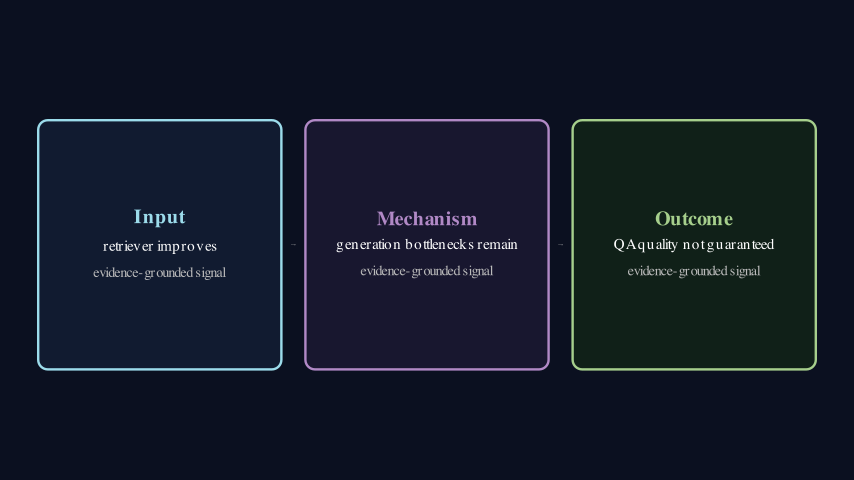
The interesting point is that retrieval is only one piece of the chain. Even if the retriever gets better at finding related documents, the generator can still miss the right evidence, overstate confidence, or hallucinate when the evidence is weak. The paper uses that tension to question a common assumption in RAG systems.
Results
Retrieval metrics improve after fine-tuning, but the end-to-end QA quality does not consistently follow. In some settings, the system still produces confident answers without enough supporting evidence. That makes the study especially relevant for policy and governance use cases, where being confidently wrong is worse than being unsure.
The paper’s main lesson is that retrieval quality alone is not a sufficient proxy for answer quality. Evaluation has to measure the whole pipeline.
Takeaways
- Better retrieval does not automatically mean better answers
- End-to-end QA evaluation matters more than isolated retriever metrics
- Domain-specific RAG for policy work needs evidence-sensitive generation
- Synthetic queries and preference tuning help, but do not solve the full problem
- Confident hallucinations remain a risk when the retrieved evidence is weak
论文: 2603.24580 作者: Saahil Mathur, Ryan David Rittner, Vedant Ajit Thakur, Daniel Stuart Schiff, Tunazzina Islam 分类: cs.CL, cs.AI, cs.CY, cs.IR, cs.LG
摘要
本文研究了用于AI政策分析的检索增强生成(RAG),所用语料为包含947份政策文档的AGORA数据集。作者将经过对比学习微调的ColBERT检索器与通过DPO训练的生成器结合起来。结果发现,更好的检索分数并不可靠地带来更好的答案。
主要贡献
- 面向AI治理和政策问答任务
- 使用包含947份精选AI政策文档的AGORA语料
- 将ColBERT检索器与DPO对齐生成器结合
- 使用合成查询和成对偏好将系统适配到政策领域
- 证明检索提升并不总能转化为更好的端到端答案质量
方法论
该系统采用标准的RAG流水线,但针对政策问答进行了定制而不是开放域检索。检索器负责找出相关政策文档,生成器则使用检索到的证据作答。作者还使用合成查询和偏好数据,让系统的两个部分都更具领域适应性。
有意思的是,检索只是链条中的一环。即使检索器更擅长找到相关文档,生成器仍然可能错过正确证据、过度自信,或者在证据薄弱时产生幻觉。论文正是利用这种张力,质疑RAG系统中的一个常见假设。
结果
微调后,检索指标确实提升了,但端到端问答质量并没有稳定跟上。在某些情况下,系统即使证据不足也会给出自信的答案。这使得这项研究对政策与治理场景尤其重要,因为“自信地错误”比“不确定”更危险。
论文的核心教训是:检索质量本身并不能作为答案质量的充分代理。评估必须覆盖整个流水线。
要点总结
- 更好的检索并不会自动带来更好的答案
- 端到端问答评估比单独看检索器指标更重要
- 面向政策工作的领域RAG需要对证据敏感的生成器
- 合成查询和偏好微调有帮助,但不能解决全部问题
- 当检索证据薄弱时,自信幻觉仍然是风险