
Paper: 2605.04018 Authors: Yilun Zhao, Jinbiao Wei, Tingyu Song, Siyue Zhang, Chen Zhao, Arman Cohan Categories: cs.CL, cs.IR
The Gap
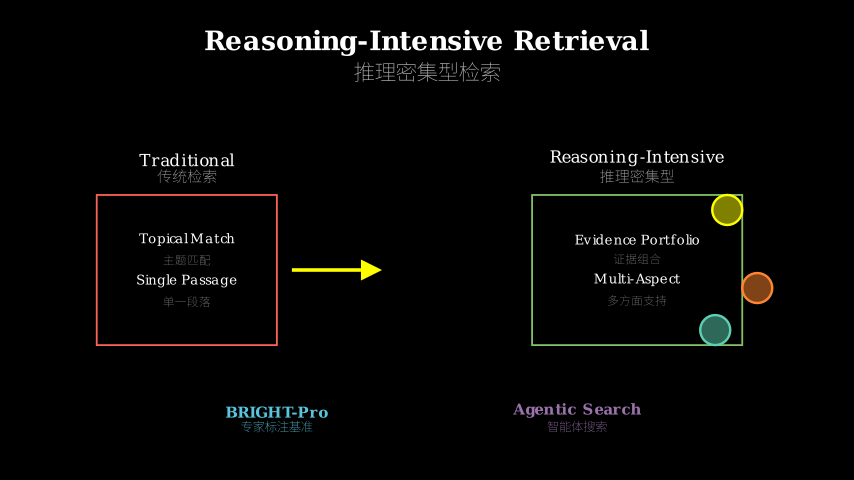
Existing retrieval benchmarks like BRIGHT evaluate retrievers as if they’re playing a single-shot matching game: given a query, find the one golden passage. But in real agentic search systems—think of an AI assistant iteratively gathering evidence to answer “What are the long-term effects of intermittent fasting?”—the retriever needs to build a portfolio of complementary evidence across multiple search rounds. Current benchmarks have narrow gold sets (often just one passage per query) and evaluate retrievers in isolation, ignoring whether they can provide diverse, non-redundant evidence when called multiple times. Training data follows the same pattern: synthetic corpora optimize for single-passage relevance, not for constructing evidence that covers different aspects of a complex question.
Problem: Agentic search needs complementary evidence portfolios
   |
   v
Assumption: Retrievers should be evaluated on aspect coverage,
            not just topical similarity
   |
   v
Method: BRIGHT-Pro (multi-aspect gold sets + agentic protocols)
        + RTriever-Synth (aspect-decomposed synthetic training)
   |
   v
Evidence: Aspect-aware metrics expose hidden behaviors;
          RTriever-4B outperforms base model on portfolio quality
   |
   v
Conclusion: Evaluation and training must shift from single-passage
            relevance to evidence portfolio construction
The Increment
One sentence: Before this paper, retrievers were judged on finding *the right passage; after, they’re judged on building a portfolio of complementary evidence across iterative search.
Core Mechanism
BRIGHT-Pro expands each query with expert-annotated multi-aspect gold evidence. Instead of “find the passage about intermittent fasting,” it asks “find evidence covering metabolic effects, cognitive impacts, and cardiovascular outcomes.” Retrievers are evaluated under two protocols: static (retrieve top-k once) and agentic (iterative retrieval where each round conditions on what’s already been found). Metrics track not just recall, but aspect coverage and redundancy.
RTriever-Synth generates training data by decomposing queries into aspects, then creating complementary positives (passages covering different aspects) and positive-conditioned hard negatives (passages similar to already-retrieved evidence but not adding new information). This trains the retriever to avoid redundancy. The authors LoRA fine-tune Qwen3-Embedding-4B on this corpus to produce RTriever-4B.
Query: "Effects of intermittent fasting"
   |
   +---> Aspect decomposition
   |        |
   |        +---> Metabolic effects
   |        +---> Cognitive impacts
   |        +---> Cardiovascular outcomes
   |
   +---> Generate complementary positives
   |        (one passage per aspect)
   |
   +---> Generate hard negatives conditioned on positives
   |        (passages similar to P1 but not adding new info)
   |
   v
Training pairs: (query, P1), (query, P2), (query, P3)
                + hard negatives for each
Think of it like assembling a legal brief. A junior associate might find ten articles all saying “intermittent fasting improves insulin sensitivity”—high topical relevance, zero portfolio value. A senior associate knows the brief needs metabolic studies, cognitive research, and cardiovascular data. BRIGHT-Pro is the rubric that checks whether you covered all three areas. RTriever-Synth is the training program that teaches the junior associate to think like the senior one: when you’ve already cited a metabolic study, go find cognitive evidence next, not another metabolic study with slightly different wording.
Key Concepts
-
Aspect-aware evaluation: Traditional retrieval metrics (NDCG, recall@k) treat all relevant passages as interchangeable. If a query has three gold passages and you retrieve the same passage three times, you get credit for high recall. Aspect-aware evaluation decomposes the query into facets (e.g., “causes,” “symptoms,” “treatments” for a medical question) and checks whether retrieved passages cover different facets. It’s the difference between “did you find relevant stuff?” and “did you find all the kinds of relevant stuff needed to answer this question?” Concretely: if a query has aspects A, B, C and you retrieve passages covering A, A, A, your aspect coverage is 33%, even if topical relevance is high.
-
Positive-conditioned hard negatives: Standard hard negatives are passages that look relevant but aren’t (e.g., a passage about “fasting in religious contexts” when the query is about “intermittent fasting for weight loss”). Positive-conditioned hard negatives are passages that *are relevant but redundant given what’s already been retrieved. If you’ve already found a passage explaining insulin sensitivity improvements, a positive-conditioned hard negative would be another passage also explaining insulin sensitivity, just phrased differently. Training on these teaches the retriever to avoid redundancy—critical for agentic search where you don’t want to waste retrieval budget on near-duplicates.
Framework Shift
Before (mainstream approach):        After (this paper):

Query --> Retriever --> Top-K        Query --> Aspect decomposition
            |                                      |
            v                                      v
      Evaluate: Did you                    Round 1: Retrieve aspect A
      find the gold                                |
      passage(s)?                                  v
                                           Round 2: Retrieve aspect B
                                           (conditioned on A)
                                                   |
                                                   v
                                           Round 3: Retrieve aspect C
                                           (conditioned on A, B)
                                                   |
                                                   v
                                           Evaluate: Did you cover
                                           all aspects without
                                           redundancy?
From single-shot relevance matching to iterative portfolio construction, the core shift is treating retrieval as a stateful, multi-turn process where each round must complement prior rounds.
Expert Assessment
Problem choice: Real gap. Agentic search is not a toy problem—it’s how LLM-based assistants actually work (Perplexity, ChatGPT search, etc.). The observation that existing benchmarks evaluate retrievers in isolation while real systems use them iteratively is sharp and under-explored. This sits at the intersection of IR and LLM agents, a hot area where evaluation lags behind deployment.
Method maturity: The aspect decomposition idea is straightforward but effective. Positive-conditioned hard negatives are clever—they directly target the redundancy problem. However, the paper leans on expert annotation for BRIGHT-Pro (expensive, doesn’t scale) and doesn’t deeply explore how to automatically decompose queries into aspects at scale. The LoRA fine-tuning is standard; the novelty is in the training data construction, not the training procedure.
Experimental integrity: Baselines are fair (lexical, general-purpose, and reasoning-intensive retrievers). The agentic evaluation protocol is well-designed. One concern: the paper shows RTriever-4B improves over its base model, but doesn’t compare against other 4B-scale retrievers trained on different synthetic corpora. We don’t know if the gains come from aspect decomposition specifically or just from more/better synthetic data. The ablation studies are thin.
Writing quality: The motivation is crisp, but the method section buries the lead—aspect decomposition and positive-conditioned negatives are introduced late and explained tersely. The paper would benefit from a standalone “Training Data Construction” section with examples. The results section is dense with tables but light on analysis of *why certain retrievers fail on aspect coverage.
Verdict: weak accept — Identifies a real gap and proposes a reasonable solution, but the experimental design doesn’t fully isolate the contribution of aspect-aware training, and the writing undersells the core ideas.
Takeaways
For practitioners building search systems: If your retriever is called multiple times (e.g., in a RAG loop or agentic workflow), evaluate it on *portfolio quality, not just top-1 accuracy. Track aspect coverage and redundancy across rounds. A retriever that scores 0.9 NDCG but returns near-duplicates is worse than one that scores 0.8 but covers diverse facets.
For synthetic data generation: When creating training pairs, don’t just generate (query, positive) pairs in isolation. Generate (query, positive_1, positive_2, …, positive_n) where each positive covers a different aspect, then create hard negatives conditioned on each positive. This teaches the model to avoid redundancy.
For evaluation design: Static benchmarks (retrieve once, measure recall) miss behaviors that only emerge in multi-turn settings. If your system is stateful, your benchmark should be too. The agentic evaluation protocol here (iterative retrieval with conditioning) is a template worth stealing.
论文: 2605.04018 作者: Yilun Zhao, Jinbiao Wei, Tingyu Song, Siyue Zhang, Chen Zhao, Arman Cohan 分类: cs.CL, cs.IR
缺口
现有的检索基准如 BRIGHT 把检索器当作单次匹配游戏来评估:给定查询,找到那个黄金段落。
但在真实的智能体搜索系统中——想象一个 AI 助手迭代收集证据来回答”间歇性禁食的长期影响是什么?”——检索器需要在多轮搜索中构建一个互补证据组合。
当前基准的黄金集很窄(每个查询通常只有一个段落),并且孤立地评估检索器,忽略了它们被多次调用时能否提供多样化、非冗余的证据。
训练数据也遵循同样的模式:合成语料库优化单段落相关性,而非构建覆盖复杂问题不同方面的证据。
问题: 智能体搜索需要互补证据组合
   |
   v
假设: 检索器应该在方面覆盖度上评估,
      而非仅仅主题相似度
   |
   v
方法: BRIGHT-Pro (多方面黄金集 + 智能体协议)
      + RTriever-Synth (方面分解的合成训练)
   |
   v
证据: 方面感知指标暴露隐藏行为;
      RTriever-4B 在组合质量上超越基础模型
   |
   v
结论: 评估和训练必须从单段落相关性
      转向证据组合构建
增量
一句话: 这篇论文之前,检索器被评判为找到**那个正确段落; 之后,它们被评判为在迭代搜索中构建一个*互补证据组合。
核心机制
BRIGHT-Pro 用专家标注的多方面黄金证据扩展每个查询。
不再是”找到关于间歇性禁食的段落”,而是”找到覆盖代谢效应、认知影响和心血管结果的证据”。
检索器在两种协议下评估:静态(一次检索 top-k)和智能体(迭代检索,每轮基于已找到的内容)。
指标不仅跟踪召回率,还跟踪方面覆盖度和冗余度。
RTriever-Synth 通过将查询分解为方面来生成训练数据,然后创建互补正例(覆盖不同方面的段落)和正例条件的困难负例(与已检索证据相似但不添加新信息的段落)。
这训练检索器避免冗余。
作者在此语料库上对 Qwen3-Embedding-4B 进行 LoRA 微调,产生 RTriever-4B。
查询: "间歇性禁食的影响"
   |
   +---> 方面分解
   |        |
   |        +---> 代谢效应
   |        +---> 认知影响
   |        +---> 心血管结果
   |
   +---> 生成互补正例
   |        (每个方面一个段落)
   |
   +---> 生成基于正例的困难负例
   |        (与 P1 相似但不添加新信息的段落)
   |
   v
训练对: (查询, P1), (查询, P2), (查询, P3)
         + 每个的困难负例
把它想象成组装法律摘要。
初级助理可能找到十篇文章都说”间歇性禁食改善胰岛素敏感性”——主题相关性高,组合价值为零。
资深助理知道摘要需要代谢研究、认知研究和心血管数据。
BRIGHT-Pro 是检查你是否覆盖所有三个领域的评分标准。
RTriever-Synth 是教初级助理像资深助理那样思考的培训计划:当你已经引用了代谢研究,接下来去找认知证据,而不是另一个措辞略有不同的代谢研究。
关键概念
- 方面感知评估: 传统检索指标(NDCG, recall@k)将所有相关段落视为可互换的。
如果一个查询有三个黄金段落,你检索同一个段落三次,你会因高召回率而得分。
方面感知评估将查询分解为方面(例如,医学问题的”原因”、“症状”、“治疗”),并检查检索到的段落是否覆盖不同方面。
这是”你找到相关内容了吗?”和”你找到回答这个问题所需的所有类型的相关内容了吗?”之间的区别。
具体来说:如果查询有方面 A、B、C,你检索到覆盖 A、A、A 的段落,你的方面覆盖度是 33%,即使主题相关性很高。
- 正例条件的困难负例: 标准困难负例是看起来相关但实际不相关的段落(例如,当查询是”减肥的间歇性禁食”时,关于”宗教背景下的禁食”的段落)。
正例条件的困难负例是确实相关但考虑到已检索内容而冗余的段落。
如果你已经找到一个解释胰岛素敏感性改善的段落,正例条件的困难负例将是另一个也解释胰岛素敏感性的段落,只是措辞不同。
在这些上训练教会检索器避免冗余——这对智能体搜索至关重要,你不想在近似重复上浪费检索预算。
框架转变
之前(主流方法):                  之后(本文方法):

查询 --> 检索器 --> Top-K        查询 --> 方面分解
            |                              |
            v                              v
      评估: 你找到                   第1轮: 检索方面 A
      黄金段落了吗?                          |
                                            v
                                     第2轮: 检索方面 B
                                     (基于 A)
                                            |
                                            v
                                     第3轮: 检索方面 C
                                     (基于 A, B)
                                            |
                                            v
                                     评估: 你是否覆盖
                                     所有方面且无冗余?
从单次相关性匹配到迭代组合构建,核心转变是将检索视为有状态的多轮过程,每轮必须补充先前轮次。
专家评审
选题眼光: 真实缺口。
智能体搜索不是玩具问题——这是基于 LLM 的助手实际工作方式(Perplexity、ChatGPT 搜索等)。
观察到现有基准孤立评估检索器而真实系统迭代使用它们,这一点敏锐且探索不足。
这处于信息检索和 LLM 智能体的交叉点,一个评估落后于部署的热门领域。
方法成熟度: 方面分解的想法简单但有效。
正例条件的困难负例很巧妙——它们直接针对冗余问题。
然而,论文依赖 BRIGHT-Pro 的专家标注(昂贵,不可扩展),并且没有深入探索如何大规模自动将查询分解为方面。
LoRA 微调是标准的; 新颖性在于训练数据构建,而非训练过程。
实验诚意: 基线公平(词汇、通用和推理密集型检索器)。
智能体评估协议设计良好。
一个担忧:论文显示 RTriever-4B 改进了其基础模型,但没有与在不同合成语料库上训练的其他 4B 规模检索器比较。
我们不知道收益是否来自方面分解本身,还是仅仅来自更多/更好的合成数据。
消融研究很薄弱。
写作功力: 动机清晰,但方法部分埋没了重点——方面分解和正例条件负例引入较晚且解释简略。
论文将受益于一个独立的”训练数据构建”部分,附带示例。
结果部分表格密集但对为什么某些检索器在方面覆盖度上失败的分析较少。
判决: 弱接收 — 识别了真实缺口并提出了合理解决方案,但实验设计没有完全隔离方面感知训练的贡献,写作低估了核心思想。
要点总结
对于构建搜索系统的实践者: 如果你的检索器被多次调用(例如,在 RAG 循环或智能体工作流中),在**组合质量*上评估它,而非仅仅 top-1 准确率。
跨轮次跟踪方面覆盖度和冗余度。
一个得分 0.9 NDCG 但返回近似重复的检索器不如一个得分 0.8 但覆盖多样方面的检索器。
对于合成数据生成: 创建训练对时,不要孤立地生成(查询,正例)对。
生成(查询, 正例_1, 正例_2, …, 正例_n),其中每个正例覆盖不同方面,然后创建基于每个正例的困难负例。
这教会模型避免冗余。
对于评估设计: 静态基准(检索一次,测量召回率)忽略了仅在多轮设置中出现的行为。
如果你的系统是有状态的,你的基准也应该是。
这里的智能体评估协议(带条件的迭代检索)是值得借鉴的模板。