Paper: 2604.13016 Authors: Yaxuan Li, Yuxin Zuo, Bingxiang He, Jinqian Zhang, Chaojun Xiao, Cheng Qian, Tianyu Yu, Huan-ang Gao, Wenkai Yang, Zhiyuan Liu Categories: cs.LG, cs.AI, cs.CL
The Gap
On-policy distillation (OPD) has become the workhorse of LLM post-training—think of it as having a student model learn by generating its own attempts and getting feedback from a teacher. It’s everywhere: RLHF, rejection sampling, iterative refinement. But here’s the puzzle: sometimes a stronger teacher makes the student worse. Practitioners know this empirically, but nobody understood why.
Prior work treated OPD as a black box optimization problem. If the teacher scores higher, distillation should work—that was the assumption. When it failed, people blamed hyperparameters or data quality. This paper asks a more fundamental question: what conditions must hold for OPD to succeed at all?
Empirical Mystery                    Mechanistic Investigation
     |                                        |
     v                                        v
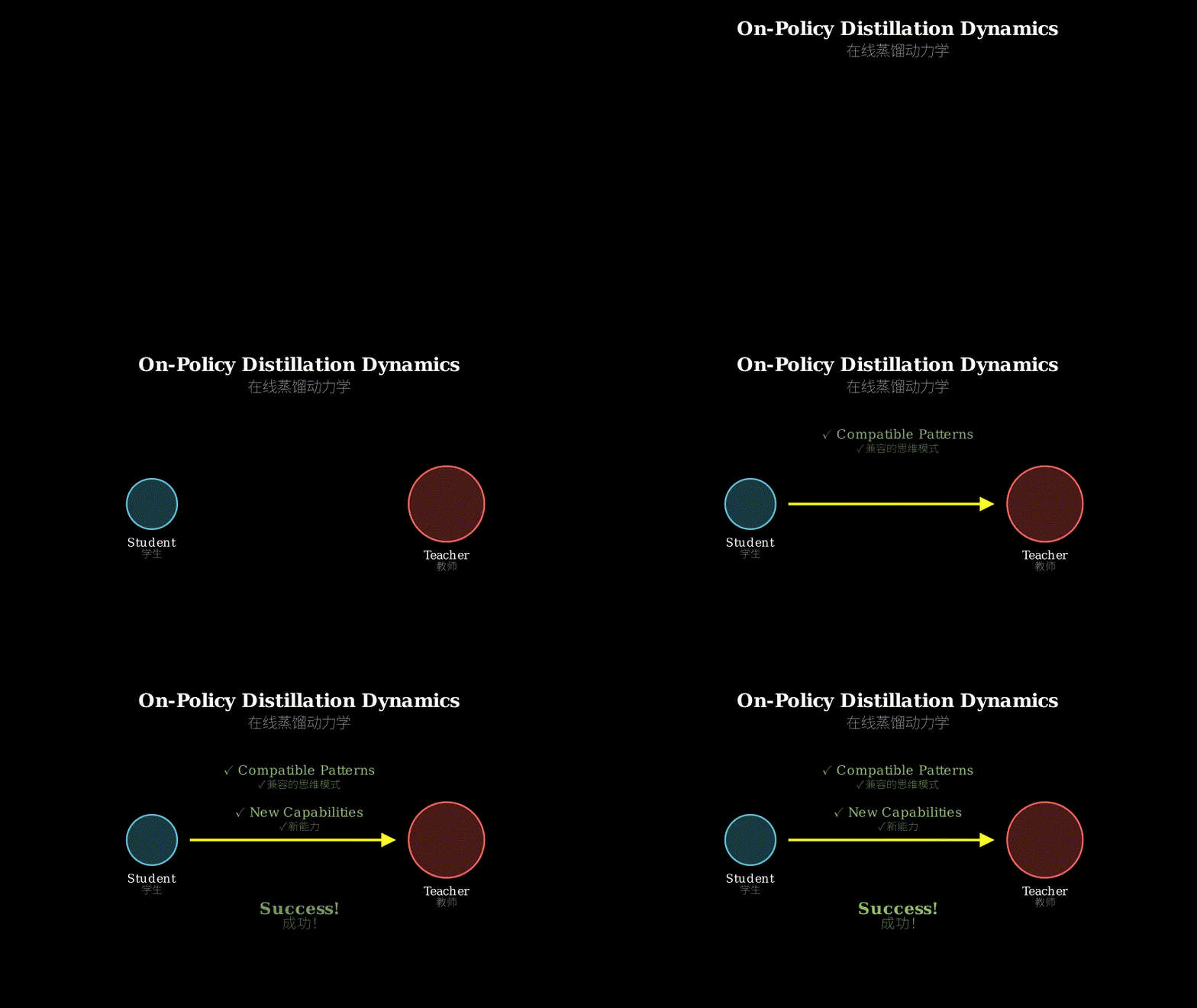
Teacher stronger     ------>     Two necessary conditions:
but student worse                1. Compatible thinking patterns
     |                           2. Genuine new capabilities
     v                                        |
Blame hyperparameters            Token-level dynamics analysis
or data quality                              |
     |                                        v
     v                           Practical recovery strategies
No principled fix    ------>     + Off-policy cold start
                                 + Teacher-aligned prompts
The Increment
One sentence: Before this paper, OPD failures were mysterious hyperparameter issues; after, we know they stem from distributional mismatch and can be diagnosed via token-level alignment patterns.
Core Mechanism
OPD works by having the student generate responses to prompts, then using a teacher to score those responses as training signal. The student updates toward higher-scoring outputs. Sounds simple, but the devil is in the distribution.
The paper identifies the core issue: the student only visits states (partial generations) it would naturally produce. If the teacher’s high-scoring paths require thinking patterns the student never explores, those paths are invisible. It’s like trying to teach someone chess by only commenting on their actual games—if they never consider certain opening moves, you can’t teach those strategies.
The mechanism breaks down into three stages: (1) student generates from its current policy, creating a distribution of visited states; (2) teacher scores these generations; (3) student updates toward higher scores. Success requires the teacher’s preferred paths to overlap with student-visited states AND offer genuinely new signal beyond what the student already knows.
Student Policy (current)
        |
        v
    [Generate]  -----> Visited States (S_student)
        |                      |
        |                      v
        |              Teacher Scores
        |                      |
        v                      v
    Update  <------  High-scoring paths in S_student
        |
        v
Student Policy (next iteration)

Key insight: If teacher's best paths lie outside S_student,
             they're invisible to the update process.
Think of it like a hiking guide teaching you a mountain trail. The guide (teacher) knows an amazing scenic route, but you (student) naturally walk a different path. The guide can only give you feedback on the trail you’re actually walking. If your path never intersects the scenic route, you’ll never discover it—no matter how enthusiastically the guide describes it. OPD only works when your natural exploration overlaps with the teacher’s knowledge, AND the teacher shows you something new along that shared path.
Key Concepts
-
Distributional Indistinguishability: Two models are distributionally indistinguishable from a student’s perspective if, when the student samples from its own policy, it can’t tell which model scored the outputs. Formally, if a 1.5B and 7B teacher both give similar scores to student-generated text, they’re indistinguishable—even though the 7B model is objectively stronger. This explains why bigger teachers sometimes don’t help: they’re better at tasks the student never attempts. It’s like having a calculus expert grade your arithmetic homework—their advanced knowledge doesn’t matter if you’re not doing calculus problems.
-
High-Probability Token Alignment: Successful OPD shows a specific signature: the student progressively aligns with the teacher on high-probability tokens (those the student already considers likely). The paper finds 97-99% of probability mass concentrates on a small shared token set. This is counterintuitive—you’d think learning happens on low-probability tokens where student and teacher disagree. But OPD works by reinforcing the student’s existing intuitions that happen to align with teacher preferences, not by forcing exploration of unlikely paths.
-
Off-Policy Cold Start: When OPD fails due to distribution mismatch, you can bootstrap it by first training on teacher-generated data (off-policy), then switching to student-generated data (on-policy). The off-policy phase shifts the student’s distribution closer to the teacher’s, creating overlap. It’s like learning a language: you start by mimicking native speakers (off-policy) before you can have conversations where they correct your own attempts (on-policy).
Framework Shift
Before (mainstream approach):        After (this paper):

Teacher (stronger model)             Teacher (stronger model)
        |                                    |
        v                                    v
    Score outputs                    Check distribution overlap
        |                                    |
        v                                    |
Student learns from                          +---> Overlap? ---> OPD works
high scores                                  |         |
        |                                    |         v
        v                                    |    No overlap? ---> OPD fails
Better teacher                               |         |
= better student                             |         v
                                             |    Recovery strategies:
(Assumption: teacher                         |    - Off-policy cold start
 quality is sufficient)                      +---> - Aligned prompt selection

                                        (Diagnosis: distribution
                                         mismatch is the root cause)
From “stronger teacher should work” to “teacher and student must share visited states,” the core shift is recognizing OPD as a distribution matching problem, not just a scoring problem.
Expert Assessment
Problem choice: This is a real gap. OPD is production-critical (used in GPT-4, Claude, etc.), and practitioners have war stories about mysterious failures. The paper doesn’t manufacture the problem—it explains existing pain points. It sits at a sweet spot: fundamental enough to matter broadly, specific enough to yield actionable insights.
Method maturity: The investigation is more diagnostic than algorithmic, which is appropriate. The weak-to-strong reverse distillation experiment is clever—showing that 1.5B and 7B teachers are indistinguishable proves the point cleanly. The token-level probing is solid. However, the proposed fixes (off-policy cold start, prompt selection) are somewhat obvious once you understand the problem. The paper’s value is in the diagnosis, not the cure.
Experimental integrity: Baselines are fair. The distributional indistinguishability claim is well-supported by multiple metrics (KL divergence, reward correlation). One concern: the experiments focus on relatively short-form tasks (math, coding). The “long-horizon” caveat in the abstract hints at limitations the paper doesn’t fully explore. The 97-99% probability mass concentration finding is striking but needs more investigation—is this universal or task-dependent?
Writing quality: The phenomenology section (Section 3) is excellent—clear examples of when OPD fails. The mechanism section (Section 4) gets dense with notation that could be simplified. The paper would benefit from reorganizing: put the two conditions (compatible thinking + new capabilities) upfront as the main claim, then use experiments to validate each. The current structure buries the key insight in the middle.
Verdict: weak accept — Solid diagnostic work on a real problem, but the solutions are incremental and the scope is narrower than the abstract suggests.
Takeaways
For practitioners: Before scaling up OPD, run a quick distributional check—sample from your student, score with your teacher, and see if the teacher’s preferences correlate with student probability. If not, you’re wasting compute. Use off-policy warm-up (even just 10-20% of training) to bridge the gap.
For researchers: The “high-probability token alignment” finding is underexplored. If OPD only reinforces existing intuitions, it can’t teach fundamentally new reasoning patterns. This suggests a hard limit on what OPD can achieve—you might need hybrid approaches that force exploration (like curiosity-driven RL) for genuine capability jumps.
Transferable technique: The weak-to-strong reverse distillation setup (using weaker models as teachers to prove a point) is a clever experimental design. It’s a general tool for testing whether your training signal actually contains new information or just confirms what the model already knows.
论文: 2604.13016 作者: Yaxuan Li, Yuxin Zuo, Bingxiang He, Jinqian Zhang, Chaojun Xiao, Cheng Qian, Tianyu Yu, Huan-ang Gao, Wenkai Yang, Zhiyuan Liu 分类: cs.LG, cs.AI, cs.CL
缺口
在线蒸馏(OPD)已成为大语言模型后训练的主力技术——可以理解为让学生模型自己生成尝试,然后从教师模型那里获得反馈来学习。
它无处不在:RLHF、拒绝采样、迭代优化。
但有个谜题:有时更强的教师反而让学生变差。
实践者凭经验知道这一点,但没人理解原因。
此前的工作把 OPD 当作黑盒优化问题。
如果教师打分更高,蒸馏就该有效——这是假设。
失败时,人们归咎于超参数或数据质量。
本文问了一个更根本的问题:OPD 成功需要满足什么条件?
经验之谜                          机制性调查
     |                                  |
     v                                  v
教师更强但学生         ------>    两个必要条件:
反而变差                          1. 兼容的思维模式
     |                            2. 真正的新能力
     v                                  |
归咎超参数或                      词元级动力学分析
数据质量                                |
     |                                  v
     v                            实用恢复策略
无原则性修复方案       ------>    + 离线策略冷启动
                                  + 教师对齐的提示选择
增量
一句话: 这篇论文之前,OPD 失败是神秘的超参数问题;
之后,我们知道它们源于分布不匹配,可通过词元级对齐模式诊断。
核心机制
OPD 的工作方式是让学生对提示生成响应,然后用教师对这些响应打分作为训练信号。
学生朝着高分输出更新。
听起来简单,但魔鬼在分布中。
本文识别出核心问题:学生只访问它自然会产生的状态(部分生成)。
如果教师的高分路径需要学生从未探索的思维模式,那些路径就是不可见的。
这就像试图通过只评论某人的实际对局来教他下棋——如果他们从不考虑某些开局走法,你就无法教那些策略。
机制分解为三个阶段:(1) 学生从当前策略生成,创建访问状态的分布;
(2) 教师对这些生成打分;
(3) 学生朝着高分更新。
成功需要教师偏好的路径与学生访问的状态重叠,并且提供超出学生已知内容的真正新信号。
学生策略(当前)
        |
        v
    [生成]  -----> 访问状态 (S_student)
        |                  |
        |                  v
        |          教师打分
        |                  |
        v                  v
    更新  <------  S_student 中的高分路径
        |
        v
学生策略(下一轮)

关键洞察:如果教师的最佳路径在 S_student 之外,
         它们对更新过程不可见。
把它想象成登山向导教你走山路。
向导(教师)知道一条绝佳的风景路线,但你(学生)自然走的是另一条路。
向导只能对你实际走的路径给反馈。
如果你的路径从不与风景路线相交,你永远发现不了它——无论向导多么热情地描述它。
OPD 只在你的自然探索与教师知识重叠时有效,并且教师在那条共享路径上向你展示新东西。
关键概念
- 分布不可区分性: 从学生视角看,如果学生从自己的策略采样时无法区分两个模型,它们就是分布不可区分的。
形式上,如果 1.5B 和 7B 教师对学生生成的文本给出相似分数,它们就是不可区分的——即使 7B 模型客观上更强。
这解释了为什么更大的教师有时没帮助:它们在学生从不尝试的任务上更好。
就像让微积分专家批改你的算术作业——如果你不做微积分题,他们的高级知识就无关紧要。
- 高概率词元对齐: 成功的 OPD 显示出特定特征:学生在高概率词元(学生已经认为可能的词元)上逐步与教师对齐。
本文发现 97-99% 的概率质量集中在一个小的共享词元集上。
这是反直觉的——你会认为学习发生在学生和教师不一致的低概率词元上。
但 OPD 通过强化学生恰好与教师偏好一致的现有直觉来工作,而不是强制探索不太可能的路径。
- 离线策略冷启动: 当 OPD 因分布不匹配而失败时,你可以通过先在教师生成的数据上训练(离线策略),然后切换到学生生成的数据(在线策略)来引导它。
离线策略阶段将学生的分布移近教师的分布,创造重叠。
这就像学语言:你先模仿母语者(离线策略),然后才能进行他们纠正你自己尝试的对话(在线策略)。
框架转变
之前(主流方法):                之后(本文方法):

教师(更强模型)                  教师(更强模型)
        |                                |
        v                                v
    对输出打分                      检查分布重叠
        |                                |
        v                                |
学生从高分学习                           +---> 重叠?---> OPD 有效
        |                                |       |
        v                                |       v
更好的教师                               |  无重叠?---> OPD 失败
= 更好的学生                             |       |
                                         |       v
(假设:教师质量                         |  恢复策略:
 足够好)                                |  - 离线策略冷启动
                                         +---> - 对齐的提示选择

                                    (诊断:分布不匹配
                                     是根本原因)
从”更强的教师应该有效”到”教师和学生必须共享访问状态”,核心转变是将 OPD 识别为分布匹配问题,而不仅仅是打分问题。
专家评审
选题眼光: 这是真缺口。
OPD 对生产至关重要(用于 GPT-4、Claude 等),实践者有关于神秘失败的战争故事。
本文没有制造问题——它解释了现有的痛点。
它处于一个甜蜜点:足够基础以广泛重要,足够具体以产生可操作的洞察。
方法成熟度: 调查更多是诊断性的而非算法性的,这是合适的。
弱到强的反向蒸馏实验很巧妙——展示 1.5B 和 7B 教师不可区分干净地证明了观点。
词元级探测是扎实的。
然而,提出的修复方案(离线策略冷启动、提示选择)一旦你理解问题就有些显而易见。
本文的价值在于诊断,而非治疗。
实验诚意: 基线公平。
分布不可区分性声明得到多个指标(KL 散度、奖励相关性)的良好支持。
一个担忧:实验集中在相对短形式的任务(数学、编码)上。
摘要中的”长期”警告暗示了论文没有充分探索的局限性。
97-99% 概率质量集中的发现很惊人,但需要更多调查——这是普遍的还是任务依赖的?
写作功力: 现象学部分(第 3 节)很出色——OPD 何时失败的清晰例子。
机制部分(第 4 节)符号密集,可以简化。
本文将受益于重组:把两个条件(兼容思维 + 新能力)作为主要声明放在前面,然后用实验验证每个。
当前结构把关键洞察埋在中间。
判决: 弱接收 — 对真实问题的扎实诊断工作,但解决方案是渐进的,范围比摘要暗示的窄。
要点总结
对实践者: 在扩大 OPD 之前,运行快速分布检查——从你的学生采样,用你的教师打分,看教师的偏好是否与学生概率相关。
如果不相关,你在浪费算力。
使用离线策略预热(即使只是训练的 10-20%)来弥合差距。
对研究者: “高概率词元对齐”发现未被充分探索。
如果 OPD 只强化现有直觉,它无法教授根本上新的推理模式。
这暗示了 OPD 能实现什么的硬限制——你可能需要强制探索的混合方法(如好奇心驱动的 RL)来实现真正的能力跃升。
可迁移技术: 弱到强的反向蒸馏设置(使用较弱模型作为教师来证明观点)是巧妙的实验设计。
这是测试你的训练信号是否真正包含新信息还是只是确认模型已知内容的通用工具。