Paper: 2605.30338 Authors: Xiaoxuan Ma, Jiashun Wang, Nicolas Ugrinovic, Yehonathan Litman, Kris Kitani Categories: cs.CV
The Gap
Existing single-image 3D reconstruction methods (NeRF-based, image-to-3D models) optimize for visual plausibility — they make scenes that look right. But when you drop these reconstructed scenes into a physics simulator, objects float in mid-air or sink through tables. The geometry is plausible but physically inconsistent.
Image-conditioned generation methods (like those using diffusion priors) improve physical plausibility by learning what stable scenes look like, but they sacrifice accuracy — they give you a plausible arrangement, not the arrangement shown in the input image. A chair might be near the table instead of behind it.
The gap: no method reconstructs scenes that are both visually faithful to the input image and physically stable enough to run in simulation without objects flying apart or collapsing.
Problem: Visual reconstruction vs Physical stability
   |
   v
Observation: Existing methods pick one
   |
   +---> Image-to-3D: Looks right, physics broken (floating, penetration)
   |
   +---> Generation: Physics plausible, image match broken (wrong positions)
   |
   v
Assumption: Need explicit physical structure understanding
   |
   v
Method: Scene-tree (gravity+support) + Physics-constrained optimization
   |
   v
Evidence: Reduced penetration/floating, stable simulation, preserved visual match
   |
   v
Conclusion: Physical structure as prior enables both goals
The Increment
One sentence: Before REST3D, you chose between visually accurate but physically broken reconstructions or physically plausible but inaccurate arrangements; after REST3D, you get scenes that match the input image and survive physics simulation.
Core Mechanism
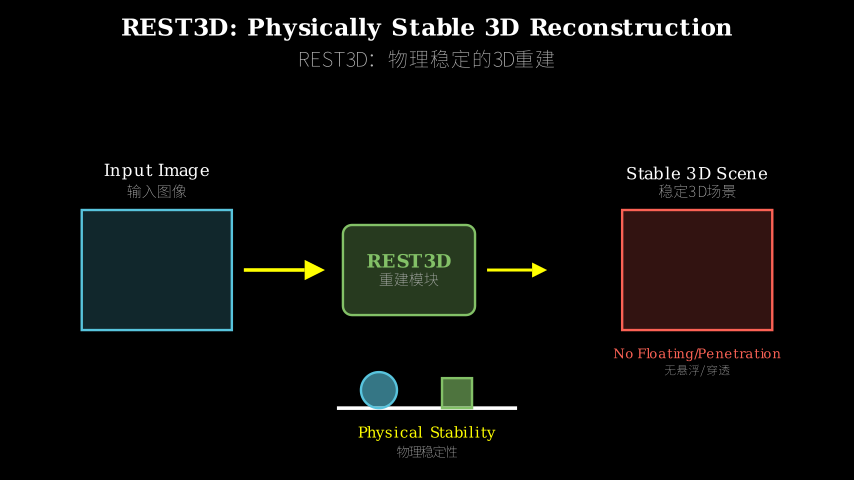
REST3D has three stages. First, it builds a scene-tree — a hierarchical representation where each object node stores its physical state (grounded, supported, floating) and relationships (what supports what). An agentic system analyzes the input image using vision-language models to construct this tree, reasoning about gravity and support from the ground up.
Second, it initializes geometry using off-the-shelf image-to-3D models for each object, then aligns them according to the scene-tree structure. Objects are positioned to respect support relationships — a book goes on the table, not floating beside it.
Third, it runs physics-constrained optimization. A differentiable physics simulator detects violations (penetration depth, unsupported objects). The optimizer adjusts object poses and shapes to minimize physical errors while keeping a visual consistency loss that penalizes deviation from the input image. The scene-tree guides which adjustments are valid — you can’t move a supported object without considering its supporter.
Input Image
    |
    v
[Scene-Tree Construction]  <--- VLM reasoning about gravity/support
    |
    | (tree structure: ground -> table -> book)
    v
[Geometry Initialization]  <--- Image-to-3D per object
    |
    | (rough 3D meshes, tree-guided placement)
    v
[Physics-Constrained Opt]  <--- Differentiable physics + visual loss
    |
    | (iterative: detect violations -> adjust -> re-simulate)
    v
Stable 3D Scene
Think of REST3D as building a house of cards with blueprints. Traditional methods are like stacking cards by eye — they look balanced in the photo, but touch them and they collapse. Generation methods are like having someone else build a stable card house for you, but they didn’t look at your photo, so the arrangement is different.
REST3D first draws blueprints (scene-tree): “This card rests on these two, which rest on the table.” Then it places rough cards (initialization) following the blueprint. Finally, it carefully adjusts each card’s position and angle (optimization) so the structure is stable and matches the photo. The blueprint prevents nonsensical adjustments — you can’t slide the top card without checking if its supports can still hold it.
Key Concepts
-
Scene-tree from gravity-support perspective: Instead of treating a scene as a flat collection of objects, REST3D organizes it as a tree rooted at the ground. Each node is an object; edges represent “X supports Y” relationships. An object’s physical state (grounded, supported, floating) is determined by tracing its path to the root. This structure encodes physical constraints: if you move a table, everything it supports must move too. The tree is built by an agentic system that uses vision-language models to reason about the image: “Is the lamp on the table or the floor? What would happen if we removed the table?” This gives the reconstruction a structural prior that pure geometry-based methods lack.
-
Physics-constrained optimization with visual consistency: The optimizer has two competing objectives. The physics loss penalizes penetration (objects overlapping), floating (objects with no support), and instability (high potential energy configurations). The visual loss penalizes deviation from the input image by comparing rendered views. The trick is balancing them: too much physics correction and the scene no longer matches the image; too much visual fidelity and objects sink through floors. The scene-tree helps by defining valid adjustment spaces — you can rotate a book on a table, but you can’t move it far from the table without breaking support. The optimization runs in a differentiable physics simulator, so gradients flow from physical violations back to object poses and shapes.
Framework Shift
Before (mainstream approach):        After (REST3D):

Image --> [Image-to-3D] --> Meshes   Image --> [Scene-Tree] --> Structure
              |                                      |
              v                                      v
         Render Loss                    [Init Geometry] <-- Tree-guided
              |                                      |
              v                                      v
         Visual Match                   [Physics + Visual Opt]
         (but unstable)                             |
                                                    v
                                         Stable + Accurate Scene

Key difference:                          Key difference:
Optimize geometry for                    Optimize geometry for
appearance only                          appearance AND physics
                                        with structural prior
From appearance-driven reconstruction to structure-aware reconstruction, the core shift is making physical relationships explicit before optimizing geometry.
Expert Assessment
Problem choice: Real gap. The simulation-readiness problem is not manufactured — VR, robotics, and content creation all need scenes that don’t explode when you add physics. The gap between visual plausibility and physical stability has been noted but not systematically addressed. This sits at the intersection of reconstruction and simulation, a growing area as digital twins and embodied AI gain traction.
Method maturity: The scene-tree idea is clever and well-motivated. Using VLMs for physical reasoning is a natural fit given their spatial understanding capabilities. The physics-constrained optimization is not novel in isolation (differentiable physics has been used before), but the integration with scene-tree guidance is thoughtful. One concern: the agentic scene-tree construction could be brittle — VLMs hallucinate, and errors in the tree propagate. The paper would benefit from ablating tree construction quality vs final stability.
Experimental integrity: Baselines are fair (NeRF methods, image-to-3D models, generation methods). Metrics cover both visual quality (PSNR, LPIPS) and physical stability (penetration volume, floating ratio, simulation success rate). The synthetic dataset (Structured3D) provides ground truth for quantitative evaluation; real-world images (ScanNet, casual photos) test generalization. One red flag: no comparison with methods that do post-hoc physics correction (e.g., running optimization without the scene-tree prior). This would isolate the contribution of the structural prior vs just adding physics loss.
Writing quality: The paper is well-structured, but the scene-tree construction section is dense and could use a worked example. The optimization section glosses over hyperparameter choices (how to weight physics vs visual loss?). The VR demo is compelling but feels like an afterthought — integrating it into the main narrative would strengthen the motivation. The related work section is thorough but could better position the work relative to recent neural simulation methods.
Verdict: weak accept — Addresses a real problem with a principled approach, but the contribution feels incremental (combining existing pieces) rather than introducing a fundamentally new technique. The scene-tree prior is the main novelty, and its robustness needs more scrutiny.
Takeaways
Structural priors beat post-hoc fixes: If you’re building a system that needs to satisfy multiple constraints (visual, physical, semantic), encode the constraints as structure *before optimization rather than adding penalty terms afterward. The scene-tree makes certain violations impossible by construction (you can’t place an object without a supporter), which is more robust than penalizing violations during optimization.
Agentic reasoning for structured outputs: Using VLMs to construct intermediate structured representations (like the scene-tree) is a pattern worth stealing. Instead of end-to-end learning, break the problem into “understand structure” (VLM) and “optimize geometry” (differentiable rendering + physics). This makes the system more interpretable and easier to debug.
Differentiable physics as a regularizer: If your reconstruction needs to be simulation-ready, add a differentiable physics simulator to the optimization loop. The key is balancing physics loss with task-specific loss (visual, semantic, etc.) — too much physics and you lose fidelity, too little and you get instability. The scene-tree provides a middle ground by defining valid adjustment spaces.
论文: 2605.30338 作者: Xiaoxuan Ma, Jiashun Wang, Nicolas Ugrinovic, Yehonathan Litman, Kris Kitani 分类: cs.CV
缺口
现有的单图3D重建方法(基于NeRF的、图像转3D模型)优化的是视觉合理性——它们让场景看起来对。
但当你把这些重建的场景放进物理模拟器,物体会悬浮在半空或穿透桌面。
几何形状合理,但物理上不一致。
基于图像条件的生成方法(比如使用扩散先验的)通过学习稳定场景的样子来改善物理合理性,但牺牲了准确性——它们给你一个合理的布局,而不是输入图像中那个布局。
椅子可能在桌子旁边而不是后面。
缺口:没有方法能重建既视觉上忠实于输入图像又物理上足够稳定、可以在仿真中运行而不会物体乱飞或坍塌的场景。
问题:视觉重建 vs 物理稳定性
   |
   v
观察:现有方法只能二选一
   |
   +---> 图像转3D:看起来对,物理坏了(悬浮、穿透)
   |
   +---> 生成方法:物理合理,图像匹配坏了(位置错误)
   |
   v
假设:需要显式的物理结构理解
   |
   v
方法:场景树(重力+支撑)+ 物理约束优化
   |
   v
证据:减少穿透/悬浮,稳定仿真,保持视觉匹配
   |
   v
结论:物理结构作为先验能同时实现两个目标
增量
一句话:REST3D之前,你要在视觉准确但物理坏掉的重建和物理合理但不准确的布局之间二选一;
REST3D之后,你得到既匹配输入图像又能在物理仿真中存活的场景。
核心机制
REST3D有三个阶段。
首先,它构建场景树——一个层次化表示,每个物体节点存储其物理状态(接地、被支撑、悬浮)和关系(什么支撑什么)。
一个智能体系统使用视觉-语言模型分析输入图像来构建这棵树,从地面向上推理重力和支撑。
其次,它使用现成的图像转3D模型为每个物体初始化几何,然后根据场景树结构对齐它们。
物体被放置以尊重支撑关系——书放在桌上,而不是悬浮在旁边。
第三,它运行物理约束优化。
一个可微物理模拟器检测违规(穿透深度、无支撑物体)。
优化器调整物体姿态和形状以最小化物理错误,同时保持视觉一致性损失,惩罚与输入图像的偏差。
场景树指导哪些调整是有效的——你不能移动被支撑的物体而不考虑它的支撑者。
输入图像
    |
    v
[场景树构建]  <--- VLM推理重力/支撑
    |
    | (树结构:地面 -> 桌子 -> 书)
    v
[几何初始化]  <--- 每个物体的图像转3D
    |
    | (粗糙3D网格,树引导的放置)
    v
[物理约束优化]  <--- 可微物理 + 视觉损失
    |
    | (迭代:检测违规 -> 调整 -> 重新仿真)
    v
稳定3D场景
把REST3D想象成用蓝图搭纸牌屋。
传统方法像凭眼睛堆纸牌——照片里看起来平衡,但一碰就塌。
生成方法像让别人帮你搭一个稳定的纸牌屋,但他们没看你的照片,所以布局不一样。
REST3D首先画蓝图(场景树):“这张牌搁在这两张上,这两张搁在桌上。
“然后按蓝图放粗糙的牌(初始化)。
最后仔细调整每张牌的位置和角度(优化),让结构既稳定又匹配照片。
蓝图防止无意义的调整——你不能滑动顶上的牌而不检查它的支撑是否还能撑住它。
关键概念
- 从重力-支撑视角的场景树:REST3D不把场景当作物体的扁平集合,而是组织成以地面为根的树。
每个节点是一个物体;
边表示”X支撑Y”关系。
物体的物理状态(接地、被支撑、悬浮)通过追溯到根的路径确定。
这个结构编码了物理约束:如果你移动桌子,它支撑的所有东西都必须跟着移动。
树由智能体系统构建,使用视觉-语言模型推理图像:“灯在桌上还是地上?
如果移走桌子会发生什么?
“这给重建提供了纯几何方法缺乏的结构先验。
- 带视觉一致性的物理约束优化:优化器有两个竞争目标。
物理损失惩罚穿透(物体重叠)、悬浮(物体无支撑)和不稳定(高势能配置)。
视觉损失通过比较渲染视图惩罚与输入图像的偏差。
诀窍是平衡它们:物理修正太多,场景不再匹配图像;
视觉保真度太高,物体会穿透地板。
场景树通过定义有效调整空间来帮助——你可以旋转桌上的书,但不能把它移离桌子太远而不破坏支撑。
优化在可微物理模拟器中运行,所以梯度从物理违规反向传播到物体姿态和形状。
框架转变
之前(主流方法):                之后(REST3D):

图像 --> [图像转3D] --> 网格      图像 --> [场景树] --> 结构
              |                                |
              v                                v
         渲染损失                    [初始化几何] <-- 树引导
              |                                |
              v                                v
         视觉匹配                    [物理 + 视觉优化]
         (但不稳定)                            |
                                              v
                                    稳定 + 准确场景

关键差异:                          关键差异:
仅为外观优化几何                    为外观和物理优化几何
                                   带结构先验
从外观驱动的重建到结构感知的重建,核心转变是在优化几何之前显式化物理关系。
专家评审
选题眼光:真实缺口。
仿真就绪问题不是人造的——VR、机器人和内容创作都需要加入物理后不会爆炸的场景。
视觉合理性和物理稳定性之间的差距已被注意到但未被系统解决。
这处于重建和仿真的交叉点,随着数字孪生和具身AI的兴起,这是一个增长领域。
方法成熟度:场景树想法巧妙且动机充分。
使用VLM进行物理推理是自然契合,考虑到它们的空间理解能力。
物理约束优化本身不新颖(可微物理之前被使用过),但与场景树引导的集成是深思熟虑的。
一个担忧:智能体场景树构建可能脆弱——VLM会幻觉,树中的错误会传播。
论文应该消融树构建质量与最终稳定性的关系。
实验诚意:基线公平(NeRF方法、图像转3D模型、生成方法)。
指标涵盖视觉质量(PSNR、LPIPS)和物理稳定性(穿透体积、悬浮比率、仿真成功率)。
合成数据集(Structured3D)提供定量评估的真值;
真实世界图像(ScanNet、随手拍照片)测试泛化。
一个警示:没有与事后物理修正方法比较(例如,运行没有场景树先验的优化)。
这会隔离结构先验的贡献与仅添加物理损失的贡献。
写作功力:论文结构良好,但场景树构建部分密集,需要一个完整示例。
优化部分略过超参数选择(如何权衡物理与视觉损失?
)。
VR演示令人信服但感觉像事后补充——将其整合进主叙事会加强动机。
相关工作部分详尽,但可以更好地相对于最近的神经仿真方法定位工作。
判决:弱接收——用原则性方法解决真实问题,但贡献感觉是增量式的(组合现有部分)而非引入根本新技术。
场景树先验是主要新颖性,其鲁棒性需要更多审查。
要点总结
结构先验胜过事后修复:如果你在构建需要满足多个约束(视觉、物理、语义)的系统,在优化**之前*将约束编码为结构,而不是之后添加惩罚项。
场景树通过构造使某些违规不可能(你不能放置没有支撑者的物体),这比在优化期间惩罚违规更鲁棒。
智能体推理用于结构化输出:使用VLM构建中间结构化表示(如场景树)是值得借鉴的模式。
不是端到端学习,而是将问题分解为”理解结构”(VLM)和”优化几何”(可微渲染+物理)。
这使系统更可解释、更易调试。
可微物理作为正则化器:如果你的重建需要仿真就绪,在优化循环中添加可微物理模拟器。
关键是平衡物理损失与任务特定损失(视觉、语义等)——物理太多会失去保真度,太少会不稳定。
场景树通过定义有效调整空间提供中间地带。