Paper: 2603.22275 Authors: Wooseok Jang, Seonghu Jeon, Jisang Han, Jinhyeok Choi, Minkyung Kwon, Seungryong Kim, Saining Xie, Sainan Liu Categories: cs.CV
The Gap
Novel view synthesis (NVS) needs to generate images from new camera angles that stay geometrically consistent — the same 3D point should look the same across views. Current diffusion models for NVS operate in VAE latent spaces, which compress images view-by-view without encoding cross-view geometric relationships. This creates a mismatch: the task demands geometric awareness, but the latent space is geometry-blind.
Prior work either trains diffusion directly in pixel space (slow, memory-hungry) or uses standard VAE latents (fast but geometrically inconsistent). The gap: no one asked whether existing geometric foundation models — already trained to extract geometrically consistent features — could serve as the latent space itself.
Problem: NVS needs geometric consistency across views
   |
   v
Observation: VAE latents are view-independent, ignore geometry
   |
   v
Hypothesis: Geometric foundation model features encode correspondences
   |
   v
Method: Use geometric features as diffusion latent space (GLD)
   |
   v
Evidence: 4.4x faster training, better 3D metrics than VAE
   |
   v
Conclusion: Geometric latents > generic compression latents for NVS
The Increment
One sentence: Before, multi-view diffusion used generic image compression latents; after, it uses geometry-aware feature spaces that already encode cross-view correspondences.
Core Mechanism
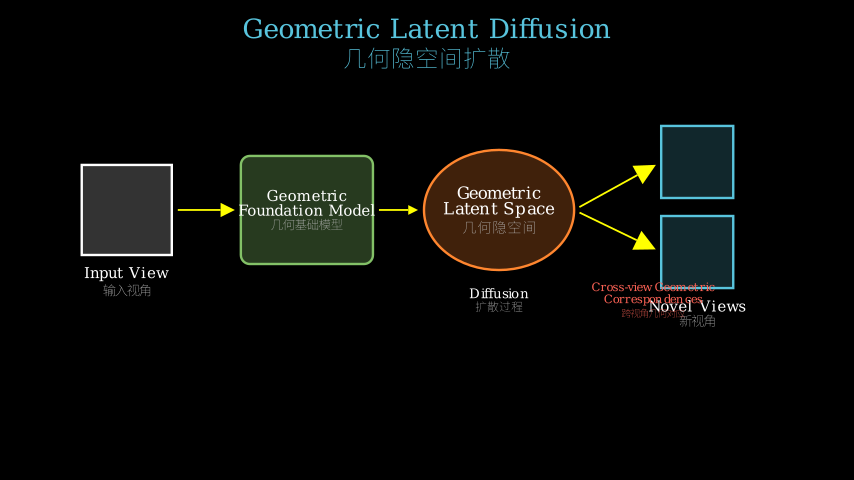
GLD has three components: a frozen geometric encoder (from DUSt3R or MASt3R foundation models), a lightweight decoder that reconstructs RGB from geometric features, and a diffusion model trained in this geometric latent space.
The geometric encoder takes multi-view images and outputs dense feature maps. These features aren’t just image descriptors — they’re trained to match across views when looking at the same 3D point. The decoder learns to invert this: given geometric features, reconstruct the RGB image. The diffusion model then learns to denoise in this geometric feature space, generating new views by sampling and decoding.
Data flows like this: input views → geometric encoder → feature maps → diffusion denoising → decoded RGB. The key trick: the encoder is frozen (pretrained), so training only touches the decoder and diffusion model. This is why it’s 4.4x faster than VAE approaches, which must train the encoder too.
Input views          Geometric encoder       Feature space
   |                  (frozen, pretrained)        |
   v                         |                    v
[img1, img2, ...]  --->  [feat1, feat2, ...]  <--- Diffusion
                             |                      model
                             v                      trains
                         Decoder                    here
                        (trainable)                 |
                             |                      v
                             v                  Denoising
                        RGB output              process
Think of it like using a translator’s brain as a compression algorithm. A professional translator doesn’t just memorize words — they build a mental model where “cat” in English and “猫” in Chinese point to the same concept. If you want to compress multilingual text, you could train a generic compressor from scratch, or you could repurpose the translator’s concept space. GLD does the latter: geometric foundation models are the “translator” that already learned to map different views to shared 3D concepts. Instead of training a new VAE to compress images, GLD borrows the geometric model’s feature space, which already knows that pixel (x1, y1) in view 1 and pixel (x2, y2) in view 2 might be the same 3D point. The decoder is like learning to “speak” from this concept space back to pixels, and the diffusion model learns to generate in this concept space where geometric relationships are already baked in.
Key Concepts
-
Geometric latent space: Most latent spaces (like VAE) compress images independently — each image becomes a code, no relationship between codes. A geometric latent space encodes correspondences: if two features come from the same 3D point viewed from different angles, they’re similar in latent space. Imagine a warehouse where boxes are labeled by GPS coordinates instead of arbitrary IDs — you can tell which boxes contain items from the same location. Geometric features work similarly: they’re labeled by 3D position, not just image appearance.
-
Frozen encoder repurposing: Training a VAE means learning both encoder (image → latent) and decoder (latent → image). GLD freezes a pretrained geometric encoder and only trains the decoder. Why does this work? The encoder already learned to extract geometrically meaningful features from millions of images. We just need to teach the decoder to invert this mapping. It’s like buying a high-end camera (encoder) and only learning to develop the film (decoder) — you don’t need to build the camera from scratch.
Framework Shift
Before (VAE-based NVS):              After (GLD):

View 1 ---> VAE encoder              View 1 ---> Geometric encoder
             |                                    (frozen, pretrained)
             v                                    |
         Latent code                              v
      (view-independent)                   Geometric features
             |                              (cross-view aware)
             v                                    |
      Diffusion model                             v
             |                              Diffusion model
             v                                    |
         VAE decoder                              v
             |                              Lightweight decoder
             v                                    |
         Output view                              v
                                             Output view

Key difference:                      Key difference:
Latent space has no                  Latent space encodes
geometric structure                  3D correspondences
From view-independent compression to geometry-aware compression, the core shift is embedding 3D structure directly into the latent space where generation happens.
Expert Assessment
Problem choice: Real gap. NVS is a hot area, and the VAE latent space mismatch is a genuine bottleneck — you’re asking a geometry-blind representation to maintain geometric consistency. The insight to repurpose geometric foundation models is clever, not manufactured.
Method maturity: This is elegant engineering, not a conceptual breakthrough. The heavy lifting (geometric feature learning) was done by DUSt3R/MASt3R. GLD’s contribution is recognizing these features can serve as latent space and showing it works. The 4.4x speedup comes mostly from freezing the encoder, which is a practical win but not a deep algorithmic innovation.
Experimental integrity: Baselines are fair (VAE, RAE, state-of-the-art NVS methods). The numbers hold up — 2D quality and 3D consistency metrics both improve. One concern: they compare against methods without text-to-image pretraining, then note GLD “remains competitive” with methods that do use it. This undersells the comparison — either compete directly or don’t claim competitiveness.
Writing quality: The abstract and intro are crisp. The method section could be tighter — there’s repetition about “geometric consistency” without showing failure cases where VAE latents break down. A single figure comparing VAE vs GLD latent space structure (e.g., t-SNE of features from the same 3D point across views) would make the geometric advantage visceral.
Verdict: weak accept — Solid engineering contribution with clear practical benefits, but the core idea is “use better features” rather than a new algorithmic principle. The speedup and quality gains justify publication, but this won’t reshape how people think about multi-view synthesis.
Takeaways
-
Repurpose, don’t retrain: If a pretrained model already extracts the structure you need (here, geometric correspondences), freeze it and train only the decoder. This pattern applies beyond vision — language models’ embeddings, audio models’ spectrograms, etc.
-
Latent space design matters: The choice of latent space isn’t just about compression ratio. For tasks with structural requirements (geometry, temporal coherence, physical constraints), use latents that encode that structure. Don’t force a diffusion model to learn structure that could be baked into the representation.
-
Benchmark against the right baseline: GLD’s win over VAE is convincing. The comparison to text-to-image pretrained methods is muddled — either train GLD with pretraining or don’t claim competitiveness. When writing papers, pick one comparison story and commit.
论文: 2603.22275 作者: Wooseok Jang, Seonghu Jeon, Jisang Han, Jinhyeok Choi, Minkyung Kwon, Seungryong Kim, Saining Xie, Sainan Liu 分类: cs.CV
缺口
新视角合成(NVS)需要从新的相机角度生成图像,并保持几何一致性——同一个 3D 点在不同视角下应该看起来一样。
当前用于 NVS 的扩散模型在 VAE 隐空间中运行,这种空间逐视角压缩图像,不编码跨视角的几何关系。
这造成了错配:任务需要几何感知,但隐空间对几何视而不见。
之前的工作要么直接在像素空间训练扩散(慢,吃内存),要么用标准 VAE 隐空间(快但几何不一致)。
缺口在于:没人问过,已有的几何基础模型——已经训练好提取几何一致特征——能否直接当隐空间用。
问题:NVS 需要跨视角几何一致性
   |
   v
观察:VAE 隐空间独立于视角,忽略几何
   |
   v
假设:几何基础模型特征编码了对应关系
   |
   v
方法:用几何特征作扩散隐空间(GLD)
   |
   v
证据:训练快 4.4 倍,3D 指标优于 VAE
   |
   v
结论:几何隐空间 > 通用压缩隐空间(针对 NVS)
增量
一句话: 之前多视角扩散用通用图像压缩隐空间; 现在用几何感知特征空间,已编码跨视角对应关系。
核心机制
GLD 有三个组件:冻结的几何编码器(来自 DUSt3R 或 MASt3R 基础模型)、轻量解码器(从几何特征重建 RGB)、在几何隐空间训练的扩散模型。
几何编码器接收多视角图像,输出密集特征图。
这些特征不只是图像描述符——它们训练成能跨视角匹配同一 3D 点。
解码器学习逆过程:给定几何特征,重建 RGB 图像。
扩散模型在几何特征空间学习去噪,通过采样和解码生成新视角。
数据流:输入视角 → 几何编码器 → 特征图 → 扩散去噪 → 解码 RGB。
关键技巧:编码器冻结(预训练),训练只涉及解码器和扩散模型。
这就是为什么比 VAE 方法快 4.4 倍——VAE 还得训练编码器。
输入视角          几何编码器           特征空间
   |            (冻结,预训练)           |
   v                   |                  v
[图1, 图2, ...]  --->  [特征1, 特征2, ...]  <--- 扩散
                         |                      模型
                         v                      在此
                     解码器                     训练
                    (可训练)                   |
                         |                      v
                         v                  去噪过程
                    RGB 输出
把它想成用翻译家的大脑当压缩算法。
专业翻译不只是记单词——他们建立心智模型,英语的”cat”和中文的”猫”指向同一概念。
如果你要压缩多语言文本,可以从零训练通用压缩器,也可以重用翻译家的概念空间。
GLD 做的是后者:几何基础模型是”翻译家”,已经学会把不同视角映射到共享 3D 概念。
GLD 不训练新 VAE 压缩图像,而是借用几何模型的特征空间,这空间已经知道视角 1 的像素 (x1, y1) 和视角 2 的像素 (x2, y2) 可能是同一 3D 点。
解码器像是学习从概念空间”说”回像素,扩散模型在这个几何关系已烘焙进去的概念空间学习生成。
关键概念
- 几何隐空间: 大多数隐空间(如 VAE)独立压缩图像——每张图变成一个码,码之间无关系。
几何隐空间编码对应关系:如果两个特征来自不同角度看到的同一 3D 点,它们在隐空间中相似。
想象一个仓库,箱子按 GPS 坐标标记而非任意 ID——你能看出哪些箱子装的是同一地点的物品。
几何特征类似:按 3D 位置标记,不只按图像外观。
- 冻结编码器重用: 训练 VAE 要学编码器(图像 → 隐空间)和解码器(隐空间 → 图像)。
GLD 冻结预训练几何编码器,只训练解码器。
为什么行得通?编码器已从数百万图像学会提取几何有意义的特征。
我们只需教解码器逆向这个映射。
就像买高端相机(编码器),只学冲洗胶片(解码器)——不必从零造相机。
框架转变
之前(基于 VAE 的 NVS):          之后(GLD):

视角 1 ---> VAE 编码器            视角 1 ---> 几何编码器
             |                              (冻结,预训练)
             v                              |
         隐编码                              v
      (独立于视角)                     几何特征
             |                          (跨视角感知)
             v                              |
      扩散模型                                v
             |                          扩散模型
             v                              |
      VAE 解码器                             v
             |                          轻量解码器
             v                              |
         输出视角                            v
                                         输出视角

关键差异:                          关键差异:
隐空间无几何结构                    隐空间编码 3D 对应关系
从独立于视角的压缩到几何感知压缩,核心转变是把 3D 结构直接嵌入生成发生的隐空间。
专家评审
选题眼光: 真缺口。
NVS 是热门领域,VAE 隐空间错配是真瓶颈——你让几何盲表示维持几何一致性。
重用几何基础模型的洞见巧妙,非人造。
方法成熟度: 这是优雅工程,非概念突破。
重活(几何特征学习)由 DUSt3R/MASt3R 完成。
GLD 的贡献是认识到这些特征可当隐空间,并证明有效。
4.4 倍加速主要来自冻结编码器,是实用胜利但非深层算法创新。
实验诚意: 基线公平(VAE、RAE、最先进 NVS 方法)。
数字站得住——2D 质量和 3D 一致性指标都提升。
一个担忧:他们对比无文生图预训练的方法,然后说 GLD”保持竞争力”于有预训练的方法。
这低估了对比——要么直接竞争,要么别声称竞争力。
写作功力: 摘要和引言简洁。
方法部分可以更紧凑——关于”几何一致性”有重复,没展示 VAE 隐空间崩溃的失败案例。
一张图对比 VAE vs GLD 隐空间结构(如同一 3D 点跨视角特征的 t-SNE)会让几何优势更直观。
判决: 弱接收——扎实工程贡献,实用收益清晰,但核心想法是”用更好特征”而非新算法原理。
加速和质量提升值得发表,但不会重塑人们对多视角合成的思考。
要点总结
- 重用,别重训: 如果预训练模型已提取你需要的结构(这里是几何对应),冻结它,只训练解码器。
这模式超越视觉——语言模型嵌入、音频模型频谱图等都适用。
- 隐空间设计重要: 隐空间选择不只关乎压缩率。
对有结构要求的任务(几何、时序连贯、物理约束),用编码该结构的隐空间。
别强迫扩散模型学习本可烘焙进表示的结构。
- 对标正确基线: GLD 胜过 VAE 令人信服。
与文生图预训练方法的对比混乱——要么用预训练训 GLD,要么别声称竞争力。
写论文时,选一个对比故事并坚持到底。