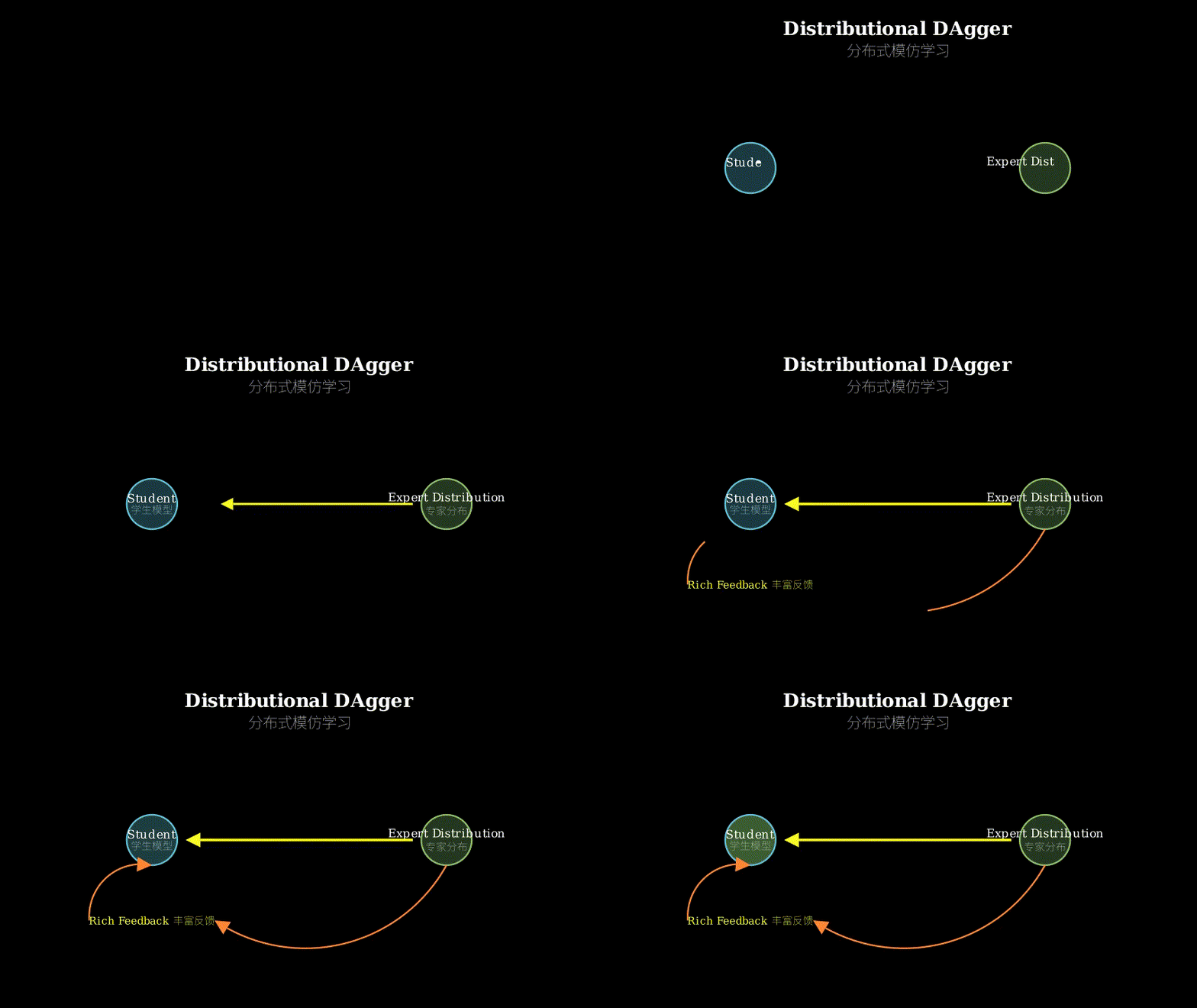
Paper: 2606.05152 Authors: Rishabh Agrawal, Jacob Fein-Ashley, Paria Rashidinejad Categories: cs.LG, cs.AI, cs.CL
The Gap
Current reasoning model training relies on Reinforcement Learning from Verifiable Rewards (RLVR): generate many candidate solutions, check if the final answer is correct, assign a binary reward. This recipe wastes rich intermediate feedback like execution traces, tool outputs, and step-by-step corrections. Existing approaches using self-distillation (reverse KL, Jensen-Shannon divergence) fail to guarantee that incorporating “better” trajectories actually improves the policy—they can increase probability on worse actions even when the expert has higher reward.
Problem: Binary rewards waste rich feedback
   |
   v
Assumption: Expert distribution available on policy-visited states
   |
   v
Method: Forward cross-entropy with expert distribution (DistIL)
   |
   v
Evidence: Monotonic improvement guarantees + empirical gains
   |
   v
Conclusion: Rich credit assignment > binary final-answer signals
The Increment
One sentence: Before this paper, reasoning models trained on final-answer correctness; after, they can propagate disagreement with expert trajectories backward through entire reasoning chains while guaranteeing policy improvement.
Core Mechanism
DistIL builds on DAgger (Dataset Aggregation) but operates in the distributional regime. At each training iteration, the current policy π generates trajectories. For states visited by π, an expert provides a distribution over what actions it would take. The learner minimizes forward cross-entropy between its action distribution and the expert’s distribution at each decision point.
The key operation is credit assignment: when the expert and student disagree at a future state, that disagreement signal propagates backward through the sequence-level gradient. If the expert places high probability on a different action at timestep t+5, the gradient adjusts not just that future decision but also earlier choices at t, t+1, t+2 that led to that divergence.
Unlike standard RL objectives that only see a final scalar reward, DistIL receives distributional feedback at every intermediate state. The forward cross-entropy direction matters: it pulls the student’s distribution toward the expert’s, rather than pushing the expert toward the student (reverse KL) or meeting halfway (Jensen-Shannon). This directional choice ensures that when the expert is better, updates provably increase probability on higher-reward actions.
Trajectory Generation:
   Current Policy π
        |
        v
   [s0] --a0--> [s1] --a1--> [s2] --a2--> [final]
        |           |           |
        v           v           v
   Expert dist  Expert dist Expert dist
   P*(·|s0)     P*(·|s1)    P*(·|s2)
        |           |           |
        +-----+-----+-----+
              |
              v
    Forward Cross-Entropy: H(P*, π)
              |
              v
    Gradient propagates disagreement backward
    through sequence: ∇ affects a0, a1, a2
Think of this as a driving instructor who sits in the passenger seat while you practice. Standard RL is like only telling you “crash” or “no crash” at the end. DistIL’s instructor continuously shows you what they would do at each intersection—turn signal, speed adjustment, lane positioning. When you deviate from their distribution of actions at mile 5, the learning signal reaches back to correct your steering at mile 2 that set up the deviation. The “forward” direction means you’re adjusting your habits toward the instructor’s, not averaging between your mistakes and their expertise. The instructor’s distribution (not single action) means they can say “70% brake gently, 30% change lanes”—capturing uncertainty and multiple valid choices.
Key Concepts
-
Forward vs Reverse KL Divergence: KL divergence measures how different two probability distributions are, but direction matters. Forward KL D_KL(Expert || Student) heavily penalizes the student for placing probability mass where the expert doesn’t—forcing coverage of all expert-approved options. Reverse KL D_KL(Student || Expert) does the opposite: it’s fine if the student ignores some expert options, as long as where it does place mass, the expert also approves. For learning from a better teacher, forward KL (used here) ensures you don’t miss good options; reverse KL lets you cherry-pick and can lock onto suboptimal modes even when better data is available.
-
Distributional Expert Access: Instead of querying “what’s the single best action here?”, the learner accesses “what’s your probability distribution over actions?”. This is weaker than needing a perfect oracle (expert might be uncertain) but stronger than scalar rewards (captures relative preferences). Practically, this could be an ensemble of models, a trained value function estimating action quality, or self-evaluation scores. The key property: local access on states the current policy visits, not requiring the expert to demonstrate optimal trajectories from scratch.
-
Sequence-Level Credit Assignment: In language model training, we make many sequential decisions (choosing tokens). A mistake at token 5 might stem from a bad choice at token 2. Standard supervised learning treats each token independently. Sequence-level gradients flow through the entire chain: when the objective measures disagreement at the sequence end, backpropagation attributes responsibility to earlier decisions. DistIL’s forward cross-entropy naturally creates this: expert-student distributional mismatch at future states produces gradients that adjust earlier policy decisions that led there.
Framework Shift
Before (RLVR):                       After (DistIL):

Policy π generates N samples         Policy π generates samples
        |                                    |
        v                                    v
Final answer checked                 Expert distribution at each state
    [Correct=1, Wrong=0]                     |
        |                                    v
        v                            Forward CE: H(P*, π)
RL objective (e.g. PPO)                      |
Maximize reward signal                       v
                                    Gradient propagates backward
Single bit at end                   Rich signal at every step
[One sentence: From end-of-sequence binary signals to every-step distributional alignment, the core shift is continuous multi-step credit assignment.]
Expert Assessment
Problem choice: Real gap. RLVR’s wastefulness is well-known—practitioners manually engineer reward shaping to inject intermediate signals. Formalizing how to use rich feedback with theoretical guarantees is a natural next step, not manufactured. This sits at the intersection of imitation learning (classical DAgger) and modern LLM training (RLHF/RLVR), bridging two mature areas.
Method maturity: Clever adaptation rather than invention. DAgger is 2011 tech; applying it distributionally and analyzing the objective choice (forward KL) is the insight. The reverse-KL failure modes (Theorem 3.1) and monotonic improvement guarantee (Theorem 4.1) provide real value—prior work used reverse KL or JS without realizing they lack these properties. However, the practical expert construction (Section 6: Best-of-N sampling, self-evaluation) feels more like “what we tried” than principled design. The gap between “assume expert distribution” and “here’s how to build one” could be tighter.
Experimental integrity: Baselines are fair (RLVR, self-distillation variants) and domains diverse (math, code, reasoning). The improvements are consistent but not massive (Table 1: +2-8% over RLVR). A concern: expert quality isn’t isolated. When DistIL outperforms baselines, is it the forward-KL objective or simply having access to distributional feedback? An ablation where baselines also get expert distributions would clarify. The Pass@N results (Table 2) are interesting but feel secondary—optimization for different metrics should be explicit.
Writing quality: Strong motivation and theory sections. The related work undersells the connection to reward shaping and curriculum learning, which solve similar problems differently. Section 5 (regret bounds) is dense—moving proof sketches to appendix and leading with intuition would help. The biggest miss: Figure 1 should show a worked example (actual reasoning trace, expert distribution, gradient flow), not just algorithmic pseudocode. Readers will skim the algorithm but remember a concrete instance.
Verdict: Weak accept — Solid theoretical contribution (monotonic improvement guarantee) and consistent empirical gains, but expert construction remains underspecified and experiments don’t fully isolate the objective’s contribution from the feedback type.
Takeaways
For practitioners: If you have access to intermediate feedback (tool outputs, execution traces, model ensembles), use forward cross-entropy to align with it rather than reverse KL or JS divergence. The directional choice matters—forward CE ensures you cover all expert-preferred options, not just mode-collapse onto one.
For researchers: The failure mode of reverse KL (Theorem 3.1) transfers beyond this setting. Any time you’re distilling from a better distribution into a worse one, check whether your objective guarantees improvement or could increase probability on worse actions. The proof technique (bounding policy improvement via distributional shift) is reusable.
Concrete technique: Best-of-N sampling as a poor-man’s expert distribution (Section 6.1). Generate N trajectories, score them, construct a categorical distribution over actions weighted by trajectory success. Simple, requires no new models, and empirically works. This is immediately deployable in any setting with verifiable outcomes.
论文: 2606.05152 作者: Rishabh Agrawal, Jacob Fein-Ashley, Paria Rashidinejad 分类: cs.LG, cs.AI, cs.CL
缺口
当前推理模型训练依赖可验证奖励强化学习(RLVR):生成大量候选解,检查最终答案是否正确,分配二元奖励。
这个配方浪费了丰富的中间反馈,如执行轨迹、工具输出、逐步修正。
现有的自蒸馏方法(反向KL散度、詹森-香农散度)无法保证融入”更好”的轨迹就能实际改进策略——即使专家有更高奖励,它们也可能增加较差动作的概率。
问题:二元奖励浪费丰富反馈
   |
   v
假设:策略访问状态上可获得专家分布
   |
   v
方法:与专家分布的前向交叉熵(DistIL)
   |
   v
证据:单调改进保证 + 实证增益
   |
   v
结论:丰富的功劳分配 > 二元最终答案信号
增量
一句话:这篇论文之前,推理模型基于最终答案正确性训练;之后,它们能将与专家轨迹的分歧向后传播穿透整条推理链,同时保证策略改进。
核心机制
DistIL 建立在 DAgger(数据集聚合)之上,但运行在分布式机制中。
每次训练迭代,当前策略π生成轨迹。
对于π访问的状态,专家提供它会采取哪些动作的分布。
学习者最小化其动作分布与专家分布在每个决策点的前向交叉熵。
关键操作是功劳分配:当专家和学生在未来状态产生分歧时,该分歧信号通过序列级梯度向后传播。
如果专家在时间步t+5对不同动作赋予高概率,梯度不仅调整那个未来决策,还调整t、t+1、t+2导致该分歧的早期选择。
与只看到最终标量奖励的标准RL目标不同,DistIL在每个中间状态接收分布式反馈。
前向交叉熵的方向很重要:它将学生的分布拉向专家,而非将专家推向学生(反向KL)或中途相遇(詹森-香农)。
这个方向性选择确保当专家更好时,更新可证明地增加高奖励动作的概率。
轨迹生成:
   当前策略 π
        |
        v
   [s0] --a0--> [s1] --a1--> [s2] --a2--> [终态]
        |           |           |
        v           v           v
   专家分布    专家分布    专家分布
   P*(·|s0)    P*(·|s1)    P*(·|s2)
        |           |           |
        +-----+-----+-----+
              |
              v
    前向交叉熵:H(P*, π)
              |
              v
    梯度向后传播分歧
    穿透序列:∇ 影响 a0, a1, a2
把这个想象成一个坐在副驾驶的驾驶教练,你在练车。
标准RL就像只在最后告诉你”撞了”还是”没撞”。
DistIL的教练在每个路口持续向你展示他们会做什么——转向灯、速度调整、车道定位。
当你在第5英里处偏离他们的动作分布时,学习信号回溯到第2英里修正你的转向,正是那次转向埋下了偏离的种子。
“前向”方向意味着你在调整自己的习惯向教练靠拢,而非在你的错误和他们的专业知识之间取平均。
教练的分布(而非单一动作)意味着他们可以说”70%轻踩刹车,30%换道”——捕捉不确定性和多个有效选择。
关键概念
- 前向与反向KL散度:KL散度衡量两个概率分布的差异,但方向重要。
前向KL D_KL(专家 || 学生) 严厉惩罚学生在专家不放概率质量的地方放置质量——强制覆盖所有专家认可的选项。
反向KL D_KL(学生 || 专家) 反之:学生忽略某些专家选项没关系,只要它确实放置质量的地方,专家也认可。
对于从更好的老师学习,前向KL(本文使用)确保你不会错过好选项;反向KL让你挑挑拣拣,即使有更好数据也可能锁定次优模式。
- 分布式专家访问:不是查询”这里最好的单一动作是什么?“,而是学习者访问”你对动作的概率分布是什么?”。
这比需要完美神谕弱(专家可能不确定),但比标量奖励强(捕捉相对偏好)。
实际上,这可以是模型集成、训练的价值函数估计动作质量,或自我评估分数。
关键属性:在当前策略访问的状态上的局部访问,不需要专家从头演示最优轨迹。
- 序列级功劳分配:在语言模型训练中,我们做许多顺序决策(选择标记)。
第5个标记的错误可能源于第2个标记的错误选择。
标准监督学习独立对待每个标记。
序列级梯度流过整条链:当目标在序列末端衡量分歧时,反向传播将责任归因于早期决策。
DistIL的前向交叉熵自然创造这一点:未来状态的专家-学生分布不匹配产生梯度,调整导致那里的早期策略决策。
框架转变
之前(RLVR):                      之后(DistIL):

策略π生成N个样本                     策略π生成样本
        |                                    |
        v                                    v
最终答案检查                          每个状态的专家分布
    [正确=1,错误=0]                          |
        |                                    v
        v                             前向CE:H(P*, π)
RL目标(如PPO)                              |
最大化奖励信号                                v
                                     梯度向后传播
末尾的单比特                          每步的丰富信号
[一句话:从序列末端二元信号到每步分布对齐,核心转变是连续多步功劳分配。
]
专家评审
选题眼光:真实缺口。
RLVR的浪费性众所周知——实践者手动设计奖励塑形来注入中间信号。
形式化如何使用丰富反馈并提供理论保证是自然的下一步,而非人造。
这处于模仿学习(经典DAgger)和现代LLM训练(RLHF/RLVR)的交叉点,连接两个成熟领域。
方法成熟度:巧妙改编而非发明。
DAgger是2011年的技术;分布式应用它并分析目标选择(前向KL)是洞见。
反向KL失败模式(定理3.1)和单调改进保证(定理4.1)提供真实价值——先前工作使用反向KL或JS却未意识到它们缺少这些性质。
然而,实际的专家构建(第6节:Best-of-N采样、自我评估)感觉更像”我们尝试的东西”而非原则性设计。
“假设专家分布”与”这是如何构建”之间的差距可以更紧密。
实验诚意:基线公平(RLVR、自蒸馏变体),领域多样(数学、代码、推理)。
改进持续但不巨大(表1:比RLVR +2-8%)。
一个担忧:专家质量未被隔离。
当DistIL优于基线时,是前向KL目标还是仅仅访问分布式反馈?基线也获得专家分布的消融实验会澄清这点。
Pass@N结果(表2)有趣但感觉次要——针对不同指标的优化应明确。
写作功力:动机和理论部分强。
相关工作低估了与奖励塑形和课程学习的联系,后者以不同方式解决类似问题。
第5节(遗憾界)密集——将证明草图移到附录并以直觉引导会有帮助。
最大遗漏:图1应展示实例(实际推理轨迹、专家分布、梯度流),而非仅算法伪代码。
读者会略读算法但记住具体实例。
判决:弱接收 — 扎实的理论贡献(单调改进保证)和持续的实证增益,但专家构建仍未充分指定,实验未完全隔离目标对反馈类型的贡献。
要点总结
对实践者:如果你能访问中间反馈(工具输出、执行轨迹、模型集成),使用前向交叉熵与之对齐,而非反向KL或JS散度。
方向性选择重要——前向CE确保你覆盖所有专家偏好的选项,而非模式坍缩到一个。
对研究者:反向KL的失败模式(定理3.1)可迁移超越本设置。
任何时候你从更好的分布蒸馏到更差的分布,检查你的目标是否保证改进或可能增加较差动作的概率。
证明技术(通过分布偏移界定策略改进)可复用。
具体技术:Best-of-N采样作为穷人版专家分布(第6.1节)。
生成N条轨迹,打分,构造按轨迹成功加权的动作分类分布。
简单,不需要新模型,实证有效。
这在任何有可验证结果的设置中都可立即部署。