
Paper: 2605.02801 Authors: Chenchen Zhang Categories: cs.CL
The Gap
Existing RL for LLM agents treats them as isolated tool users—optimize which API to call, what prompt to send, when to return an answer. But modern LLM systems are teams: agents spawn sub-agents, delegate subtasks, communicate intermediate results, aggregate outputs, and decide when to stop. Prior work (ReAct, Reflexion, LATS) optimizes individual action selection. No framework exists for optimizing coordination decisions: when to parallelize work, whom to delegate to, how to merge results, when the team should stop.
The paper identifies a conceptual gap: RL research has no shared vocabulary for multi-agent orchestration. Industrial systems (Kimi Agent Swarm, OpenAI Codex) clearly use some form of coordination learning, but academic work lacks a unifying lens to study, compare, and advance these methods.
Problem: LLM agents now work in teams
   |
   v
Gap: RL methods optimize individual actions, not coordination
   |
   v
Assumption: Coordination = graph of temporal orchestration events
   |
   v
Method: Orchestration trace framework (3 axes: rewards, credit, decisions)
   |
   v
Evidence: 84-paper survey + industrial case analysis
   |
   v
Conclusion: 5 orchestration decisions, 8 reward families, sparse credit assignment
The Increment
One sentence: Before this paper, RL for LLM agents meant optimizing tool calls; after, it means optimizing how agent teams spawn, delegate, communicate, aggregate, and stop.
Core Mechanism
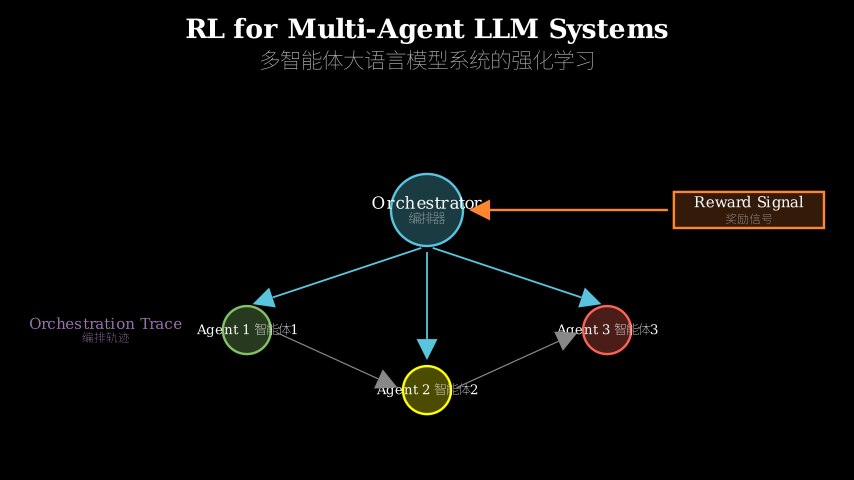
The framework models multi-agent coordination as orchestration traces—temporal interaction graphs where nodes are events (spawn sub-agent, delegate task, send message, aggregate results, stop) and edges are causal dependencies. Each trace is a replayable execution log of team behavior.
The framework decomposes orchestration learning into three axes. First, reward design spans eight families: task rewards (correctness, efficiency), orchestration rewards (parallelism speedup, split quality, aggregation coherence), communication rewards (message relevance), and stopping rewards (early termination bonus). Second, credit assignment attaches signals to eight units—from individual tokens to entire teams—with explicit counterfactual message-level credit remaining rare. Third, orchestration decisions break into five sub-problems: when to spawn (parallelism timing), whom to delegate to (agent selection), how to communicate (message content/routing), how to aggregate (merge strategy), and when to stop (termination condition).
Orchestration Trace (temporal graph):

    [Start]
       |
       v
    [Spawn A] ---message---> [Spawn B]
       |                        |
       v                        v
    [Tool Use]              [Delegate C]
       |                        |
       +-------aggregate--------+
                  |
                  v
              [Stop]

Three Axes:
  Rewards: task + orchestration + communication + stopping
  Credit:  token | action | message | episode | team
  Decisions: spawn | delegate | communicate | aggregate | stop
Think of orchestration traces like a construction project timeline. Individual workers (agents) are skilled, but the project manager must decide: when to hire subcontractors (spawn), which specialist handles which task (delegate), how teams share blueprints (communicate), how to merge deliverables from different crews (aggregate), and when the building is done (stop). Traditional RL trains workers to swing hammers better. This framework trains the project manager to coordinate the crew. The trace is the Gantt chart—it records who did what, when, and how work flowed between teams. Rewards evaluate not just whether the building stands, but whether parallelizing the electrical and plumbing work saved time, whether the right specialist got the right task, and whether the final inspection happened at the right moment.
Key Concepts
-
Orchestration trace: A temporal graph recording multi-agent coordination events. Unlike a simple action log (agent A called tool X, agent B returned result Y), a trace captures *coordination structure: agent A spawned agent B, B delegated to C, C sent a message back to A, A aggregated B and C’s outputs, then stopped. It’s the difference between a list of chess moves and a diagram showing how pieces coordinate to control the board. The trace makes coordination decisions explicit and replayable, so RL can optimize them.
-
Credit assignment unit: Where you attach the “blame” or “praise” signal in RL. Token-level credit: this specific word in the prompt caused success. Action-level: choosing this tool was good. Message-level: sending this particular communication helped. Episode-level: the whole task succeeded. Team-level: the entire multi-agent system performed well. Finer units (token, message) enable precise learning but require expensive counterfactual estimation—“would the team have succeeded if agent A hadn’t sent that message?” Coarser units (episode, team) are cheap to compute but give weak learning signals. The paper finds message-level counterfactual credit is almost absent in current work, a major gap.
-
Orchestration reward: A reward component that evaluates *how agents coordinate, not just what they achieve. Task reward: did you solve the problem correctly? Orchestration reward: did you parallelize work efficiently (speedup), split the task intelligently (subtask coherence), aggregate results without redundancy (merge quality), or stop at the right time (avoid wasted computation)? For example, two agent teams might both solve a coding task correctly (same task reward), but one spawns 10 agents sequentially (slow), the other spawns 3 in parallel (fast). Orchestration rewards capture this efficiency difference, incentivizing better coordination patterns.
Framework Shift
Before (mainstream RL for LLM agents):

  [Agent] --action--> [Tool/API] --result--> [Agent] --stop-->
     ^                                          |
     |                                          v
     +-------------- RL optimizes --------------+
                  (which tool, what prompt)


After (orchestration trace framework):

         [Coordinator Agent]
              |   |   |
         spawn | delegate | communicate
              v   v   v
         [Agent A] [Agent B] [Agent C]
              |       |       |
         tool use  message  aggregate
              |       |       |
              +-------+-------+
                      |
                   [Stop]
                      ^
                      |
         RL optimizes orchestration decisions:
         when/whom/how/merge/stop
From optimizing individual agent actions to optimizing team coordination structure, the core shift is making coordination decisions first-class RL targets.
Expert Assessment
Problem choice: Real gap. Industrial systems clearly coordinate agents (OpenAI’s Codex spawns sub-agents for different code modules, Anthropic’s Claude Code delegates to specialized tools), but academic RL work treats agents as solo actors. The gap isn’t manufactured—it’s the natural evolution as LLM agents scale from single-shot tool use to persistent multi-agent workflows. The timing is right: enough industrial evidence exists to motivate the problem, but academic methods lag behind.
Method maturity: This is a *framework paper, not a novel algorithm. The contribution is conceptual—organizing the design space into three axes (rewards, credit, decisions) and providing a shared vocabulary (orchestration traces). The 84-paper survey is thorough, and the exclusion log (32 records) shows disciplined curation. However, the paper doesn’t propose new RL methods or run experiments. It’s a map of the territory, not a new vehicle to cross it. The value is in synthesis and gap identification (e.g., “no explicit RL for stopping decisions”), not algorithmic innovation.
Experimental integrity: No experiments—this is a survey and framework paper. The “scale gap” analysis (comparing academic evaluation regimes to industrial deployment envelopes) is honest about limitations: the paper cannot independently verify industrial training traces, only connect public evidence to academic methods. The artifact (GitHub repo with tagged papers, exclusion log, JSON schema) is a strong reproducibility move, rare for survey papers.
Writing quality: The abstract is dense but well-structured. The three-axis decomposition (rewards, credit, decisions) is clean and memorable. However, the paper likely buries key insights in dense taxonomy tables. A rewrite of the “orchestration decisions” section with concrete examples (e.g., “when to spawn: agent detects subtask parallelism, spawns two sub-agents, measures speedup”) would make the framework more actionable. The industrial case studies (Kimi, Codex, Claude) feel tacked on—integrating them earlier as motivating examples would strengthen the narrative.
Verdict: weak accept — Solid conceptual contribution and thorough survey, but lacks algorithmic novelty or empirical validation. Useful as a reference framework for future work, not a standalone breakthrough.
Takeaways
-
Orchestration trace as a data structure: If you’re building multi-agent LLM systems, log coordination events (spawn, delegate, message, aggregate, stop) as a temporal graph, not just a flat action sequence. This makes coordination patterns debuggable and learnable. Steal the JSON schema from the artifact.
-
Reward decomposition: Don’t lump task success and coordination efficiency into one scalar. Separate task rewards (correctness) from orchestration rewards (parallelism speedup, aggregation quality). This lets you diagnose whether failures come from bad individual actions or bad coordination.
-
The stopping decision gap: No current RL method explicitly trains agents when to stop a multi-agent workflow. If you’re designing a coordination system, this is low-hanging fruit—add a stopping reward (penalize unnecessary computation, reward early correct termination) and train a stopping policy.
-
Message-level credit assignment: Current methods use episode-level or team-level credit (cheap but weak signal). If you can afford counterfactual estimation, message-level credit (“did this specific communication help?”) is an underexplored lever for improving coordination.
论文: 2605.02801 作者: Chenchen Zhang 分类: cs.CL
缺口
现有的大语言模型智能体强化学习将它们视为孤立的工具使用者——优化调用哪个API、发送什么提示、何时返回答案。
但现代大语言模型系统是团队:智能体生成子智能体、委派子任务、传递中间结果、聚合输出、决定何时停止。
先前工作(ReAct、Reflexion、LATS)优化单个动作选择。
不存在优化协调决策的框架:何时并行化工作、委派给谁、如何合并结果、团队何时应该停止。
论文指出了一个概念缺口:强化学习研究缺乏多智能体编排的共享词汇。
工业系统(Kimi Agent Swarm、OpenAI Codex)显然使用了某种形式的协调学习,但学术工作缺乏统一的视角来研究、比较和推进这些方法。
问题:大语言模型智能体现在以团队形式工作
   |
   v
缺口:强化学习方法优化单个动作,而非协调
   |
   v
假设:协调 = 时序编排事件的图
   |
   v
方法:编排轨迹框架(三轴:奖励、信用、决策)
   |
   v
证据:84篇论文调研 + 工业案例分析
   |
   v
结论:5种编排决策、8类奖励、稀疏信用分配
增量
一句话: 这篇论文之前,大语言模型智能体的强化学习意味着优化工具调用;之后,它意味着优化智能体团队如何生成、委派、通信、聚合和停止。
核心机制
该框架将多智能体协调建模为编排轨迹——时序交互图,其中节点是事件(生成子智能体、委派任务、发送消息、聚合结果、停止),边是因果依赖。
每条轨迹是团队行为的可重放执行日志。
框架将编排学习分解为三个轴。
第一,奖励设计涵盖八个家族:任务奖励(正确性、效率)、编排奖励(并行加速、拆分质量、聚合连贯性)、通信奖励(消息相关性)和停止奖励(提前终止奖金)。
第二,信用分配将信号附加到八个单元——从单个词元到整个团队——显式反事实消息级信用仍然罕见。
第三,编排决策分解为五个子问题:何时生成(并行时机)、委派给谁(智能体选择)、如何通信(消息内容/路由)、如何聚合(合并策略)、何时停止(终止条件)。
编排轨迹(时序图):

    [开始]
       |
       v
    [生成A] ---消息---> [生成B]
       |                   |
       v                   v
    [工具使用]          [委派C]
       |                   |
       +-------聚合--------+
                  |
                  v
              [停止]

三个轴:
  奖励:任务 + 编排 + 通信 + 停止
  信用:词元 | 动作 | 消息 | 回合 | 团队
  决策:生成 | 委派 | 通信 | 聚合 | 停止
把编排轨迹想象成建筑项目时间线。
单个工人(智能体)有技能,但项目经理必须决定:何时雇佣分包商(生成)、哪个专家处理哪个任务(委派)、团队如何共享图纸(通信)、如何合并不同团队的交付物(聚合)、建筑何时完工(停止)。
传统强化学习训练工人更好地挥锤子。
这个框架训练项目经理协调团队。
轨迹就是甘特图——它记录谁做了什么、何时做、工作如何在团队间流动。
奖励不仅评估建筑是否矗立,还评估并行化电气和管道工作是否节省了时间、正确的专家是否得到了正确的任务、最终检查是否在正确的时刻发生。
关键概念
- 编排轨迹: 记录多智能体协调事件的时序图。
与简单的动作日志(智能体A调用工具X、智能体B返回结果Y)不同,轨迹捕获协调结构:智能体A生成智能体B、B委派给C、C向A发送消息、A聚合B和C的输出、然后停止。
这是国际象棋走法列表与展示棋子如何协调控制棋盘的图表之间的区别。
轨迹使协调决策显式且可重放,因此强化学习可以优化它们。
- 信用分配单元: 在强化学习中附加”责备”或”赞扬”信号的位置。
词元级信用:提示中的这个特定词导致了成功。
动作级:选择这个工具是好的。
消息级:发送这个特定通信有帮助。
回合级:整个任务成功了。
团队级:整个多智能体系统表现良好。
更细的单元(词元、消息)实现精确学习但需要昂贵的反事实估计——“如果智能体A没有发送那条消息,团队会成功吗?“更粗的单元(回合、团队)计算便宜但给出弱学习信号。
论文发现消息级反事实信用在当前工作中几乎不存在,这是一个主要缺口。
- 编排奖励: 评估智能体**如何协调的奖励组件,而不仅仅是实现了什么*。
任务奖励:你正确解决问题了吗?编排奖励:你高效地并行化工作了吗(加速)、智能地拆分任务了吗(子任务连贯性)、无冗余地聚合结果了吗(合并质量)、在正确的时间停止了吗(避免浪费计算)?例如,两个智能体团队可能都正确解决了编码任务(相同的任务奖励),但一个顺序生成10个智能体(慢),另一个并行生成3个(快)。
编排奖励捕获这种效率差异,激励更好的协调模式。
框架转变
之前(主流大语言模型智能体强化学习):

  [智能体] --动作--> [工具/API] --结果--> [智能体] --停止-->
     ^                                        |
     |                                        v
     +-------------- 强化学习优化 -------------+
                  (哪个工具、什么提示)


之后(编排轨迹框架):

         [协调智能体]
              |   |   |
         生成 | 委派 | 通信
              v   v   v
         [智能体A] [智能体B] [智能体C]
              |       |       |
         工具使用  消息  聚合
              |       |       |
              +-------+-------+
                      |
                   [停止]
                      ^
                      |
         强化学习优化编排决策:
         何时/给谁/如何/合并/停止
从优化单个智能体动作到优化团队协调结构,核心转变是使协调决策成为一等强化学习目标。
专家评审
选题眼光: 真实缺口。
工业系统明确协调智能体(OpenAI的Codex为不同代码模块生成子智能体,Anthropic的Claude Code委派给专用工具),但学术强化学习工作将智能体视为独行者。
缺口不是人造的——这是大语言模型智能体从单次工具使用扩展到持久多智能体工作流的自然演化。
时机恰当:存在足够的工业证据来激发问题,但学术方法落后。
方法成熟度: 这是一篇**框架论文*,不是新算法。
贡献是概念性的——将设计空间组织成三个轴(奖励、信用、决策)并提供共享词汇(编排轨迹)。
84篇论文的调研很彻底,排除日志(32条记录)显示了严格的策展。
然而,论文没有提出新的强化学习方法或运行实验。
这是领域的地图,不是穿越它的新载具。
价值在于综合和缺口识别(例如,“没有显式的停止决策强化学习”),而非算法创新。
实验诚意: 没有实验——这是一篇调研和框架论文。
“规模差距”分析(比较学术评估制度与工业部署范围)对局限性很诚实:论文无法独立验证工业训练轨迹,只能将公开证据与学术方法联系起来。
工件(带标记论文、排除日志、JSON模式的GitHub仓库)是强有力的可重现性举措,在调研论文中很少见。
写作功力: 摘要密集但结构良好。
三轴分解(奖励、信用、决策)简洁且易记。
然而,论文可能将关键洞察埋在密集的分类表中。
重写”编排决策”部分并加入具体例子(例如,“何时生成:智能体检测子任务并行性,生成两个子智能体,测量加速”)会使框架更可操作。
工业案例研究(Kimi、Codex、Claude)感觉是附加的——更早地将它们整合为激励性例子会加强叙事。
判决: 弱接收 — 扎实的概念贡献和彻底的调研,但缺乏算法新颖性或实证验证。
作为未来工作的参考框架有用,但不是独立的突破。
要点总结
- 编排轨迹作为数据结构: 如果你正在构建多智能体大语言模型系统,将协调事件(生成、委派、消息、聚合、停止)记录为时序图,而不仅仅是平面动作序列。
这使协调模式可调试和可学习。
从工件中窃取JSON模式。
- 奖励分解: 不要将任务成功和协调效率混为一个标量。
将任务奖励(正确性)与编排奖励(并行加速、聚合质量)分开。
这让你诊断失败是来自糟糕的单个动作还是糟糕的协调。
- 停止决策缺口: 当前没有强化学习方法显式训练智能体何时停止多智能体工作流。
如果你正在设计协调系统,这是低垂的果实——添加停止奖励(惩罚不必要的计算,奖励提前正确终止)并训练停止策略。
- 消息级信用分配: 当前方法使用回合级或团队级信用(便宜但信号弱)。
如果你能负担反事实估计,消息级信用(“这个特定通信有帮助吗?“)是改进协调的未充分探索的杠杆。