Paper: 2605.15196 Authors: Xiang Fan, Yuheng Wang, Bohan Fang, Zhongzheng Ren, Ranjay Krishna Categories: cs.CV, cs.LG
The Gap
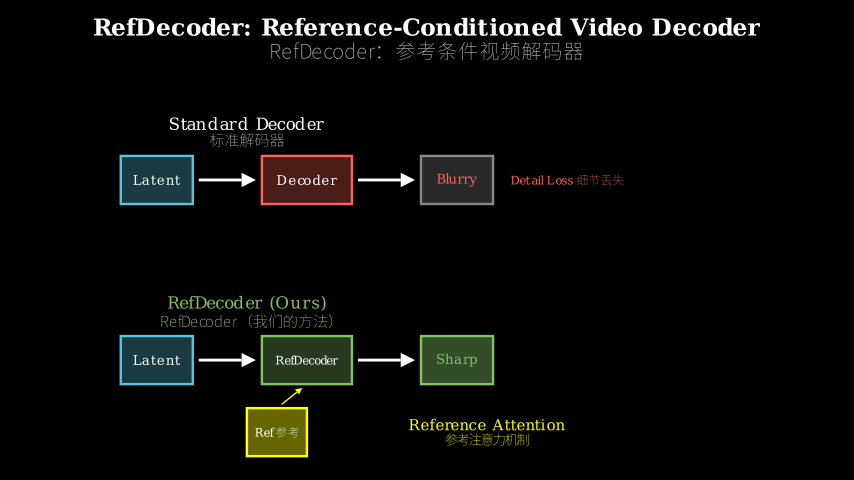
Latent diffusion models dominate video generation. They compress videos into latent space, denoise them with heavily conditioned networks (text, reference images, control signals), then decode back to pixels. The denoiser gets all the context it needs. The decoder? It’s flying blind—unconditional, seeing only the denoised latent without access to the reference image that started it all.
This asymmetry causes detail loss and inconsistency. The denoiser might preserve structure in latent space, but the decoder has to hallucinate pixel-level details from scratch. It doesn’t know what the input image looked like, so it can’t maintain texture, color, or fine structure. Prior work (Stable Diffusion, VideoVAE) focused on conditioning the denoiser while leaving the decoder as a fixed, unconditional upsampler.
Problem: Decoder blindness
    |
    v
Assumption: Decoder needs same conditioning as denoiser
    |
    v
Method: Inject reference image into decoder via attention
    |
    v
Evidence: +2.1dB PSNR, better consistency on VBench
    |
    v
Conclusion: Conditioning symmetry matters
The Increment
One sentence: Before RefDecoder, video generation conditioned the denoiser but not the decoder; after RefDecoder, both see the reference image, closing the detail-loss gap.
Core Mechanism
RefDecoder adds a lightweight image encoder that processes the reference frame into high-dimensional tokens. These tokens carry pixel-level detail—texture, color, edges. During decoding, at each upsampling stage, the decoder’s latent tokens attend to these reference tokens via cross-attention. The reference tokens act as a lookup table: “What did this region look like in the input?” The decoder queries them to recover fine details instead of guessing.
The architecture is modular. The image encoder is separate from the main decoder backbone, so RefDecoder can be swapped into existing systems (Stable Diffusion, VideoVAE+) without retraining the denoiser. The reference attention layers are inserted at each decoder block, co-processing latent and reference tokens. The decoder still upsamples the latent, but now it has a cheat sheet—the reference image—to guide pixel reconstruction.
Reference Image
    |
    v
[Image Encoder] --> Reference Tokens (high-dim, detail-rich)
                         |
                         v
Denoised Latent --> [Decoder Block 1] <-- Attend to Reference
    |                    |
    v                    v
Upsample --> [Decoder Block 2] <-- Attend to Reference
    |                    |
    v                    v
Upsample --> [Decoder Block 3] <-- Attend to Reference
    |
    v
Output Video
Think of the decoder as a sketch artist working from a blurry photo (the latent). Without RefDecoder, the artist has never seen the original subject—they’re guessing hair color, clothing texture, background details. With RefDecoder, the artist has the original photo pinned to their easel. At each stage (rough sketch → line art → shading → final), they glance at the photo to check: “Was the shirt striped or solid? What color were the eyes?” The reference tokens are that pinned photo, and attention is the glance. The artist still does the drawing (upsampling), but they’re no longer hallucinating details—they’re copying from ground truth.
Key Concepts
-
Reference Attention: Standard cross-attention, but the keys and values come from the reference image instead of text or other modalities. The decoder’s latent tokens (queries) ask, “What should this spatial region look like?” and the reference tokens (keys/values) answer with pixel-level detail. This is different from self-attention (tokens attend to each other) or text cross-attention (tokens attend to language embeddings). Reference attention is spatial: it aligns decoder positions with reference positions to transfer texture and structure.
-
Conditioning Symmetry: In latent diffusion, the denoiser is heavily conditioned (text, image, control nets), but the decoder is typically unconditional—it only sees the latent, not the conditioning signals. RefDecoder argues this is a design flaw. If the denoiser needs context to preserve structure, the decoder needs the same context to preserve detail. Symmetry means both stages see the reference image, closing the information gap between latent-space reasoning and pixel-space reconstruction.
Framework Shift
Before (mainstream approach):        After (RefDecoder):

Reference Image                      Reference Image
    |                                    |
    v                                    +---> [Image Encoder]
[Denoiser] <-- conditioned                        |
    |                                             v
    v                                      Reference Tokens
Denoised Latent                                   |
    |                                             |
    v                                             |
[Decoder] <-- blind, unconditional    [Decoder] <+-- attends at each stage
    |                                    |
    v                                    v
Output (detail loss)                 Output (detail preserved)
From asymmetric conditioning (denoiser sees everything, decoder sees nothing) to symmetric conditioning (both see the reference), the core shift is treating the decoder as an equal partner in the generation pipeline.
Expert Assessment
Problem choice: Real gap. The decoder blindness issue is well-motivated—anyone who’s used Stable Diffusion for image-to-video has seen the detail drift. The paper doesn’t manufacture a problem; it names an architectural oversight that’s been hiding in plain sight. This sits at the intersection of VAE design and conditional generation, a natural next step after years of denoiser improvements.
Method maturity: Clever and simple. Reference attention is not a new primitive, but applying it to the decoder is an insight, not brute force. The modularity (drop-in replacement, no denoiser retraining) is elegant. However, the paper doesn’t explore why prior work didn’t condition decoders—was it a conscious tradeoff (speed, memory) or an oversight? A simpler baseline (e.g., concatenating the reference image to the latent) would strengthen the case that attention is necessary.
Experimental integrity: Baselines are fair (unconditional decoders from Stable Diffusion and VideoVAE+), and the +2.1dB PSNR gain is substantial. VBench I2V results show consistent improvements in subject/background consistency. However, the paper doesn’t report inference speed or memory overhead, which matters for a drop-in component. The ablation on reference encoder depth is useful, but missing ablations on where to inject attention (early vs. late decoder stages) or whether self-attention between reference tokens helps.
Writing quality: The abstract and intro are crisp. The method section is clear but could use a diagram showing the attention mechanism’s spatial alignment (how do latent positions map to reference positions?). The related work section is thin—it mentions VideoVAE and Stable Diffusion but doesn’t engage with prior work on conditional VAEs or reference-based generation (e.g., ControlNet, IP-Adapter). Rewriting the related work to position RefDecoder in the broader landscape of conditioning strategies would elevate the paper.
Verdict: weak accept — Solid contribution with clear gains, but needs more analysis on computational cost and deeper engagement with related work.
Takeaways
Drop-in conditioning: RefDecoder shows that you can improve a generation pipeline by conditioning a previously unconditional component without retraining upstream modules. This pattern transfers: if your pipeline has an asymmetry (one stage sees context, another doesn’t), try injecting that context into the blind stage via attention. It’s cheaper than end-to-end retraining and often works.
Attention as a lookup table: The reference attention mechanism is a clean example of using cross-attention for spatial detail transfer, not semantic alignment. This framing (decoder queries reference for pixel-level details) is useful for any task where you have a high-quality reference and a low-quality reconstruction—super-resolution, inpainting, style transfer.
Modularity as a feature: Designing components that can be swapped into existing systems without retraining is underrated. RefDecoder’s modularity makes it adoptable, which matters more than a 0.5dB gain that requires rebuilding the entire pipeline.
论文: 2605.15196 作者: Xiang Fan, Yuheng Wang, Bohan Fang, Zhongzheng Ren, Ranjay Krishna 分类: cs.CV, cs.LG
缺口
潜在扩散模型统治着视频生成领域。
它们把视频压缩到潜在空间,用重度条件化的网络(文本、参考图像、控制信号)去噪,然后解码回像素。
去噪器拿到了它需要的所有上下文。
解码器呢?
它在盲飞——无条件,只能看到去噪后的潜在表示,接触不到启动整个流程的参考图像。
这种不对称导致细节丢失和不一致。
去噪器可能在潜在空间保留了结构,但解码器必须从零开始臆造像素级细节。
它不知道输入图像长什么样,所以无法维持纹理、颜色或精细结构。
此前的工作(Stable Diffusion、VideoVAE)专注于条件化去噪器,却把解码器当成固定的、无条件的上采样器。
问题:解码器失明
    |
    v
假设:解码器需要和去噪器一样的条件
    |
    v
方法:通过注意力机制将参考图像注入解码器
    |
    v
证据:+2.1dB PSNR,VBench 上更好的一致性
    |
    v
结论:条件对称性很重要
增量
一句话: RefDecoder 之前,视频生成只条件化去噪器而不条件化解码器;RefDecoder 之后,两者都能看到参考图像,填补了细节丢失的缺口。
核心机制
RefDecoder 添加了一个轻量级图像编码器,将参考帧处理成高维 token。
这些 token 携带像素级细节——纹理、颜色、边缘。
解码过程中,在每个上采样阶段,解码器的潜在 token 通过交叉注意力机制关注这些参考 token。
参考 token 充当查找表:“这个区域在输入中长什么样?“解码器查询它们来恢复精细细节,而不是瞎猜。
架构是模块化的。
图像编码器独立于主解码器骨干网络,所以 RefDecoder 可以即插即用到现有系统(Stable Diffusion、VideoVAE+)而无需重训练去噪器。
参考注意力层插入到每个解码器块中,共同处理潜在 token 和参考 token。
解码器仍然对潜在表示进行上采样,但现在它有了小抄——参考图像——来指导像素重建。
参考图像
    |
    v
[图像编码器] --> 参考 Token(高维,细节丰富)
                         |
                         v
去噪后的潜在表示 --> [解码器块 1] <-- 关注参考
    |                    |
    v                    v
上采样 --> [解码器块 2] <-- 关注参考
    |                    |
    v                    v
上采样 --> [解码器块 3] <-- 关注参考
    |
    v
输出视频
把解码器想象成一个根据模糊照片(潜在表示)作画的素描师。
没有 RefDecoder,画师从未见过原始对象——他们在猜头发颜色、衣服纹理、背景细节。
有了 RefDecoder,画师把原始照片钉在画架上。
在每个阶段(粗略草图 → 线稿 → 阴影 → 完成),他们瞥一眼照片确认:“衬衫是条纹还是纯色?眼睛是什么颜色?“参考 token 就是那张钉在画架上的照片,注意力机制就是那一瞥。
画师仍然在画画(上采样),但他们不再臆造细节——他们在从真实情况复制。
关键概念
- 参考注意力:标准的交叉注意力,但键和值来自参考图像而非文本或其他模态。
解码器的潜在 token(查询)问:“这个空间区域应该长什么样?“参考 token(键/值)用像素级细节回答。
这不同于自注意力(token 互相关注)或文本交叉注意力(token 关注语言嵌入)。
参考注意力是空间性的:它对齐解码器位置和参考位置来传递纹理和结构。
- 条件对称性:在潜在扩散中,去噪器被重度条件化(文本、图像、控制网络),但解码器通常是无条件的——它只看到潜在表示,看不到条件信号。
RefDecoder 认为这是设计缺陷。
如果去噪器需要上下文来保留结构,解码器需要同样的上下文来保留细节。
对称性意味着两个阶段都能看到参考图像,填补潜在空间推理和像素空间重建之间的信息鸿沟。
框架转变
之前(主流方法):                之后(RefDecoder):

参考图像                          参考图像
    |                                |
    v                                +---> [图像编码器]
[去噪器] <-- 有条件                           |
    |                                        v
    v                                   参考 Token
去噪后的潜在表示                              |
    |                                        |
    v                                        |
[解码器] <-- 盲目,无条件          [解码器] <+-- 每阶段都关注
    |                                |
    v                                v
输出(细节丢失)                   输出(细节保留)
从不对称条件化(去噪器看到一切,解码器什么都看不到)到对称条件化(两者都看到参考),核心转变是把解码器当作生成流程中的平等伙伴。
专家评审
选题眼光:真实缺口。
解码器失明问题动机充分——任何用过 Stable Diffusion 做图生视频的人都见过细节漂移。
论文没有制造问题;它点出了一个一直藏在众目睽睽之下的架构疏忽。
这处于 VAE 设计和条件生成的交叉点,是去噪器改进多年后的自然下一步。
方法成熟度:巧妙且简单。
参考注意力不是新原语,但把它应用到解码器是洞见,不是蛮力。
模块化(即插即用,无需重训练去噪器)很优雅。
然而,论文没有探讨为什么此前的工作不条件化解码器——这是有意的权衡(速度、内存)还是疏忽?一个更简单的基线(例如,把参考图像拼接到潜在表示)会加强注意力机制必要性的论证。
实验诚意:基线公平(来自 Stable Diffusion 和 VideoVAE+ 的无条件解码器),+2.1dB PSNR 增益很可观。
VBench I2V 结果显示主体/背景一致性持续改进。
然而,论文没有报告推理速度或内存开销,这对即插即用组件很重要。
参考编码器深度的消融实验有用,但缺少关于在哪里注入注意力(解码器早期 vs 晚期阶段)或参考 token 之间的自注意力是否有帮助的消融。
写作功力:摘要和引言简洁。
方法部分清晰,但可以加一张图展示注意力机制的空间对齐(潜在位置如何映射到参考位置?)。
相关工作部分单薄——提到了 VideoVAE 和 Stable Diffusion,但没有与条件 VAE 或基于参考的生成(例如 ControlNet、IP-Adapter)的先前工作交锋。
重写相关工作,把 RefDecoder 放在更广阔的条件化策略景观中,会提升论文档次。
判决:弱接收 — 扎实的贡献,增益明确,但需要更多关于计算成本的分析和与相关工作更深入的交锋。
要点总结
即插即用条件化:RefDecoder 表明,你可以通过条件化一个此前无条件的组件来改进生成流程,而无需重训练上游模块。
这个模式可迁移:如果你的流程有不对称性(一个阶段看到上下文,另一个看不到),试着通过注意力机制把那个上下文注入盲目阶段。
这比端到端重训练便宜,而且经常有效。
注意力作为查找表:参考注意力机制是使用交叉注意力进行空间细节传递(而非语义对齐)的清晰例子。
这个框架(解码器查询参考以获取像素级细节)对任何有高质量参考和低质量重建的任务都有用——超分辨率、修复、风格迁移。
模块化作为特性:设计能即插即用到现有系统而无需重训练的组件被低估了。
RefDecoder 的模块化使其易于采用,这比需要重建整个流程才能获得 0.5dB 增益更重要。