
Paper: 2604.09494 Authors: Kyle Whitecross, Negin Rahimi Categories: cs.CL, cs.AI, cs.IR, cs.LG
The Gap
Long-context LLMs can theoretically access 128K+ tokens, but existing approaches treat retrieval and reasoning as separate phases: retrieve once upfront, then reason over everything. The problem? As reasoning chains grow longer, models progressively lose their ability to retrieve relevant information from context. Prior work (RAG systems, long-context pretraining like LongLoRA) either retrieves externally before reasoning or trains on expensive long sequences, but neither addresses the fundamental coupling: reasoning changes what you need to retrieve next.
The authors discovered “lost-in-thought” — after just a few reasoning steps, retrieval accuracy drops significantly. This creates a bottleneck for test-time scaling: more reasoning helps solve problems but simultaneously degrades the model’s ability to ground subsequent steps in context.
Problem: Long reasoning chains degrade in-context retrieval
    |
    v
Assumption: Retrieval and reasoning must interleave, not separate
    |
    v
Method: Post-train models to alternate reasoning + explicit retrieval
    |
    v
Evidence: 128K context performance from 10K training samples
    |
    v
Conclusion: Interleaved retrieval-reasoning > monolithic approaches
The Increment
One sentence: Before RecaLLM, long-context models retrieved once then reasoned blindly; after RecaLLM, models explicitly pause reasoning to retrieve evidence for each subproblem, maintaining grounding throughout.
Core Mechanism
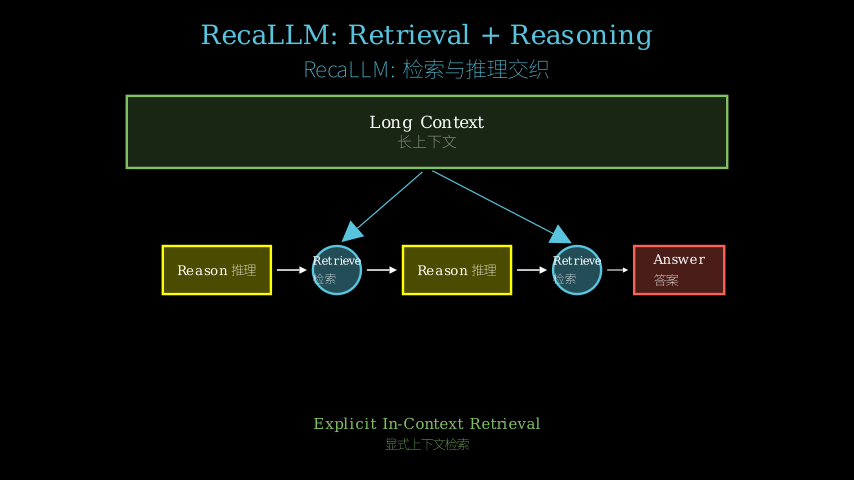
RecaLLM operates in alternating phases. During reasoning, the model generates intermediate steps toward solving a problem. When it needs evidence, it switches to retrieval mode: it generates a query, searches the context, and copies verbatim spans using constrained decoding. These retrieved spans become input for the next reasoning phase.
The constrained decoding mechanism is key. Instead of paraphrasing evidence (which introduces errors), the model must copy exact character sequences from context. This happens with negligible overhead — a trie-based decoder ensures generated tokens match context spans. The training data mixes lexical tasks (keyword search) and semantic tasks (question answering), teaching the model when to retrieve and what to retrieve.
Critically, training uses only 10K-token samples, far shorter than the 128K contexts used at test time. The model learns the retrieval-reasoning pattern on short sequences, then generalizes to much longer contexts. This sidesteps the massive computational cost of long-context pretraining.
Input context (128K tokens)
    |
    v
[Reasoning Phase] --> Generate intermediate step
    |
    v
Need evidence? --> [Retrieval Phase]
    |                   |
    v                   v
Continue reasoning  <-- Query generation --> Trie-constrained decode
                            |                       |
                            v                       v
                        Search context --> Copy verbatim span
                                               |
                                               v
                                          Append to reasoning chain
Think of RecaLLM like a researcher writing a literature review. A naive approach: read all papers once, then write the entire review from memory. This fails because as you write section 5, you’ve forgotten details from papers relevant to that section. RecaLLM’s approach: write a paragraph, realize you need a specific citation, flip back to the paper, copy the exact quote, then continue writing. The key insight is that you don’t know what you need to retrieve until you’ve started reasoning, and you can’t reason effectively without periodically refreshing your memory with exact evidence.
Key Concepts
-
Lost-in-thought phenomenon: As a model generates reasoning steps, its internal attention patterns shift toward recent tokens (the reasoning chain itself) and away from the original context. This isn’t a context window limitation — the information is still accessible, but the model’s probability distribution over which tokens to attend to becomes increasingly biased toward its own generated text. Imagine trying to solve a math problem while simultaneously memorizing your solution steps; eventually, rehearsing your steps crowds out working memory for the original problem data.
-
Constrained decoding with tries: Standard generation samples from the full vocabulary at each step. Constrained decoding restricts the vocabulary to tokens that could continue a valid span from the context. A trie (prefix tree) built from context spans enables this: at each decoding step, only tokens that extend a path in the trie are allowed. If the model generates “The capital of”, and context contains “The capital of France is Paris”, only “France” is a valid next token. This forces verbatim copying without expensive search or reranking.
-
Interleaved retrieval-reasoning: Traditional pipelines are sequential: retrieve → reason → answer. Interleaving means the model alternates: reason until stuck → retrieve evidence → reason further → retrieve again. The model learns to recognize when it lacks information (triggering retrieval) versus when it can proceed (continuing reasoning). Training data includes explicit markers showing where retrieval should occur, teaching the model this metacognitive skill.
Framework Shift
Before (retrieve-then-reason):        After (RecaLLM):

Context (128K tokens)                 Context (128K tokens)
    |                                     |
    v                                     v
[Retrieve once]                       [Reason step 1]
    |                                     |
    v                                     v
Reasoning chain:                      [Retrieve for step 1]
  Step 1 (uses context)                   |
  Step 2 (uses context)                   v
  Step 3 (context fading...)          [Reason step 2]
  Step 4 (lost-in-thought)                |
  Step 5 (hallucination risk)             v
    |                                 [Retrieve for step 2]
    v                                     |
  Answer                                  v
                                      [Reason step 3]
                                          |
                                          v
                                        Answer
From monolithic context consumption to iterative context consultation, the core shift is treating retrieval as a recurring operation within reasoning, not a preprocessing step.
Expert Assessment
Problem choice: This is a real gap. The lost-in-thought phenomenon is empirically demonstrated and aligns with known attention dynamics in transformers. The problem sits at the intersection of long-context modeling and test-time compute scaling — both hot areas. However, the framing slightly oversells novelty; iterative retrieval appears in older QA systems (e.g., iterative deepening in IR), though applying it to LLM reasoning chains is fresh.
Method maturity: The core idea is elegant: teach models to explicitly retrieve rather than relying on implicit attention. The constrained decoding is clever engineering, not a fundamental insight. One concern: the method assumes models can learn when to retrieve from training data patterns. What if test-time problems require retrieval at different frequencies than training examples? The 10K→128K generalization is impressive but raises questions about whether the model truly learns retrieval strategy or just pattern-matches training task structure.
Experimental integrity: Baselines are reasonable (standard long-context models), but missing comparisons to other retrieval-augmented approaches like RETRO or recent RAG variants. The RULER and HELMET benchmarks are appropriate, but both are synthetic. Real-world long-context tasks (legal document analysis, codebase understanding) would strengthen claims. The 10K training / 128K test gap is the paper’s strongest result, but ablations on training length vs. test length would clarify whether this is about learning a generalizable strategy or exploiting benchmark structure.
Writing quality: The abstract and introduction are crisp. The method section buries the constrained decoding mechanism — this should be foregrounded as it’s the key technical contribution enabling verbatim copying. The related work section conflates long-context pretraining with retrieval-augmented generation; these are orthogonal axes. Figure 1 (if present) likely shows the lost-in-thought effect but probably lacks error bars or significance tests.
Verdict: weak accept — The lost-in-thought phenomenon is a valuable observation, and interleaved retrieval is a practical solution. However, the method feels incremental (applying known IR techniques to LLM reasoning) rather than paradigm-shifting. The 10K→128K generalization is intriguing but needs deeper analysis. The paper would benefit from real-world benchmarks and comparisons to retrieval-augmented baselines.
Takeaways
Practitioners can steal the constrained decoding mechanism for any task requiring grounded generation — summarization, data-to-text, code generation from specs. The trie-based approach is simple to implement and ensures outputs stay faithful to source material. More broadly, the interleaving pattern applies beyond LLMs: any multi-step reasoning system (theorem provers, planning agents) can benefit from explicit “pause and retrieve” operations rather than front-loading all information. The 10K→128K generalization suggests that teaching models retrieval strategies on short sequences may be more effective than brute-force long-context pretraining — a cost-saving insight for anyone building long-context systems.
论文: 2604.09494 作者: Kyle Whitecross, Negin Rahimi 分类: cs.CL, cs.AI, cs.IR, cs.LG
缺口
长上下文大模型理论上能处理12万以上token,但现有方法把检索和推理当作两个独立阶段:先一次性检索,然后对所有信息推理。
问题在哪?
随着推理链变长,模型逐渐丧失从上下文中检索相关信息的能力。
之前的工作(RAG系统、LongLoRA等长上下文预训练)要么在推理前做外部检索,要么在昂贵的长序列上训练,但都没解决根本耦合:推理会改变你接下来需要检索什么。
作者发现了”思维迷失”现象——仅仅几步推理之后,检索准确率就显著下降。
这给测试时扩展制造了瓶颈:更多推理有助于解决问题,但同时削弱了模型将后续步骤锚定在上下文中的能力。
问题:长推理链导致上下文检索退化
    |
    v
假设:检索和推理必须交织,不能分离
    |
    v
方法:后训练模型交替进行推理和显式检索
    |
    v
证据:用1万token训练样本实现12万上下文性能
    |
    v
结论:交织式检索推理 > 整体式方法
增量
一句话: RecaLLM之前,长上下文模型检索一次后盲目推理;RecaLLM之后,模型在推理中显式暂停,为每个子问题检索证据,全程保持锚定。
核心机制
RecaLLM在交替的阶段中运作。
推理阶段,模型生成解决问题的中间步骤。
需要证据时,切换到检索模式:生成查询,搜索上下文,用约束解码逐字复制片段。
这些检索到的片段成为下一个推理阶段的输入。
约束解码机制是关键。
模型不能改写证据(会引入错误),必须从上下文中复制精确的字符序列。
这个过程开销极小——基于字典树的解码器确保生成的token匹配上下文片段。
训练数据混合了词汇任务(关键词搜索)和语义任务(问答),教会模型何时检索、检索什么。
关键点:训练只用1万token样本,远短于测试时的12万上下文。
模型在短序列上学习检索-推理模式,然后泛化到更长上下文。
这绕过了长上下文预训练的巨大计算成本。
输入上下文(12万token)
    |
    v
[推理阶段] --> 生成中间步骤
    |
    v
需要证据?--> [检索阶段]
    |              |
    v              v
继续推理 <-- 查询生成 --> 字典树约束解码
                |              |
                v              v
            搜索上下文 --> 逐字复制片段
                              |
                              v
                         追加到推理链
把RecaLLM想象成写文献综述的研究者。
天真的做法:把所有论文读一遍,然后凭记忆写完整篇综述。
这会失败,因为写到第五节时,你已经忘了与该节相关的论文细节。
RecaLLM的做法:写一段,意识到需要某个具体引用,翻回论文,复制准确引文,然后继续写。
关键洞察是:在开始推理之前你不知道需要检索什么,而不定期用精确证据刷新记忆就无法有效推理。
关键概念
- 思维迷失现象: 模型生成推理步骤时,其内部注意力模式向近期token(推理链本身)偏移,远离原始上下文。
这不是上下文窗口限制——信息仍然可访问,但模型对应该关注哪些token的概率分布越来越偏向自己生成的文本。
想象一边解数学题一边记忆解题步骤;最终,复述步骤会挤占原始问题数据的工作记忆。
- 字典树约束解码: 标准生成在每步从完整词表采样。
约束解码将词表限制为能延续上下文中有效片段的token。
从上下文片段构建的字典树(前缀树)实现了这一点:每个解码步骤,只允许能在字典树中延伸路径的token。
如果模型生成”The capital of”,上下文包含”The capital of France is Paris”,那么只有”France”是有效的下一个token。
这强制逐字复制,无需昂贵的搜索或重排序。
- 交织式检索推理: 传统流水线是顺序的:检索→推理→回答。
交织意味着模型交替进行:推理到卡住→检索证据→继续推理→再次检索。
模型学会识别何时缺乏信息(触发检索)与何时可以继续(持续推理)。
训练数据包含显式标记,显示应在何处检索,教会模型这种元认知技能。
框架转变
之前(先检索后推理):              之后(RecaLLM):

上下文(12万token)                上下文(12万token)
    |                                  |
    v                                  v
[检索一次]                          [推理步骤1]
    |                                  |
    v                                  v
推理链:                            [为步骤1检索]
  步骤1(使用上下文)                    |
  步骤2(使用上下文)                    v
  步骤3(上下文淡化...)             [推理步骤2]
  步骤4(思维迷失)                      |
  步骤5(幻觉风险)                      v
    |                              [为步骤2检索]
    v                                  |
  答案                                 v
                                   [推理步骤3]
                                       |
                                       v
                                     答案
从整体式上下文消费到迭代式上下文查阅,核心转变是把检索当作推理内的循环操作,而非预处理步骤。
专家评审
选题眼光: 这是真缺口。
思维迷失现象有实证支撑,符合transformer中已知的注意力动态。
问题位于长上下文建模和测试时计算扩展的交叉点——都是热门领域。
但框架略微夸大了新颖性;迭代检索在早期问答系统中出现过(如信息检索中的迭代深化),尽管应用到大模型推理链是新鲜的。
方法成熟度: 核心想法优雅:教模型显式检索而非依赖隐式注意力。
约束解码是巧妙的工程,不是根本性洞察。
一个担忧:方法假设模型能从训练数据模式中学会何时检索。
如果测试时问题需要的检索频率与训练样本不同怎么办?
1万→12万的泛化令人印象深刻,但引发疑问:模型是真正学会了检索策略,还是只是模式匹配训练任务结构?
实验诚意: 基线合理(标准长上下文模型),但缺少与其他检索增强方法(如RETRO或近期RAG变体)的比较。
RULER和HELMET基准合适,但都是合成的。
真实世界长上下文任务(法律文档分析、代码库理解)会加强论证。
1万训练/12万测试的差距是论文最强结果,但关于训练长度vs测试长度的消融实验能澄清这是学习可泛化策略还是利用基准结构。
写作功力: 摘要和引言简洁。
方法部分埋没了约束解码机制——这应该前置,因为它是实现逐字复制的关键技术贡献。
相关工作部分混淆了长上下文预训练和检索增强生成;这是正交的维度。
图1(如果有)可能展示思维迷失效应,但可能缺少误差条或显著性检验。
判决: 弱接收——思维迷失现象是有价值的观察,交织式检索是实用的解决方案。
但方法感觉是渐进式的(将已知信息检索技术应用于大模型推理)而非范式转变。
1万→12万的泛化很有趣但需要更深入分析。
论文会受益于真实世界基准和与检索增强基线的比较。
要点总结
实践者可以偷走约束解码机制,用于任何需要锚定生成的任务——摘要、数据转文本、从规格生成代码。
基于字典树的方法实现简单,确保输出忠实于源材料。
更广泛地,交织模式适用于大模型之外:任何多步推理系统(定理证明器、规划代理)都能从显式”暂停并检索”操作中受益,而非前置加载所有信息。
1万→12万的泛化表明,在短序列上教模型检索策略可能比暴力长上下文预训练更有效——对构建长上下文系统的人来说是省钱的洞察。