
Paper: 2603.05488 Authors: Siddharth Boppana, Annabel Ma, Max Loeffler, Raphael Sarfati, Eric Bigelow, Atticus Geiger, Owen Lewis, Jack Merullo Categories: cs.CL, cs.AI, cs.LG
The Gap
Chain-of-thought reasoning models like DeepSeek-R1 and o1 generate long reasoning traces before answering. Everyone assumed these tokens reflect genuine computation—the model working through the problem step by step. But what if the model already knows the answer and is just going through the motions?
Prior work treated CoT as a black box: you feed in a question, get reasoning tokens, then an answer. Interpretability research probed activations to decode what models “believe,” but nobody systematically compared internal beliefs against the reasoning performance. The field lacked tools to distinguish genuine reasoning from what the authors call “reasoning theater”—performative token generation that looks like thinking but isn’t.
Problem: CoT tokens cost compute, but are they necessary?
   |
   v
Assumption: Model's internal belief != what it writes
   |
   v
Method: Probe activations + force early answers + monitor CoT
   |
   v
Evidence: Answer decodable 80% earlier on easy tasks
   |
   v
Conclusion: Most CoT is theater; probe-guided exit saves tokens
The Increment
One sentence: Before, we trusted CoT tokens as reasoning; now we know models often decide early and perform the rest.
Core Mechanism
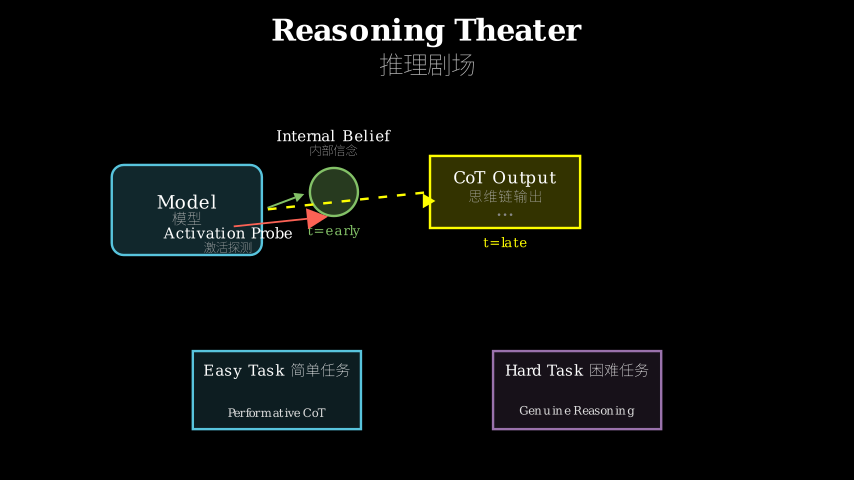
The method has three parallel measurement systems running on the same model during CoT generation. First, activation probing: train linear classifiers on the model’s internal states at each token position to decode what answer the model currently believes. Second, early forced answering: at various points during CoT, interrupt generation and force the model to output its answer immediately. Third, a CoT monitor: a separate model reads the reasoning trace and tries to predict the final answer from the text alone.
The data flows like this: the model generates CoT token by token. At each step, probes read the activations and output a probability distribution over possible answers. Simultaneously, the monitor reads the accumulated text. When you force an early answer, you’re asking “if you had to commit right now, what would you say?” The gap between when probes decode the answer, when forced answers stabilize, and when the monitor can tell reveals the disconnect between internal belief and external performance.
Question Input
     |
     v
[Model Generates CoT Token-by-Token]
     |
     +---> [Activation Probe] ---> Decoded Belief
     |
     +---> [Force Answer] -------> Actual Output
     |
     +---> [CoT Monitor] --------> Text-Based Prediction

Compare timing: When does each signal converge?
Think of it like watching a poker player. The activation probe is reading their micro-expressions and pupil dilation—the involuntary signals that leak their hand. Forcing an early answer is like making them bet before they wanted to—you see what they’d do under pressure. The CoT monitor is another player trying to read their betting pattern and table talk. If the micro-expressions reveal a strong hand way before the player’s betting reflects it, they’re bluffing or slow-playing. Here, if probes decode the answer while the model keeps “reasoning,” that’s theater.
Key Concepts
-
Activation Probing: Imagine the model’s internal state as a high-dimensional space where each point represents what the model “believes” at that moment. A probe is just a simple classifier (linear layer) trained to map points in this space to answers. If you can train a probe that accurately predicts the final answer from activations at token 50, but the model doesn’t output that answer until token 200, the model knew early but kept generating. It’s like reading someone’s brain activity to see they’ve made a decision before they announce it.
-
Performative CoT (Reasoning Theater): The model generates tokens that look like reasoning—“let me think step by step,” backtracking, self-correction—but these tokens don’t change its internal belief about the answer. It’s already confident. Why keep going? Possibly because training incentivized verbose reasoning, or because the model learned that humans expect to see work shown. Concrete example: on an easy MMLU question like “What is the capital of France?”, probes decode “Paris” after 20% of the CoT, but the model writes 200 more tokens about European geography before answering.
-
Probe-Guided Early Exit: Once you have probes that reliably decode answers, you can use them as a stopping criterion. Instead of generating all CoT tokens, monitor probe confidence. When it crosses a threshold (say, 95% confident), stop generation and output the answer. This is adaptive computation—easy questions get short reasoning, hard questions get more tokens. The model still does the same internal computation per token, but you generate fewer tokens overall.
Framework Shift
Before (mainstream approach):        After (this paper):

Question                             Question
   |                                    |
   v                                    v
[Generate Full CoT]                  [Generate CoT + Probe Each Step]
   |                                    |
   v                                    +---> Internal Belief
Answer                                  |     (decoded early)
                                        |
Trust: CoT = Reasoning                 v
                                     Answer

                                  Insight: Belief != Performance
From treating CoT as a necessary reasoning process to recognizing it as often performative, the core shift is measurement—looking inside instead of trusting the output.
Expert Assessment
Problem choice: This is a real gap with immediate practical implications. The field is deploying reasoning models at scale (o1, R1) without understanding their internal dynamics. The question “are these tokens necessary?” is both scientifically interesting and economically important. It sits at the intersection of interpretability and efficiency, two hot areas.
Method maturity: Clever and simple. Activation probing isn’t new, but the three-way comparison (probes vs forced answers vs monitor) is elegant. The authors didn’t overcomplicate—they used existing tools in a smart configuration. One concern: probe training requires labeled data and might not generalize across domains. They acknowledge this but don’t fully explore it.
Experimental integrity: Baselines are fair. Testing on both MMLU (easy recall) and GPQA-Diamond (hard reasoning) shows the effect is task-dependent, which is honest. The 80% token reduction on MMLU is dramatic, but the 30% on GPQA-Diamond is more modest—they don’t oversell. One red flag: they only test two models (DeepSeek-R1 and GPT-OSS). Generalization to other architectures is unclear. Also, probe accuracy depends on training data quality, which could be a confound.
Writing quality: The paper is clear and well-structured. The “reasoning theater” framing is catchy, maybe too catchy—it risks oversimplifying. The section on inflection points (backtracking, aha moments) feels tacked on, like they wanted to soften the blow by showing some CoT is genuine. If they rewrote that section to more rigorously define what counts as genuine reasoning, the paper would be stronger.
Verdict: weak accept — Solid empirical work with practical value, but limited theoretical depth and narrow model coverage.
Takeaways
Practitioners can steal the probe-guided early exit strategy immediately. If you’re running inference on reasoning models, train probes on a small validation set and use them as stopping criteria. This isn’t just about saving tokens—it’s about understanding when your model is actually uncertain versus when it’s performing.
The three-way measurement framework (internal belief, forced output, external monitor) is transferable. You could apply this to any generative process where you suspect the model is “going through the motions”—code generation, creative writing, dialogue. If probes decode the outcome early, you’re wasting compute.
The deeper insight: don’t trust the tokens. Models are trained to produce outputs that humans expect, not necessarily outputs that reflect their internal state. This has implications for alignment, interpretability, and debugging. If a model writes “I’m uncertain” but probes show high confidence, that’s a red flag.
论文: 2603.05488 作者: Siddharth Boppana, Annabel Ma, Max Loeffler, Raphael Sarfati, Eric Bigelow, Atticus Geiger, Owen Lewis, Jack Merullo 分类: cs.CL, cs.AI, cs.LG
缺口
像DeepSeek-R1和o1这样的链式思考推理模型会在回答前生成很长的推理轨迹。 所有人都假设这些token反映了真实的计算过程——模型在一步步解决问题。 但如果模型其实早就知道答案,只是在走过场呢?
此前的工作把CoT当黑盒:输入问题,得到推理token,然后是答案。 可解释性研究会探测激活值来解码模型的”信念”,但没人系统地比较内部信念和推理表现。 该领域缺乏工具来区分真实推理和作者所说的”推理剧场”——看起来像思考但实际不是的表演性token生成。
问题: CoT token消耗算力,但它们必要吗?
   |
   v
假设: 模型内部信念 != 它写出的内容
   |
   v
方法: 探测激活值 + 强制提前回答 + 监控CoT
   |
   v
证据: 简单任务上答案可提前80%解码
   |
   v
结论: 大部分CoT是剧场;探针引导退出节省token
增量
一句话: 之前我们信任CoT token就是推理;现在我们知道模型常常早早决定,剩下的都是表演。
核心机制
这个方法有三个并行的测量系统,在CoT生成过程中同时运行在同一个模型上。 第一,激活值探测:在每个token位置训练线性分类器来解码模型内部状态,看它当前相信什么答案。 第二,强制提前回答:在CoT的不同时刻打断生成,强制模型立即输出答案。 第三,CoT监控器:一个独立模型读取推理轨迹,试图仅从文本预测最终答案。
数据流是这样的:模型逐token生成CoT。 每一步,探针读取激活值并输出可能答案的概率分布。 同时,监控器读取累积的文本。 当你强制提前回答时,你在问”如果现在必须表态,你会说什么?”探针何时解码出答案、强制回答何时稳定、监控器何时能判断——这三者之间的时间差揭示了内部信念和外部表现的脱节。
问题输入
     |
     v
[模型逐Token生成CoT]
     |
     +---> [激活值探针] ---> 解码的信念
     |
     +---> [强制回答] -------> 实际输出
     |
     +---> [CoT监控器] ------> 基于文本的预测

比较时机: 每个信号何时收敛?
把它想象成观察一个扑克玩家。 激活值探针在读他们的微表情和瞳孔放大——泄露手牌的非自愿信号。 强制提前回答就像让他们在想下注前就必须下注——你看到他们在压力下会做什么。 CoT监控器是另一个玩家试图从下注模式和桌面话语中读牌。 如果微表情早就暴露了强牌,但玩家的下注还没反映出来,那他们在虚张声势或慢打。 这里,如果探针解码出答案而模型还在”推理”,那就是剧场。
关键概念
-
激活值探测: 把模型的内部状态想象成一个高维空间,每个点代表模型在那一刻”相信”什么。 探针就是一个简单的分类器(线性层),训练来把这个空间中的点映射到答案。 如果你能训练一个探针,在第50个token的激活值就准确预测最终答案,但模型直到第200个token才输出那个答案,说明模型早就知道但继续生成。 就像读取某人的大脑活动,看到他们在宣布之前就已经做出决定。
-
表演性CoT(推理剧场): 模型生成看起来像推理的token——“让我一步步想”、回溯、自我纠正——但这些token并不改变它对答案的内部信念。 它已经很确定了。 为什么还要继续?可能因为训练激励了冗长的推理,或者因为模型学到了人类期望看到工作过程。 具体例子:在简单的MMLU问题上,比如”法国的首都是什么?“,探针在20%的CoT后就解码出”巴黎”,但模型还要写200个token讨论欧洲地理才回答。
-
探针引导的提前退出: 一旦你有了能可靠解码答案的探针,就可以用它们作为停止标准。 不生成所有CoT token,而是监控探针置信度。 当它超过阈值(比如95%确定),就停止生成并输出答案。 这是自适应计算——简单问题得到短推理,难问题得到更多token。 模型每个token的内部计算还是一样的,但你总体生成的token更少。
框架转变
之前(主流方法):                  之后(本文方法):

问题                             问题
   |                                |
   v                                v
[生成完整CoT]                     [生成CoT + 每步探测]
   |                                |
   v                                +---> 内部信念
答案                                |     (提前解码)
                                    |
信任: CoT = 推理                    v
                                  答案

                               洞察: 信念 != 表现
从把CoT当作必要推理过程,到认识到它常常是表演性的,核心转变是测量——向内看而不是信任输出。
专家评审
选题眼光: 这是个真缺口,有直接的实践意义。 该领域正在大规模部署推理模型(o1、R1),却不理解它们的内部动态。 “这些token必要吗?”这个问题既有科学趣味又有经济重要性。 它处在可解释性和效率的交叉点,两个热门领域。
方法成熟度: 巧妙且简单。 激活值探测不是新东西,但三方比较(探针vs强制回答vs监控器)很优雅。 作者没有过度复杂化——他们用现有工具做了聪明的配置。 一个担忧:探针训练需要标注数据,可能不能跨领域泛化。 他们承认了这点但没充分探索。
实验诚意: 基线公平。 在MMLU(简单回忆)和GPQA-Diamond(困难推理)上测试显示效果依赖任务,这很诚实。 MMLU上80%的token削减很惊人,但GPQA-Diamond上30%更温和——他们没有过度推销。 一个警示:他们只测试了两个模型(DeepSeek-R1和GPT-OSS)。 对其他架构的泛化不清楚。 另外,探针准确度依赖训练数据质量,这可能是混淆因素。
写作功力: 论文清晰且结构良好。 “推理剧场”这个框架很抓人,也许太抓人了——有过度简化的风险。 关于拐点(回溯、顿悟时刻)的部分感觉是硬加上去的,像是他们想通过展示一些CoT是真实的来缓和冲击。 如果他们重写那部分,更严格地定义什么算真实推理,论文会更强。
判决: 弱接收 — 扎实的实证工作,有实践价值,但理论深度有限,模型覆盖面窄。
要点总结
实践者可以立即偷走探针引导的提前退出策略。 如果你在推理模型上跑推理,在小验证集上训练探针,用它们作为停止标准。 这不只是节省token——而是理解你的模型何时真的不确定,何时在表演。
三方测量框架(内部信念、强制输出、外部监控器)是可迁移的。 你可以把它应用到任何你怀疑模型在”走过场”的生成过程——代码生成、创意写作、对话。 如果探针早早解码出结果,你就在浪费算力。
更深的洞察:不要信任token。 模型被训练来产生人类期望的输出,不一定是反映其内部状态的输出。 这对对齐、可解释性和调试都有影响。 如果模型写”我不确定”但探针显示高置信度,那是个危险信号。