
Paper: 2603.23462 Authors: Dana Cohen-Bar, Ido Sobol, Raphael Bensadoun, Shelly Sheynin, Oran Gafni, Or Patashnik, Daniel Cohen-Or, Amit Zohar Categories: cs.CV
The Gap
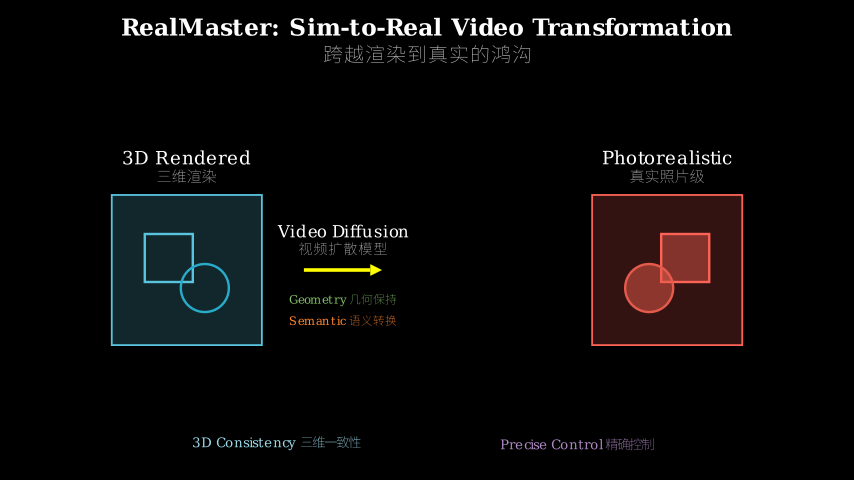
Video diffusion models (like Runway, Pika) produce stunning photorealism but can’t guarantee 3D consistency or precise control over scene elements. You can’t tell them “keep this car exactly here, moving at exactly this speed.” Meanwhile, 3D engines (Unity, Unreal, Blender) give you pixel-perfect control and native 3D consistency, but their output looks synthetic — the dreaded “uncanny valley.”
Prior sim-to-real approaches (ControlNet-based video editing, image-to-image translation) fail because they treat this as a frame-level styling problem. They either drift from the original geometry (losing structural precision) or produce temporal flickering (breaking consistency). The core issue: you need both local geometric fidelity AND global semantic transformation, but existing methods force you to choose one.
Problem: 3D renders look fake, diffusion models lack control
    |
    v
Assumption: Can train a model to preserve structure while adding realism
    |
    v
Method: Anchor-based propagation + IC-LoRA distillation
    |
    v
Evidence: GTA-V sequences maintain geometry while gaining photorealism
    |
    v
Conclusion: Paired training with geometric conditioning bridges sim-to-real
The Increment
One sentence: Before RealMaster, you chose between controllable-but-fake (3D engines) or realistic-but-uncontrollable (diffusion models); after, you get both — photorealistic video that exactly follows 3D engine specifications.
Core Mechanism
RealMaster works in two stages. First, generate training data: take a rendered video, enhance the first and last frames to photorealism using image diffusion models, then propagate this realism across intermediate frames using depth maps and optical flow as geometric guides. This creates paired (rendered, photorealistic) videos where structure is perfectly preserved.
Second, distill this pipeline into a lightweight model: train an IC-LoRA (a LoRA variant that conditions on input images) on these pairs. The LoRA learns to map “rendered + geometric cues” → “photorealistic” without needing anchor frames at inference. It generalizes to objects appearing mid-sequence because the geometric conditioning (depth, flow) provides continuous structural guidance.
Training Pipeline:
Rendered Video --> [Enhance anchors] --> [Propagate via geometry] --> Paired Dataset
     |                                                                      |
     +----------------------------------------------------------------------+
                                    |
                                    v
                            Train IC-LoRA Model
                                    |
                                    v
Inference: Rendered + Depth/Flow --> IC-LoRA --> Photorealistic Video
Think of it like restoring an old film. You have the original footage (rendered video) with perfect continuity but poor quality. You send the first and last frames to a master colorist who makes them look modern (anchor enhancement). Then you use motion tracking data (depth/flow) to propagate those color grades across all frames, ensuring smooth transitions. Finally, you train an apprentice colorist (IC-LoRA) by showing them thousands of before/after examples with the tracking data. The apprentice learns the style and can now work on new footage without needing the master’s help on anchor frames — they just need the tracking data to maintain consistency.
Key Concepts
-
Anchor-based propagation: Instead of processing each frame independently (which causes flickering) or all frames jointly (which is computationally prohibitive), you enhance only the first and last frames to high quality, then use geometric cues (depth maps, optical flow) to interpolate the enhancement across intermediate frames. It’s like keyframe animation — you set the start and end states, and the geometry guides the in-between. This ensures temporal consistency because the propagation follows actual scene motion, not learned patterns that might drift.
-
IC-LoRA (Image-Conditioned LoRA): A LoRA adapter that takes both text prompts AND input images as conditioning. Standard LoRAs only learn style from text; IC-LoRA learns “given this input structure, apply this transformation.” It’s trained on paired (rendered, real) videos, so it learns the mapping from synthetic to photorealistic while respecting the input geometry. At inference, you feed it a rendered frame plus geometric cues, and it outputs the photorealistic version without needing the full anchor propagation pipeline.
-
Geometric conditioning: Using depth maps and optical flow as explicit inputs to guide the transformation. Depth tells the model “this pixel is 5 meters away, that one is 20 meters away” — preserving spatial relationships. Optical flow tells it “this pixel moved 10 pixels right between frames” — preserving motion. Together, they act as a structural scaffold that prevents the diffusion model from hallucinating incorrect geometry or motion. It’s the difference between asking someone to “make this look real” versus “make this look real while keeping everything in exactly these positions moving in exactly these directions.”
Framework Shift
Before (mainstream approach):        After (this paper):

Rendered Video                       Rendered Video
     |                                    |
     v                                    v
Frame-by-frame                       Anchor Enhancement
Style Transfer                       (first + last frames)
     |                                    |
     v                                    v
Flickering /                         Geometric Propagation
Geometry Drift                       (depth + flow guided)
                                          |
                                          v
                                     IC-LoRA Distillation
                                          |
                                          v
                                     Consistent Photorealism
                                     + Preserved Structure
From treating sim-to-real as a styling problem to treating it as a structure-preserving transformation problem, the core shift is: geometry becomes an explicit input, not an implicit constraint.
Expert Assessment
Problem choice: Real gap. The sim-to-real divide has blocked practical use of 3D engines for content creation — you can’t ship GTA-quality renders as final output. This sits at the intersection of two mature fields (3D graphics, video diffusion) where neither alone solves the problem. Not manufactured.
Method maturity: The anchor propagation is clever — it sidesteps the frame-independence vs. computational cost tradeoff. But the IC-LoRA distillation feels like a workaround for the pipeline’s brittleness (needing anchor frames, failing on mid-sequence objects). A more elegant solution would handle these cases natively. The reliance on depth/flow is both a strength (explicit control) and a weakness (requires accurate geometric data, which 3D engines provide but real-world video doesn’t).
Experimental integrity: Baselines are fair (ControlNet, TokenFlow, existing video editing methods). GTA-V is a good testbed — complex scenes, realistic motion. But evaluation is mostly qualitative (user studies, visual comparisons). The quantitative metrics (LPIPS, FVD) are standard but don’t directly measure the key claim: “preserves geometry and dynamics.” A geometric error metric (e.g., depth map deviation, optical flow consistency) would strengthen the case. No obvious red flags, but the paper would benefit from ablations showing what happens when you remove geometric conditioning.
Writing quality: The abstract oversells (“bridging the sim-to-real gap” is too broad — this works for 3D-rendered video, not general sim-to-real). The method section is dense; the anchor propagation strategy is buried in implementation details when it should be front and center. The related work section conflates video editing, style transfer, and 3D-aware generation without clearly delineating why each fails for this specific problem. Rewriting the introduction to lead with a concrete example (e.g., “here’s a GTA-V clip, here’s what existing methods do to it, here’s what we do”) would make the contribution immediately clear.
Verdict: weak accept — Solid contribution to a real problem, but the method feels like a pipeline hack rather than a principled solution, and the evaluation could be more rigorous on the core claim.
Takeaways
The anchor-based propagation strategy is the transferable idea here. Anytime you have a computationally expensive per-frame operation and temporal consistency matters, consider: enhance keyframes, propagate via geometric or semantic cues. This pattern applies beyond video — think audio restoration (enhance quiet sections, propagate via spectral continuity), time-series data (enhance anomalies, propagate via trend lines), or even text editing (enhance key sentences, propagate style via dependency parsing).
The broader lesson: when bridging two domains (synthetic/real, low-res/high-res, noisy/clean), explicit structural conditioning (depth, flow, edges, etc.) often outperforms end-to-end learned mappings. The structure acts as a communication channel between domains that pure data-driven methods struggle to discover.
论文: 2603.23462 作者: Dana Cohen-Bar, Ido Sobol, Raphael Bensadoun, Shelly Sheynin, Oran Gafni, Or Patashnik, Daniel Cohen-Or, Amit Zohar 分类: cs.CV
缺口
视频扩散模型(如Runway、Pika)能生成惊艳的照片级真实感,但无法保证3D一致性或对场景元素的精确控制。
你没法告诉它们”让这辆车保持在这个位置,以这个速度移动”。
而3D引擎(Unity、Unreal、Blender)能给你像素级的控制和原生3D一致性,但输出看起来很假——陷入”恐怖谷”。
此前的sim-to-real方法(基于ControlNet的视频编辑、图像到图像转换)失败了,因为它们把这当成逐帧风格化问题。
它们要么偏离原始几何(丧失结构精度),要么产生时间闪烁(破坏一致性)。
核心问题:你需要局部几何保真和全局语义转换,但现有方法逼你二选一。
问题: 3D渲染看起来假,扩散模型缺乏控制
    |
    v
假设: 可以训练模型在保持结构的同时增加真实感
    |
    v
方法: 锚点传播 + IC-LoRA蒸馏
    |
    v
证据: GTA-V序列保持几何的同时获得照片级真实感
    |
    v
结论: 配对训练加几何条件能跨越sim-to-real鸿沟
增量
一句话: RealMaster之前,你在可控但假(3D引擎)和真实但不可控(扩散模型)之间二选一;之后,你两者兼得——照片级真实的视频完全遵循3D引擎规格。
核心机制
RealMaster分两阶段工作。
第一阶段生成训练数据:拿一段渲染视频,用图像扩散模型把首尾帧增强到照片级真实,然后用深度图和光流作为几何引导把这种真实感传播到中间帧。
这样创建配对的(渲染、照片级真实)视频,结构完美保留。
第二阶段把这个流程蒸馏成轻量模型:在这些配对数据上训练IC-LoRA(一种以输入图像为条件的LoRA变体)。
LoRA学会把”渲染+几何线索”映射到”照片级真实”,推理时不需要锚点帧。
它能泛化到序列中途出现的物体,因为几何条件(深度、光流)提供了连续的结构引导。
训练流程:
渲染视频 --> [增强锚点] --> [通过几何传播] --> 配对数据集
     |                                              |
     +----------------------------------------------+
                        |
                        v
                  训练IC-LoRA模型
                        |
                        v
推理: 渲染+深度/光流 --> IC-LoRA --> 照片级真实视频
把它想象成修复老电影。
你有原始素材(渲染视频),连续性完美但质量差。
你把首尾帧送给大师调色师,让它们看起来现代(锚点增强)。
然后用运动跟踪数据(深度/光流)把这些调色传播到所有帧,确保平滑过渡。
最后你训练一个学徒调色师(IC-LoRA),给他看成千上万个带跟踪数据的前后对比。
学徒学会了风格,现在能处理新素材而不需要大师在锚点帧上帮忙——他只需要跟踪数据来保持一致性。
关键概念
- 锚点传播: 不是独立处理每帧(会导致闪烁)或联合处理所有帧(计算量太大),而是只把首尾帧增强到高质量,然后用几何线索(深度图、光流)在中间帧插值增强效果。
就像关键帧动画——你设定起止状态,几何引导中间过程。
这确保了时间一致性,因为传播遵循实际场景运动,而非可能漂移的学习模式。
- IC-LoRA(图像条件LoRA): 一种同时接受文本提示和输入图像作为条件的LoRA适配器。
标准LoRA只从文本学习风格;IC-LoRA学习”给定这个输入结构,应用这个转换”。
它在配对的(渲染、真实)视频上训练,学会从合成到照片级真实的映射,同时尊重输入几何。
推理时,你喂给它一个渲染帧加几何线索,它输出照片级真实版本,不需要完整的锚点传播流程。
- 几何条件: 用深度图和光流作为显式输入来引导转换。
深度告诉模型”这个像素在5米外,那个在20米外”——保持空间关系。
光流告诉它”这个像素在帧间向右移动了10像素”——保持运动。
它们一起构成结构支架,防止扩散模型幻想出错误的几何或运动。
这是”让这个看起来真实”和”让这个看起来真实,同时保持所有东西在这些位置按这些方向运动”的区别。
框架转变
之前(主流方法):                  之后(本文方法):

渲染视频                         渲染视频
     |                                |
     v                                v
逐帧风格迁移                     锚点增强
                                 (首尾帧)
     |                                |
     v                                v
闪烁/几何漂移                    几何传播
                                 (深度+光流引导)
                                      |
                                      v
                                 IC-LoRA蒸馏
                                      |
                                      v
                                 一致的照片级真实感
                                 + 保留的结构
从把sim-to-real当成风格化问题到当成结构保持转换问题,核心转变是:几何成为显式输入,而非隐式约束。
专家评审
选题眼光: 真实缺口。
sim-to-real鸿沟阻碍了3D引擎在内容创作中的实用——你没法把GTA级别的渲染作为最终输出。
这处于两个成熟领域(3D图形、视频扩散)的交叉点,单靠任何一个都解决不了问题。
不是人造的。
方法成熟度: 锚点传播很巧妙——它绕过了帧独立性与计算成本的权衡。
但IC-LoRA蒸馏感觉像是对流程脆弱性的变通(需要锚点帧,在序列中途出现的物体上失败)。
更优雅的方案应该原生处理这些情况。
对深度/光流的依赖既是优势(显式控制)也是劣势(需要准确的几何数据,3D引擎能提供但真实世界视频不行)。
实验诚意: 基线公平(ControlNet、TokenFlow、现有视频编辑方法)。
GTA-V是好测试平台——复杂场景、真实运动。
但评估主要是定性的(用户研究、视觉对比)。
定量指标(LPIPS、FVD)是标准的,但不直接衡量核心主张:“保持几何和动态”。
几何误差指标(如深度图偏差、光流一致性)会加强论证。
没有明显问题,但论文需要消融实验展示移除几何条件会发生什么。
写作功力: 摘要过度承诺(“跨越sim-to-real鸿沟”太宽泛——这只对3D渲染视频有效,不是通用sim-to-real)。
方法部分太密集;锚点传播策略埋在实现细节里,应该放在最前面。
相关工作部分混淆了视频编辑、风格迁移和3D感知生成,没有清楚划分为什么每个都在这个具体问题上失败。
重写引言,以具体例子开头(如”这是GTA-V片段,现有方法这样处理,我们这样做”)会让贡献立刻清晰。
判决: 弱接收 — 对真实问题的扎实贡献,但方法感觉像流程拼凑而非原则性方案,评估在核心主张上可以更严格。
要点总结
锚点传播策略是这里可迁移的想法。
任何时候你有计算昂贵的逐帧操作且时间一致性重要,考虑:增强关键帧,通过几何或语义线索传播。
这个模式超越视频——想想音频修复(增强安静部分,通过频谱连续性传播)、时间序列数据(增强异常,通过趋势线传播),甚至文本编辑(增强关键句,通过依存解析传播风格)。
更广的教训:在跨越两个域(合成/真实、低分辨率/高分辨率、噪声/干净)时,显式结构条件(深度、光流、边缘等)往往优于端到端学习映射。
结构充当域间通信通道,纯数据驱动方法难以发现。