Paper: 2604.15308 Authors: Hao Gao, Shaoyu Chen, Yifan Zhu, Yuehao Song, Wenyu Liu, Qian Zhang, Xinggang Wang Categories: cs.CV
The Gap
Diffusion-based motion planners can model complex multimodal trajectory distributions, but they’re trained purely with imitation learning — they copy expert demonstrations without understanding what makes a trajectory good or bad in closed-loop interactions. When deployed, they suffer from stochastic instabilities and lack corrective feedback when things go wrong. Meanwhile, directly applying RL to high-dimensional trajectory spaces is unstable due to sparse rewards and credit assignment problems.
Problem: Diffusion planners copy but don't understand quality
    |
    v
Assumption: Decouple generation from evaluation
    |
    v
Method: Generator creates candidates + Discriminator reranks by quality
    |
    v
Evidence: 56% collision reduction vs pure diffusion
    |
    v
Conclusion: Separation of concerns stabilizes RL optimization
The Increment
One sentence: Before — diffusion planners generate diverse trajectories but can’t distinguish good from bad; after — a discriminator learns to rerank candidates using closed-loop feedback, stabilizing RL training.
Core Mechanism
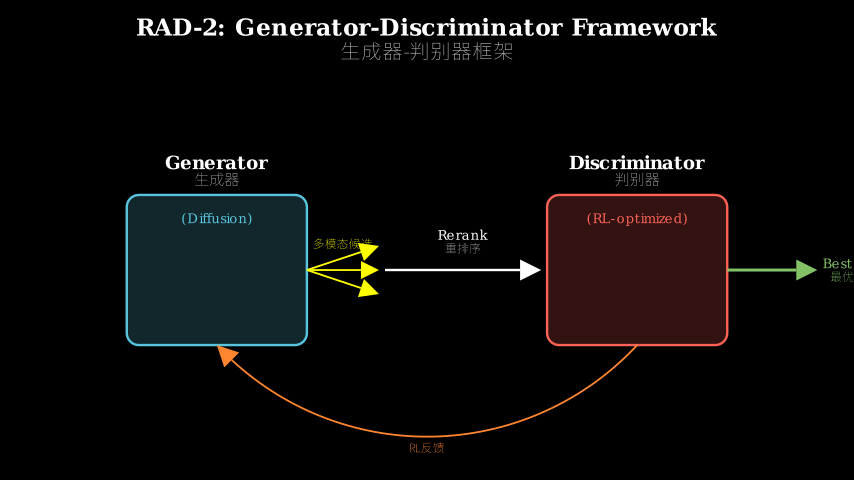
RAD-2 splits planning into two stages. First, a diffusion model generates multiple trajectory candidates by iteratively denoising random noise into plausible paths. This generator is trained on expert demonstrations and learns the manifold of reasonable driving behaviors. Second, a discriminator network scores each candidate based on long-term driving quality — collision avoidance, comfort, progress toward goals. The discriminator is trained with reinforcement learning using closed-loop simulation feedback.
The key insight: don’t force RL to optimize the entire high-dimensional diffusion process. Instead, let diffusion handle diversity (it’s good at that), and let RL handle quality assessment (a much lower-dimensional problem). The discriminator sees features like trajectory shape, predicted collisions, and comfort metrics, then outputs a scalar score. During inference, generate N candidates, rerank them, pick the top one.
To make RL training stable, they introduce two techniques. Temporally Consistent Group Relative Policy Optimization exploits the fact that consecutive planning steps are correlated — if a trajectory was good 0.1 seconds ago, it’s probably still reasonable now. This temporal coherence provides denser learning signals. On-policy Generator Optimization feeds closed-loop outcomes back to the generator, nudging it toward high-reward regions so the discriminator doesn’t waste time evaluating terrible candidates.
Input scene features
    |
    v
[Diffusion Generator] ---> Candidate 1 --\
    |                      Candidate 2 ----\
    |                      Candidate 3 ------\
    |                           ...            \
    v                                           v
Noise --> Denoise --> Trajectories         [Discriminator]
                                                |
                                                v
                                           Score each
                                                |
                                                v
                                           Pick best --> Execute
                                                ^
                                                |
                                        RL feedback from
                                        closed-loop sim
Think of it like a chess player with a coach. The player (generator) has learned patterns from watching grandmasters and can propose creative moves. The coach (discriminator) has played thousands of games and knows which moves lead to wins or losses. The player suggests five candidate moves; the coach evaluates each based on experience and picks the strongest. Over time, the coach’s feedback shapes the player’s intuition, so they propose better candidates. The player doesn’t need to understand every consequence — that’s the coach’s job. The player just needs to stay in the realm of sensible moves.
Key Concepts
-
Diffusion-based trajectory generation: Imagine sculpting a path from clay. You start with a random blob (noise) and gradually refine it by removing what doesn’t look like a valid trajectory. At each step, a neural network predicts “this part looks too jerky” or “this curve is too sharp” and smooths it out. After many refinement steps, you have a plausible driving path. The beauty: you can start from different random blobs and get different valid paths, capturing multimodal futures (maybe turn left, maybe turn right).
-
Credit assignment problem in RL: You execute a 5-second trajectory and crash at the end. Which of the 50 waypoints along that trajectory was the mistake? The first waypoint that steered slightly wrong? The middle waypoint that failed to brake? RL struggles to assign blame when rewards are sparse and delayed. RAD-2’s temporal consistency trick says: if two consecutive planning cycles produce similar trajectories, their quality scores should be similar too. This correlation provides gradient signal even when the final outcome is far away.
-
Generator-discriminator decoupling: Instead of training one network to both generate and evaluate (which mixes two hard problems), split them. The generator focuses on “what’s possible” (learned from demonstrations). The discriminator focuses on “what’s good” (learned from trial and error). This is like separating a brainstorming session from a decision meeting — different cognitive modes, different optimization objectives.
Framework Shift
Before (pure diffusion):                After (RAD-2):

Expert demos                            Expert demos
    |                                       |
    v                                       v
[Diffusion Model]                      [Generator]
    |                                       |
    v                                       v
Single trajectory                      N candidates
    |                                       |
    v                                       v
Execute                                [Discriminator] <-- RL feedback
                                            |
                                            v
                                       Rerank & pick best
                                            |
                                            v
                                       Execute

(No feedback loop)                     (Closed-loop learning)
From monolithic generation to staged generation-evaluation, the core shift is separating “what’s plausible” from “what’s optimal.”
Expert Assessment
Problem choice: Real gap. Diffusion planners are trendy but their closed-loop brittleness is well-documented. The paper targets a genuine pain point: imitation learning doesn’t teach you to recover from mistakes. The positioning is smart — ride the diffusion wave while fixing its Achilles’ heel.
Method maturity: The generator-discriminator split is conceptually clean, but not groundbreaking — it’s essentially reranking with learned scoring. The novelty is in the RL training tricks (temporal consistency, on-policy generator updates). These feel engineered rather than principled, but engineering matters in robotics. The BEV-Warp simulation environment is a clever practical contribution — warping feature maps is faster than re-rendering scenes.
Experimental integrity: Strong baselines (Diffusion-ES, UniAD, VAD). The 56% collision reduction is impressive, but I’d want to see failure mode analysis — when does reranking pick the wrong candidate? The real-world deployment section is thin (2 paragraphs, no quantitative metrics). Ablations are thorough. One concern: they compare against pure diffusion, but what about simpler reranking schemes (e.g., rule-based scoring)? Would be good to isolate the RL contribution.
Writing quality: Abstract and intro are crisp. Method section gets dense — the temporal consistency formulation (Eq. 4-6) could use a worked example. The BEV-Warp description feels rushed, probably because it’s a side contribution. Figure 3 (framework overview) does heavy lifting. If I were reviewing, I’d ask them to expand the failure case discussion and tighten the RL math exposition.
Verdict: weak accept — Solid engineering work addressing a real problem, with strong empirical results. Not a conceptual breakthrough, but the combination of techniques is effective and the real-world deployment (even if under-documented) adds credibility. The field needs more papers that make diffusion planners actually work in closed-loop settings.
Takeaways
Decouple generation from evaluation when RL is involved: If your generative model produces high-dimensional outputs (trajectories, images, molecules), don’t force RL to optimize the generator directly. Train a separate critic to score outputs, then use RL on the critic. The generator can be trained with imitation or likelihood, which is more stable.
Exploit temporal coherence in sequential decision-making: If your agent replans every 0.1 seconds, consecutive plans should have correlated quality. Use this as a regularizer or auxiliary loss to densify reward signals. This trick generalizes beyond driving — any high-frequency replanning scenario.
Reranking is underrated: Generate multiple candidates with a fast generative model, then rerank with a slower but smarter evaluator. This pattern appears in language models (best-of-N sampling), protein design, and now motion planning. The key: make generation cheap and diverse, make evaluation expensive and accurate.
Build domain-specific simulators: BEV-Warp’s insight — simulate in feature space rather than pixel space — is transferable. If you have a learned representation (BEV features, latent codes), you can often warp/transform it faster than re-rendering from scratch. Useful for any closed-loop RL training where simulation is the bottleneck.
论文: 2604.15308 作者: Hao Gao, Shaoyu Chen, Yifan Zhu, Yuehao Song, Wenyu Liu, Qian Zhang, Xinggang Wang 分类: cs.CV
缺口
基于扩散模型的运动规划器能够建模复杂的多模态轨迹分布,但它们纯粹通过模仿学习训练——只是复制专家演示,并不理解在闭环交互中什么样的轨迹是好是坏。
部署后,它们会出现随机不稳定性,在出错时缺乏纠正反馈。
与此同时,直接对高维轨迹空间应用强化学习会因为稀疏奖励和信用分配问题而不稳定。
问题:扩散规划器会复制但不理解质量
    |
    v
假设:将生成与评估解耦
    |
    v
方法:生成器创建候选 + 判别器按质量重排序
    |
    v
证据:相比纯扩散模型碰撞率降低56%
    |
    v
结论:关注点分离稳定了强化学习优化
增量
一句话: 之前——扩散规划器生成多样化轨迹但无法区分好坏;
之后——判别器学会使用闭环反馈对候选轨迹重排序,稳定了强化学习训练。
核心机制
RAD-2将规划分为两个阶段。
首先,扩散模型通过迭代去噪将随机噪声转化为合理路径,生成多个轨迹候选。
这个生成器在专家演示上训练,学习合理驾驶行为的流形。
其次,判别器网络根据长期驾驶质量——避免碰撞、舒适度、朝目标前进——对每个候选打分。
判别器通过强化学习使用闭环仿真反馈训练。
关键洞察:不要强迫强化学习优化整个高维扩散过程。
相反,让扩散处理多样性(它擅长这个),让强化学习处理质量评估(一个低得多维度的问题)。
判别器看到轨迹形状、预测碰撞、舒适度指标等特征,然后输出标量分数。
推理时,生成N个候选,重排序,选择最优的。
为了使强化学习训练稳定,他们引入了两个技术。
时序一致性组相对策略优化利用了连续规划步骤相关的事实——如果一条轨迹在0.1秒前是好的,现在可能仍然合理。
这种时序一致性提供了更密集的学习信号。
在线策略生成器优化将闭环结果反馈给生成器,将其推向高奖励区域,这样判别器就不会浪费时间评估糟糕的候选。
输入场景特征
    |
    v
[扩散生成器] ---> 候选1 --\
    |              候选2 ----\
    |              候选3 ------\
    |               ...          \
    v                             v
噪声 --> 去噪 --> 轨迹      [判别器]
                                |
                                v
                           对每个打分
                                |
                                v
                           选最优 --> 执行
                                ^
                                |
                        来自闭环仿真的
                        强化学习反馈
把它想象成一个有教练的棋手。
棋手(生成器)通过观看大师对局学会了模式,能提出创造性的走法。
教练(判别器)下过数千盘棋,知道哪些走法会导致胜负。
棋手建议五个候选走法;
教练根据经验评估每个走法,选择最强的。
随着时间推移,教练的反馈塑造了棋手的直觉,让他们提出更好的候选。
棋手不需要理解每个后果——那是教练的工作。
棋手只需要保持在合理走法的范围内。
关键概念
- 基于扩散的轨迹生成: 想象用黏土雕刻一条路径。
你从一个随机团块(噪声)开始,通过去除不像有效轨迹的部分逐渐细化它。
每一步,神经网络预测”这部分看起来太抖”或”这个曲线太急”并将其平滑。
经过多次细化步骤,你得到一条合理的驾驶路径。
美妙之处:你可以从不同的随机团块开始,得到不同的有效路径,捕捉多模态未来(可能左转,可能右转)。
- 强化学习中的信用分配问题: 你执行一条5秒的轨迹,最后撞车了。
这条轨迹上的50个路径点中哪一个是错误?第一个稍微转错方向的路径点?中间没有刹车的路径点?当奖励稀疏且延迟时,强化学习很难分配责任。
RAD-2的时序一致性技巧说:如果两个连续的规划周期产生相似的轨迹,它们的质量分数应该也相似。
这种相关性即使在最终结果很远时也提供梯度信号。
- 生成器-判别器解耦: 与其训练一个网络同时生成和评估(混合了两个难题),不如将它们分开。
生成器专注于”什么是可能的”(从演示中学习)。
判别器专注于”什么是好的”(从试错中学习)。
这就像将头脑风暴会议与决策会议分开——不同的认知模式,不同的优化目标。
框架转变
之前(纯扩散):                    之后(RAD-2):

专家演示                            专家演示
    |                                   |
    v                                   v
[扩散模型]                          [生成器]
    |                                   |
    v                                   v
单一轨迹                            N个候选
    |                                   |
    v                                   v
执行                                [判别器] <-- 强化学习反馈
                                        |
                                        v
                                   重排序并选最优
                                        |
                                        v
                                   执行

(无反馈循环)                      (闭环学习)
从单体生成到分阶段生成-评估,核心转变是将”什么是合理的”与”什么是最优的”分离。
专家评审
选题眼光: 真实缺口。
扩散规划器很流行,但它们的闭环脆弱性有充分记录。
论文针对一个真实痛点:模仿学习不会教你如何从错误中恢复。
定位很聪明——乘扩散浪潮的同时修复其致命弱点。
方法成熟度: 生成器-判别器分离在概念上很清晰,但不算突破性——本质上是用学习的评分进行重排序。
新颖性在于强化学习训练技巧(时序一致性、在线策略生成器更新)。
这些感觉更像工程而非原理性的,但工程在机器人学中很重要。
BEV-Warp仿真环境是一个巧妙的实用贡献——扭曲特征图比重新渲染场景更快。
实验诚意: 强基线(Diffusion-ES、UniAD、VAD)。
56%的碰撞率降低令人印象深刻,但我想看失败模式分析——重排序什么时候会选错候选?真实世界部署部分很薄(2段,无定量指标)。
消融实验很彻底。
一个担忧:他们与纯扩散比较,但与更简单的重排序方案(例如基于规则的评分)相比如何?最好能隔离强化学习的贡献。
写作功力: 摘要和引言简洁。
方法部分变得密集——时序一致性公式(公式4-6)可以用一个实例说明。
BEV-Warp描述感觉仓促,可能因为它是副贡献。
图3(框架概览)承担了重任。
如果我在审稿,我会要求他们扩展失败案例讨论并收紧强化学习数学阐述。
判决: 弱接收——扎实的工程工作解决了真实问题,有强实证结果。
不是概念突破,但技术组合有效,真实世界部署(即使文档不足)增加了可信度。
该领域需要更多让扩散规划器在闭环设置中真正工作的论文。
要点总结
涉及强化学习时将生成与评估解耦: 如果你的生成模型产生高维输出(轨迹、图像、分子),不要强迫强化学习直接优化生成器。
训练一个单独的评判器对输出打分,然后在评判器上使用强化学习。
生成器可以用模仿或似然训练,这更稳定。
在序列决策中利用时序一致性: 如果你的智能体每0.1秒重新规划,连续的计划应该有相关的质量。
将此用作正则化器或辅助损失以密化奖励信号。
这个技巧超越驾驶——任何高频重规划场景都适用。
重排序被低估了: 用快速生成模型生成多个候选,然后用更慢但更智能的评估器重排序。
这种模式出现在语言模型(best-of-N采样)、蛋白质设计,现在是运动规划。
关键:让生成便宜且多样,让评估昂贵且准确。
构建领域特定模拟器: BEV-Warp的洞察——在特征空间而非像素空间模拟——是可迁移的。
如果你有学习的表示(BEV特征、潜在编码),你通常可以比从头重新渲染更快地扭曲/变换它。
对于任何闭环强化学习训练中仿真是瓶颈的情况都有用。