Paper: 2606.17030 Authors: Jie Zhang, Xiaoyue Chen, Anzhe Chen, Chenxu Lv, Deqing Li, Gengze Zhou, Hang Yin, Haoqi Yuan, Haoyang Li, Jiahao Li Categories: cs.CV
The Gap
Existing embodied world models are siloed: a model trained for robotic arm manipulation uses joint angles as actions; one for autonomous driving uses steering commands; indoor navigation models rely on discrete motion primitives. None share a common action interface. This forces practitioners to train separate models per domain, wasting data and compute. Worse, it prevents cross-embodiment transfer (e.g., a skill learned in simulation transferring to a different robot). The paper asks: can we design a single world model that speaks one language—natural language—and works across diverse embodiments? The hypothesis is that language, being compositional and domain-agnostic, can serve as a universal action encoding.
+--------------------------------------+
| Problem: Fragmented world models     |
| - Different action spaces per domain |
| - No cross-embodiment transfer       |
+--------------------------------------+
          |
          v
+--------------------------------------+
| Assumption: Natural language can     |
| serve as a unified action interface  |
+--------------------------------------+
          |
          v
+--------------------------------------+
| Method:                              |
| 1) Double-Stream MMDiT with frozen   |
|    Qwen2.5-VL (language encoder)     |
| 2) Embodied World Knowledge corpus   |
|    (8.6M videos, 200M+ frames)       |
| 3) General+Expert progressive        |
|    curriculum training               |
+--------------------------------------+
          |
          v
+--------------------------------------+
| Evidence: Rank 1 on EWMBench,        |
| DreamGen Bench, outperforms all      |
| open-source on WorldModelBench and   |
| PBench. Strong zero-shot on          |
| RoboTwin-IF.                         |
+--------------------------------------+
          |
          v
+--------------------------------------+
| Conclusion: Language-conditioned     |
| video world model is effective and   |
| generalizes across embodiments.      |
+--------------------------------------+
The Increment
One sentence: Before this paper, world models required per-domain action definitions and struggled to transfer across embodiments; after this paper, a single model using natural language as actions predicts physically plausible future videos across robotic manipulation, driving, navigation, and human-to-robot transfer.
Core Mechanism
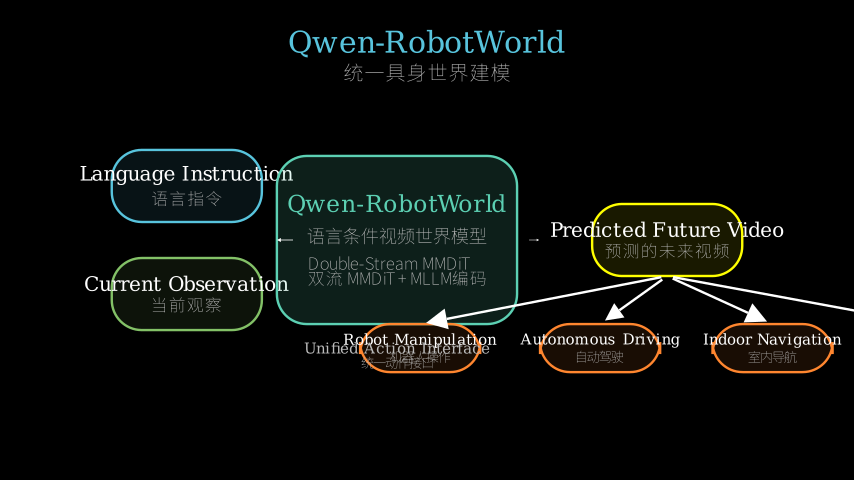
The model, called Qwen-RobotWorld, consists of three key components. First, a Double-Stream MMDiT (Mixture of Multi-scale Diffusion Transformer) with 60 layers processes visual and language information in parallel. The visual stream takes video-VAE latents from the current observation. The language stream takes natural language instructions encoded by a frozen Qwen2.5-VL, a large multimodal language model. At each layer, cross-attention fuses the two streams, allowing the visual features to be conditioned on language.
Second, the Embodied World Knowledge (EWK) corpus is a massive collection of 8.6 million video clips (over 200 million frames) covering more than 20 embodiments and 500+ action categories. Each clip is annotated with a natural language description of the action being performed. This data provides the training material for the model to learn the mapping from language to visual dynamics.
Third, the General+Expert Progressive Curriculum trains the model in two stages. Stage 1 (“General”) pre-trains on internet-scale video data (e.g., everyday human activities) to learn generic visual priors (object permanence, physics, motion patterns). Stage 2 (“Expert”) fine-tunes on the EWK corpus to specialize in embodied scenarios while keeping the shared language interface. The key insight is that general video understanding transfers to embodied domains, reducing the need for expensive embodied data.
Data flow: given a current observation image (or video clip) and a natural language instruction (e.g., “pick up the red block”), the model outputs a sequence of future video frames showing the predicted outcome.
       Observation             Language Instruction
           |                          |
      [Video-VAE]                [Qwen2.5-VL]
           |                          |
      [Latent Z]                [Token embeddings]
           |                          |
           +--- Joint Attention ------+
           |      (per layer)
           v
   [Diffusion Transformer (60 layers, dual stream)]
           |
           v
      [Predicted Future Video Frames]
Structural Metaphor: Think of Qwen-RobotWorld as a master chef who reads a recipe (the language instruction) and looks at the ingredients already laid out (the observation). The chef’s brain is the Double-Stream MMDiT: one hemisphere processes the visual state of ingredients (video-VAE latents), the other interprets the recipe text (Qwen2.5-VL). At each cooking step (diffusion layer), the chef combines what he sees with what the recipe says (joint attention) to imagine the next stage of the dish (future frame). The EWK corpus is his vast collection of cookbooks (videos of cooking, cleaning, driving) from which he learned both general kitchen physics (how oil heats, how spatulas move) and specific cuisines (robotic arm grasps, car turns). The progressive curriculum is like starting with a culinary school that teaches basic knife skills on random vegetables (internet video), then specializing in French pastry (embodied tasks). The chef can now take any recipe (language command) and any prep state (observation) and predict what the dish will look like moment by moment.
Key Concepts
-
Language as a Universal Action Interface: Instead of using raw joint angles or torque commands, the model takes a natural language sentence like “move the gripper 10 cm left” or “turn left at the next intersection.” The key insight is that language is compositional—you can combine words to describe novel actions—and domain-agnostic—the same phrase “push the button” applies to a robot arm, a human hand, or a drone. This replaces dozens of ad-hoc action spaces with one shared vocabulary. For example, in prior work, a driving model might use a discrete set of actions {steer, accelerate, brake}, each coded as a one-hot vector. Here, the action is simply “turn right at low speed,” which a pretrained LLM can parse.
-
Double-Stream MMDiT with Frozen LLM: The model does not train the language encoder from scratch. Instead, it freezes Qwen2.5-VL (a powerful multimodal LLM) and uses its output embeddings as conditioning signals. This is critical because LLMs already embed rich semantic knowledge about objects, scenes, and actions. The visual stream uses a 3D VAE to compress video frames into latents. At each Transformer layer, the two streams exchange information via cross-attention, allowing visual features to be modulated by language. This design avoids catastrophic forgetting of language knowledge and leverages a strong pre-trained foundation.
-
General+Expert Progressive Curriculum: Training a world model from scratch on embodied data alone is data-inefficient because embodied data is scarce and expensive. The paper proposes a two-step curriculum: first train on massive internet video (e.g., YouTube) to learn universal visual dynamics—how objects fall, roll, interact with each other. This stage uses language-conditioned video prediction but with noisy, uncurated captions from general video datasets. Then, in the expert stage, the model is fine-tuned on the high-quality EWK corpus with clean action-language annotations specific to embodied tasks. This progressive scheme improves generalization: the model can handle unseen embodiments because it already understands basic physics from the general stage.
Framework Shift
Before Qwen-RobotWorld, the dominant approach was to train separate world models for each embodiment, each with its own action encoding and data pipeline. After the paper, the field moves toward a unified model with a shared language interface and cross-embodiment training data.
Before (mainstream approach):              After (this paper):

+-----------------+   +----------------+   +----------------------------------+
| Robotic arm     |   | Autonomous     |   |  Qwen-RobotWorld                 |
| world model     |   | driving world  |   |  (single model)                  |
| Actions: angles |   | model          |   |  Actions: natural language       |
| Data: 500k      |   | Actions: steer,|   |  Data: 8.6M videos (20+ embo.)   |
| demos           |   | throttle       |   |  Training: General+Expert        |
+-----------------+   +----------------+   |  Output: video across all domains |
        |                    |             +----------------------------------+
        v                    v                         |
+------------------+  +------------------+             v
| Prediction: arm  |  | Prediction: car  |   +-----------------------------+
| motion frames    |  | scene frames     |   | Prediction: arm motion, car |
+------------------+  +------------------+   | scenes, indoor navigation,  |
                                              | human manipulation          |
                                              +-----------------------------+
One sentence: From fragmented, domain-specific world models to a unified, language-conditioned video world model that generalizes across embodiments, the core shift is replacing task-specific action encodings with natural language as a universal interface.
Expert Assessment
Problem choice: Real gap. The fragmentation of embodied world models is a practical bottleneck for transferring knowledge across domains. The paper correctly identifies that language can bridge this gap. However, the assumption that natural language is sufficient to capture precise motion (e.g., “move 2.3 cm”) is untested for fine-grained control. The problem sits at an important intersection of video generation and robot learning, timely given the rise of foundation models.
Method maturity: Clever engineering rather than a radical insight. The main contributions—freezing a strong LLM, building a large text-video corpus, and using curriculum training—are solid but incremental. The Double-Stream MMDiT is a natural extension of existing diffusion transformer architectures (e.g., DiT, MMDiT). The paper does not propose a novel architecture; it expertly combines known pieces. There are simpler approaches (e.g., directly fine-tuning an existing video generation model like Sora), but those are not open-source, so this is a pragmatic contribution.
Experimental integrity: Fair baselines: they compare against open-source video world models (e.g., UniPi, VideoPoet) and show consistent improvement. Benchmarks are well-established (EWMBench, DreamGen, etc.). One red flag: the zero-shot results on RoboTwin-IF are promising but the paper does not provide failure analysis or cases where language grounding fails. Also, no comparison against closed-source models like OpenAI’s Sora, though understandable due to availability. The ablation study on the curriculum is present but could be more thorough—e.g., what if you skip the general stage?
Writing quality: The paper is dense and technically detailed, typical of a system report. The weakest section is the related work, which is a laundry list rather than a narrative. The best section is the method description, particularly the data pipeline. If I were the authors, I would rewrite the evaluation to include more qualitative examples (success and failure cases) and a clearer summary of limitations.
Verdict: Weak accept — The paper delivers a solid, well-executed system that pushes forward the unification of embodied world models, but the technical novelty is limited to integration and curation rather than algorithmic invention.
Takeaways
- Use frozen LLMs as action encoders: If you’re building a video prediction model for embodied tasks, lock a pre-trained LLM (like Qwen2.5-VL or LLaVA) and only train the visual backbone. This saves compute and leverages rich semantic priors.
- Curate a multi-embodiment video corpus: The EWK dataset shows that collecting diverse embodied data (20+ embodiments, 500+ actions) is feasible and synergistic. Practitioners starting a new embodied project should consider pooling across platforms rather than curating per-robot data.
- Curriculum training from general video: Pre-training on internet video before fine-tuning on task-specific data is a proven recipe for improving generalization. Even if your final target is a narrow domain (e.g., pick-and-place), starting with generic human video helps the model learn physics that transfers.
- Natural language as a universal action space: The most transferable idea is replacing discrete action tokens with language. This is not novel in isolation (many works use language for task specification), but the paper demonstrates that it works for *video prediction across domains, not just policy learning.
论文: 2606.17030 作者: Jie Zhang, Xiaoyue Chen, Anzhe Chen, Chenxu Lv, Deqing Li, Gengze Zhou, Hang Yin, Haoqi Yuan, Haoyang Li, Jiahao Li 分类: cs.CV
缺口
现有的具身世界模型是孤立的:机械臂操作模型用关节角度作动作,自动驾驶模型用转向指令,室内导航模型依赖离散运动原语。 它们之间没有共享的动作接口。 这就迫使研究者为每个领域单独训练模型,浪费数据和计算资源。 更麻烦的是,它阻止了跨具身的迁移(例如,在仿真中学到的技能无法迁移到不同的机器人上)。 这篇论文问的是:能否设计一个世界模型,只讲一种语言——自然语言——并且能在多种具身形态下工作? 假设是语言是组合性且领域无关的,可以充当通用动作编码。
+-----------------------------------------+
| 问题:碎片化的世界模型                   |
| - 每个领域用不同的动作空间               |
| - 无法跨具身迁移                         |
+-----------------------------------------+
          |
          v
+-----------------------------------------+
| 假设:自然语言可以作为统一的动作接口     |
+-----------------------------------------+
          |
          v
+-----------------------------------------+
| 方法:                                   |
| 1) 双流MMDiT + 冻结的Qwen2.5-VL         |
| 2) 具身世界知识语料库 (EWK)             |
|    (860万视频,2亿+帧)                   |
| 3) 通用+专家渐进课程训练                 |
+-----------------------------------------+
          |
          v
+-----------------------------------------+
| 证据:在EWMBench、DreamGen Bench排名第一 |
| 在WorldModelBench和PBench上超过所有       |
| 开源模型。在RoboTwin-IF上零样本能力强。  |
+-----------------------------------------+
          |
          v
+-----------------------------------------+
| 结论:语言条件视频世界模型有效且           |
| 能跨具身泛化。                           |
+-----------------------------------------+
增量
一句话:在这篇论文之前,世界模型需要为每个领域定义专用动作,难以跨具身迁移;在这篇论文之后,一个使用自然语言作为动作的单一模型可以跨机器人操作、自动驾驶、导航和人到机器人迁移,预测物理上空合理的未来视频。
核心机制
模型名为Qwen-RobotWorld,由三个关键组件构成。 首先,双流MMDiT(混合多尺度扩散变换器),共60层,并行处理视觉和语言信息。 视觉流从当前观测中提取视频VAE潜变量。 语言流接收由冻结的Qwen2.5-VL(一个大型多模态语言模型)编码的自然语言指令。 每一层通过交叉注意力融合两流,使视觉特征受语言条件调制。
其次,具身世界知识(EWK) 语料库包含860万个视频片段(超过2亿帧),覆盖20多种具身形态和500多个动作类别。 每个片段都标注了正在执行的动作的自然语言描述。 该数据为模型学习从语言到视觉动态的映射提供了训练素材。
第三,通用+专家渐进课程分两阶段训练。 阶段1(通用)在海量互联网视频数据(如日常人类活动)上预训练,学习通用视觉先验(物体恒存性、物理规律、运动模式)。 阶段2(专家)在EWK语料库上微调,专门针对具身场景,同时保持共享的语言接口。 关键洞察是通用视频理解知识可以迁移到具身领域,从而减少对昂贵具身数据的依赖。
数据流:给定当前观测图像(或视频片段)和自然语言指令(如”拿起红色方块”),模型输出未来视频帧序列,展示预测的结果。
      观测图像                语言指令
        |                       |
   [视频VAE]               [Qwen2.5-VL]
        |                       |
   [潜变量Z]               [词元嵌入]
        |                       |
        +---- 逐层联合注意力 ---+
        |
   [扩散变换器 (60层, 双流)]
        |
        v
   [预测的未来视频帧]
结构比喻:把Qwen-RobotWorld想象成一位主厨,他读食谱(语言指令),看已经准备好的食材(观测)。 主厨的大脑就是双流MMDiT:一个半球处理食材的视觉状态(视频VAE潜变量),另一个半球解译食谱文字(Qwen2.5-VL)。 每一步烹饪(扩散层),主厨把看到的和食谱说的结合起来(联合注意力),想象菜肴的下一个阶段(未来帧)。 EWK语料库是主厨庞大的菜谱收藏(烹饪、清洁、驾驶视频),他从中学会了通用厨房物理(油如何加热、锅铲如何移动),也学会了特定菜系(机械臂抓取、汽车转弯)。 渐进课程像是先从烹饪学校开始,在随机蔬菜上练基础刀工(互联网视频),然后专攻法式甜点(具身任务)。 现在这位主厨拿到任何食谱(语言命令)和任何备菜状态(观测),都能预测每一时刻菜肴的样子。
关键概念
-
语言作为通用动作接口:模型不使用原始的关节角度或扭矩命令,而是接受自然语言句子,如”把机械手向左移动10厘米”或”在下一个路口左转”。 关键洞察是语言是组合性的——你可以组合词语来描述新动作——并且与领域无关——短语”按按钮”适用于机械臂、人手或无人机。 这就把数十种临时动作空间替换为共享的词汇表。 例如,此前自动驾驶模型可能使用离散动作为{转向,加速,刹车},每个编码为独热向量。 在这里,动作就是”以低速右转”,预训练的LLM就能解析。
-
双流MMDiT与冻结LLM:模型不从头训练语言编码器,而是冻结Qwen2.5-VL(一个强大的多模态LLM),使用其输出嵌入作为条件信号。 这很关键,因为LLM已经嵌入了丰富的对象、场景和动作语义知识。 视觉流使用3D VAE将视频帧压缩为潜变量。 每一层Transformer通过交叉注意力交换两流信息,使视觉特征受到语言的调制。 这种设计避免了语言知识的灾难性遗忘,并利用了强大的预训练基础。
-
通用+专家渐进课程:从头在具身数据上训练世界模型效率低下,因为具身数据稀缺且昂贵。 论文提出两阶段课程:首先在海量互联网视频(如YouTube)上训练,学习通用视觉动态——物体如何下落、滚动、相互作用。 这一阶段使用语言条件视频预测,但标注源自通用视频数据集,带有噪声和未经整理的描述。 然后,在专家阶段,模型在高质量的EWK语料库上微调,该语料库包含具身任务专用的动作-语言标注。 这种渐进方案提升了泛化能力:模型能处理未见过的具身形态,因为它在通用阶段已经理解基本物理。
框架转变
在Qwen-RobotWorld之前,主流方法是针对每种具身形态单独训练世界模型,各有各的动作编码和数据管道。 在这篇论文之后,领域转向单一模型,共享语言接口和跨具身训练数据。
之前(主流方法):                        之后(本文):

+----------------+   +-----------------+   +-----------------------------------+
| 机械臂世界模型   |   | 自动驾驶世界模型  |   | Qwen-RobotWorld(单一模型)         |
| 动作:关节角度   |   | 动作:转向、油门  |   | 动作:自然语言                      |
| 数据:50万演示   |   | 数据:驾驶场景    |   | 数据:860万视频(20+具身)           |
+----------------+   +-----------------+   | 训练:通用+专家渐进课程              |
        |                    |             | 输出:覆盖所有领域的视频             |
        v                    v             +-----------------------------------+
+------------------+ +------------------+                    |
| 预测:机械臂运动帧 | | 预测:车辆场景帧  |                    v
+------------------+ +------------------+         +--------------------------------+
                                                 | 预测:机械臂运动、车辆场景、      |
                                                 | 室内导航、人手操作                 |
                                                 +--------------------------------+
一图胜千言:从碎片化、领域专用的世界模型到统一的、语言条件的视频世界模型,核心转变是用自然语言替代任务特定的动作编码,作为通用接口。
专家评审
选题眼光:真缺口。具身世界模型的碎片化是知识跨领域迁移的实际瓶颈。 论文正确指出语言可以弥合这一鸿沟。 但是,假设自然语言足以捕捉精细运动(如”移动2.3厘米”)这一点未经精细控制测试。 该问题位于视频生成和机器人学习的交叉点,在基础模型兴起的当下非常及时。
方法成熟度:巧妙的工程而非颠覆性洞见。 主要贡献——冻结强大的LLM、构建大规模文本-视频语料库、使用课程训练——扎实但渐进。 双流MMDiT是现有扩散变换器架构(如DiT、MMDiT)的自然扩展。 论文没有提出全新架构;它熟练地组装了已知部件。 存在更简单的方法(如直接微调已有的视频生成模型如Sora),但这些不公开,因此本论文是实用的贡献。
实验诚意:基线公平,与开源视频世界模型(如UniPi、VideoPoet)对比,显示一致改进。 基准选择成熟(EWMBench、DreamGen等)。 一个值得警惕之处:在RoboTwin-IF上的零样本结果很吸引人,但论文未提供失败案例分析或语言接地失效的情景。 另外,未与OpenAI的Sora等闭源模型比较,尽管可以理解。 针对课程的消融实验存在但不充分——例如,跳过通用阶段会怎样?
写作功力:论文内容密集、技术细节详尽,符合系统报告风格。 最弱的相关工作部分像列表而不是叙述。 最好的部分是方法描述,特别是数据管道。 如果我是作者,我会重写评估部分,加入更多定性示例(成功和失败案例),以及对局限性的更清晰总结。
判决:弱接收——论文构建了一个扎实、执行良好的系统,推动了具身世界模型的统一,但技术新颖性限于集成和策划,而非算法发明。
要点总结
- 使用冻结的LLM作为动作编码器:如果你要构建具身任务的视频预测模型,锁定预训练的LLM(如Qwen2.5-VL或LLaVA),只训练视觉骨干网路。 这节省了计算资源并利用了丰富的语义先验。
- 策划多具身视频语料库:EWK数据集表明,收集多样化具身数据(20多种具身,500多个动作)是可行且协同的。 开始新具身项目的实践者应考虑跨平台汇集数据,而不是为每个机器人独立收集。
- 从通用视频进行课程训练:在互联网视频上预训练,然后在任务特定数据上微调,是提升泛化能力的成熟配方。 即使最终目标很狭窄(如抓取放置),从通用人类视频开始也能帮助模型学习可迁移的物理规律。
- 自然语言作为通用动作空间:最具迁移性的想法是用语言替换离散动作词元。 这在独立意义上并不新颖(很多工作已用语言指定任务),但本文证明它对跨领域的视频预测有效,而不仅仅用于策略学习。