
Paper: 2603.00905 Authors: Zhanpeng Luo, Ce Zhang, Silong Yong, Cunxi Dai, Qianwei Wang, Haoxi Ran, Guanya Shi, Katia Sycara, Yaqi Xie Categories: cs.CV
The Gap
Current multimodal LLMs like GPT-4V and Gemini excel at describing what they see in images — identifying objects, reading text, even understanding complex scenes. But ask them “which object is closer to the camera?” or “what would this scene look like from 30 degrees to the left?” and they stumble. The problem isn’t lack of visual understanding; it’s that these models process images as flat projections, lacking explicit geometric reasoning about 3D space. Prior work has tried fine-tuning MLLMs on 3D datasets or adding specialized 3D encoders, but these approaches require expensive retraining and don’t generalize well beyond their training distribution. The fundamental issue: MLLMs have no structured way to convert 2D observations into explorable 3D representations.
The Increment
Before: MLLMs guess at spatial relationships from 2D cues → After: MLLMs write programs that reconstruct 3D scenes and query them explicitly.
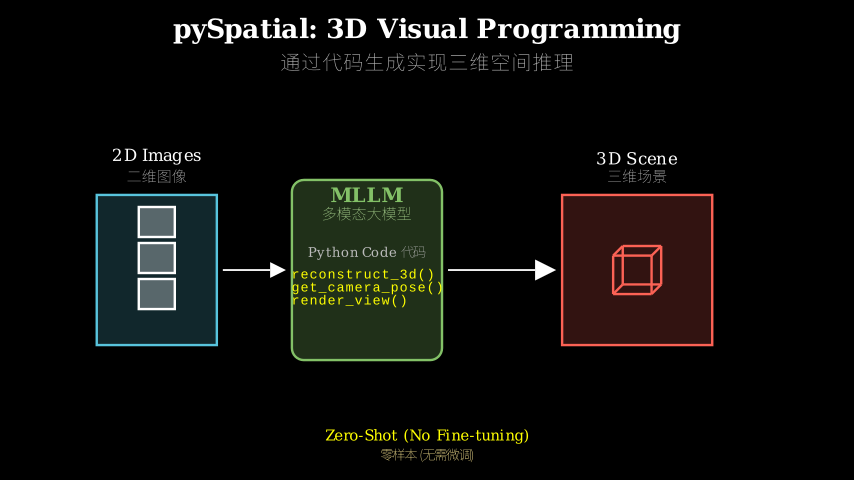
Think of pySpatial as a film production pipeline. The MLLM is the director who doesn’t operate cameras or edit footage directly, but instead writes a shooting script (Python code). This script calls upon specialized crew members: the cinematographer (camera pose estimator) figures out where each shot was taken from, the VFX team (3D reconstruction module) builds a digital set from the footage, and the virtual camera operator (novel view renderer) can generate any angle the director requests. The director composes these operations in sequence — first reconstruct the scene, then estimate distances, then render a new viewpoint — turning a passive viewer into an active scene explorer.
The framework provides MLLMs with a library of spatial tools wrapped as Python functions: reconstruct_3d(), estimate_camera_poses(), render_novel_view(), measure_distance(), etc. Given an image sequence and a question like “Is the red cube behind the blue sphere?”, the model generates a program that might first call reconstruct_3d() to build a point cloud, then get_object_coordinates() to locate both objects, and finally compare their depth values. Crucially, this happens zero-shot — no gradient updates, no fine-tuning on 3D data. The MLLM leverages its existing code generation abilities, just with a new API.
The execution is deterministic: the generated Python code runs against actual computer vision libraries (like COLMAP for structure-from-motion, NeRF for novel view synthesis). This grounds the reasoning in geometric truth rather than learned correlations. If the model’s spatial logic is wrong, the program fails or produces nonsensical output, providing a clear error signal.
Key Concepts
Visual Programming for Spatial Reasoning
Most people think of programming as writing instructions for computers. But here’s a different lens: programming is a way to decompose complex problems into sequences of well-defined operations. When you write result = function_a(function_b(input)), you’re saying “first do B, then do A with B’s output.” This compositional structure is exactly what spatial reasoning needs.
Consider the question: “From the camera’s perspective, what’s to the left of the red chair?” A human solves this by: (1) identifying the chair, (2) understanding where the camera is, (3) projecting a leftward direction from that viewpoint, (4) checking what objects fall in that region. Each step is discrete and depends on the previous one. pySpatial lets the MLLM express this same decomposition in code:
chair_pos = get_object_position("red chair")
camera_pose = estimate_camera_pose(images[0])
left_direction = compute_left_vector(camera_pose)
objects_left = query_objects_in_direction(chair_pos, left_direction)
The power isn’t just that this works — it’s that the MLLM can invent new compositions for novel questions without seeing examples. That’s the zero-shot magic.
Structure from Motion (SfM) as Scene Archaeology
Imagine you have 20 photos of a room taken from different angles, but you don’t know where the photographer stood for each shot. Structure from Motion is like being an archaeologist who reconstructs both the room’s layout and the photographer’s path from the photos alone.
Here’s the intuition: if the same corner of a table appears in two photos, but looks slightly different (different angle, different size), that tells you something about how the camera moved between shots. By finding thousands of these correspondences — matching points across images — SfM algorithms solve a giant geometric puzzle. The output is twofold: a sparse 3D point cloud (the “structure”) and the camera position/orientation for each photo (the “motion”).
In pySpatial, SfM is the foundation. Before the MLLM can reason about “what’s behind what” or “how far apart are these objects,” it needs a 3D map. The reconstruct_3d() function wraps tools like COLMAP, which performs SfM automatically. The MLLM doesn’t need to understand the linear algebra inside SfM — it just needs to know: “This function takes multiple images and gives me a 3D scene I can query.”
Zero-Shot via Tool Composition
“Zero-shot” usually means a model handles tasks it wasn’t explicitly trained on. But there’s a spectrum. Some zero-shot methods rely on the model having seen similar tasks (few-shot prompting, for instance). pySpatial’s zero-shot is more radical: the MLLM has likely never seen spatial reasoning problems during training, yet it solves them by recognizing that its existing skill — writing Python code — can be repurposed.
Think of it like this: you’ve never assembled a specific IKEA bookshelf, but you know how to read instruction manuals and use a screwdriver. When faced with the new bookshelf, you don’t need training — you compose known skills in a new sequence. Similarly, GPT-4 knows how to write function calls, handle return values, and chain operations. pySpatial just provides a new “instruction manual” (the spatial tool API). The model reads the docstrings, understands what each function does, and composes them to solve spatial queries.
The key enabler: modern LLMs have strong in-context learning for code. Show them a few examples of API usage (in the system prompt), and they generalize to unseen function combinations. This is why pySpatial works without fine-tuning — the model’s code generation ability is already mature enough to handle novel tool orchestration.
Expert Assessment
Problem significance: Spatial reasoning is a genuine bottleneck for embodied AI — robots navigating homes, AR systems understanding room layouts, autonomous vehicles interpreting 3D scenes. The affected community is large: robotics, AR/VR, autonomous systems, and even accessibility tech (helping visually impaired users understand spatial environments). The problem is worth solving, though I’d note it’s more acute for robotics than for, say, general chatbot applications.
Method maturity: This is a proof-of-concept with promising real-world validation (the indoor navigation experiments are a nice touch), but it’s not deployment-ready. Several limitations stand out:
- Computational cost: Running SfM and NeRF for every query is expensive. The paper doesn’t report inference times, but I’d estimate minutes per query on consumer hardware. That’s fine for offline analysis, problematic for real-time robotics.
- Failure modes: What happens when 3D reconstruction fails (textureless surfaces, reflective materials)? The paper doesn’t discuss error handling or graceful degradation. In practice, SfM can produce garbage on challenging scenes.
- Generalization boundaries: The experiments use relatively clean, well-lit indoor scenes. How does this perform on outdoor environments with dynamic lighting, or cluttered spaces where object segmentation is ambiguous?
- Tool dependency: The framework is only as good as its underlying tools. If COLMAP fails to reconstruct a scene, the MLLM’s program will fail too. There’s no learned fallback.
The authors acknowledge the zero-shot nature means no task-specific optimization, but they don’t deeply explore when this is a feature vs. a bug. For some applications, fine-tuning on domain-specific 3D data might yield better results.
Experimental rigor: The benchmarks (MindCube, Omni3D-Bench) are appropriate, and the 12.94% improvement over GPT-4.1-mini is substantial. However, I have concerns:
- Baseline fairness: The baselines are vanilla MLLMs without access to 3D tools. A fairer comparison would include methods like 3D-LLM or other tool-augmented approaches. The paper positions itself against “pure MLLM” baselines, which makes the gains look larger than they might be against specialized 3D reasoning methods.
- Dataset representativeness: MindCube and Omni3D-Bench are synthetic or semi-synthetic. The real-world navigation experiments are compelling but limited in scope (one environment type). More diverse real-world evaluation would strengthen the claims.
- Ablation studies: The paper lacks ablations on which tools are most critical. Is it the 3D reconstruction? The novel view synthesis? Understanding the contribution of each component would help practitioners adapt the framework.
One red flag: the paper doesn’t discuss failure cases in detail. Every method has breaking points; not showing them suggests either the experiments were too narrow or the authors are overselling robustness.
Verdict: Weak accept — the core idea of visual programming for spatial reasoning is sound and the zero-shot capability is genuinely impressive, but the evaluation needs more depth and the practical limitations need honest discussion.
Takeaways
Tool composition as a reasoning strategy: The big idea here isn’t specific to 3D vision — it’s that you can extend LLM capabilities by giving them APIs to specialized tools and letting them write programs. This pattern works because modern LLMs are strong code generators. Practitioners can steal this for other domains: instead of fine-tuning a model for scientific computing, give it access to NumPy/SciPy and let it write analysis scripts. Instead of training on medical data, provide APIs to diagnostic tools and let it compose workflows.
Explicit intermediate representations beat end-to-end opacity: pySpatial forces the model to construct an explicit 3D scene representation before reasoning. This is slower than an end-to-end neural approach, but it’s *interpretable and debuggable. When the model gets an answer wrong, you can inspect the generated code and see where the logic failed. For high-stakes applications (medical diagnosis, autonomous driving), this transparency is worth the computational cost. The takeaway: don’t always optimize for end-to-end differentiability; sometimes discrete, inspectable steps are better.
Zero-shot via skill transfer, not data transfer: Most zero-shot learning relies on transferring knowledge from similar tasks. pySpatial shows a different path: transfer *skills (code generation) to new domains (spatial reasoning) by providing the right interface. This suggests a general strategy: identify what your model is already good at, then design domain-specific APIs that let it apply those skills. For instance, if your LLM is good at logical reasoning, wrap theorem provers as function calls; if it’s good at language translation, wrap linguistic databases as queryable APIs.
The limits of tool-use without learning: pySpatial’s zero-shot nature is both strength and weakness. It works out-of-the-box but can’t improve from experience. If you deploy this in a specific environment (say, a warehouse), it won’t get better at handling that warehouse’s quirks over time. The lesson: tool-use frameworks are great for rapid prototyping and broad generalization, but for production systems, you’ll likely want a hybrid approach — start with tool composition, then fine-tune on domain data to handle edge cases.
论文: 2603.00905 作者: Zhanpeng Luo, Ce Zhang, Silong Yong, Cunxi Dai, Qianwei Wang, Haoxi Ran, Guanya Shi, Katia Sycara, Yaqi Xie 分类: cs.CV
缺口
当前的多模态大语言模型,比如GPT-4V和Gemini,在描述图像内容方面表现出色——识别物体、阅读文字、理解复杂场景都不在话下。但如果问它们”哪个物体离相机更近?”或者”从左侧30度角看这个场景会是什么样?“,它们就开始磕磕绊绊了。问题不在于视觉理解能力不足,而在于这些模型把图像当作平面投影来处理,缺乏对三维空间的显式几何推理。此前的研究尝试在3D数据集上微调MLLM,或者添加专门的3D编码器,但这些方法需要昂贵的重新训练,而且泛化能力有限。根本症结在于:MLLM没有结构化的方式将2D观察转换为可探索的3D表征。
增量
之前: MLLM从2D线索猜测空间关系 → 之后: MLLM编写程序来重建3D场景并显式查询。
可以把pySpatial想象成一个电影制作流水线。MLLM是导演,不直接操作摄影机或剪辑素材,而是编写拍摄脚本(Python代码)。这个脚本调用专业团队成员:摄影指导(相机位姿估计器)确定每个镜头的拍摄位置,特效团队(3D重建模块)从素材构建数字布景,虚拟摄影师(新视角渲染器)可以生成导演要求的任何角度。导演按顺序编排这些操作——先重建场景,再估算距离,然后渲染新视角——将被动观看者变成主动场景探索者。
这个框架为MLLM提供了一套封装为Python函数的空间工具库:reconstruct_3d()、estimate_camera_poses()、render_novel_view()、measure_distance()等等。给定一组图像序列和问题”红色立方体在蓝色球体后面吗?“,模型生成的程序可能先调用reconstruct_3d()构建点云,然后用get_object_coordinates()定位两个物体,最后比较它们的深度值。关键在于这是零样本完成的——无需梯度更新,无需在3D数据上微调。MLLM利用其现有的代码生成能力,只是换了一套新API。
执行过程是确定性的:生成的Python代码调用真实的计算机视觉库(比如用于运动恢复结构的COLMAP,用于新视角合成的NeRF)。这将推理锚定在几何真值上,而非学习到的相关性。如果模型的空间逻辑有误,程序会失败或产生荒谬输出,提供清晰的错误信号。
关键概念
空间推理的视觉编程范式
多数人认为编程就是给计算机写指令。但换个角度看:编程是将复杂问题分解为一系列定义明确的操作的方式。当你写result = function_a(function_b(input))时,你在说”先做B,然后用B的输出做A”。这种组合结构正是空间推理所需要的。
考虑这个问题:“从相机视角看,红色椅子左边是什么?”人类的解决步骤是:(1)识别椅子,(2)理解相机位置,(3)从该视点投射一个向左的方向,(4)检查该区域内有什么物体。每一步都是离散的,依赖前一步的结果。pySpatial让MLLM用代码表达同样的分解:
chair_pos = get_object_position("红色椅子")
camera_pose = estimate_camera_pose(images[0])
left_direction = compute_left_vector(camera_pose)
objects_left = query_objects_in_direction(chair_pos, left_direction)
强大之处不仅在于这能工作——而在于MLLM可以为新问题发明新的组合方式,无需见过示例。这就是零样本的魔力所在。
运动恢复结构(SfM)如同场景考古学
想象你有一个房间的20张照片,从不同角度拍摄,但你不知道每张照片的拍摄位置。运动恢复结构就像考古学家,仅从照片就能重建房间布局和摄影师的行走路径。
直觉是这样的:如果桌子的同一个角在两张照片中都出现了,但看起来略有不同(角度不同、大小不同),这就告诉你相机在两次拍摄之间如何移动。通过找到成千上万个这样的对应关系——跨图像匹配点——SfM算法解决一个巨大的几何谜题。输出是双重的:稀疏3D点云(“结构”)和每张照片的相机位置/方向(“运动”)。
在pySpatial中,SfM是基础。在MLLM能推理”什么在什么后面”或”这些物体相距多远”之前,它需要一张3D地图。reconstruct_3d()函数封装了COLMAP这样的工具,自动执行SfM。MLLM不需要理解SfM内部的线性代数——它只需知道:“这个函数接收多张图像,给我一个可查询的3D场景。”
通过工具组合实现零样本
“零样本”通常指模型处理未经明确训练的任务。但这有个光谱。有些零样本方法依赖模型见过相似任务(比如少样本提示)。pySpatial的零样本更激进:MLLM在训练期间可能从未见过空间推理问题,却通过认识到其现有技能——编写Python代码——可以重新利用来解决它们。
可以这样理解:你从未组装过某个特定的宜家书架,但你知道如何阅读说明书和使用螺丝刀。面对新书架时,你不需要培训——你以新的顺序组合已知技能。类似地,GPT-4知道如何编写函数调用、处理返回值、链接操作。pySpatial只是提供了一本新”说明书”(空间工具API)。模型阅读文档字符串,理解每个函数的作用,然后组合它们来解决空间查询。
关键推动因素:现代LLM对代码有强大的上下文学习能力。在系统提示中展示几个API使用示例,它们就能泛化到未见过的函数组合。这就是pySpatial无需微调就能工作的原因——模型的代码生成能力已经足够成熟,可以处理新颖的工具编排。
专家评审
问题重要性: 空间推理确实是具身AI的瓶颈——机器人在家中导航、AR系统理解房间布局、自动驾驶车辆解读3D场景。受影响的群体很大:机器人学、AR/VR、自主系统,甚至无障碍技术(帮助视障用户理解空间环境)。这个问题值得解决,不过我要指出,对机器人学的意义比对通用聊天机器人应用更大。
方法成熟度: 这是一个有前景的概念验证,真实世界验证(室内导航实验)是个亮点,但还不能直接部署。几个明显的局限:
- 计算成本: 为每个查询运行SfM和NeRF开销很大。论文没报告推理时间,但我估计在消费级硬件上每个查询要几分钟。这对离线分析没问题,对实时机器人就成问题了。
- 失效模式: 当3D重建失败时(无纹理表面、反光材料)会发生什么?论文没讨论错误处理或优雅降级。实际上,SfM在挑战性场景上可能产生垃圾结果。
- 泛化边界: 实验使用相对干净、光照良好的室内场景。在动态光照的户外环境,或物体分割模糊的杂乱空间中表现如何?
- 工具依赖: 框架的好坏取决于底层工具。如果COLMAP无法重建场景,MLLM的程序也会失败。没有学习到的后备方案。
作者承认零样本特性意味着没有任务特定优化,但没有深入探讨这何时是优势何时是劣势。对某些应用,在特定领域3D数据上微调可能产生更好结果。
实验严谨性: 基准测试(MindCube、Omni3D-Bench)是合适的,相比GPT-4.1-mini提升12.94%也很可观。但我有些担忧:
- 基线公平性: 基线是没有3D工具访问权限的原版MLLM。更公平的比较应该包括3D-LLM或其他工具增强方法。论文将自己定位为对抗”纯MLLM”基线,这让提升看起来比对抗专门3D推理方法时更大。
- 数据集代表性: MindCube和Omni3D-Bench是合成或半合成的。真实世界导航实验很有说服力但范围有限(一种环境类型)。更多样化的真实世界评估会加强论证。
- 消融研究: 论文缺少关于哪些工具最关键的消融实验。是3D重建?新视角合成?理解每个组件的贡献能帮助实践者改编框架。
一个警示信号:论文没有详细讨论失败案例。每种方法都有破坏点;不展示它们要么说明实验范围太窄,要么作者在过度推销鲁棒性。
判决: 弱接收——视觉编程用于空间推理的核心思想是合理的,零样本能力确实令人印象深刻,但评估需要更多深度,实际局限需要诚实讨论。
要点总结
工具组合作为推理策略: 这里的大想法不局限于3D视觉——而是你可以通过给LLM提供专业工具API并让它们编写程序来扩展能力。这个模式有效是因为现代LLM是强大的代码生成器。实践者可以将此偷用到其他领域:与其在科学计算上微调模型,不如给它访问NumPy/SciPy的权限让它写分析脚本。与其在医疗数据上训练,不如提供诊断工具API让它组合工作流。
显式中间表征胜过端到端黑箱: pySpatial强制模型在推理前构建显式3D场景表征。这比端到端神经方法慢,但**可解释且可调试*。当模型答错时,你可以检查生成的代码,看逻辑在哪里失败。对高风险应用(医疗诊断、自动驾驶),这种透明性值得计算成本。启示:不要总是优化端到端可微性;有时离散的、可检查的步骤更好。
通过技能迁移而非数据迁移实现零样本: 多数零样本学习依赖从相似任务迁移知识。pySpatial展示了不同路径:通过提供正确接口,将**技能*(代码生成)迁移到新领域(空间推理)。这提示了一个通用策略:识别你的模型已经擅长什么,然后设计特定领域API让它应用这些技能。比如,如果你的LLM擅长逻辑推理,就把定理证明器封装为函数调用;如果它擅长语言翻译,就把语言学数据库封装为可查询API。
无学习的工具使用的局限: pySpatial的零样本特性既是优势也是劣势。它开箱即用但无法从经验中改进。如果你在特定环境(比如仓库)部署它,它不会随时间推移更好地处理该仓库的特殊情况。教训:工具使用框架很适合快速原型和广泛泛化,但对生产系统,你可能需要混合方法——从工具组合开始,然后在领域数据上微调以处理边缘情况。