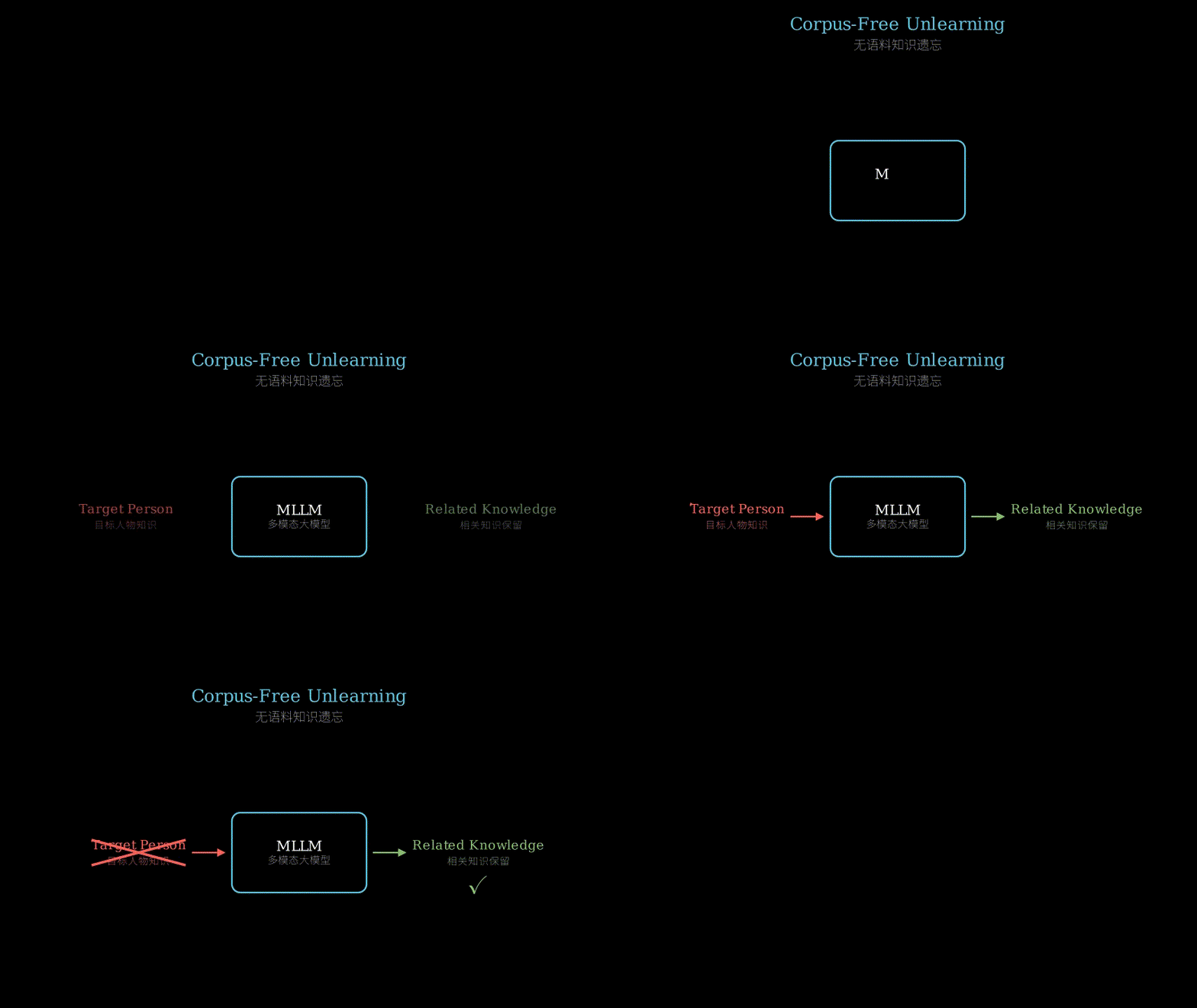
Paper: 2608.11149 Authors: Huafeng Chen, Yueming Lyu, Ziyuan Chen, Wenda Tan, Chenyang Si, Liucheng Guo, Caifeng Shan Categories: cs.CV
The Gap
Machine unlearning for multimodal models has, until now, been studied under a convenient fiction: that whoever asks for deletion also hands you the data. The TOFU lineage and its multimodal descendants (MLLMU-Bench, CLEAR, MMUBench, FIUBench) all construct a forget set and a retain set, then evaluate methods — gradient ascent, GA+KL regularization, NPO, preference-optimization variants, single-image unlearning — that need both sets to compute a loss. The forget set tells the optimizer what to push down; the retain set tells it what not to break.
Real deletion requests do not look like that. Under a right-to-be-forgotten request you receive an identity: a name, possibly a photograph, possibly a short description. You do not receive the pretraining shards where that person appeared. You often cannot even enumerate what the model knows about them. So the entire loss-based machinery is unavailable at the moment you actually need it.
Two secondary gaps ride along. First, most benchmarks unlearn injected knowledge — fictitious profiles fine-tuned in specifically so the experiment is clean. That measures how well you can undo your own fine-tuning, not how well you can remove knowledge the model absorbed naturally from web-scale data, which is diffuse and redundantly encoded. Second, multimodal evaluation has been thin: if you suppress a name in text but a photograph still elicits the biography, you have not deleted anything, you have moved the doorknob.
PRMU targets all three at once: corpus-free requests, naturally acquired person knowledge, and probes that attack from both text and image sides plus fine-grained locality tiers.
[Real deletion request: only a name + a face]
                 |
                 v
[Problem] MLLM unlearning methods require forget corpus + retain corpus
          and mostly test undoing self-injected knowledge
                 |
                 v
[Assumption] target person knowledge is reachable as a key direction
             and nearby knowledge can be shielded by projection
                 |
                 v
[Method] PRMU benchmark: corpus-free probes + adversarial reactivation
         + locality tiers
         SGPE baseline: gate -> displace -> project -> cross-modal control
                 |
                 v
[Evidence] aggressive forgetting == locality collapse for baselines
           text-side forgetting gets reactivated by images
           SGPE holds a better point on the trade-off curve
                 |
                 v
[Conclusion] corpus-free person-centric unlearning is open
             local gated editing beats corpus-style optimization here
The Increment
One sentence: Before, “multimodal unlearning” meant fine-tuning a model against a curated forget set; after, there is a benchmark that removes that crutch and shows most existing methods were quietly depending on it.
Core Mechanism
PRMU is the primary contribution, so start there. A request is an identity, not a dataset. The benchmark then probes the model from several angles: direct textual questions about the person, image-conditioned questions using photographs, paraphrased and indirect questions, and adversarial reformulations designed to reactivate suppressed knowledge (asking about the role instead of the name, showing the face without naming, multi-hop routes into the same fact). Against that it measures locality at several radii — other attributes of related-but-not-targeted people, visually or nominally similar identities, co-occurring entities, and general multimodal utility that has nothing to do with people at all. The scoring is a trade-off surface, not a single number: how much forgetting per unit of collateral damage.
SGPE, the accompanying baseline, is deliberately lightweight and has three moving parts. Knowledge displacement replaces destruction: rather than driving the target’s output probability toward zero (which is what makes gradient ascent collapse into gibberish and drag neighbors down with it), SGPE rewrites the target’s value vector toward a neutral “no information about this person” response. The knowledge slot survives; only its contents are swapped. Protected parameter-space editing handles the collateral problem: the weight update is projected into the null space of a set of protected key directions harvested from neighboring identities and general capabilities, so the edit can only move in the directions no one else is using. Locality-aware multimodal control is a similarity gate at inference: the edited pathway only activates when the incoming hidden state is close enough to the target’s key, and that key is built to respond to both textual and visual evidence of the person — which is what closes the image-reactivation hole.
   text probe                  image probe
   who is X                    [photo of X]
        |                           |
        +------------+--------------+
                     |
                     v
          [ encode ] -> hidden state h
                     |
                     v
        + - - - - - - - - - - - - - - - +
        |  SIMILARITY GATE              |
        |  s = cos( h . k_target )      |
        |  compare s with tau           |
        + - - - - - - - - - - - - - - - +
              |                    |
           s < tau              s > tau
              |                    |
              v                    v
      [ original FFN ]      [ edited FFN path ]
              |                    |
              |            v_target => v_neutral
              |            (displacement not deletion)
              |                    |
              |       dW = P * ( v_neutral - v_target ) * k_target^T
              |       P = projector onto null space of K_protected
              |                    |
              +---------+----------+
                        v
                  [ decode ]
         no information available about this person
Think of the model’s feed-forward layers as a mailroom. Every pigeonhole is keyed by who a letter is about, and the sorting machine’s wiring decides which pigeonhole a letter lands in. A corpus-based unlearning method is the equivalent of being handed every letter that ever mentioned Alice and told to burn them plus rewire the machine — but in a real deletion request you get a slip of paper with her name and a photo, and nothing else.
SGPE is the mailroom clerk’s answer. It does not smash Alice’s pigeonhole (that is gradient ascent, and it takes out the shelf brackets holding up Bob’s and Alicia’s boxes too). Instead it slides in a redirect slip: letters for Alice go to the “unknown resident” bin — that is knowledge displacement. When the clerk rewires the sorting machine to honor the redirect, he first tapes over every wire that other residents’ deliveries depend on and only splices into the slack that is left — that is the null-space projection. And the redirect is not applied blindly to everything: the clerk checks each envelope and only diverts it if the address really matches Alice, so mail for Alicia two streets over passes through untouched — that is the similarity gate with threshold tau. Finally, he checks both the written name *and the photo taped to the envelope, because otherwise anyone can bypass the redirect by mailing a picture — that is the cross-modal control.
The metaphor also predicts the method’s weakness: a redirect slip is not a deletion. The original address still exists in the machine; someone who knows the internal wiring can read past the slip.
Key Concepts
-
Corpus-free unlearning: Standard unlearning is like being asked to remove a chapter when you have both the chapter and the rest of the book in front of you — you can compute exactly what to suppress and what to preserve. Corpus-free means you get a Post-it saying “remove chapter about Alice” and the book is written in a language where Alice’s information is smeared across ten thousand pages you cannot search. All you can do is work from the request itself: derive a representation of “Alice” inside the model, then act locally around it. This is why the setting pushes methods toward model editing and away from fine-tuning — editing only needs a target, while fine-tuning needs examples.
-
Fine-grained locality: “Did the edit break anything?” is too coarse a question, because damage falls off with distance. Concretely: after deleting Bill from the model, does it still know his co-founder? Does it still answer about a different Bill? Does it still recognize faces that look like his? Does it still caption a photograph of a bicycle correctly? These are four different radii, and a method can pass the outermost (general utility intact) while catastrophically failing the innermost (all similar identities collapse to “unknown”). PRMU’s contribution here is insisting on the tiers rather than one aggregate retain score.
-
Knowledge reactivation: Suppression is not removal. If you train a model to refuse “who is this person” but it still completes “the founder of the company that made Windows was ___”, the fact is intact and only the front door is locked. Multimodal models have an extra door: the image encoder. A face is a query that never touches the tokens you trained against. Adversarial reactivation probes are the security-testing equivalent of trying the windows after someone changed the lock — and per the paper, existing methods fail this consistently.
Framework Shift
Before (corpus-driven unlearning):     After (request-driven editing):

  [forget corpus] [retain corpus]        [name] + [face photo]
         |              |                        |
         +------+-------+                        v
                v                       [ locate target key k ]
    [ GA / GA+KL / NPO / DPO loss ]              |
                |                                v
                v                       [ gate: fire only near k
    [ all weights drift together ]        across text AND image ]
                |                                |
                v                                v
    forgetting strength                 [ edit inside null space
      ~ collateral damage                 of protected keys ]
                |                                |
                v                                v
    text-only forgetting               one resident relocated
    image path still leaks             neighbors left standing
From optimizing a model against data you were given, to surgically rewriting a model around a pointer you were given — the core shift is treating deletion as an addressing problem instead of a training problem.
Expert Assessment
Problem choice: The gap is real, and it is the gap that matters for anyone who has to actually comply with a deletion request. The corpus assumption in TOFU-style benchmarks has always been an experimental convenience mistaken for a setting. That said, the framing is slightly oversold: knowledge editing (ROME, MEMIT, AlphaEdit and their multimodal cousins) has been “corpus-free” for years — what is new is naming the setting, building person-centric multimodal probes for it, and forcing forgetting methods to compete inside it. The more distinctive move is the insistence on *naturally acquired knowledge, which is much harder to benchmark honestly and is where I would have spent more of the paper.
Method maturity: SGPE is a competent composite, not an insight. Displacement-instead-of-destruction, null-space-protected updates, and similarity gating are each established ideas; the assembly plus the cross-modal key is the new part. The authors label it a baseline, which is the right posture. What nags is that a similarity gate over a target key is, functionally, a learned blocklist compiled into the weights — and the obvious simpler competitor is an explicit blocklist: a face-recognition plus name-matching filter at the input that returns a refusal. That would likely win on both forgetting and locality while being trivially reversible and clearly *not unlearning. A paper in this space needs to confront that baseline head-on and argue why weight-space matters (auditability, distillation robustness, no inference overhead), rather than leaving it implicit.
Experimental integrity: I cannot verify the tables from the abstract, so read the following as the checklist I would apply. Two structural risks stand out. First, the adversarial reactivation probes and the defense were designed by the same team, which biases in favor of SGPE unless the probes were frozen before the method existed. Second, SGPE has an explicit tunable knob (tau) that slides along the forgetting-locality trade-off, while baselines are typically reported at one operating point; if the comparison is single-point rather than full curves, the “competitive trade-off” claim is partly an artifact of tuning. The paper’s own headline finding — baselines collapse under *aggressive forgetting settings — also depends on who chose “aggressive.” The honest presentation is Pareto fronts for every method, and I would look for those first.
Writing quality: The abstract reads like the benchmark carried the paper and the method section was written second. The section most likely to be thin, and most in need of care, is the data construction and verification protocol: how do you establish that a given model *naturally knows fact F about person P before you ask it to forget F? Without a per-model knowledge-elicitation step, part of any forgetting score is measuring the removal of knowledge that was never there. Rewriting that protocol with explicit pre-verification, inter-probe agreement, and a report of how much target knowledge each backbone actually possessed would elevate the whole paper from a useful benchmark to a citable standard.
Verdict: weak accept — the setting is the right one and the probes are a genuine contribution, but the method is an assembly of known parts and the evaluation design has enough self-refereeing risk that the trade-off claims need full curves before I would believe them.
Takeaways
Things worth stealing regardless of whether you care about unlearning:
- Redirect, do not destroy. Any time you want a model to stop producing X, rewriting X’s target toward a specific benign output is more stable than minimizing X’s likelihood. Unbounded suppression objectives have no floor, so they keep pushing until representations degrade; a displacement target gives the optimizer somewhere to stop. This transfers directly to safety fine-tuning and refusal training.
- Gate the edit instead of globalizing it. Wrapping a weight modification in a runtime similarity check turns a broad behavioral change into a narrow one and makes locality a tunable parameter rather than a hope. Useful for any per-entity or per-tenant behavior override.
- Project into the null space of what you want to protect. Collect key directions for the capabilities you cannot afford to lose, project your update orthogonal to them. Cheap, general, and applicable to any localized weight surgery — not just deletion.
- Test every modality after suppressing one. The generalizable red flag: a suppression that was trained on text and never audited against images. The same applies to code versus prose, one language versus another, tool-call format versus chat format. Any channel you did not test is an open channel.
- Design evaluations as distance tiers, not pass/fail. “Did it break anything” hides the failure mode; “did it break things at radius 1, 2, 3” locates it. This is a reusable eval-design pattern for any intervention with a blast radius.
- A framing worth reusing: distinguish “you were given the data” from “you were given a pointer.” Whole classes of methods silently assume the former. Asking which of your own tools survive the latter is a productive way to find real gaps.
论文: 2608.11149 作者: Huafeng Chen, Yueming Lyu, Ziyuan Chen, Wenda Tan, Chenyang Si, Liucheng Guo, Caifeng Shan 分类: cs.CV
缺口
多模态模型的机器遗忘研究,一直建立在一个方便的假设上:提出删除请求的人,会顺手把数据也交给你。
从 TOFU 到它的多模态后代(MLLMU-Bench、CLEAR、MMUBench、FIUBench),全都要先构造一个”遗忘集”和一个”保留集”,然后评测那些必须同时依赖两个集合才能算出损失的方法——梯度上升、GA+KL、NPO、各种偏好优化变体、单图遗忘。
遗忘集告诉优化器该压低什么,保留集告诉它别弄坏什么。
但真实的删除请求不长这样。
被遗忘权请求送到你手上的是一个身份:一个名字,也许一张照片,也许一句简短描述。
不会附带这个人出现过的预训练数据分片。
你甚至常常无法枚举模型到底知道他什么。
于是在真正需要动手的那一刻,整套基于损失的机器全都用不上。
还有两个附带缺口。
第一,大多数基准遗忘的是”注入”进去的知识——为了实验干净而专门微调进去的虚构档案。
这衡量的是你撤销自己微调的能力,而不是移除模型从网络规模数据里自然吸收的知识的能力;后者是弥散的、冗余编码的,完全是另一个难度。
第二,多模态评测一直很薄:如果你在文本侧压住了名字,但一张照片仍能诱出完整生平,那你什么都没删掉,只是换了个门把手。
PRMU 一次性针对这三点:无语料请求、自然获得的人物知识、以及从文本和图像两侧同时进攻的探针加上细粒度的局部性分层。
[真实删除请求: 只有一个名字 + 一张脸]
                 |
                 v
[问题] 现有 MLLM 遗忘方法需要 forget 语料 + retain 语料
       且主要测试撤销自己注入的知识
                 |
                 v
[假设] 目标人物知识可以定位为一个 key 方向
       邻近知识可以靠投影屏蔽住
                 |
                 v
[方法] PRMU 基准: 无语料探针 + 对抗性重激活 + 局部性分层
       SGPE 基线: 门控 -> 位移 -> 投影 -> 跨模态控制
                 |
                 v
[证据] 基线在激进遗忘设置下 局部性直接崩塌
       文本侧遗忘掉的知识 被图像重新激活
       SGPE 在权衡曲线上占据更好的点
                 |
                 v
[结论] 无语料的人物知识遗忘远未解决
       在这个设定下 局部门控编辑优于语料式优化
增量
一句话:在这篇论文之前,“多模态遗忘”意味着拿一个精心构造的遗忘集去微调模型;在这之后,有了一个把这根拐杖抽掉的基准,并且暴露出大多数现有方法其实一直在偷偷依赖它。
核心机制
PRMU 才是主贡献,先说它。
请求是一个身份,不是一个数据集。
基准随后从多个角度探测模型:关于这个人的直接文本提问、用照片做条件的图像提问、改写和迂回提问,以及专门设计来重新激活被压制知识的对抗式重述(问角色而不提名字、只给脸不给名、绕多跳路径通向同一个事实)。
对应地,它在多个半径上度量局部性——相关但非目标人物的其他属性、外形或名字相似的身份、共同出现的实体,以及跟人物完全无关的通用多模态能力。
打分是一张权衡曲面,不是一个数字:每单位附带损伤能换来多少遗忘。
配套的 SGPE 基线刻意做得很轻,有三个部件。
知识位移用替换取代摧毁:它不把目标的输出概率压向零(正是这一点让梯度上升坍缩成胡言乱语,并把邻居一起拖下水),而是把目标的 value 向量改写为一个中性的”没有这个人的信息”的回答。
知识槽位保留下来,只换掉里面的内容。
受保护参数空间编辑处理附带损伤:权重更新被投影到一组受保护 key 方向的零空间里,这些方向从邻近身份和通用能力上采集而来,于是编辑只能在别人没用到的方向上移动。
局部性感知的多模态控制是推理时的相似度门:只有当输入的隐状态足够靠近目标的 key 时,编辑路径才被激活;而这个 key 被构造成对该人物的文本证据和视觉证据都有响应——这正是堵住图像重激活漏洞的关键。
   文本探针                    图像探针
   who is X                    [photo of X]
        |                           |
        +------------+--------------+
                     |
                     v
          [ encode ] -> hidden state h
                     |
                     v
        + - - - - - - - - - - - - - - - +
        |  SIMILARITY GATE              |
        |  s = cos( h . k_target )      |
        |  compare s with tau           |
        + - - - - - - - - - - - - - - - +
              |                    |
           s < tau              s > tau
              |                    |
              v                    v
      [ original FFN ]      [ edited FFN path ]
              |                    |
              |            v_target => v_neutral
              |            ( displacement not deletion )
              |                    |
              |       dW = P * ( v_neutral - v_target ) * k_target^T
              |       P = projector onto null space of K_protected
              |                    |
              +---------+----------+
                        v
                  [ decode ]
             no information about this person
把模型的前馈层想成一间邮件分拣室。
每个信格按”这封信是关于谁的”编号,分拣机的接线决定信落进哪个格子。
基于语料的遗忘方法,等于有人把历史上所有提到 Alice 的信件都搬来交给你,让你烧掉并重新接线——可现实中的删除请求只给你一张写着她名字的纸条和一张照片,别的什么都没有。
SGPE 是分拣员的答案。
它不砸掉 Alice 的信格(那是梯度上升,顺手会把撑着 Bob 和 Alicia 格子的隔板一起打断)。
它塞进一张改投单:寄给 Alice 的信统一送到”未知住户”箱——这就是知识位移。
当他要在分拣机上改线来落实这张改投单时,先用胶带把其他住户投递所依赖的每一根线全都封住,只在剩下的松弛处接线——这就是零空间投影。
而改投单不是无脑对所有信生效:分拣员逐封检查,只有地址确实匹配 Alice 才改投,隔两条街的 Alicia 的信照常通过——这就是阈值 tau 的相似度门。
最后,他既看写的名字,也看贴在信封上的照片,否则任何人只要寄张照片就能绕过改投——这就是跨模态控制。
这个核喻同时预测了方法的弱点:改投单不等于删除。
原始地址仍然刻在机器里,懂内部接线的人可以绕过纸条读到它。
关键概念
-
无语料遗忘:标准遗忘像是让你删掉一章,而整章和整本书都摊在你面前——你可以精确算出该压什么、该保什么。无语料则是只给你一张便签写着”删掉关于 Alice 的那一章”,而这本书用一种语言写成,Alice 的信息糊在你搜不到的一万页里。你唯一能做的是从请求本身出发:在模型内部导出一个”Alice”的表示,然后在它周围做局部手术。这也解释了为什么这个设定把方法推向模型编辑、推离微调——编辑只需要一个目标,微调需要样本。
-
细粒度局部性:“编辑弄坏东西了吗”这个问题太粗,因为损伤随距离衰减。具体点说:把 Bill 从模型里删掉后,它还知道他的联合创始人吗?还能回答另一个叫 Bill 的人吗?还认得出长得像他的脸吗?还能正确描述一张自行车照片吗?这是四个不同半径,一个方法完全可能通过最外圈(通用能力完好)却在最内圈灾难性失败(所有相似身份统统变成”未知”)。PRMU 的贡献就在于坚持分层,而不是给一个聚合的 retain 分数。
-
知识重激活:压制不是移除。如果你训练模型拒答”这个人是谁”,它却仍然会补全”做出 Windows 的那家公司的创始人是 ___“,那这个事实完好无损,只是前门被锁了。多模态模型还多一道门:图像编码器。一张脸是一个从不经过你训练过的那些 token 的查询。对抗性重激活探针相当于安全测试里”换了锁之后去试试窗户”——按论文的说法,现有方法在这一项上稳定地失败。
框架转变
之前 ( 语料驱动的遗忘 ):                之后 ( 请求驱动的编辑 ):

  [forget 语料] [retain 语料]            [名字] + [人脸照片]
         |              |                        |
         +------+-------+                        v
                v                       [ 定位目标 key k ]
    [ GA / GA+KL / NPO / DPO 损失 ]              |
                |                                v
                v                       [ 门控: 仅在 k 附近触发
    [ 全部权重一起漂移 ]                  文本 与 图像 都算 ]
                |                                |
                v                                v
    遗忘强度 ~ 附带损伤                 [ 在受保护 key 的零空间内
                |                         做编辑 ]
                v                                |
    只忘了文本侧                                  v
    图像通路仍然泄漏                    一位住户被搬走
                                        邻居全都站着
一句话:从”用给定的数据去优化模型”,到”围绕给定的指针去精确改写模型”,核心转变是把删除当成寻址问题而不是训练问题。
专家评审
选题眼光:缺口是真的,而且正是所有真要落地合规的人面对的那个缺口。
TOFU 系基准里的语料假设,一直是被当成设定来对待的实验便利。
不过框架有点被抬高了:知识编辑(ROME、MEMIT、AlphaEdit 及其多模态变体)本来就”无语料”好几年了——新的是给这个设定起名、为它造出以人物为中心的多模态探针、并逼着遗忘类方法进这个场子里比。
更有辨识度的动作其实是坚持用自然获得的知识,这件事诚实地做基准要难得多,也是我认为这篇论文本该花更多篇幅的地方。
方法成熟度:SGPE 是一个称职的组合,不是一个洞见。
“位移而非摧毁”、“零空间保护更新”、“相似度门控”三样各自都是成熟想法,新的部分是这套组装加上跨模态的 key。
作者自己把它定位成 baseline,这个姿态是对的。
真正扎人的地方是:一个建立在目标 key 上的相似度门,功能上就是一个编译进权重里的可学习黑名单——而最明显的更简单竞争者是显式黑名单:在输入端加人脸识别加名字匹配,命中就拒答。
那玩法很可能在遗忘和局部性上双赢,同时极易被撤销、并且显然不是遗忘。
这个领域的论文必须正面处理这个基线,论证权重空间为什么重要(可审计、蒸馏后仍成立、无推理开销),而不是把它默默放过。
实验诚意:我无法从摘要验证表格,所以下面按”我会拿去核对的清单”来读。
两个结构性风险很突出。
第一,对抗性重激活探针和防御方法是同一批人设计的,除非探针在方法成型前就冻结,否则天然偏向 SGPE。
第二,SGPE 有一个显式可调旋钮(tau)在遗忘-局部性权衡上滑动,而基线通常只报一个工作点;如果对比是单点而非完整曲线,“有竞争力的权衡”就有一部分是调参产生的假象。
论文自己的头条发现——基线在激进遗忘设置下崩塌——同样取决于是谁定义了”激进”。
诚实的呈现方式是给每个方法画帕累托前沿,我会先去找这个。
写作功力:摘要读起来像是基准撑起了整篇论文,方法部分是后写的。
最可能偷懒、也最需要下功夫的是数据构造与验证协议:你怎么确认某个模型在被要求遗忘之前,本来就自然地知道关于人物 P 的事实 F?
没有逐模型的知识诱导步骤,任何遗忘分数里都掺着”移除了本来不存在的知识”的水分。
把这一节重写成带显式前置验证、探针间一致性、以及各 backbone 实际掌握了多少目标知识的报告,能把整篇论文从一个好用的基准提升为一个可被引用的标准。
判决:弱接收 —— 设定选得对、探针是真贡献,但方法是已知部件的组装,且评测设计存在足够的”自己当裁判”风险,在看到完整权衡曲线之前我不会相信那些权衡结论。
要点总结
不管你关不关心遗忘,下面这些值得偷:
- 改投而非销毁。 任何时候你想让模型停止产生 X,把 X 的目标改写为一个具体的良性输出,都比最小化 X 的似然更稳。无界的压制目标没有下限,会一直推到表示劣化为止;位移目标给优化器一个停下来的地方。这条可以直接搬到安全微调和拒答训练。
- 给编辑加门,而不是让它全局生效。 用一个运行时相似度检查把权重修改包起来,就把一次宽泛的行为改变变成窄的,并让局部性成为可调参数而不是一种祝愿。适用于任何按实体、按租户的行为覆盖。
- 投影到你要保护的东西的零空间里。 采集你不能损失的能力对应的 key 方向,让更新与它们正交。便宜、通用,适用于任何局部权重手术,不限于删除。
- 压制了一个模态之后,去测所有模态。 可泛化的红旗是:一个在文本上训练、却从未在图像上审计过的压制。同理适用于代码 vs 散文、一种语言 vs 另一种、工具调用格式 vs 聊天格式。你没测过的通道就是敞开的通道。
- 把评测设计成距离分层,而不是通过/不通过。 “有没有弄坏东西”掩盖失败模式,“在半径 1、2、3 上有没有弄坏”能定位它。这是任何带爆炸半径的干预都能复用的评测设计模式。
- 一个值得复用的思维框架:区分”数据交给了你”和”只给了你一个指针”。整整一类方法都在默默假设前者。问一句”我手上的工具在后者下还有哪些能活”,是找真缺口的高产办法。