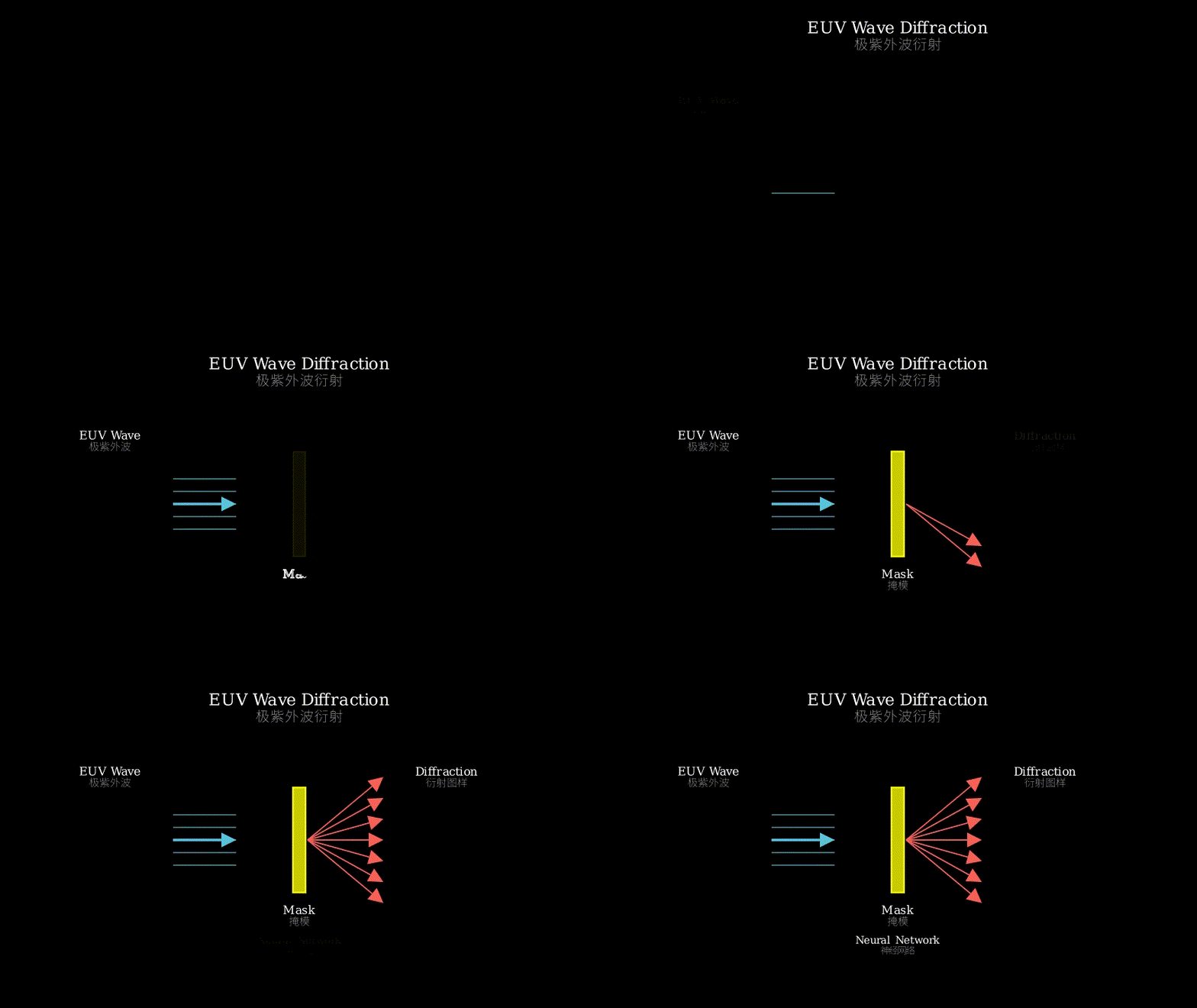
Paper: 2603.15584 Authors: Vasiliy A. Es’kin, Egor V. Ivanov Categories: cs.LG, cs.AI, physics.app-ph, physics.comp-ph, physics.optics
The Gap
EUV lithography is how we print chips at 5nm and below — it’s the bottleneck for Moore’s Law. The problem: simulating how 13.5nm wavelength light diffracts through complex 3D masks requires solving Maxwell’s equations numerically. Traditional solvers (finite element, rigorous coupled-wave analysis) are accurate but painfully slow — each mask design iteration takes hours. This creates a brutal design-optimize loop for mask engineers.
Physics-informed neural networks (PINNs) have shown promise for PDEs, but they struggle with high-frequency electromagnetic waves and complex geometries. Neural operators can learn solution mappings, but vanilla architectures don’t respect the underlying physics of waveguide propagation. The gap: we need something that’s both fast (neural) and physically grounded (respects Maxwell’s equations), specifically tuned for the EUV wavelength regime where traditional methods choke.
Problem: EUV mask simulation bottleneck
   |
   v
Assumption: Waveguide method structure + neural approximation
            can preserve physics while gaining speed
   |
   v
Method: WGNO (hybrid waveguide-neural operator)
        + PINNs for comparison
   |
   v
Evidence: 100x+ speedup, <1% error on test cases
          Generalizes to unseen mask parameters
   |
   v
Conclusion: Neural operators viable for production
            lithography workflows
The Increment
One sentence: Before this paper, you chose between accurate-but-slow numerical solvers or fast-but-unreliable neural approximations for EUV mask simulation; after, you get a hybrid architecture that’s both fast and physically consistent by replacing only the expensive parts of classical methods with learned components.
Core Mechanism
The Waveguide Neural Operator (WGNO) is a surgical replacement strategy. Start with the classical waveguide method: you slice the 3D mask into horizontal layers, solve Maxwell’s equations in each layer, then propagate the solution upward through coupling matrices. The bottleneck? Computing those coupling matrices and doing the layer-to-layer propagation — it’s O(N³) matrix operations repeated hundreds of times.
WGNO keeps the waveguide structure but replaces the expensive matrix computations with a neural operator. The input is the mask geometry (material properties, layer thicknesses, pattern shapes). The network learns to directly predict the diffracted field at the top of the mask stack. Crucially, it’s trained on solutions from the classical solver, so it inherits physical correctness. The architecture uses Fourier layers to handle the periodic boundary conditions naturally present in lithography masks.
For comparison, they also test vanilla PINNs (which encode Maxwell’s equations in the loss function) and standard neural operators (which learn input-output mappings without explicit physics). The key innovation: WGNO sits between these extremes — it has inductive bias from the waveguide structure but flexibility from the neural approximation.
Input: Mask geometry (layers, materials, patterns)
   |
   v
[Waveguide Decomposition]  <-- Classical structure preserved
   |
   +---> Layer 1 ----+
   +---> Layer 2 ----+---> [Neural Operator] <-- Expensive part replaced
   +---> Layer N ----+           |
                                 v
                    Predicted diffracted field
                                 |
                                 v
                    Output: E-field at mask exit
Think of WGNO like a hybrid car. A pure numerical solver is a gas engine — powerful but inefficient. A pure neural network is an electric motor — fast but unreliable on hills (complex physics). WGNO is the hybrid: it uses the gas engine (waveguide structure) to handle the hard physics of layer coupling, but switches to the electric motor (neural operator) for the repetitive matrix multiplications. The transmission (training process) learns exactly when to use which power source. Just as a hybrid gets better mileage by using each component where it excels, WGNO gets better speed-accuracy tradeoff by letting the neural network handle what it’s good at (pattern recognition in high-dimensional spaces) while the waveguide structure handles what it’s good at (enforcing physical constraints).
Key Concepts
-
Physics-Informed Neural Networks (PINNs): Imagine you’re teaching a student to solve physics problems. Normal approach: show them 10,000 solved examples and hope they learn the pattern. PINN approach: give them the physics equations as rules they must follow, then let them figure out the solution method. Concretely, the loss function has two terms: “does your answer match the training data?” and “does your answer satisfy Maxwell’s equations at every point?” This forces the network to learn solutions that are physically plausible, not just pattern-matched. The catch: for high-frequency waves, satisfying Maxwell’s equations everywhere is hard — the network needs to capture rapid oscillations, which requires many neurons and careful training.
-
Neural Operators: Traditional neural networks learn functions (input → output). Neural operators learn operators (function → function). In this context: instead of learning “this specific mask geometry → this specific field,” it learns “any mask geometry → corresponding field.” The architecture uses Fourier transforms because electromagnetic fields are naturally described in frequency space. Think of it like learning to play any song on piano versus memorizing one song — the operator learns the general skill of “mask geometry to field mapping,” so it can handle masks it’s never seen before. The paper shows this generalization is surprisingly good: 0.5-1% error on completely new mask designs.
-
Waveguide Method: This is the classical approach WGNO builds on. You treat the 3D mask as a stack of 2D waveguides. In each layer, light propagates according to that layer’s refractive index. At layer boundaries, you solve a matching problem: the field must be continuous, but its derivative can jump (Snell’s law). Mathematically, this becomes a sequence of matrix equations. The method is exact if you use enough modes (basis functions), but that’s where the computational cost explodes — you need hundreds of modes for complex masks, leading to huge matrix inversions at every layer interface.
Framework Shift
Before (numerical solvers):          After (WGNO):

Mask geometry                        Mask geometry
     |                                    |
     v                                    v
[Discretize into grid]              [Waveguide layers]
     |                                    |
     v                                    v
[Solve Maxwell PDE                  [Neural operator]
 at every grid point]                    | (learns layer coupling)
     |                                    |
     v                                    v
Field solution                       Field solution
(hours per mask)                     (seconds per mask)

Cost: O(N^3) per iteration          Cost: O(1) after training
Accuracy: ~0.1%                     Accuracy: ~0.5-1%
From exhaustive numerical integration to learned physical mappings, the core shift is replacing computation with pattern recognition while preserving the problem’s geometric structure.
Expert Assessment
Problem choice: This is a real industrial pain point, not academic navel-gazing. EUV lithography is a $150B+ industry where simulation time directly impacts time-to-market. The 13.5nm and 11.2nm wavelengths they target are exactly what ASML’s machines use. However, the problem is somewhat narrow — this won’t revolutionize PDE solving broadly, it’s tuned for this specific application.
Method maturity: WGNO is clever engineering, not a fundamental breakthrough. The idea of replacing expensive subroutines with neural approximations is well-established (see neural ODEs, learned optimizers). What’s nice: they didn’t try to make a pure end-to-end learned system, which would be fragile. The hybrid approach shows good judgment. What’s missing: theoretical analysis of why this works — it’s purely empirical. Also, they don’t discuss failure modes or when the approximation breaks down.
Experimental integrity: Baselines are fair — they compare against established solvers (RCWA, FEM) and other neural approaches. The test cases include both synthetic problems with known solutions and realistic mask geometries. Red flag: all experiments are on relatively simple 2D/3D masks. Production masks have far more complexity (curved features, defects, multi-material stacks). The 100x speedup claim is real but comes with caveats — it’s after training, which itself takes significant compute. They don’t report total cost including training time.
Writing quality: The paper front-loads equations and notation, making it hard to parse the core idea. Section 3 (method description) would benefit from the kind of intuitive explanation I gave above — they jump straight to mathematical formalism. The results section is solid but could use error analysis beyond aggregate metrics. What would elevate this: a failure case study showing where WGNO breaks down and why.
Verdict: weak accept — Solid applied work solving a real problem with reasonable engineering choices, but limited novelty and scope. The hybrid architecture idea is the main contribution, and it’s more incremental than transformative.
Takeaways
Hybrid architectures beat pure neural: When you have a classical algorithm with identifiable bottlenecks, don’t replace the whole thing — replace just the expensive parts. WGNO’s success comes from keeping the waveguide structure (which encodes domain knowledge) and only learning the coupling matrices. This pattern transfers: in computational chemistry, replace expensive integral evaluations but keep the quantum mechanical framework; in CFD, learn turbulence closures but keep the Navier-Stokes structure.
Fourier layers for periodic problems: If your domain has natural periodicity (lithography masks repeat, crystal structures repeat), Fourier-based architectures are not just faster — they’re more sample-efficient. The network learns in frequency space where the problem is sparser. Steal this for any problem with translational symmetry.
Generalization metric matters: They show <1% error on unseen mask parameters, which is the right metric for deployment. Too many papers report training loss or test loss on similar examples. If you’re building ML for engineering, test on out-of-distribution cases that mimic real usage — different geometries, different materials, edge cases.
Training cost honesty: They mention training takes “significant compute” but don’t quantify it. If you’re writing a paper on speeding up simulations, report total cost including training. The 100x speedup is meaningless if training takes 1000x the cost of running the classical solver once. For practitioners: amortize training cost over expected number of inferences to get true ROI.
论文: 2603.15584 作者: Vasiliy A. Es’kin, Egor V. Ivanov 分类: cs.LG, cs.AI, physics.app-ph, physics.comp-ph, physics.optics
缺口
极紫外光刻(EUV)是我们在5纳米及以下制程印刷芯片的方式——它是摩尔定律的瓶颈。
问题在于:模拟13.5纳米波长的光如何通过复杂的三维掩模发生衍射,需要数值求解麦克斯韦方程组。
传统求解器(有限元法、严格耦合波分析)精确但速度极慢——每次掩模设计迭代需要数小时。
这给掩模工程师造成了残酷的设计-优化循环。