
Paper: 2603.06569 Authors: Boqiang Zhang, Lei Ke, Ruihan Yang, Qi Gao, Tianyuan Qu, Rossell Chen, Dong Yu, Leoweiliang Categories: cs.CV
The Gap
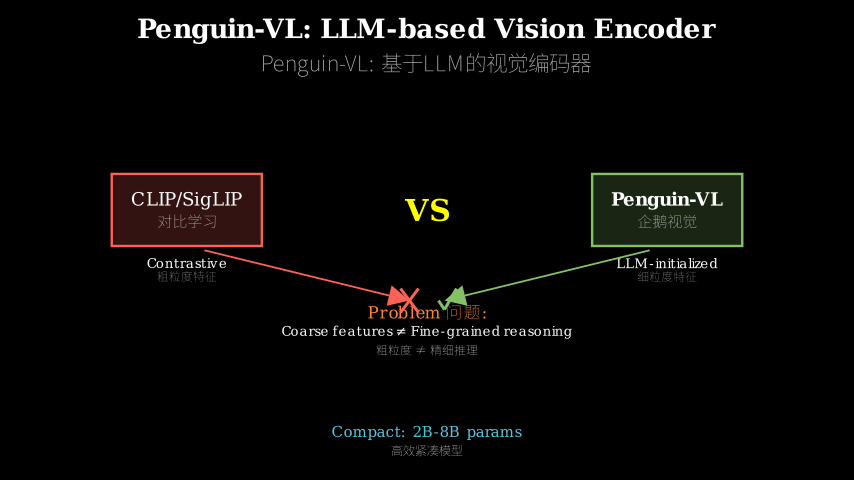
Vision-language models have hit a wall: everyone assumes you need CLIP or SigLIP as your vision encoder. The field has been scaling model size (10B, 30B parameters) to compensate for what’s actually a representation problem. CLIP-style encoders are trained via contrastive learning—matching images to text captions—which teaches them to recognize “this is a cat” vs “this is a dog” but throws away the fine-grained details needed for tasks like reading documents, counting objects, or understanding spatial relationships.
The specific limitation: contrastive pretraining optimizes for discrimination (category-level matching), not reconstruction (preserving visual details). This creates an objective mismatch when you plug these encoders into VLMs that need to generate dense captions, solve math problems from diagrams, or track objects across video frames. Prior work (Qwen2-VL, InternVL) just scaled up—bigger models, more parameters—without questioning whether the vision encoder itself is the bottleneck.
Problem: VLMs need fine-grained visual details
   |
   v
Assumption: CLIP's contrastive learning discards these details
   |
   v
Method: Initialize vision encoder from text-only LLM instead
   |
   v
Evidence: 2B model matches 8B CLIP-based models on benchmarks
   |
   v
Conclusion: Representation quality > model size
The Increment
One sentence: Before this paper, compact VLMs were stuck with CLIP’s coarse representations; after, you can get better visual understanding from a 2B model by ditching contrastive pretraining entirely.
Core Mechanism
Penguin-VL replaces the standard CLIP vision encoder with what they call Penguin-Encoder: a vision transformer initialized from the weights of a text-only language model (specifically, Qwen2.5). Here’s how it works: take a pretrained LLM’s transformer blocks, add a lightweight vision-specific adapter on top (a few projection layers), then train this hybrid on image-text pairs. The key insight is that LLMs already learned rich representations from massive text corpora—representations that capture relationships, hierarchies, and compositional structure. These transfer surprisingly well to visual data.
The architecture has three components: (1) Penguin-Encoder processes images into patch embeddings, (2) a projection layer maps these to the LLM’s embedding space, (3) the language model (Qwen2.5-2B or 8B) generates text conditioned on both image and text tokens. During training, they use a two-stage approach: first, align the vision encoder to the LLM’s representation space using image-caption pairs; second, fine-tune the entire system on instruction-following data (VQA, reasoning tasks).
Input Image
    |
    v
[Penguin-Encoder]  <-- initialized from LLM weights
    | (patch embeddings)
    v
[Projection Layer]
    | (aligned tokens)
    v
[Language Model] --> Generated Text
    ^
    |
Text Input
Think of it like this: imagine you’re teaching someone to describe paintings. The CLIP approach is like training them by showing pairs of paintings and one-word labels (“landscape”, “portrait”) and asking “do these match?” They get good at categorization but terrible at noticing brushstroke details. The Penguin approach is like taking someone who’s already a skilled writer (the LLM) and teaching them to look at paintings—they bring their existing ability to construct detailed descriptions and just need to learn how to “see”. The LLM’s pretrained weights are the writing skill; the vision adapter is the eye training. Because the foundation is already strong, you need less training data and fewer parameters to achieve detailed visual understanding.
Key Concepts
-
Objective Mismatch: Contrastive learning (CLIP’s training method) teaches a model to answer “are these two things similar?” by pulling matching pairs together and pushing non-matching pairs apart in embedding space. This is great for retrieval (“find images of cats”) but actively harmful for generation tasks. Why? Because to make “cat” and “kitten” have similar embeddings, you must discard the differences—exact fur patterns, whisker count, eye color. VLMs need those differences to generate accurate descriptions or solve visual reasoning problems. It’s like training a detective to only notice whether someone is “suspicious” or “not suspicious” and then asking them to write a detailed witness report.
-
LLM Weight Initialization: Instead of training a vision encoder from scratch or using CLIP, Penguin copies the weights from a text-only language model into the vision transformer. This works because transformers are architecture-agnostic—the same self-attention mechanism that processes word sequences can process image patch sequences. The pretrained weights encode general relational reasoning (how parts compose into wholes, how context modifies meaning) that transfers across modalities. Concretely: if an LLM learned that “red” and “apple” often co-occur, that statistical pattern helps the vision encoder recognize red regions in apple images, even before seeing a single image during pretraining.
-
Data Efficiency: Penguin-VL achieves comparable performance to larger models while training on less data. This isn’t magic—it’s because the LLM initialization provides a better starting point. Think of it like learning to play piano after already playing guitar vs starting from zero: the finger dexterity and music theory transfer, so you need fewer piano-specific practice hours. The vision encoder inherits compositional reasoning from the LLM, so it needs fewer image-text pairs to learn visual grounding. The paper shows this explicitly: their 2B model matches 8B CLIP-based models, suggesting the representation quality compensates for parameter count.
Framework Shift
Before (mainstream approach):        After (this paper):

[CLIP Encoder]                       [LLM Weights]
     |                                     |
  (trained on                           (copy)
   image-text                             |
   contrastive                            v
   pairs)                          [Vision Encoder]
     |                                     |
     v                                  (fine-tune
[Frozen Features]                      on images)
     |                                     |
     v                                     v
[Language Model]                    [Language Model]
     |                                     |
     v                                     v
  Output                               Output

Key: Separate vision                Key: Unified representation
     pretraining phase                    from language knowledge
From “train vision and language separately, then glue them together” to “bootstrap vision understanding from language knowledge directly”, the core shift is treating visual reasoning as a specialization of general relational reasoning rather than a separate modality requiring separate pretraining.
Expert Assessment
Problem choice: This is a real gap, not manufactured. The field has been throwing compute at VLMs (30B+ parameter models) while ignoring that CLIP’s design assumptions don’t align with VLM use cases. The timing is right—edge deployment is becoming critical, and the “just scale it” approach is hitting practical limits. However, the framing as “exploring efficiency limits” undersells the conceptual contribution: this is really about questioning the CLIP orthodoxy.
Method maturity: This is clever insight, not brute force. The core idea—LLM weights transfer to vision—is simple and testable. But there’s a missed opportunity: the paper doesn’t deeply investigate why this works. Is it the attention patterns? The layer normalization statistics? The positional encoding structure? A more thorough mechanistic analysis would strengthen the contribution. Also, they don’t compare against other non-contrastive vision pretraining methods (e.g., MAE, DINO), which would isolate whether LLM initialization specifically matters or if any non-contrastive approach would work.
Experimental integrity: The baselines are mostly fair—they compare against Qwen2-VL and InternVL, which are strong references. The benchmarks span diverse tasks (math, documents, video), which is good. However, there’s a red flag: they don’t report training compute or data volume in detail. “Data efficiency” claims need precise measurements—how many GPU hours, how many image-text pairs, what’s the convergence curve? Without this, we can’t verify whether the gains come from better initialization or just different hyperparameters. Also, the ablations focus on encoder choice but don’t isolate other variables (projection layer design, training schedule).
Writing quality: The abstract and introduction are strong—clear problem statement, bold claim. But the method section is rushed. They describe the architecture in half a page, then jump to results. A reader wanting to reproduce this would struggle. The ablation section (presumably in appendix) should be in the main paper—that’s where the scientific meat is. Also, they overuse “fine-grained” without defining it precisely: fine-grained spatial? Temporal? Semantic? The paper would benefit from a dedicated “Why This Works” section with visualizations of what CLIP vs Penguin encoders actually preserve.
Verdict: weak accept — The core idea is sound and the results are promising, but the paper feels like it’s hiding the most interesting parts (mechanistic analysis, detailed ablations) in favor of benchmark numbers.
Takeaways
For practitioners building VLMs: Don’t default to CLIP. If your task needs detailed visual understanding (OCR, diagram parsing, fine-grained VQA), try initializing your vision encoder from an LLM. The code is available, and the approach is a drop-in replacement.
For researchers: This paper suggests a broader principle: modality-specific pretraining might be overrated. If you’re working on audio-language or video-language models, consider whether your audio/video encoder really needs contrastive pretraining or if LLM weight transfer would work. The key question: does your downstream task need discrimination (matching) or generation (reconstruction)?
For efficiency-focused teams: The 2B model matching 8B models is the headline, but the real takeaway is that representation quality matters more than parameter count. Before scaling up, audit whether your bottleneck is model capacity or representation mismatch. This paper is evidence that architectural choices (what you initialize from) can substitute for scale.
Specific technique to steal: The two-stage training (alignment then instruction tuning) is standard, but the weight copying from LLM to vision encoder is novel and transferable. If you’re training any multimodal model, try initializing the non-language encoder from language model weights—it’s a simple experiment that might save you weeks of pretraining.
论文: 2603.06569 作者: Boqiang Zhang, Lei Ke, Ruihan Yang, Qi Gao, Tianyuan Qu, Rossell Chen, Dong Yu, Leoweiliang 分类: cs.CV
缺口
视觉语言模型遇到了瓶颈:所有人都认为必须用CLIP或SigLIP作为视觉编码器。
领域一直在扩大模型规模(10B、30B参数)来弥补本质上是表示问题的缺陷。
CLIP式编码器通过对比学习训练——匹配图像和文本标题——这教会它们识别”这是猫”vs”这是狗”,但丢弃了阅读文档、计数物体或理解空间关系等任务所需的细粒度细节。
具体局限:对比预训练优化的是判别(类别级匹配),而非重建(保留视觉细节)。
当你把这些编码器插入需要生成密集描述、从图表解数学题或跨视频帧追踪物体的VLM时,就产生了目标不匹配。
先前工作(Qwen2-VL、InternVL)只是扩大规模——更大的模型、更多参数——而没有质疑视觉编码器本身是否就是瓶颈。
问题: VLM需要细粒度视觉细节
   |
   v
假设: CLIP的对比学习丢弃了这些细节
   |
   v
方法: 改用纯文本LLM初始化视觉编码器
   |
   v
证据: 2B模型在基准测试上匹敌8B的CLIP模型
   |
   v
结论: 表示质量 > 模型规模
增量
一句话: 这篇论文之前,紧凑型VLM困在CLIP的粗糙表示里;之后,完全抛弃对比预训练,用2B模型就能获得更好的视觉理解。
核心机制
Penguin-VL用他们称为Penguin-Encoder的东西替换了标准CLIP视觉编码器:一个从纯文本语言模型(具体是Qwen2.5)权重初始化的视觉transformer。
工作原理:拿一个预训练LLM的transformer块,在上面加一个轻量级视觉专用适配器(几个投影层),然后在图像-文本对上训练这个混合体。
关键洞察是LLM已经从海量文本语料中学到了丰富表示——捕捉关系、层次和组合结构的表示。
这些表示出人意料地能迁移到视觉数据。
架构有三个组件:(1)Penguin-Encoder将图像处理成patch嵌入,(2)投影层将这些映射到LLM的嵌入空间,(3)语言模型(Qwen2.5-2B或8B)基于图像和文本token生成文本。
训练时采用两阶段方法:首先,用图像-标题对将视觉编码器对齐到LLM的表示空间;其次,在指令跟随数据(VQA、推理任务)上微调整个系统。
输入图像
    |
    v
[Penguin-Encoder]  <-- 从LLM权重初始化
    | (patch嵌入)
    v
[投影层]
    | (对齐的token)
    v
[语言模型] --> 生成文本
    ^
    |
文本输入
这样想:假设你在教人描述画作。
CLIP方法像是通过展示画作和单词标签对(“风景”、“肖像”)训练他们,问”这些匹配吗?”他们擅长分类但不擅长注意笔触细节。
Penguin方法像是找一个已经是熟练作家的人(LLM),教他们看画——他们带来现有的构建详细描述的能力,只需学会如何”看”。
LLM的预训练权重是写作技能;视觉适配器是眼睛训练。
因为基础已经很强,需要更少的训练数据和更少的参数就能实现详细的视觉理解。
关键概念
- 目标不匹配: 对比学习(CLIP的训练方法)教模型回答”这两个东西相似吗?”通过在嵌入空间中拉近匹配对、推远非匹配对。
这对检索(“找猫的图片”)很好,但对生成任务有害。
为什么?因为要让”猫”和”小猫”有相似嵌入,必须丢弃差异——确切的毛皮图案、胡须数量、眼睛颜色。
VLM需要这些差异来生成准确描述或解决视觉推理问题。
就像训练侦探只注意某人是”可疑”还是”不可疑”,然后让他们写详细的目击报告。
- LLM权重初始化: Penguin不是从头训练视觉编码器或使用CLIP,而是将纯文本语言模型的权重复制到视觉transformer中。
这有效是因为transformer与架构无关——处理词序列的自注意力机制同样能处理图像patch序列。
预训练权重编码了跨模态迁移的通用关系推理(部分如何组成整体、上下文如何修改含义)。
具体来说:如果LLM学到”红色”和”苹果”经常共现,这种统计模式帮助视觉编码器识别苹果图像中的红色区域,即使预训练期间没见过一张图像。
- 数据效率: Penguin-VL用更少数据训练就达到了更大模型的可比性能。
这不是魔法——是因为LLM初始化提供了更好的起点。
想象学钢琴:已经会吉他vs从零开始:手指灵活性和乐理知识迁移,所以需要更少的钢琴专项练习时间。
视觉编码器从LLM继承了组合推理,所以需要更少的图像-文本对来学习视觉基础。
论文明确展示了这点:他们的2B模型匹敌8B的CLIP模型,表明表示质量弥补了参数数量。
框架转变
之前(主流方法):                  之后(本文方法):

[CLIP编码器]                     [LLM权重]
     |                                |
  (在图像-文本                      (复制)
   对比对上                           |
   训练)                              v
     |                          [视觉编码器]
     v                                |
[冻结特征]                         (在图像上
     |                            微调)
     v                                |
[语言模型]                            v
     |                          [语言模型]
     v                                |
  输出                                v
                                   输出

关键:独立的视觉                关键:直接从语言知识
     预训练阶段                      统一表示
从”分别训练视觉和语言,然后粘合”到”直接从语言知识引导视觉理解”,核心转变是将视觉推理视为通用关系推理的特化,而非需要独立预训练的独立模态。
专家评审
选题眼光: 这是真缺口,不是人造的。
领域一直在给VLM砸算力(30B+参数模型),却忽视了CLIP的设计假设与VLM用例不对齐。
时机恰当——边缘部署变得关键,“直接扩大规模”的方法正碰到实际限制。
但是,将其框定为”探索效率极限”低估了概念贡献:这实际上是在质疑CLIP正统。
方法成熟度: 这是巧劲,不是蛮力。
核心想法——LLM权重迁移到视觉——简单且可测试。
但有个错失的机会:论文没有深入研究为什么有效。
是注意力模式?层归一化统计?位置编码结构?更彻底的机制分析会加强贡献。
另外,他们没有与其他非对比视觉预训练方法(如MAE、DINO)比较,这能隔离出LLM初始化是否特别重要,还是任何非对比方法都行。
实验诚意: 基线大体公平——他们与Qwen2-VL和InternVL比较,这些是强参考。
基准测试跨越多样任务(数学、文档、视频),这很好。
但有个警示:他们没有详细报告训练算力或数据量。
“数据效率”声明需要精确测量——多少GPU小时、多少图像-文本对、收敛曲线是什么?没有这些,我们无法验证收益来自更好的初始化还是只是不同的超参数。
另外,消融实验聚焦编码器选择但没有隔离其他变量(投影层设计、训练计划)。
写作功力: 摘要和引言很强——清晰的问题陈述、大胆的主张。
但方法部分仓促。
他们用半页描述架构,然后跳到结果。
想复现的读者会很困难。
消融部分(大概在附录)应该在正文——那才是科学精华。
另外,他们过度使用”细粒度”却没有精确定义:细粒度空间?时间?语义?论文会受益于专门的”为何有效”部分,配上CLIP vs Penguin编码器实际保留什么的可视化。
判决: 弱接收 — 核心想法扎实,结果有希望,但论文感觉在隐藏最有趣的部分(机制分析、详细消融),偏爱基准数字。
要点总结
对于构建VLM的实践者: 不要默认用CLIP。
如果你的任务需要详细视觉理解(OCR、图表解析、细粒度VQA),试试从LLM初始化视觉编码器。
代码可用,方法是即插即用的替代品。
对于研究者: 这篇论文暗示了更广泛的原则:模态专用预训练可能被高估了。
如果你在做音频-语言或视频-语言模型,考虑你的音频/视频编码器是否真的需要对比预训练,还是LLM权重迁移就行。
关键问题:你的下游任务需要判别(匹配)还是生成(重建)?
对于关注效率的团队: 2B模型匹敌8B模型是标题,但真正要点是表示质量比参数数量更重要。
扩大规模之前,审查你的瓶颈是模型容量还是表示不匹配。
这篇论文证明架构选择(从什么初始化)能替代规模。
可偷的具体技术: 两阶段训练(对齐然后指令调优)是标准的,但从LLM到视觉编码器的权重复制是新颖且可迁移的。
如果你在训练任何多模态模型,试试从语言模型权重初始化非语言编码器——这是个简单实验,可能为你省下数周预训练时间。