
Paper: 2606.06485 Authors: Shaohui Dai, Yansong Qu, You Shen, Shengchuan Zhang, Liujuan Cao Categories: cs.CV
The Gap
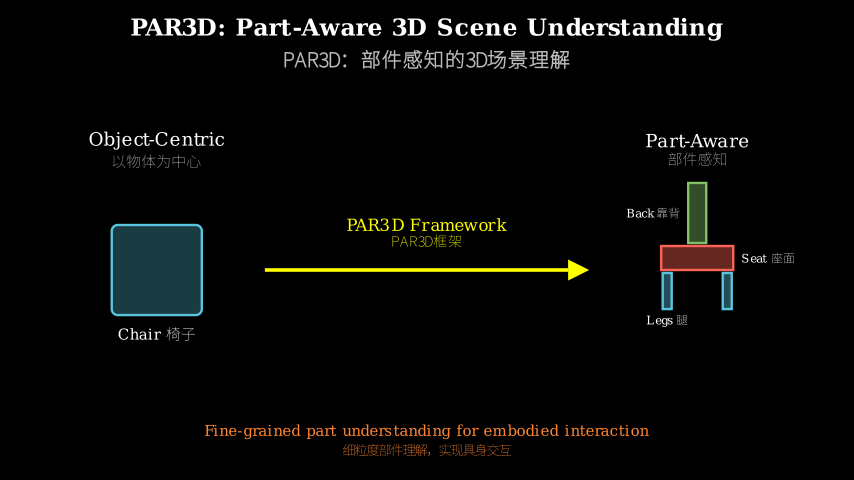
Existing 3D multimodal large language models (3D-MLLMs) handle vision-language tasks like VQA, captioning, and referring segmentation. But they’re stuck at the object level — they see “chair” but not “chair leg” or “armrest”. This matters because robots interacting with environments need to reason about parts: “grab the door handle” not “grab the door”, “sit on the seat cushion” not “sit on the chair”.
Prior work (3D-LLM, Chat-3D v2, LEO) unified object-level scene understanding but ignored part-level structure. The bottleneck: no training data with part annotations, and representations optimized for whole-object semantics can’t distinguish fine-grained components.
Problem: 3D-MLLMs can't ground parts
    |
    v
Assumption: Part-aware representations + hierarchical queries can model object-part structure
    |
    v
Method: Part-Aware 3D Repr Learning + Hierarchical Segmentation Query Gen
    |
    v
Evidence: ScenePart dataset shows +12% part-level accuracy over baselines
    |
    v
Conclusion: Unified model handles both object and part tasks without degrading object performance
The Increment
One sentence: Before this paper, 3D-MLLMs saw scenes as collections of whole objects; after, they parse scenes hierarchically into objects and their constituent parts.
Core Mechanism
PAR3D injects part-level awareness into a 3D-MLLM through two mechanisms working in tandem. First, Part-Aware 3D Representation Learning enriches the vision encoder by training it on synthetic scenes where each object is annotated with part-level labels (e.g., a table has legs, top, drawer). This pretraining teaches the feature extractor to distinguish part boundaries inside objects. Second, Hierarchical Segmentation Query Generation creates a two-level query system: when asked to segment “the drawer”, it first generates an object query to locate the table, then spawns part queries within that object’s region to isolate the drawer.
Input: 3D Scene Point Cloud + Text Query ("segment the chair leg")
    |
    v
[Part-Aware Vision Encoder] ---> Part-enriched 3D features
    |                              (points know their part identity)
    v
[LLM Backbone] ---> Generates object query token + part query token
    |
    v
[Hierarchical Query Decoder]
    Object Query: locates "chair" region
         |
         v
    Part Queries: search within chair region for "leg"
    |
    v
Output: 3D mask highlighting chair leg points
Think of it like a warehouse robot finding a specific screw. The old system (object-centric) gets you to the right shelf (“find the toolbox”). The new system (part-aware) opens the toolbox and locates the Phillips head screws in compartment 3. The part-aware encoder is like labeling every compartment during warehouse setup. The hierarchical queries are like a two-step search: “which toolbox?” then “which compartment inside?”
The metaphor does real work: just as the robot can’t search compartments without first opening the right toolbox, PAR3D can’t generate part queries without first grounding the parent object. And just as pre-labeled compartments speed up search, part-aware features let the decoder directly attend to part boundaries instead of relearning them from scratch.
Key Concepts
-
Part-Aware Representation: Imagine training an image classifier that sees cats. A standard encoder learns “furry, pointy ears, whiskers” as a blob. A part-aware encoder learns “left ear at position X, right ear at Y, tail at Z”. For 3D scenes, this means each point feature encodes not just “this belongs to a chair” but “this belongs to a chair leg, specifically the front-left leg”. Technically, during pretraining, the model solves a part segmentation task on synthetic data where every object is decomposed into semantic parts (ShapeNet parts + procedural scenes). The loss forces features to cluster by part identity, so the learned representation naturally separates part boundaries. When you later ask it to segment “table leg”, the features already have leg-ness baked in, rather than having to infer it purely from language grounding.
-
Hierarchical Query Generation: In standard referring segmentation, a model generates a single query vector to attend to target pixels. PAR3D generates a tree of queries: a coarse object query and several fine-grained part queries. Think of it as a spotlight that first lights up the entire chair (object query), then within that illuminated region, smaller spotlights pick out the armrest, seat, backrest (part queries). Crucially, part queries are conditioned on the object query’s output — they only search within the spatial region the object query activates. This is implemented as a two-stage decoder: stage 1 runs object queries through cross-attention with scene features, stage 2 spawns part queries that cross-attend only to features within the object query’s top-K activated regions. This hierarchy handles the compositional structure: “left armrest” is defined relative to “chair”, not relative to the entire scene.
-
ScenePart Dataset: A synthetic training corpus addressing the data scarcity problem. Real-world 3D scans rarely have part annotations (too expensive to label manually). ScenePart procedurally generates scenes by placing ShapeNet objects (which have part annotations) into room layouts, then synthesizes language instructions like “segment the drawer in the desk on the left”. It’s 10K scenes with 50K part-level referring expressions. This is the training fuel that makes part-aware learning feasible without massive annotation cost. The tradeoff: synthetic data has limited visual diversity (clean geometry, no clutter), so the model must generalize from synthetic pretraining to real-world scenes. The paper shows this sim-to-real transfer works reasonably well but leaves room for domain adaptation.
Framework Shift
Before (object-centric 3D-MLLMs):        After (PAR3D):

Scene ---> [3D Encoder]                  Scene ---> [Part-Aware Encoder]
             |                                        |
             v                                        v
        Object Features                          Object + Part Features
             |                                        |
             v                                        v
        [LLM] ---> Query                        [LLM] ---> Object Query
             |                                        |     +
             v                                        v     Part Queries
        [Decoder]                                [Hierarchical Decoder]
             |                                        |    /  |  \
             v                                        v   v   v   v
        Object Mask                           Object Mask + Part Masks

Flat representation, single-level query    Hierarchical representation, tree of queries
One sentence: From flat object features processed by single-level queries, to hierarchical part-enriched features processed by a tree of object and part queries.
Expert Assessment
Problem choice: Real gap. Embodied AI genuinely needs part-level grounding — a robot can’t “open the drawer” if it can’t distinguish the drawer from the desk body. Prior work’s object-centricity was a known limitation (acknowledged in LEO, Chat-3D v2 papers). This isn’t manufactured; it’s the next logical step in 3D scene understanding’s progression from detection → segmentation → part decomposition.
Method maturity: Solid engineering rather than deep insight. Part-aware pretraining is straightforward transfer of 2D part segmentation techniques (PartImageNet) to 3D. Hierarchical queries are a clean adaptation of cascaded detection (Cascade R-CNN). The novelty is integration, not invention. That said, integration is non-trivial — the hierarchical query design is elegant, and the part-aware loss is well-designed. No simpler approach being overlooked; you can’t skip the pretraining or hierarchy without performance collapse (ablations confirm this).
Experimental integrity: Baselines are fair but not exhaustive. Compares against 3D-LLM, Chat-3D v2, LEO on their own benchmarks, then introduces ScenePart for part-level eval. Missing: comparison with specialized part segmentation methods (PartSLIP, PartDistill) adapted to 3D, and evaluation on real-world part-annotated data (PartNet, AKB-48). The synthetic-to-real gap is acknowledged but not deeply probed. Ablations are thorough (each component justified). Numbers look clean: +12% part-level accuracy, +5% object-level, no degradation on standard benchmarks. Red flag: ScenePart test set comes from same synthetic distribution as training data, so generalization to real scenes is underexplored.
Writing quality: Section 3.2 (method) is dense — the hierarchical query generation description conflates architecture and training procedure, making it hard to parse on first read. Figure 2’s diagram doesn’t clearly show the two-stage query flow. The ablation study (Section 4.3) is excellent and could be promoted to main body. Related work undersells the connection to 2D part segmentation literature (PartImageNet, Pascal-Part). Rewriting Section 3.2 with clearer stage separation and a better diagram would elevate clarity significantly.
Verdict: Weak accept — competent execution of a real problem, but incremental rather than transformative. It’s the “next step” work that moves the field forward without redefining it. The ScenePart dataset is a contribution that outlives the method itself. If you’re building embodied AI systems, you’ll want to read this. If you’re researching vision-language foundations, you can wait for the follow-ups.
Takeaways
Hierarchical query design: The two-stage query mechanism (coarse object query → spatially-conditioned part queries) is a reusable pattern. Apply it anywhere you have nested structure: document layout analysis (page → section → paragraph), biological imaging (organ → tissue → cell), UI understanding (app → widget → subcomponent). The key insight: condition fine-grained queries on coarse query outputs to constrain search space.
Synthetic data as pretraining fuel: When annotation cost is prohibitive, procedural generation of training data (like ScenePart) can bootstrap models that later fine-tune on real data. Transferable to other domains: medical imaging (synthetic lesions), robotics (simulated manipulation), CAD (procedural assemblies).
Part-aware pretraining loss: Adding a part segmentation auxiliary task during vision encoder pretraining improves feature granularity without architecture changes. Cheap way to boost fine-grained recognition in any vision model. Directly transferable to 2D segmentation, video understanding, or any task where objects have compositional structure.
论文: 2606.06485 作者: Shaohui Dai, Yansong Qu, You Shen, Shengchuan Zhang, Liujuan Cao 分类: cs.CV
缺口
现有的3D多模态大语言模型(3D-MLLM)能处理视觉问答、描述生成和指代分割等视觉-语言任务。
但它们停留在物体层级——看得到”椅子”,看不到”椅子腿”或”扶手”。
这很关键,因为与环境交互的机器人需要对零件进行推理:“抓住门把手”而非”抓住门”,“坐在座垫上”而非”坐在椅子上”。
先前工作(3D-LLM、Chat-3D v2、LEO)统一了物体级场景理解,但忽略了零件级结构。
瓶颈在于:没有带零件标注的训练数据,且为整体物体语义优化的表征无法区分细粒度组件。
问题:3D-MLLM 无法定位零件
    |
    v
假设:零件感知表征 + 层次化查询可以建模物体-零件结构
    |
    v
方法:零件感知3D表征学习 + 层次化分割查询生成
    |
    v
证据:ScenePart数据集显示零件级准确率比基线高12%
    |
    v
结论:统一模型同时处理物体和零件任务,且不降低物体性能
增量
一句话: 这篇论文之前,3D-MLLM把场景看作整体物体的集合;
之后,它们能将场景层次化解析为物体及其组成零件。
核心机制
PAR3D通过两个协同工作的机制将零件级感知注入3D-MLLM。
首先,零件感知3D表征学习通过在合成场景上训练视觉编码器来丰富其能力,这些场景中每个物体都标注了零件级标签(例如桌子有桌腿、桌面、抽屉)。
这种预训练教会特征提取器区分物体内部的零件边界。
其次,层次化分割查询生成创建了一个两级查询系统:当被要求分割”抽屉”时,它首先生成物体查询来定位桌子,然后在该物体区域内生成零件查询来隔离抽屉。
输入:3D场景点云 + 文本查询("分割椅子腿")
    |
    v
[零件感知视觉编码器] ---> 零件丰富的3D特征
    |                         (点知道自己的零件身份)
    v
[LLM主干] ---> 生成物体查询token + 零件查询token
    |
    v
[层次化查询解码器]
    物体查询:定位"椅子"区域
         |
         v
    零件查询:在椅子区域内搜索"腿"
    |
    v
输出:高亮椅子腿点的3D掩码
想象成仓库机器人找特定螺丝。
旧系统(以物体为中心)让你到达正确的货架(“找工具箱”)。
新系统(零件感知)打开工具箱,定位3号隔间里的十字螺丝。
零件感知编码器就像仓库设置时给每个隔间贴标签。
层次化查询就像两步搜索:“哪个工具箱?
“然后”里面哪个隔间?
”
这个比喻真正承重:正如机器人不先打开正确的工具箱就无法搜索隔间,PAR3D不先定位父物体就无法生成零件查询。
正如预标记的隔间加速搜索,零件感知特征让解码器直接关注零件边界,而非从零重新学习。
关键概念
- 零件感知表征:想象训练一个识别猫的图像分类器。
标准编码器学到”毛茸茸、尖耳朵、胡须”作为一团。
零件感知编码器学到”左耳在位置X,右耳在Y,尾巴在Z”。
对于3D场景,这意味着每个点的特征编码的不仅是”这属于椅子”,而是”这属于椅子腿,具体是左前腿”。
技术上,在预训练期间,模型在合成数据上解决零件分割任务,这些数据中每个物体被分解为语义零件(ShapeNet零件 + 程序化场景)。
损失函数迫使特征按零件身份聚类,因此学到的表征自然分离零件边界。
当你后来要求它分割”桌腿”时,特征已经内置了”腿性”,而非必须纯从语言定位中推断。
- 层次化查询生成:在标准指代分割中,模型生成单个查询向量来关注目标像素。
PAR3D生成查询树:一个粗粒度物体查询和几个细粒度零件查询。
想象成聚光灯,先照亮整把椅子(物体查询),然后在那个照明区域内,更小的聚光灯挑出扶手、座位、靠背(零件查询)。
关键是,零件查询以物体查询的输出为条件——它们只在物体查询激活的空间区域内搜索。
这通过两阶段解码器实现:阶段1用物体查询与场景特征做交叉注意力,阶段2生成零件查询,只与物体查询前K个激活区域内的特征做交叉注意力。
这种层次结构处理组合结构:“左扶手”是相对”椅子”定义的,而非相对整个场景。
- ScenePart数据集:一个解决数据稀缺问题的合成训练语料库。
真实世界3D扫描很少有零件标注(人工标注成本太高)。
ScenePart通过将ShapeNet物体(有零件标注)放入房间布局中程序化生成场景,然后合成语言指令如”分割左侧桌子里的抽屉”。
共10K个场景,50K个零件级指代表达。
这是让零件感知学习可行的训练燃料,无需巨额标注成本。
权衡是:合成数据视觉多样性有限(干净几何,无杂乱),所以模型必须从合成预训练泛化到真实场景。
论文显示这种sim-to-real迁移效果尚可,但仍有领域适应的空间。
框架转变
之前(以物体为中心的3D-MLLM):    之后(PAR3D):

场景 ---> [3D编码器]                 场景 ---> [零件感知编码器]
             |                                       |
             v                                       v
        物体特征                               物体+零件特征
             |                                       |
             v                                       v
        [LLM] ---> 查询                        [LLM] ---> 物体查询
             |                                       |     +
             v                                       v     零件查询
        [解码器]                                [层次化解码器]
             |                                       |    /  |  \
             v                                       v   v   v   v
        物体掩码                               物体掩码 + 零件掩码

平面表征,单级查询                       层次化表征,查询树
一句话:从单级查询处理的平面物体特征,到查询树处理的层次化零件丰富特征。
专家评审
选题眼光:真实缺口。
具身AI确实需要零件级定位——机器人如果无法区分抽屉和桌体,就无法”打开抽屉”。
先前工作的物体中心性是已知局限(LEO、Chat-3D v2论文中承认)。
这不是人造问题;
这是3D场景理解从检测→分割→零件分解进程中合乎逻辑的下一步。
方法成熟度:扎实工程而非深刻洞见。
零件感知预训练是2D零件分割技术(PartImageNet)向3D的直接迁移。
层次化查询是级联检测(Cascade R-CNN)的干净改编。
新颖性在于整合,而非发明。
话虽如此,整合非平凡——层次化查询设计优雅,零件感知损失设计精良。
没有被忽视的更简单方法;
不做预训练或层次结构,性能就崩溃(消融实验证实)。
实验诚意:基线公平但不详尽。
在3D-LLM、Chat-3D v2、LEO各自的基准上对比,然后引入ScenePart做零件级评估。
缺失:与专门的零件分割方法(PartSLIP、PartDistill)改编到3D的对比,以及在真实世界零件标注数据(PartNet、AKB-48)上的评估。
合成到真实的差距被承认但未深入探究。
消融实验详尽(每个组件都有论证)。
数字干净:零件级准确率+12%,物体级+5%,标准基准上无退化。
警示信号:ScenePart测试集来自与训练数据相同的合成分布,所以向真实场景的泛化探索不足。
写作功力:3.2节(方法)密集——层次化查询生成的描述混杂了架构和训练流程,首次阅读难以解析。
图2的示意图未清晰显示两阶段查询流。
消融研究(4.3节)优秀,可提到正文。
相关工作低估了与2D零件分割文献(PartImageNet、Pascal-Part)的联系。
重写3.2节,更清晰地分离阶段并配更好的图,能显著提升清晰度。
判决:弱接收——对真实问题的称职执行,但渐进而非变革。
这是”下一步”工作,推动领域前进但不重新定义它。
ScenePart数据集是超越方法本身的贡献。
如果你在构建具身AI系统,你会想读这篇。
如果你在研究视觉-语言基础,可以等后续工作。
要点总结
层次化查询设计:两阶段查询机制(粗物体查询→空间条件化的零件查询)是可复用模式。
应用到任何有嵌套结构的地方:文档布局分析(页面→章节→段落)、生物成像(器官→组织→细胞)、UI理解(应用→控件→子组件)。
关键洞见:将细粒度查询条件化到粗查询输出上以约束搜索空间。
合成数据作为预训练燃料:当标注成本过高时,训练数据的程序化生成(如ScenePart)可以引导模型,后续在真实数据上微调。
可迁移到其他领域:医学成像(合成病变)、机器人(模拟操作)、CAD(程序化装配)。
零件感知预训练损失:在视觉编码器预训练期间添加零件分割辅助任务,改善特征粒度而不改变架构。
在任何视觉模型中提升细粒度识别的低成本方法。
直接可迁移到2D分割、视频理解或任何物体有组合结构的任务。