Paper: 2603.13215 Authors: Ziqi Ma, Mengzhan Liufu, Georgia Gkioxari Categories: cs.CV
The Gap
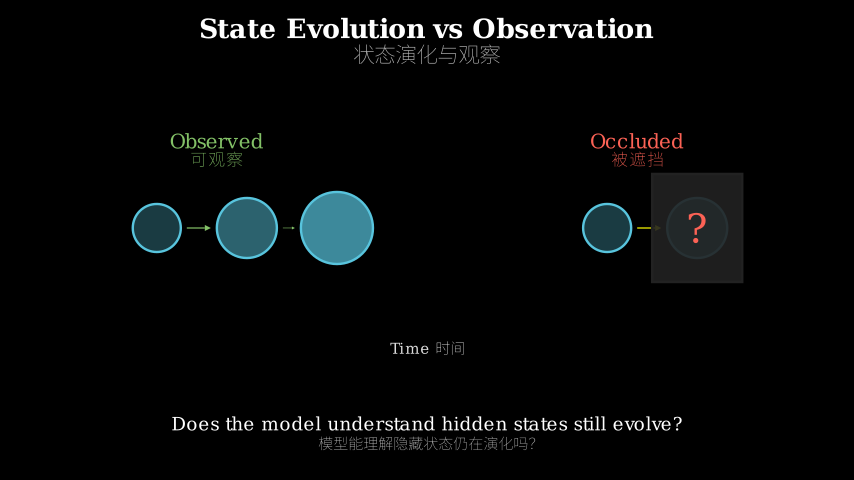
Video world models like Sora and Genie can generate impressive video sequences, but they’re trained on continuous observation streams. Nobody’s asked: do these models understand that the world keeps evolving when you’re not looking? Water pours, ice melts, plants grow—all regardless of whether a camera is watching. Current models conflate “generating the next frame” with “simulating state evolution,” but these are fundamentally different capabilities.
The gap: existing video generation benchmarks only test continuous observation scenarios. They never probe whether models can maintain consistent state evolution under observation control (occlusion, darkness, camera looking away). This matters because true world models need object permanence and physics understanding, not just pixel prediction.
Problem: Video models trained on continuous observation
    |
    v
Assumption: Observation = State Evolution (conflated)
    |
    v
Method: STEVO-Bench with observation control
    |
    +---> Insert occluders
    +---> Turn off lights
    +---> Camera lookaway trajectories
    |
    v
Evidence: Models fail to maintain state evolution
    |
    v
Conclusion: Current models lack true world simulation
The Increment
One sentence: Before this paper, we assumed video models understood physics because they generated plausible frames; after, we know they’re mostly doing pixel-level pattern matching without decoupling observation from state.
Core Mechanism
STEVO-Bench isn’t a new model—it’s a diagnostic protocol. The benchmark takes naturally-occurring evolution processes (water pouring, ice melting, candles burning) and applies three types of observation control: (1) inserting occluders that block the view, (2) turning off lights to create darkness, (3) specifying camera trajectories that look away from the evolving object.
For each scenario, the benchmark generates two videos: one with continuous observation (baseline) and one with observation control. Then it evaluates whether the model maintains consistent state evolution in both cases. The evaluation is automatic: it detects the evolving object, tracks its state changes, and checks if the evolution continues at the correct rate when observation is interrupted.
The key insight is using observation control as a probe. If a model truly simulates physics, the water should pour at the same rate whether you’re watching or not. If it’s just doing pixel prediction, the evolution will freeze or behave inconsistently when observation is interrupted.
Input: Evolution scenario (e.g., water pouring)
    |
    v
Generate two conditions:
    |
    +---> Continuous observation --> Video A
    |
    +---> With observation control --> Video B
          (occluder/darkness/lookaway)
    |
    v
Automatic evaluation:
    |
    +---> Detect evolving object
    +---> Track state changes
    +---> Compare evolution rates
    |
    v
Output: Failure mode classification
Think of STEVO-Bench like testing whether a child has object permanence. You show them a toy, then hide it under a blanket. A baby without object permanence thinks the toy ceased to exist. Current video models are like that baby—when you block their view, they don’t maintain the hidden state. The benchmark is the blanket test, but for AI.
The metaphor maps directly: the toy is the evolving object (water, ice), the blanket is the observation control (occluder, darkness), and the child’s behavior is the model’s generated video. Just as developmental psychologists use hiding games to test cognitive milestones, STEVO-Bench uses observation control to test whether models have achieved “world simulation” versus mere “pixel prediction.”
Key Concepts
-
State Evolution vs Observation: In the real world, these are independent. A pot of water boils whether you’re watching or not—the state (temperature, bubble formation) evolves according to physics. Observation is just sampling that state through sensors. Video models trained on continuous footage never learn this distinction because they never encounter scenarios where observation is interrupted. They learn “when I see frame N, generate frame N+1” but not “the world state advances by Δt, which I then observe.” It’s like learning to predict movie frames versus understanding the physics that generated those frames.
-
Observation Control: This means deliberately manipulating what the camera sees without changing the underlying state evolution. Three types: (1) Occlusion—put something in front of the camera, (2) Illumination—turn off lights so the camera sees darkness, (3) Viewpoint—move the camera to look elsewhere. The crucial point: in all cases, the hidden process should continue evolving. If you occlude a pouring faucet for 5 seconds, when you remove the occluder, the water level should be 5 seconds higher. Current models fail this test because they treat “not seeing” as “not happening.”
-
Failure Mode Disentanglement: STEVO-Bench doesn’t just say “the model failed”—it classifies how it failed. Does the evolution freeze completely? Does it continue but at the wrong rate? Does the object disappear? Does it reappear in the wrong state? This diagnostic approach reveals whether the failure is about object permanence, physics understanding, or temporal consistency. It’s like a doctor not just saying “you’re sick” but diagnosing whether it’s bacterial, viral, or autoimmune.
Framework Shift
Before (mainstream approach):        After (this paper):

Video Model                          Video Model
    |                                    |
    v                                    v
Frame t --> Frame t+1                State t --> State t+1
    |                                    |
    v                                    v
Continuous observation               Observation (may be blocked)
    |                                    |
    v                                    v
Evaluation: visual quality           Evaluation: state consistency
                                         under observation control
From “generate plausible next frames” to “simulate state evolution independent of observation,” the core shift is testing whether models understand the world or just predict pixels.
Expert Assessment
Problem choice: This is a real gap that matters. The field has been celebrating video generation quality without asking whether these models have genuine world understanding. The problem sits at a critical juncture—as we move toward embodied AI and robotics, we need models that understand object permanence and physics, not just pixel patterns. The timing is perfect because models like Sora have raised expectations about “world simulation” capabilities.
Method maturity: Elegant in its simplicity. Rather than proposing a new architecture, the authors designed a diagnostic that exposes existing models’ limitations. The three types of observation control (occlusion, darkness, lookaway) are well-chosen and cover the key scenarios. However, the automatic evaluation could be more robust—detecting and tracking evolving objects in generated videos is itself a hard problem, and errors here could confound the results.
Experimental integrity: The baselines are fair—they test multiple state-of-the-art video models under identical conditions. The diversity of evolution scenarios (water, ice, candles, plants) is good. One concern: the paper doesn’t deeply analyze whether training data bias could explain the failures. If training datasets rarely contain occluded or dark scenes, models might fail simply due to distribution shift rather than fundamental architectural limitations. This distinction matters for future work.
Writing quality: The abstract and introduction are crisp. The related work section could be tighter—it spends too much time on general video generation rather than focusing on world models and physics understanding. The results section would benefit from more failure case visualizations. The discussion of data bias feels rushed and deserves a dedicated section with quantitative analysis of training data characteristics.
Verdict: weak accept — Important diagnostic that will influence how we evaluate video world models, but the paper is more about exposing problems than solving them, and some evaluation details need strengthening.
Takeaways
For practitioners building video models: add observation control to your training data. Generate synthetic scenarios where objects are occluded, scenes go dark, or cameras look away, then return. This forces models to maintain internal state representations rather than relying on continuous pixel streams.
For researchers: the “observation control as probe” technique transfers to other domains. Testing whether language models maintain consistent world states across context windows, whether audio models understand sound sources that move out of microphone range, whether robotics models track objects that leave the visual field.
For benchmark designers: automatic failure mode classification is valuable. Don’t just report aggregate metrics—disentangle why systems fail. This diagnostic approach (detect, track, compare, classify) can be adapted to probe other capabilities like causal reasoning or counterfactual understanding.
The core transferable insight: test whether your model understands the underlying process or just the observable patterns. Interrupt the observation, then check if the model’s internal state evolved correctly during the gap.
论文: 2603.13215 作者: Ziqi Ma, Mengzhan Liufu, Georgia Gkioxari 分类: cs.CV
缺口
Sora和Genie这类视频世界模型能生成令人印象深刻的视频序列,但它们都是在连续观察流上训练的。
没人问过:这些模型理解”你不看的时候世界还在演化”吗?
水在流,冰在化,植物在长——无论摄像头是否在看。
当前模型把”生成下一帧”和”模拟状态演化”混为一谈,但这是根本不同的能力。
缺口在于:现有视频生成基准只测试连续观察场景。
它们从不探测模型能否在观察控制下(遮挡、黑暗、摄像头转向)保持一致的状态演化。
这很重要,因为真正的世界模型需要客体永久性和物理理解,而非仅仅像素预测。
问题:视频模型在连续观察上训练
    |
    v
假设:观察 = 状态演化(混淆)
    |
    v
方法:带观察控制的STEVO-Bench
    |
    +---> 插入遮挡物
    +---> 关闭灯光
    +---> 摄像头转向轨迹
    |
    v
证据:模型无法维持状态演化
    |
    v
结论:当前模型缺乏真正的世界模拟
增量
一句话: 这篇论文之前,我们以为视频模型理解物理因为它们生成了合理的帧;之后,我们知道它们主要在做像素级模式匹配,没有将观察与状态解耦。
核心机制
STEVO-Bench不是新模型——它是诊断协议。
基准测试采用自然发生的演化过程(水流、冰融化、蜡烛燃烧),施加三种观察控制:(1)插入遮挡物阻挡视线,(2)关闭灯光制造黑暗,(3)指定摄像头轨迹让其转向别处。
对每个场景,基准生成两个视频:一个连续观察(基线),一个带观察控制。
然后评估模型在两种情况下是否保持一致的状态演化。
评估是自动的:检测演化对象,跟踪其状态变化,检查观察中断时演化是否以正确速率继续。
关键洞察是用观察控制作为探针。
如果模型真正模拟物理,无论你看不看,水都应该以相同速率流动。
如果只是做像素预测,观察中断时演化会冻结或表现不一致。
输入:演化场景(如水流)
    |
    v
生成两种条件:
    |
    +---> 连续观察 --> 视频A
    |
    +---> 带观察控制 --> 视频B
          (遮挡/黑暗/转向)
    |
    v
自动评估:
    |
    +---> 检测演化对象
    +---> 跟踪状态变化
    +---> 比较演化速率
    |
    v
输出:失败模式分类
把STEVO-Bench想象成测试儿童是否有客体永久性。
你给他们看玩具,然后藏在毯子下。
没有客体永久性的婴儿会认为玩具不存在了。
当前视频模型就像那个婴儿——当你挡住它们的视线,它们不维持隐藏状态。
基准测试就是毯子测试,但针对AI。
这个比喻直接映射:玩具是演化对象(水、冰),毯子是观察控制(遮挡物、黑暗),儿童的行为是模型生成的视频。
正如发展心理学家用藏物游戏测试认知里程碑,STEVO-Bench用观察控制测试模型是否达到”世界模拟”而非仅仅”像素预测”。
关键概念
- 状态演化vs观察: 在真实世界中,这两者是独立的。
一锅水无论你看不看都在沸腾——状态(温度、气泡形成)按物理规律演化。
观察只是通过传感器采样那个状态。
在连续镜头上训练的视频模型从未学到这个区别,因为它们从未遇到观察中断的场景。
它们学的是”当我看到第N帧,生成第N+1帧”而非”世界状态前进Δt,然后我观察它”。
这就像学习预测电影帧与理解生成那些帧的物理之间的区别。
- 观察控制: 这意味着故意操纵摄像头看到的内容,而不改变底层状态演化。
三种类型:(1)遮挡——在摄像头前放东西,(2)照明——关灯让摄像头看到黑暗,(3)视点——移动摄像头看别处。
关键点:在所有情况下,隐藏过程都应该继续演化。
如果你遮挡流水的水龙头5秒,移除遮挡物时,水位应该高出5秒的量。
当前模型在这个测试上失败,因为它们把”看不见”当作”没发生”。
- 失败模式解耦: STEVO-Bench不只是说”模型失败了”——它分类模型如何失败。
演化完全冻结了吗?
继续了但速率错误?
对象消失了?
以错误状态重现?
这种诊断方法揭示失败是关于客体永久性、物理理解还是时间一致性。
就像医生不只说”你病了”而是诊断是细菌性、病毒性还是自身免疫性。
框架转变
之前(主流方法):                之后(本文方法):

视频模型                          视频模型
    |                                 |
    v                                 v
第t帧 --> 第t+1帧                  状态t --> 状态t+1
    |                                 |
    v                                 v
连续观察                          观察(可能被阻断)
    |                                 |
    v                                 v
评估:视觉质量                    评估:观察控制下的
                                      状态一致性
从”生成合理的下一帧”到”模拟独立于观察的状态演化”,核心转变是测试模型理解世界还是只预测像素。
专家评审
选题眼光: 这是个真实且重要的缺口。
该领域一直在庆祝视频生成质量,却没问这些模型是否有真正的世界理解。
问题处于关键节点——随着我们迈向具身AI和机器人,我们需要理解客体永久性和物理的模型,而非只是像素模式。
时机完美,因为Sora这类模型提高了对”世界模拟”能力的期望。
方法成熟度: 简洁优雅。
作者没有提出新架构,而是设计了暴露现有模型局限的诊断。
三种观察控制(遮挡、黑暗、转向)选择得当,覆盖了关键场景。
但自动评估可以更稳健——在生成视频中检测和跟踪演化对象本身就是难题,这里的错误可能混淆结果。
实验诚意: 基线公平——在相同条件下测试多个最先进的视频模型。
演化场景的多样性(水、冰、蜡烛、植物)很好。
一个担忧:论文没有深入分析训练数据偏差是否能解释失败。
如果训练数据集很少包含遮挡或黑暗场景,模型可能只是因为分布偏移而失败,而非根本的架构局限。
这个区别对未来工作很重要。
写作功力: 摘要和引言简洁。
相关工作部分可以更紧凑——花太多时间在通用视频生成上,而非聚焦世界模型和物理理解。
结果部分需要更多失败案例可视化。
数据偏差的讨论感觉仓促,值得用专门章节定量分析训练数据特征。
判决: 弱接收 — 重要的诊断将影响我们如何评估视频世界模型,但论文更多是暴露问题而非解决问题,一些评估细节需要加强。
要点总结
对构建视频模型的实践者:在训练数据中加入观察控制。
生成对象被遮挡、场景变暗或摄像头转向然后返回的合成场景。
这迫使模型维持内部状态表示而非依赖连续像素流。
对研究者:“观察控制作为探针”技术可迁移到其他领域。
测试语言模型是否在上下文窗口间维持一致的世界状态,音频模型是否理解移出麦克风范围的声源,机器人模型是否跟踪离开视野的对象。
对基准设计者:自动失败模式分类很有价值。
不要只报告总体指标——解耦系统为何失败。
这种诊断方法(检测、跟踪、比较、分类)可以适配探测其他能力,如因果推理或反事实理解。
核心可迁移洞察:测试你的模型理解底层过程还是只理解可观察模式。
中断观察,然后检查模型的内部状态在间隙期间是否正确演化。