
Paper: 2603.02176 Authors: Hao Li, Chunjiang Mu, Jianhao Chen, Siyue Ren, Zhiyao Cui, Yiqun Zhang, Lei Bai, Shuyue Hu Categories: cs.CL
The Gap
AI agents now have access to hundreds of thousands of skills—tools for everything from data analysis to video editing. But here’s the problem: existing approaches treat skills like a flat list. When you have 200,000 skills, finding the right ones becomes impossible. Prior work either uses naive keyword search (which fails at scale) or assumes you already know which skills you need (which defeats the purpose). Nobody has tackled the fundamental question: how do you organize, discover, and compose skills when the ecosystem grows beyond human comprehension?
The paper identifies two specific failures in current systems: (1) retrieval bottleneck—flat skill lists make discovery O(n) expensive and semantically shallow, and (2) composition blindness—agents invoke skills one-at-a-time without understanding how to chain them into multi-step workflows.
Problem: Skill chaos at scale (200K+ skills, flat organization)
   |
   v
Assumption: Structure enables both discovery and composition
   |
   v
Method: Tree-based categorization + DAG-based orchestration
   |
   v
Evidence: Tree retrieval ~= oracle selection; DAG >> flat invocation
   |
   v
Conclusion: Hierarchical organization unlocks skill ecosystem potential
The Increment
One sentence: Before this paper, agents drowned in flat skill lists and invoked tools one-by-one; after, they navigate hierarchical skill trees and compose multi-tool pipelines automatically.
Core Mechanism
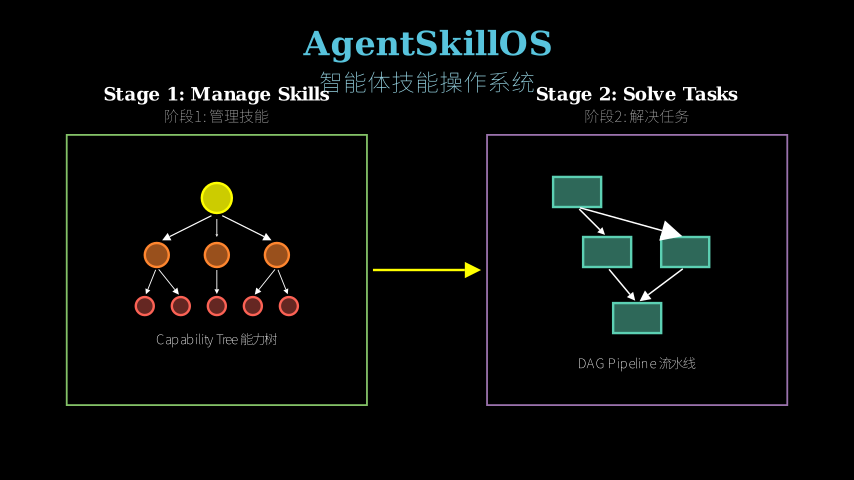
AgentSkillOS operates in two stages. First, the “Manage Skills” stage takes a chaotic pile of skills and recursively organizes them into a capability tree. Think of it like building a library classification system: start with broad categories (data processing, content creation), then recursively subdivide each node until individual skills sit at the leaves. Each node gets a semantic description, and the tree structure itself becomes a search index.
Second, the “Solve Tasks” stage uses this tree for intelligent retrieval and orchestration. When a task arrives, the system doesn’t search all 200K skills—it traverses the tree, pruning irrelevant branches early. Once it identifies candidate skills, it doesn’t just pick one; it constructs a DAG (directed acyclic graph) that chains multiple skills together. Each node in the DAG is a skill execution, and edges represent data dependencies. The system reasons about which skills to invoke, in what order, and how to route outputs between them.
Stage 1: Manage Skills              Stage 2: Solve Tasks

  [Flat skill pile]                 [User task]
         |                                |
         v                                v
  Recursive categorize            Tree-based retrieval
         |                          /           \
         v                         v             v
    Capability tree           [Skill A]      [Skill B]
    /     |     \                  \           /
  Cat1  Cat2  Cat3                  v         v
  / \    |    / \              DAG orchestration
S1  S2  S3  S4  S5                   |
                                     v
                                [Final output]
Here’s the structural metaphor: AgentSkillOS works like a city’s infrastructure system. The capability tree is the road network—highways branch into streets, streets into alleys, and you can navigate from “transportation” down to “bicycle repair shop” without checking every business in the city. The DAG orchestration is the supply chain—when you order a pizza, the system doesn’t just call one shop; it coordinates flour delivery, dough preparation, baking, and delivery in a dependency graph. Each step waits for its inputs, and the whole pipeline executes in parallel where possible. Without the road network, you’d wander randomly. Without the supply chain, you’d make a hundred phone calls yourself.
Key Concepts
-
Capability Tree: Imagine you’re organizing a toolbox with 200,000 tools. You could dump them in a pile, but then finding a Phillips-head screwdriver takes forever. Instead, you build nested drawers: “Fastening” contains “Screwdrivers” which contains “Phillips” which contains individual sizes. That’s a capability tree. Each node is a category with a semantic description, and skills live at the leaves. The key insight: you can search by traversing the tree, checking only relevant branches. If you need image editing, you never look inside the “audio processing” subtree. This turns O(n) search into O(log n) traversal.
-
DAG-based Orchestration: Most agents invoke skills sequentially: call skill A, get result, call skill B with that result. But complex tasks need parallel execution and dependency management. A DAG (directed acyclic graph) represents this explicitly: nodes are skill invocations, edges are data flows. If skill C needs outputs from both A and B, the DAG shows that A and B can run in parallel, then C waits for both. Concrete example: creating a video thumbnail requires (1) extracting a frame, (2) generating a title overlay, then (3) compositing them. Steps 1 and 2 are independent (parallel), step 3 depends on both (sequential). The DAG captures this structure, enabling efficient execution.
-
Recursive Categorization: How do you build the capability tree in the first place? You can’t manually sort 200K skills. Recursive categorization works like this: given a set of skills, ask an LLM to propose high-level categories. Assign skills to categories. For each category with too many skills (say, >100), recursively subdivide it. Stop when each leaf node has a manageable number of skills. It’s like organizing files: if a folder has 10,000 items, you create subfolders by date, project, or type, then recursively subdivide those. The result is a balanced tree where no node is overwhelming.
Framework Shift
Before (mainstream approach):        After (this paper):

[Flat skill list]                    [Hierarchical tree]
  Skill_1                                  Root
  Skill_2                               /   |   \
  Skill_3                            Cat1 Cat2 Cat3
  ...                                / \   |   / \
  Skill_200000                     S1 S2  S3 S4 S5
      |
      v                            [Task]
  Linear search                       |
      |                               v
      v                          Tree traversal
  Single invocation                   |
      |                               v
      v                          DAG pipeline
  [Output]                        /   |   \
                                 v    v    v
                              [Skill executions]
                                     |
                                     v
                                 [Output]
From unstructured skill hoarding to structured skill orchestration, the core shift is treating skills as a composable ecosystem rather than a flat toolbox.
Expert Assessment
Problem choice: This is a real gap, not manufactured. The agent skill explosion is happening right now—Claude, GPT, and other platforms are accumulating thousands of tools. The paper correctly identifies that nobody has solved organization and composition at scale. It sits at the intersection of tool-use agents and software engineering (dependency management, modular composition), which is timely.
Method maturity: The tree-based retrieval is straightforward—almost obvious in hindsight, which is a good sign. The DAG orchestration is borrowed from workflow systems but applied cleverly to agent skills. There’s no deep algorithmic novelty here, but that’s fine; the contribution is recognizing that existing techniques (hierarchical indexing, dependency graphs) solve the agent skill problem. One concern: the recursive categorization relies heavily on LLM quality. If the LLM produces bad categories, the whole tree collapses.
Experimental integrity: The benchmark is solid—30 tasks across five domains, with artifact-based evaluation (actual outputs, not just text). Using Bradley-Terry for aggregation is appropriate. However, the baselines are weak. They compare against “flat invocation” and “native agent,” but where’s the comparison to vector-based retrieval (embed all skills, retrieve via similarity)? That’s the obvious alternative, and its absence is suspicious. The experiments show tree retrieval approximates oracle selection, but “oracle” here means “human-selected skills,” not “optimal skills.” The numbers look good (DAG substantially outperforms flat), but I’d want to see failure cases.
Writing quality: The abstract and introduction are clear. The method section is dense—too much notation for what’s conceptually simple. Figure quality is mediocre; the diagrams don’t illuminate the mechanism as well as they could. The related work section is thin; they don’t engage deeply with prior work on tool retrieval or workflow systems. If they rewrote Section 3 (method) with more intuition and fewer symbols, the paper would be much stronger.
Verdict: weak accept — Addresses a real problem with a sensible solution, but the execution is workmanlike rather than inspired, and the experimental evaluation leaves obvious gaps.
Takeaways
Practitioners can steal three concrete ideas:
-
Hierarchical skill indexing: If you’re building a tool-use system, don’t store tools in a flat list or rely solely on vector embeddings. Build a category tree (manually or via LLM-assisted clustering) and use it for coarse-grained filtering before fine-grained retrieval. This is cheap to implement and scales logarithmically.
-
Explicit dependency graphs for multi-tool tasks: Stop invoking tools sequentially in a loop. Represent multi-step workflows as DAGs where nodes are tool calls and edges are data dependencies. This enables parallelism, makes debugging easier (you can visualize the execution plan), and clarifies what depends on what.
-
Benchmark design for agent outputs: The paper’s evaluation approach—generate artifacts (videos, documents, visualizations), then use LLM-based pairwise comparison + Bradley-Terry aggregation—is a practical template for evaluating agent systems where outputs are complex and subjective. It’s more rigorous than single-judge scoring but cheaper than human evaluation at scale.
The meta-lesson: when your system accumulates too many components (skills, tools, APIs), don’t just throw embeddings at it. Add structure—hierarchies for discovery, graphs for composition. The paper doesn’t invent new algorithms; it shows that old ideas (trees, DAGs) solve new problems (agent skill chaos).
论文: 2603.02176 作者: Hao Li, Chunjiang Mu, Jianhao Chen, Siyue Ren, Zhiyao Cui, Yiqun Zhang, Lei Bai, Shuyue Hu 分类: cs.CL
缺口
AI智能体现在能调用数十万个技能——从数据分析到视频编辑,应有尽有。
但问题来了:现有方法把技能当成扁平列表。
当你有20万个技能时,找到合适的就成了不可能的任务。
之前的工作要么用简单的关键词搜索(规模化后失效),要么假设你已经知道需要哪些技能(这就失去了意义)。
没人解决过根本问题:当技能生态增长到超出人类理解范围时,如何组织、发现和组合它们?
论文指出当前系统的两个具体失效点:(1)检索瓶颈——扁平技能列表让发现的复杂度是O(n)且语义浅薄,(2)组合盲区——智能体逐个调用技能,不懂如何将它们串联成多步工作流。
问题:规模化的技能混乱(20万+技能,扁平组织)
   |
   v
假设:结构化同时支持发现和组合
   |
   v
方法:树状分类 + DAG编排
   |
   v
证据:树检索 ~= 预言机选择; DAG >> 扁平调用
   |
   v
结论:层次化组织释放技能生态潜力
增量
一句话: 这篇论文之前,智能体淹没在扁平技能列表中且逐个调用工具;之后,它们能导航层次化技能树并自动组合多工具流水线。
核心机制
AgentSkillOS分两个阶段运作。
第一阶段”管理技能”把混乱的技能堆递归组织成能力树。
想象建立图书馆分类系统:从宽泛类别开始(数据处理、内容创作),然后递归细分每个节点,直到单个技能位于叶子节点。
每个节点都有语义描述,树结构本身成为搜索索引。
第二阶段”解决任务”用这棵树做智能检索和编排。
任务到来时,系统不搜索全部20万技能——它遍历树,提前剪掉无关分支。
找到候选技能后,它不只是选一个;而是构建一个DAG(有向无环图)把多个技能串起来。
DAG中每个节点是一次技能执行,边代表数据依赖。
系统推理该调用哪些技能、按什么顺序、如何在它们之间路由输出。
阶段1:管理技能                阶段2:解决任务

  [扁平技能堆]                  [用户任务]
         |                           |
         v                           v
  递归分类                      树检索
         |                      /         \
         v                     v           v
    能力树                 [技能A]      [技能B]
    /  |  \                    \         /
  类1 类2 类3                   v       v
  / \  |  / \               DAG编排
S1 S2 S3 S4 S5                  |
                                v
                           [最终输出]
结构性比喻:AgentSkillOS像城市基础设施系统。
能力树是路网——高速路分支成街道,街道分支成小巷,你能从”交通”导航到”自行车修理店”而不用检查城里每家店铺。
DAG编排是供应链——当你点披萨时,系统不只是打给一家店;它协调面粉配送、面团准备、烘烤和配送,形成依赖图。
每步等待输入,整个流水线在可能的地方并行执行。
没有路网,你会随机游荡。
没有供应链,你得自己打一百个电话。
关键概念
- 能力树: 想象你在整理一个有20万件工具的工具箱。
你可以把它们堆成一堆,但那样找个十字螺丝刀要找到天荒地老。
你应该建嵌套抽屉:“紧固件”包含”螺丝刀”,螺丝刀包含”十字型”,十字型包含各种尺寸。
这就是能力树。
每个节点是带语义描述的类别,技能在叶子节点。
关键洞察:你可以通过遍历树来搜索,只检查相关分支。
如果你需要图像编辑,永远不会看”音频处理”子树。
这把O(n)搜索变成O(log n)遍历。
- 基于DAG的编排: 大多数智能体顺序调用技能:调用技能A,得到结果,用结果调用技能B。
但复杂任务需要并行执行和依赖管理。
DAG(有向无环图)显式表示这个:节点是技能调用,边是数据流。
如果技能C需要A和B的输出,DAG显示A和B可以并行运行,然后C等待两者。
具体例子:创建视频缩略图需要(1)提取帧,(2)生成标题叠加层,然后(3)合成它们。
步骤1和2独立(并行),步骤3依赖两者(顺序)。
DAG捕获这个结构,实现高效执行。
- 递归分类: 你一开始怎么建能力树?不能手动排序20万技能。
递归分类这样工作:给定一组技能,让LLM提出高层类别。
把技能分配到类别。
对每个技能太多的类别(比如>100个),递归细分它。
当每个叶节点有可管理数量的技能时停止。
就像整理文件:如果文件夹有1万个项目,你按日期、项目或类型创建子文件夹,然后递归细分那些。
结果是平衡树,没有节点过载。
框架转变
之前(主流方法):                之后(本文方法):

[扁平技能列表]                  [层次化树]
  技能_1                              根
  技能_2                           /  |  \
  技能_3                         类1 类2 类3
  ...                           / \  |  / \
  技能_200000                  S1 S2 S3 S4 S5
      |
      v                          [任务]
  线性搜索                          |
      |                            v
      v                        树遍历
  单次调用                          |
      |                            v
      v                        DAG流水线
  [输出]                        /  |  \
                               v   v   v
                           [技能执行]
                                |
                                v
                            [输出]
从无结构的技能囤积到结构化的技能编排,核心转变是把技能当作可组合生态而非扁平工具箱。
专家评审
选题眼光: 这是真缺口,不是人造的。
智能体技能爆炸正在发生——Claude、GPT和其他平台正在积累数千工具。
论文正确识别出没人解决过规模化的组织和组合问题。
它处于工具使用智能体和软件工程(依赖管理、模块化组合)的交叉点,很及时。
方法成熟度: 树检索很直接——事后看几乎显而易见,这是好兆头。
DAG编排借鉴自工作流系统但巧妙应用到智能体技能。
这里没有深刻的算法创新,但没关系;贡献在于认识到现有技术(层次索引、依赖图)解决了智能体技能问题。
一个担忧:递归分类严重依赖LLM质量。
如果LLM产生糟糕的类别,整棵树就崩了。
实验诚意: 基准测试扎实——五个领域的30个任务,基于产出物评估(实际输出,不只是文本)。
用Bradley-Terry聚合是合适的。
但基线很弱。
他们对比”扁平调用”和”原生智能体”,但基于向量的检索(嵌入所有技能,通过相似度检索)的对比在哪?那是显而易见的替代方案,它的缺席可疑。
实验显示树检索接近预言机选择,但这里”预言机”指”人工选择的技能”,不是”最优技能”。
数字看起来不错(DAG大幅优于扁平),但我想看失败案例。
写作功力: 摘要和引言清晰。
方法部分密集——对概念上简单的东西用了太多符号。
图表质量一般;图示没有很好地阐明机制。
相关工作部分单薄;他们没有深入讨论工具检索或工作流系统的先前工作。
如果他们重写第3节(方法),多些直觉少些符号,论文会强得多。
判决: 弱接收——用合理方案解决真实问题,但执行是工匠级而非启发性的,实验评估留下明显空白。
要点总结
实践者能偷走三个具体想法:
- 层次化技能索引: 如果你在构建工具使用系统,别把工具存在扁平列表或只依赖向量嵌入。
建立类别树(手动或通过LLM辅助聚类),用它做粗粒度过滤再做细粒度检索。
这实现起来便宜且对数级扩展。
- 多工具任务的显式依赖图: 别在循环里顺序调用工具。
把多步工作流表示为DAG,节点是工具调用,边是数据依赖。
这支持并行,让调试更容易(你能可视化执行计划),并明确什么依赖什么。
- 智能体输出的基准设计: 论文的评估方法——生成产出物(视频、文档、可视化),然后用基于LLM的成对比较+Bradley-Terry聚合——是评估输出复杂且主观的智能体系统的实用模板。
它比单评委打分更严格但比规模化人工评估更便宜。
元教训:当你的系统积累太多组件(技能、工具、API)时,别只是扔嵌入上去。
加结构——用层次做发现,用图做组合。
论文没发明新算法;它展示了旧想法(树、DAG)解决新问题(智能体技能混乱)。