Paper: 2606.24855 Authors: Negin Raoof, Richard Zhuang, Marianna Nezhurina, Etash Guha, Atula Tejaswi, Ryan Marten, Charlie F. Ruan, Tyler Griggs, Alexander Glenn Shaw, Hritik Bansal Categories: cs.AI
The Gap
Existing open projects like SWE-Smith, SERA, and Nemotron-Terminal each target a single benchmark (e.g., SWE-bench, terminal tasks). They produce models that excel in that narrow environment but fail to generalize to other agentic scenarios — web navigation, API usage, multi-step reasoning, etc. No one had systematically studied how to curate training data for broad agentic competence. This paper fills that void with a fully open data pipeline, controlled ablations, and a released dataset that demonstrably improves generalization.
+----------------------------------------------------+
| Problem: Agentic models do not generalize          |
| across tasks (single-benchmark focus)              |
+---------------------------+------------------------+
                            |
                            v
+----------------------------------------------------+
| Assumption: A curated, diverse data pipeline       |
| can overcome this limitation                       |
+---------------------------+------------------------+
                            |
                            v
+----------------------------------------------------+
| Method: 100+ controlled ablation experiments       |
| to design pipeline stages (task selection,         |
| generation, filtering). Produce 100K dataset.      |
| Fine-tune Qwen3-32B.                               |
+---------------------------+------------------------+
                            |
                            v
+----------------------------------------------------+
| Evidence: 44.8% avg across 7 agentic benchmarks;   |
| +3.9% over best open model (Nemotron-Terminal-32B) |
| Strong scaling with dataset size.                  |
+---------------------------+------------------------+
                            |
                            v
+----------------------------------------------------+
| Conclusion: Open data curation pipeline works;     |
| released pipeline, dataset, and model.             |
+----------------------------------------------------+
The Increment
One sentence: Before this paper, open agentic models were trained on single-benchmark data and lacked generalization; after, we have a systematic, open data curation pipeline that yields a model outperforming the previous best by 3.9% across 7 benchmarks, with strong scaling properties and full open release.
Core Mechanism
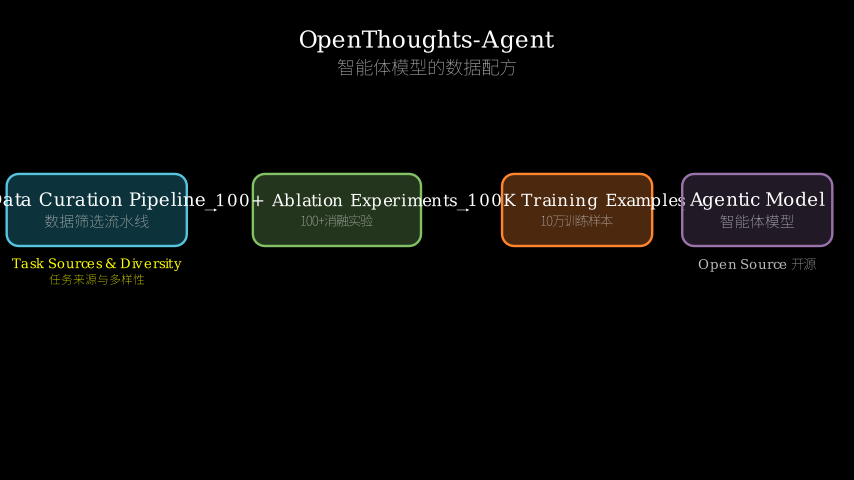
The OpenThoughts-Agent project consists of three major stages: task source curation, data generation, and data filtering / selection. First, they gather tasks from diverse sources (web environments, code execution, multi-turn dialogues) rather than relying on a single benchmark. Second, they use teacher models to generate trajectory data (chain-of-thought plus actions) for each task. Third, they apply filtering criteria (e.g., correctness, diversity, task difficulty) to select a final training set.
The key innovation is the systematic ablation: over 100 controlled experiments vary which task sources are used, how trajectories are generated, and which filtering rules are applied. The authors identify that task diversity is the single most important factor — using tasks from multiple domains yields significantly better generalization than using any single domain, even with less data per domain. The resulting recipe (the “data recipe”) is fixed into a pipeline that produces a 100K example dataset.
+------------------------+     +------------------------+     +----------------------+
| Task Source Curation   | --> | Data Generation        | --> | Data Filtering       |
| (multiple domains:     |     | (teacher model +       |     | (correctness,        |
|  SWE, web, terminal,   |     |  trajectory sampling)  |     |  diversity,          |
|  multi-turn, ...)      |     |                        |     |  difficulty)         |
+------------------------+     +------------------------+     +----------+-----------+
                                                                         |
                                                                         v
+-------------------------------------------------------------------+
| Final Dataset: ~100K examples                                      |
| (training Qwen3-32B)                                               |
+-------------------------------------------------------------------+
Structural metaphor: Think of OT-Agent as a master chef developing a new multi-course menu. The task sources are the ingredient markets: you can’t make a diverse menu if you only buy potatoes (single benchmark). The data generation is the cooking process — each recipe must be tested. The ablation experiments are tasting trials where the chef systematically changes one ingredient at a time (e.g., swap chicken for tofu, add more spice) to see what affects the final dish. The filtering is plating: you discard burnt or bland portions. The final dataset is the cookbook that reproduces the menu at scale. Just as a good chef knows that “variety of produce” matters more than “perfection of one vegetable”, the authors found that task diversity dominates other factors. Anyone can now follow their recipe and bake a better agentic model.
Key Concepts
-
Agentic fine-tuning for generalization: Training a language model to not just answer questions, but to perform sequences of actions (click buttons, call APIs, write code, etc.) across different environments. Unlike standard instruction tuning, agentic data must include state transitions and tool use. The key challenge is that a model trained only on terminal commands won’t know how to navigate a web page. OT-Agent’s approach mixes these environments so the model learns transferable strategies.
-
Data ablation: A controlled experiment where you systematically remove or modify one component of the data pipeline and measure the effect on final model performance. For example, they vary whether the dataset includes web tasks, or swap the trajectory generation method. This is like testing fertilizer recipes: you plant seeds in different soil mixes and measure growth. The authors did over 100 such experiments to isolate which pipeline choices actually matter.
-
Scaling laws for synthetic data: The property that model performance improves predictably as the training dataset grows, assuming the data is generated from a consistent, high-quality pipeline. OT-Agent shows that their pipeline exhibits clean scaling — each doubling of dataset size yields a predictable gain. This means practitioners can extrapolate how much data they need to reach a target performance, similar to how scaling laws work for language model pretraining.
Framework Shift
Before (mainstream approach):
+-----------------------+       +---------------------+
| Single benchmark      | --->  | Fine-tuned model    |
| (e.g., SWE-bench)     |       | Good only on that   |
|                       |       | benchmark; poor on  |
| + low diversity       |       | others              |
+-----------------------+       +---------------------+

After (this paper):
+---------------------------+       +------------------------------+
| Multiple task sources     | --->  | Data curation pipeline       |
| (web, terminal, API, ...) |       | (selection, generation,      |
| + high diversity          |       |  filtering)                  |
+---------------------------+       +---------------+--------------+
                                                    |
                                                    v
+------------------------------------------+       +---------------------+
| Diverse dataset (100K examples)          | --->  | Fine-tuned model    |
| Balanced across domains + quality filter |       | Good across 7       |
+------------------------------------------+       | benchmarks          |
                                                    +---------------------+
One sentence: From single-benchmark overspecialization to multi-domain curated diversity, the core shift is recognizing that training data recipe (task diversity + pipeline) matters more than brute-force scaling of any single task type.
Expert Assessment
Problem choice: Real gap. The field was stalled at “train a model that can do one thing well” vs. “build an agent that can adapt.” This paper directly targets the bottleneck of data curation, which is where most real-world engineering effort goes. Timely and practical.
Method maturity: More clever engineering than breakthrough insight. The systematic ablation is rigorous and valuable — it’s the kind of work that should be done but rarely is in open research. However, there’s no new loss function, architecture, or training technique. The progress comes from careful data design, not algorithmic novelty. That’s fine, but don’t expect a paradigm shift.
Experimental integrity: Good. Baselines are reasonable (Nemotron-Terminal-32B as strongest open model). They control for compute (same base model, same training setup). The scaling comparison across dataset sizes is clean. One red flag: they don’t report variance across seeds for their 44.8% number — is it stable? Also, all benchmarks are simulated; real-world agentic performance might differ.
Writing quality: Competent but dense. The ablation results section (which is the heart of the paper) is a wall of tables with brief commentary. If the authors had dedicated one or two illustrative ablation figures (e.g., bar charts showing the effect of removing each data source), the paper would be much clearer. As is, the reader has to work to extract the qualitative insights.
Verdict: Weak accept — A solid engineering contribution that fills a real gap and provides open resources. It won’t change how we think about AI, but it will change how we build agents, which matters.
Takeaways
-
Use the released pipeline as a starting point: If you need a generalist agent, don’t start from scratch. The OT-Agent pipeline gives you a battle-tested recipe to generate diverse training data. Swap in your own task sources if needed.
-
The “diversity trumps quantity” rule: Their ablation shows that mixing multiple task domains dramatically improves generalization even if you reduce per-domain examples. Practitioners should prioritize collecting data from 3-4 different environments rather than obsessing over 100K examples from one environment.
-
Scaling estimation is now possible: Because the pipeline exhibits clean scaling, you can estimate how much synthetic data you need to reach a target accuracy. This is useful for budgeting compute and data generation costs.
-
Open data curation is as valuable as model weights: The released dataset and experimental logs allow others to reproduce and extend the work. This sets a standard for future agentic model development — release the recipe, not just the loaf.
论文: 2606.24855 作者: Negin Raoof, Richard Zhuang, Marianna Nezhurina, Etash Guha, Atula Tejaswi, Ryan Marten, Charlie F. Ruan, Tyler Griggs, Alexander Glenn Shaw, Hritik Bansal 分类: cs.AI
缺口
现有的开源项目如 SWE-Smith、SERA 和 Nemotron-Terminal 都只针对单一基准测试(例如 SWE-bench、终端任务)。它们训练的模型在特定环境中表现优异,但无法泛化到其他智能体场景——网页导航、API 调用、多步推理等。没有人系统地研究过如何精选训练数据以获得广泛的智能体能力。这篇论文填补了这个空白,提供了一个完全开源的数据管道、受控消融实验和一个公开的数据集,并且证明了其在泛化性上的显著改进。
+----------------------------------------------------+
| 问题:智能体模型缺乏跨任务泛化能力                  |
| (只针对单一基准测试)                              |
+---------------------------+------------------------+
                            |
                            v
+----------------------------------------------------+
| 假设:精心设计的多来源数据管道                      |
| 可以克服这一局限                                    |
+---------------------------+------------------------+
                            |
                            v
+----------------------------------------------------+
| 方法:100 多次受控消融实验                         |
| 来设计管道阶段(任务选择、生成、过滤)。            |
| 产出 100K 数据集。微调 Qwen3-32B。                  |
+---------------------------+------------------------+
                            |
                            v
+----------------------------------------------------+
| 证据:7 个智能体基准平均 44.8%;                   |
| 超过最好开源模型 3.9 个点(Nemotron-Terminal-32B) |
| 数据集大小展现出很强的可扩展性。                    |
+---------------------------+------------------------+
                            |
                            v
+----------------------------------------------------+
| 结论:开源数据管道有效;                           |
| 公开了管道、数据集和模型。                          |
+----------------------------------------------------+
增量
一句话:这篇论文之前,开源智能体模型只在单一基准数据上训练,缺乏泛化能力;之后,我们有了一个系统的开源数据精选管道,产出的模型在 7 个基准测试上平均提升了 3.9%,并且具有强大的规模扩展性,所有资源全部开源。
核心机制
OpenThoughts-Agent 项目包含三个主要阶段:任务来源甄选、数据生成和数据过滤/选择。首先,他们从多种来源收集任务(网页环境、代码执行、多轮对话等),而不是依赖单一基准。其次,他们使用教师模型为每个任务生成轨迹数据(思维链加动作序列)。最后,他们运用过滤标准(如正确性、多样性、难度)来筛选最终的训练集。
关键的创新在于系统性的消融:超过 100 个受控实验,改变任务来源、轨迹生成方式和过滤规则。作者发现任务多样性是最重要的因素——同时使用多个领域的任务,即使每个领域的数据量减少,也能显著提升泛化能力。最终的”数据配方”被固定为一个管道,产出约 10 万个样本的数据集。
+------------------------+     +------------------------+     +----------------------+
| 任务来源甄选           | --> | 数据生成               | --> | 数据过滤             |
| (多个领域:            |     | (教师模型 + 轨迹采样) |     | (正确性、多样性、   |
|  SWE、网页、终端、       |     |                         |     |  难度)               |
|  多轮对话等)           |     |                         |     |                      |
+------------------------+     +------------------------+     +----------+-----------+
                                                                         |
                                                                         v
+-------------------------------------------------------------------+
| 最终数据集:约 10 万条样本                                        |
| (用于微调 Qwen3-32B)                                             |
+-------------------------------------------------------------------+
核喻:把 OT-Agent 想象成一位大厨在开发一套多道菜菜单。任务来源就像食材市场——如果你只买土豆(单一基准),就做不出多样化的菜单。数据生成是烹饪过程——每道菜都要试做。消融实验就是试吃环节,大厨每次只换一种食材(比如鸡肉换豆腐,多加辣椒),看看对最终菜品有什么影响。过滤是摆盘——扔掉烧焦或变味的。最终的数据集就是一本可以复现整套餐谱的菜谱书。正如好厨师懂得”食材多样性比单一食材的完美更重要”,作者发现任务多样性比其他因素都关键。现在任何人都可以按照这份食谱烤出更好的智能体模型。
关键概念
-
面向泛化的智能体微调:训练语言模型不只是回答问题,而是要在不同环境中执行一连串动作(点击按钮、调用 API、写代码等)。与标准的指令微调不同,智能体数据必须包含状态转移和工具使用。关键挑战在于:只在终端命令上训练的模型不知道怎么浏览网页。OT-Agent 的方法混合多种环境,让模型学到可迁移的策略。
-
数据消融:一种受控实验,系统性地移除或修改数据管道中的某个组件,然后测量最终模型性能的变化。例如,他们可以改变数据集是否包含网页任务,或者替换轨迹生成方法。这就像测试肥料配方:在不同土壤组合中播种,测量作物生长量。作者做了 100 多次这样的实验,来隔离出哪些管道选择真正起作用。
-
合成数据的规模定律:模型性能随着训练数据集大小增长而可预测提升(假设数据来自一致的、高质量的管道)。OT-Agent 表明他们的管道展现出清晰的规模律——数据集大小每翻一倍,性能增益大致可预测。这意味着实践者可以推算需要多少数据才能达到目标性能,类似于语言模型预训练中的规模定律。
框架转变
之前(主流方法):
+-----------------------+       +---------------------+
| 单一基准测试          | --->  | 微调后的模型        |
| (例如 SWE-bench)    |       | 只在该基准上好;    |
| + 低多样性            |       | 在其他任务上差      |
+-----------------------+       +---------------------+

之后(本文方法):
+---------------------------+       +------------------------------+
| 多种任务来源              | --->  | 数据精选管道                 |
| (网页、终端、API……)     |       | (选择、生成、过滤)           |
| + 高多样性                |       |                              |
+---------------------------+       +---------------+--------------+
                                                    |
                                                    v
+------------------------------------------+       +---------------------+
| 多样化数据集(10 万样本)                 | --->  | 微调后的模型        |
| 跨领域平衡 + 质量过滤                    |       | 在 7 个基准上都好  |
+------------------------------------------+       +---------------------+
一句话:从单一基准的过度特化,到多领域精选的多样化,核心转变是认识到训练数据配方(任务多样性 + 管道设计)比暴力扩大单一任务类型的数据量更重要。
专家评审
选题眼光:真缺口。这个阶段卡在”训练一个模型做好一件事”和”构建一个能适应的智能体”之间。这篇论文直接击中数据精选的瓶颈,这是现实工程中最费力的地方。时机恰当,实用性强。
方法成熟度:更多是精妙的工程而非突破性洞见。系统的消融实验严谨且有价值——这种工作应该做但很少在开源研究中做。然而,没有新的损失函数、架构或训练技巧。进步来自精心的数据设计,而非算法创新。这没问题,但别指望范式转移。
实验诚意:良好。基线选得合理(Nemotron-Terminal-32B 作为最强开源模型)。他们控制了计算量(相同的基座模型、相同的训练设置)。不同数据集大小下的规模对比很干净。一个警示:他们没有报告 44.8% 这个数字的方差——结果稳定吗?另外,所有基准都是模拟的,真实环境的智能体表现可能有出入。
写作功力:合格但偏密。消融结果部分(论文的核心)是一堆表格和简短的评注。如果作者拿出一两幅启发性的消融图(比如去掉某个数据源的柱状图),论文会清晰很多。目前读者需要自己费力提取定性洞见。
判决:弱接收——一项扎实的工程贡献,填补了实际缺口,且开放了资源。它不会改变我们对 AI 的思考方式,但会改变我们构建智能体的方式,这很重要。
要点总结
-
直接使用已发布的管道作为起点:如果你需要一个通用智能体,不必从头开始。OT-Agent 管道给你一个经过检验的配方来生成多样化训练数据。如果需要,替换自己的任务来源即可。
-
“多样性胜过数量”法则:他们的消融表明,混合多个任务域能显著提升泛化能力,即使减少每个域的例子数。实践者应优先收集来自三四种不同环境的数据,而不是执着于从单一环境获取 10 万条样本。
-
现在可以预估数据需求:由于管道表现出清晰的规模律,你可以推算需要多少合成数据才能达到目标准确率。这对于预算计算和数据生成成本非常有用。
-
开源数据精选比开源模型权重更有价值:公开的数据集和实验日志让其他人可以复现和扩展这项工作。这为未来的智能体模型开发树立了标准——公布食谱,而不仅仅是面包。